What Is Geographic Farming in Real Estate? Complete 2026 Guide
May 06, 2026
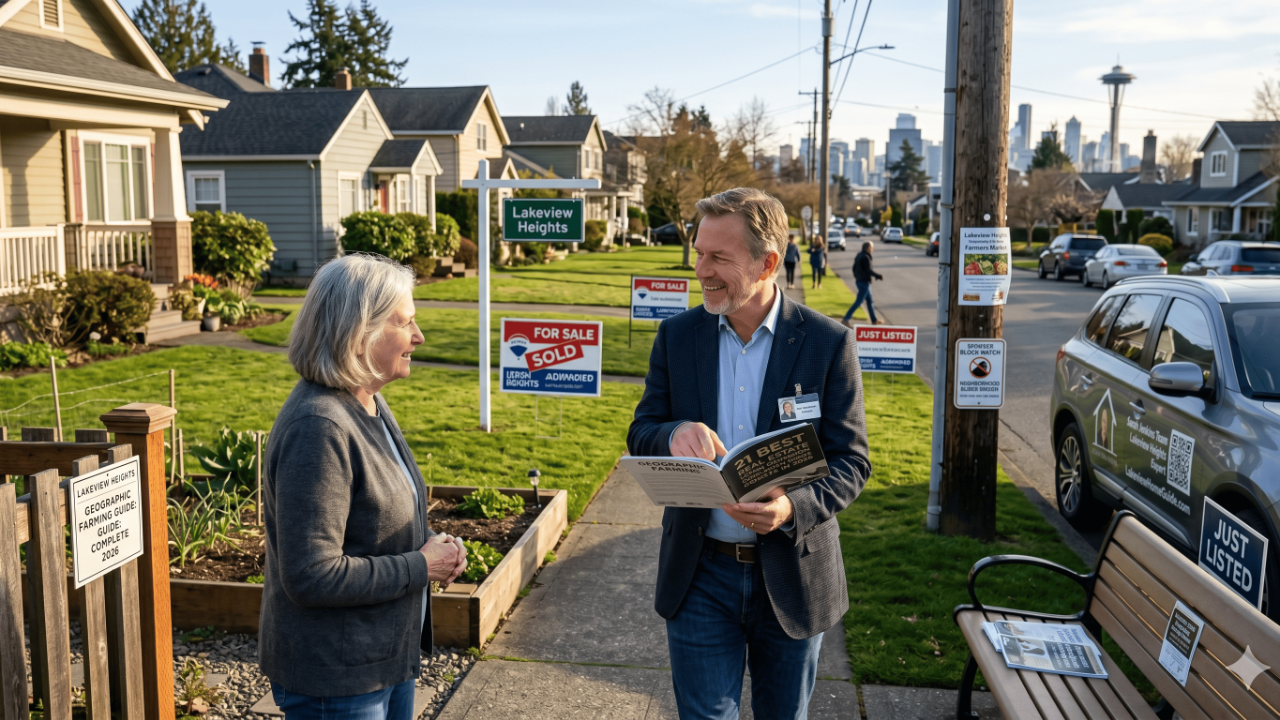
Back in 2022 one of my agents claimed a 580-home neighborhood here in Northern Virginia: $720K average price, 9% turnover, and no other agent owning it. He mailed it every three weeks for fourteen months without skipping. Two years later he'd closed ten deals off that one neighborhood, about $190,000 in commission on roughly $14,000 of mail. That's farming run as a system instead of a wish.
If you're weighing whether it still works, this is the same approach my team and I run right now, and the exact play I teach inside the real estate coaching programs at Jamil Academy. Below you get the definition, how to choose a farm the numbers support, what to mail and how often, the real costs, and the mistakes that quietly drain budgets.
Quick Answer
Geographic farming is a long-term strategy where you market to one defined neighborhood or ZIP code until you become the agent homeowners there think of first. Run it with monthly direct mail, local market data, and a real community presence, and a healthy farm produces 5 to 10% of the area’s yearly listings within 12 to 24 months. Pick the right area, commit for at least a year, and the recognition keeps paying you long after the postcards stop.
In This Guide
Geographic vs demographic farming
Why geographic farming still works in 2026
How to pick a profitable farm area
What is a good turnover rate for a farm?
How many homes should be in a farm?
What does geographic farming cost?
How often to mail and for how long
7 farming postcards that produce listings
7 mistakes that kill a farming campaign
Geographic farming vs other lead-gen channels
Your 30-day farm launch plan
Frequently asked questions

What is geographic farming in real estate?
Geographic farming means you pick one neighborhood and market to it on repeat until your name is the one that comes to mind when somebody on that street decides to sell. Every homeowner in the boundary sees your face and your brand every three or four weeks, for a year or longer, whether they're thinking about moving or not.
The word "farming" is doing real work here. A farmer doesn't scatter seed in spring and dig for potatoes a week later, and neither does this. You prep the ground, you show up on a schedule, and you wait through a full cycle before the harvest shows up.
Since the typical owner only moves once every seven to nine years, your job is never to close them today. It's to already be their agent in their head on the day the decision finally lands.
The version that works in 2026 isn't mail alone. Postcards on the kitchen counter are still the backbone. On top of that, the agents taking over neighborhoods add community events, yard signs, and hyper-local social posts. A little digital retargeting then follows those same households online. The mailbox plants the flag and everything else keeps it standing.
Geographic vs demographic farming
People often ask about the two main kinds of farming, so it's worth drawing the line clearly. Both are forms of real estate farming, where you market to the same audience on repeat until they know your name. Geographic farming is defined by a place: a subdivision, a ZIP code, a cluster of streets. Everyone inside the boundary is a target, no matter who they are.
Demographic farming is defined by a type of person instead of a place. Think move-up buyers, recent divorces, or absentee landlords spread across a whole metro. Same idea of repeated, focused outreach, just a different way of drawing the circle. This guide stays on the geographic side, where the map is your boundary, but plenty of top producers run one of each at once.
Why geographic farming still works in 2026
Scroll any agent feed and it's the same recycled tip carousels and lookalike Reels fighting for a second and a half of attention. Inboxes and feeds are packed. Mailboxes aren't, and that's the whole opening. People get less physical mail than they did ten years ago, so a sharp postcard stands out more now, not less.
The response numbers back this up. The 2025 ANA direct mail report pegs the average mail response rate near 4.4%, against about 0.12% for email, which is roughly 36 times the return per piece. In real estate, prospect lists tend to land in the 2.7 to 4.4% range and an established farm list climbs to 5 to 9% once recognition builds.
Around 72% of people go through their mail weekly, and the average piece hangs around the house for about 17 days before it gets tossed. Set that against the blink of attention a paid ad gets in the scroll and the gap is obvious.
5-9%
farm response rate once recognition builds
17 days
average mail piece stays in the home
7-9 yrs
how often the typical owner moves
63%
response lift when mail is paired with digital
How to pick a profitable farm area
Most farming failures happen before a single stamp gets licked, because the agent chose badly. They go after the fancy ZIP they wish they lived in, or the first area Zillow shows them, mail it twice, hear nothing, and walk away. A weak farm can't be rescued by pretty mailers, and a strong one quietly does half the work for you.
Here's the four-part screen I run before committing a dollar to any neighborhood:
- Size: 250 to 1,000 homes. Too few and you never get enough chances at a listing; too many and you can't afford to stay consistent. If you're newer, start at 250 to 500.
- Turnover: total annual sales divided by total homes, and you want at least 6%. Under that, even a nice-looking area won't throw off enough deals to earn back the spend.
- Competition: pull two years of MLS listing data. If one agent already holds 20% or more of the listings, walk away. They have won the trust battle and you'd be paying every month to lose it.
- The math check: average sale price times your commission rate times turnover times a 5% conversion, divided by 12, gives your rough monthly revenue. If that's not at least ten times your monthly mail cost, the area doesn't pencil out.
I have watched agents around here try to farm a 5,000-home ZIP and tap out by month three because the bill was brutal. The ones who pick a smaller, vetted pocket reach month twelve with money left and a pipeline that's finally filling. Selection decides most of the outcome, so spend more time choosing the neighborhood than designing the card.
What is a good turnover rate for a real estate farm?
Turnover rate is the number I check first, because it tells you whether a neighborhood sells often enough to feed a campaign at all. The formula is simple: homes sold in the last 12 months divided by total homes, times 100.
So a 500-home neighborhood with 35 sales in a year runs 7%, which is healthy. That same neighborhood with only 18 sales sits at 3.6%, so skip it. Even a great conversion rate can't squeeze enough deals out of that little movement to pay you back.
Luxury is the exception worth naming. High-end owners stay put longer, so those areas often run 3 to 5%, but a 4% farm at a $2M average sale still produces serious revenue per closing, so the lower rate is fine there. Pull your numbers from the MLS or from RPR, which is free for NAR members, and look at the trailing 24 and 36 month averages instead of just the last year.
One hot year can hide a soft farm; a rate that holds or climbs across three years is the real thing.
How many homes should be in a real estate farm?
The most common budgeting mistake I see is going too big. An agent eyes a 4,000-home ZIP, multiplies the sales by their commission, sees a giant number, and commits. Month two shows up, the postage bill is $2,400, the phone hasn't rung, and they cut the whole thing in a panic. Consistency is the asset, and you can't be consistent on a farm you can't afford.
The right size gives you three things at once: enough homes to throw off regular listings, a bill you can carry for eighteen months, and enough volume per mailing to read your results. Here's how I size farms by stage:
Pick a size you can mail without flinching for eighteen straight months. A 300-home farm mailed every three weeks for a year and a half will out-produce a 1,500-home farm you mail on and off for six.
What does geographic farming cost?
Farming costs less than most agents assume. They picture a $5,000-a-month machine and quietly back out, when a small consistent farm actually runs less than two months of Zillow leads. Here's the per-piece breakdown I budget with in 2026:
A clean way to plan is about a dollar a piece all in, which lands you near $2 per household a month if you mail twice. Put that next to Zillow Premier Agent. Spend $1,200 a month at a 1.5% conversion and you're paying roughly $5,400 to close one deal, on a lead you share with three other agents and lose the day you cancel.
The mail is different. Cancel your farm tomorrow and last month’s postcard is still stuck to somebody’s fridge, and you can see which direct mail formats still pull before you commit a budget.

How often to mail and for how long
This is where most campaigns quietly die. An agent mails twice, hears nothing, and decides farming doesn't work in their market. When I ask how many touches they actually sent, the answer is almost always two or three, and two or three pieces isn't a campaign, it's a sample size.
Research lands in the same place every time: people need four to five touches before a brand even registers. In real estate, where an owner sells maybe once a decade, the runway is longer still. You're not chasing whoever is listing next week. You're buying the top spot in their memory for the day, fourteen months out, when they finally decide. Here's the twelve-month cadence my team runs in a fresh farm:
- Months 1 to 3: just-sold and just-listed postcards to build credibility with fast social proof
- Months 4 to 6: add a quarterly market report so you become the local data source
- Months 7 to 9: add a value tip card and your first community event invite
- Months 10 to 12: anniversary touches, a holiday card, and a branded calendar magnet
By month twelve you have put at least a dozen different pieces in front of the neighborhood and it recognizes you on sight. Listings usually start landing between months 9 and 15, and once they do they tend to keep coming, because every closing becomes the social proof on the next postcard. Most agents quit before they ever feel that compounding kick in.
7 farming postcards that produce listings
A one-note farm goes stale fast; people tune out a repeat message by the third mailing. The farms that actually book listing appointments rotate between social proof, useful data, and lifestyle pieces. These are the seven I cycle through with my team, and they double as a starting menu of real estate farming ideas.
1. Just-sold postcards
Mail within a week of any closing in or near the farm. Lead with a real headline like "Just sold in 6 days for 102% of list price," because a specific number beats a vague claim every time. This is your credibility workhorse.
2. Just-listed postcards
A new listing in the farm is a free reason to mail, even when it's not your listing. A "coming soon in [neighborhood]" piece signals activity and nudges the fence-sitters, and pairing every just-listed with a just-sold about three weeks later tells a full story.
3. Neighborhood market reports
Quarterly numbers on days on market, list-to-sale ratio, and current inventory for that specific farm. This is what makes you the local data source instead of another face asking for business, and it drives more of my farm callbacks than any other piece.
4. Value tip cards
Seasonal maintenance checklists, a recipe from a neighborhood restaurant, a contractor you actually trust. Anything genuinely useful that's not a pitch. These are the ones that end up pinned to the fridge, which is exactly where you want to live.
5. Community event invitations
A fall pumpkin patch, a spring shred day, holiday photos with Santa. Host one small event a quarter and use the invitation itself as the mailer, then drop every RSVP straight into your CRM.
6. Closing anniversary touches
Send past clients in or near the farm a card on their closing anniversary with an updated home value. Since households move every seven to nine years, that card is often what triggers the call when the time finally comes, and it drives a big share of my repeat business.
7. Door-to-door pop-bys
Once a quarter, leave a small branded gift on every porch: cookies, a pumpkin in October, a bag of ice melt in winter. No knock needed. A tag that reads "from your neighborhood Realtor" plus a real object at the door builds recognition faster than almost anything you can mail. Add a simple circle-prospecting script for the doors that do open and you compound the effect.
7 mistakes that kill a geographic farming campaign
I have watched a lot of agents start a farm and bail. The reasons rhyme. Read these before you mail the first postcard, not after you have burned $3,000 wondering what went wrong.
Quitting after three mailings
Recognition doesn't switch on until four or five touches, so three pieces is barely the warm-up. Almost nobody who quits here actually gave farming a fair test.
Picking a farm with a dominant agent
If someone already owns a quarter of the listings, you're paying to learn a lesson the MLS would have told you on day one. Check first, then commit.
Choosing a farm that's too big
A 3,000-home farm at a dollar a piece is $36,000 a year. Most agents can't carry that and quit by month four. Pick smaller and actually finish.
Vague headlines
"Thinking of selling?" is invisible. "Just sold in 6 days for $42,000 over asking" gets read. Specifics earn the glance.
Mailing with no tracking
Without a dedicated phone number, a QR code, or a CRM source field, you can't tell what's working, so you end up cutting the wrong pieces.
Running a single channel
Pairing mail with digital retargeting lifts response by as much as 63%. Mail with no follow-up funnel behind it leaves money on the table.
Treating it like a campaign instead of an asset
"I will mail for three months and see" is the mindset that produces nothing. The agents who win commit for eighteen months and treat the farm as equity they're building.
Geographic farming vs other lead-gen channels
Here's the comparison I walk my agents through. The point isn't to crown one winner; it's to layer them based on where you're in your career. If you want the wider menu, this sits alongside the full set of real estate lead-generation strategies.
Farming is the only line on that table that gets cheaper the longer you run it. Year one costs a lot per closing. By year three, once recognition has built and referrals start arriving next to the listings, the cost per deal drops under everything else on the list. That's why veterans sit in the same farm for decades: the asset only improves.
Before you set a budget, run a real deal through the Commission Split Calculator so you're planning against your actual take-home, not your gross.
Your 30-day farm launch plan
If you read this far, you're not the type to forget it by next week, so here's the concrete next month.
- Week 1: choose a 250 to 500 home farm with the four-part screen, and pull two years of MLS data to confirm no agent sits above 20% of listings.
- Week 2: set up a tracking phone number, a simple landing page with UTM tags, and a CRM source field labeled "Farm."
- Week 3: design or order your first three pieces: a just-sold, a market report, and a value tip card. Wise Pelican, ProspectsPLUS, or a local printer all do the job.
- Week 4: mail the first batch, then put the next eleven mailings on the calendar at 21 to 30 day gaps and refuse to move the dates.
Then comes the only hard part: keep going for eighteen months without quitting. That's the whole game. Most agents won't do it, and the few who do end up owning the neighborhood.

Frequently asked questions
What is geographic farming in real estate?
Geographic farming is a long game where you market to one defined neighborhood or ZIP code, month after month, until homeowners there think of you first when it's time to sell. It runs on consistent direct mail, local market data, and a real presence in the community, and a well-run farm usually starts producing listings somewhere between month 9 and month 18.
What are the two main types of farming in real estate?
The two are geographic farming and demographic farming. Geographic farming targets everyone inside a physical area, like a subdivision or ZIP code. Demographic farming targets a type of person regardless of where they live, such as move-up buyers, divorcing owners, or expired listings. This guide is about the geographic kind, where the boundary is the map, not the profile.
What is a good turnover rate for a real estate farm?
Aim for at least 6% a year, treat 8% as a strong farm, and get excited about anything above 10%. Divide the homes sold in the last twelve months by the total homes in the area. Luxury pockets run lower, often 3 to 5%, but the higher price per sale can still make the math work.
How many homes should be in a real estate farm?
Keep it between 250 and 1,000 homes, and start at the low end if you're newer. The number one budget mistake I see is an agent picking a 3,000 or 5,000 home ZIP code, running out of money by month four, and blaming farming. A smaller area you can mail every month for a year and a half beats a giant one you abandon.
How long does geographic farming take to work?
Most agents see their first farm listings around months 9 to 15, with recognition really compounding by month 18. It takes four to five touches before people even register your name, and since homeowners only move every 7 to 9 years, you're playing for the moment they decide, not for this week.
Is geographic farming worth it for new agents?
It's one of the few channels where a newer agent can out-work a veteran, because the thing that wins is consistency, not years in the business. A 500-home farm at about a dollar a piece runs roughly $6,000 a year, and a single $500K sale at 2.5% pays that back twice over. The catch is you have to give it a full year before you judge it.
What is the 80/20 rule in real estate farming?
Roughly 80% of your results come from 20% of your effort, and in farming that 20% is almost always consistency plus picking the right area. Nail the farm selection and the mailing cadence and you can be sloppier about everything else. Get those two wrong and no amount of clever postcard design saves you.
About the Author
Written by Saad Jamil, founder of Jamil Academy and a currently producing Top 1% Realtor in Northern Virginia, with $500M+ in career sales and 800+ homes closed. Saad still sells today and teaches agents the exact systems he runs. View Saad’s Zillow profile.
Educational content that reflects current real estate marketing practices. Verify USPS postage rates and consult a marketing professional for guidance specific to your campaign.
Free: 5 Ways to Get More Listings Without Cold Calling
Five lead strategies that work without cold calls or ad spend, from an agent with $500M sold and 900+ homes closed.
No spam. Unsubscribe any time.
Your Coach