Single Property Websites (2026): What They Cost, What to Include and How to Get Leads
Oct 26, 2026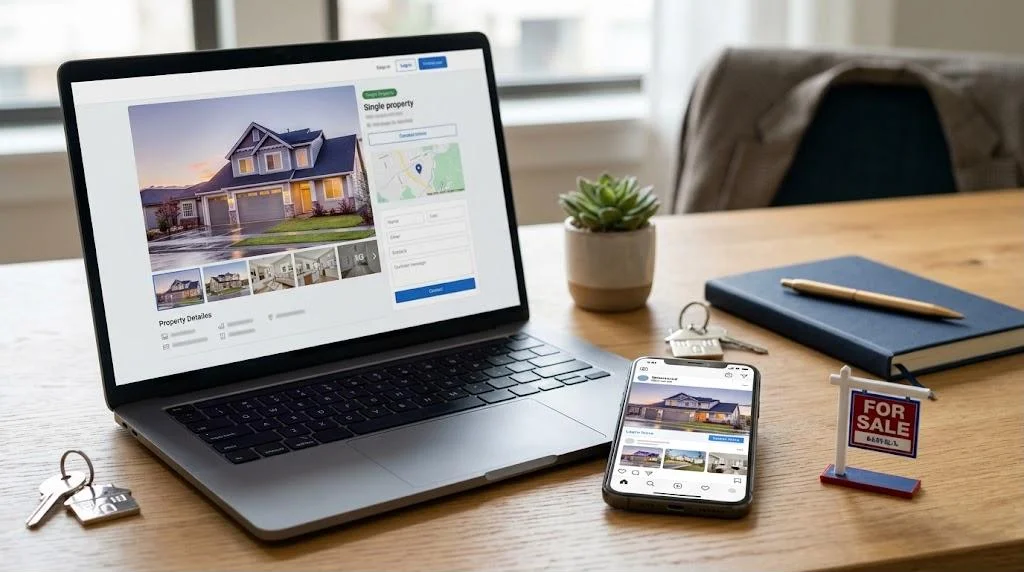
A single property website is a website for one listing, usually on its own web address. One dedicated vendor publishes prices from $24.95 a year per site. A do-it-yourself build with your own domain and website builder usually costs more per listing.
To get leads from one, it needs strong photos and details, a short contact form, traffic from signs, email, social posts or ads, and fast follow-up. Under NAR's MLS policy it likely counts as public marketing, which starts a one business day clock.
This guide covers what a property website is, published prices, what buyers value, how to turn visitors into leads and the rules. I read every vendor page and rule cited here on 26 October 2026.
Where I stand: I am a Realtor with Samson Properties in Virginia, and I run Jamil Academy, which sells training to agents. This is not a hands-on test of each tool: it is built from vendor pages, NAR survey data and the rules themselves. The one product block near the end is my own.
This guide contains an affiliate link to Listings to Leads. If you sign up through it, I may earn a commission at no extra cost to you. Other tools mentioned are not affiliate links.
Quick answer
- What it is: one listing on its own web address, with photos, details and your contact form.
- Lowest published price I found: $24.95 a year for one site, or $24.95 a month for up to 25 active sites, at Listings Unlimited.
- Do it yourself: a .com domain from $11.28 the first year on sale at Namecheap, plus a builder such as Squarespace from $19 a month billed yearly, or $25 billed monthly.
- What buyers value: photos (81 percent rate them very useful), detailed information (77 percent) and floor plans (57 percent), per NAR's 2025 Profile.
- Leads: one address everywhere, a short form and fast follow-up through your CRM.
- Rules: Fair Housing ad wording, the MLS one business day rule for public marketing, and consent for automated texts and calls.
- What is a single property website?
- Why do agents build a single property website for a listing?
- How much does a single property website cost?
- Which kind of single property site should you use?
- What will your listings cost? Try the calculator
- What should a single property website include?
- How do you get leads from a single property website?
- What are the ad rules for promoting a listing website?
- Which fair housing, MLS and follow-up rules apply?
- Single property website build checklist
- When is a single property website not worth it?
- What I could not verify
- Frequently asked questions
What is a single property website?
Short answer: a website for one listing, usually on its own address, that holds the home's photos, details, tour and contact options in one place. You may also see it called a property website, a single property site or a listing website.
Writing for Inman in August 2021, Craig C. Rowe described it as "a domain dedicated to a listing that if designed correctly, serves as the hub for all information on the listing."
Vendors use the terms loosely. Virtuance, a real estate photography company, calls a single property website "a dedicated landing page designed to showcase an individual real estate listing."
Inman separates the two. It says landing pages "evolved naturally into lead capture tools typically with a single call to action." Inman adds that property sites are "often the reason a person ended up at a landing page."
How it differs from the other places a listing lives
| Page type | What it shows | Who controls it | Main job |
|---|---|---|---|
| Single property website | One listing | You, the listing agent | Show off the home and collect inquiries |
| Listing landing page | One offer, often one listing | You | Capture leads from one ad or campaign |
| IDX website | Many brokers' MLS listings | You, within your MLS's IDX rules | Let buyers search the market |
| MLS listing | One listing, shared with MLS participants | Your MLS, under its rules | Cooperation with other brokers |
| Portal listing page | One listing among many on a portal | The portal | Portal traffic, on the portal's design and contact flow |
Sources: Inman, 30 August 2021; Virtuance blog, updated 12 February 2025; NAR's Internet Data Exchange policy page. My summary, read 26 October 2026.
NAR's IDX policy page says IDX "gives MLS participants the ability to authorize limited electronic display of their listings" by other participants. So an IDX site shows the whole market, while a single property website covers one home.
They do different jobs. For the search-site side, my guide on whether IDX websites generate leads looks at that question.
Single property website or portal page?
A portal page belongs to the portal, which controls the design and the contact flow. I found no Zillow page explaining who receives a listing's inquiries, so I make no claim about it.
My view: think of it as the home's own brochure on the web, with a contact form. It adds to the MLS and portals, not replaces them.
Why do agents build a single property website for a listing?
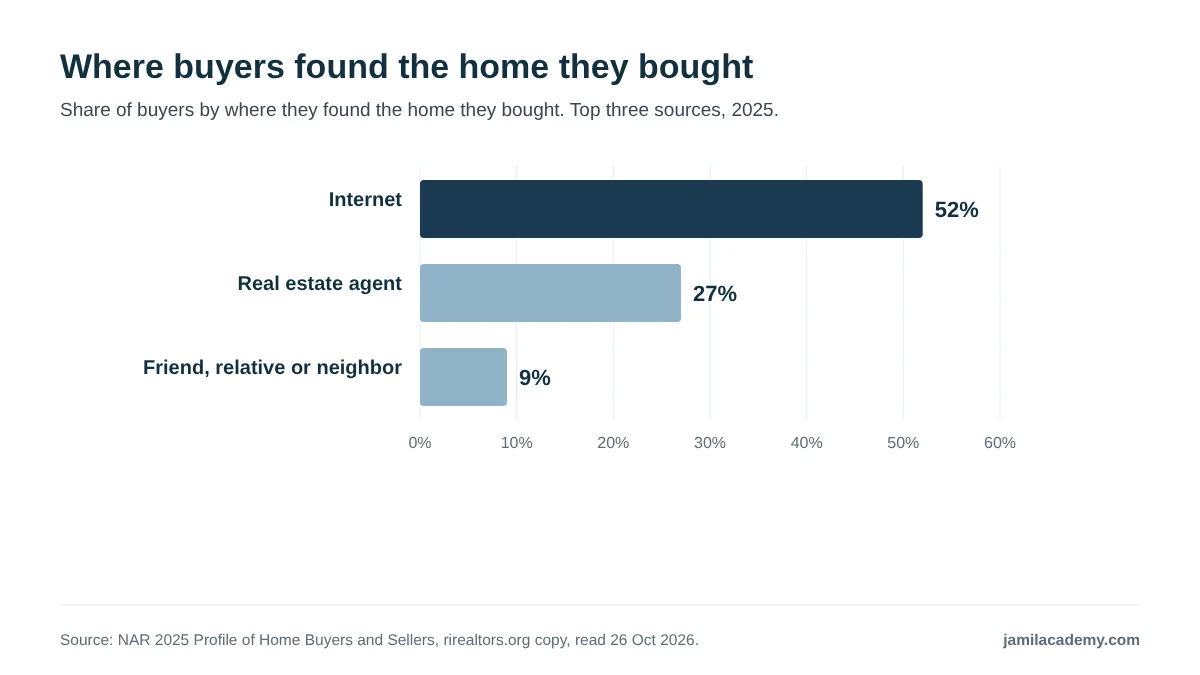
Short answer: buyers search online, and a site with one memorable address gives every sign, flyer, email and ad somewhere to send people. NAR's 2025 Profile puts the agent's own website at 49 percent among the ways listing agents marketed homes.
NAR's 2025 Profile of Home Buyers and Sellers covers buyers who closed between July 2024 and June 2025, and was released on 4 November 2025. It says: "In 2025, 52 percent of buyers found their home on the internet, 27 percent through a real estate agent."
Another 9 percent found it through a friend, relative or neighbor. Also, "Forty-six percent of buyers reported that their initial step was looking online for properties for sale." And 70 percent used mobile or tablet devices.
Source: NAR, 2025 Profile of Home Buyers and Sellers, read in the copy hosted by Rhode Island Realtors on 26 October 2026.
How listing agents market homes today
The same report shows how listing agents marketed homes. The agent's own website sits close to Realtor.com.
| How listing agents marketed the home | Share in NAR's 2025 Profile |
|---|---|
| Listed on the MLS | 85% |
| Yard sign | 67% |
| Open house | 59% |
| Listed on Realtor.com | 50% |
| Listed on the agent's own website | 49% |
| Listed on third-party aggregators | 46% |
| Listed on the company's website | 42% |
Source: NAR, 2025 Profile of Home Buyers and Sellers, read 26 October 2026. Agents could use more than one method.
What a property site does that a portal does not
- One address for print: a web address or QR code on the sign and flyer leads to this home.
- Your inquiries: the form sends leads to you and your CRM.
- Your story: you choose the photos, floor plan, tour and description.
- Something to share: one link for social posts, email and ads.
My view: the strongest reason is control. You decide what a buyer sees first and where their question goes. That matters more than any design feature.
How much does a single property website cost?
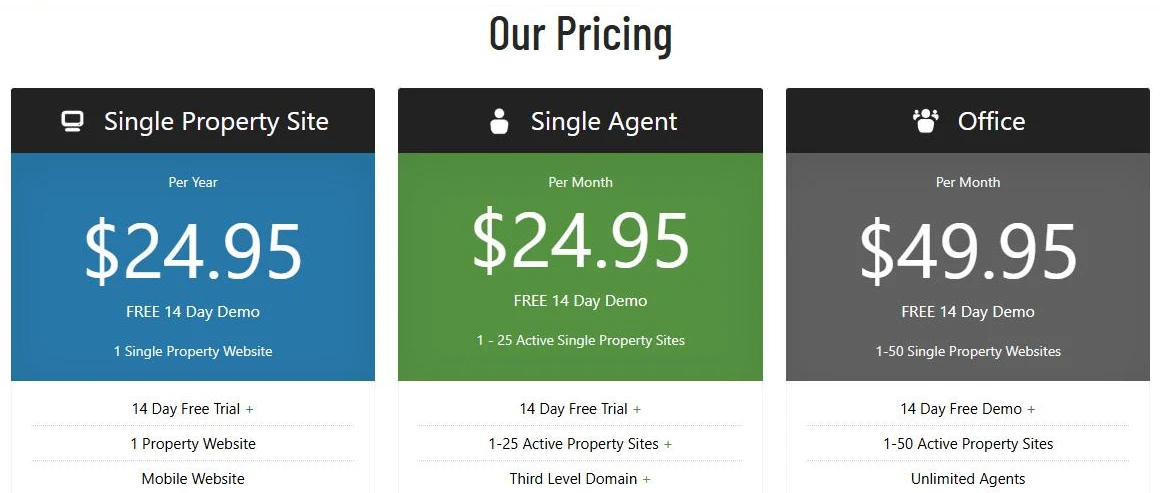
Short answer: published prices start at $24.95 a year for one site, or $24.95 a month for up to 25 active sites. Full agent websites cost more: Placester's plan with property landing pages is $129 a month.
| Vendor and plan | Published price | What it covers | Page date |
|---|---|---|---|
| Listings Unlimited, Single Property Site | $24.95 a year | 1 single property website | Modified 17 Sep 2026 |
| Listings Unlimited, Single Agent | $24.95 a month | 1 to 25 active sites, then $0.89 per listing a month | Same page |
| Listings Unlimited, Office | $49.95 a month | 1 to 50 sites, then $1.00 per listing a month | Same page |
| Listings to Leads | $60 a month for 0 to 10 listings, up to $340 for 251 to 350 (in-app screenshot from about 2022) | Single property websites, listing import and ads; priced by listings marketed at a time | Not confirmed as current |
| Placester, Agent Essential, Plus, Premier | $59, $79 or $129 a month; $566, $758 or $1,238 billed yearly | Full agent website. "Property Landing Pages" only in Agent Premier among agent plans | No date shown |
| AgentFire, Pro or Plus | $165 or $215 a month, plus design setup from $800 | Full agent website. A "Listings Hub" is described, but not which plan includes it | Modified 20 Oct 2026 |
| Luxury Presence | Not published | Full agent website; property site templates on every plan | Blog post updated 14 Oct 2026 |
Sources: listingsunlimited.com/pricing; the Subscription article in the Listings to Leads help center; placester.com/pricing; agentfire.com/pricing and agentfire.com/tour; luxurypresence.com. All read 26 October 2026. Prices before tax and ad spend.
Listings to Leads needs a caveat. Its homepage text lists $30 to $110 a month by listing count, under a 2014 copyright footer. A newer in-app screenshot in its help center, from about 2022, shows $60 to $340 a month.
Neither is confirmed as today's price, and its homepage did not load in a live check on 26 October 2026. If you try Listings to Leads (affiliate link), check the plan screen during the free trial before you rely on any figure.
Listings Unlimited, the lowest published price
Every Listings Unlimited plan includes an automatic third-level address, such as 555MainSt.IsForSale.com, plus "Mobile Lead Capture", "Text Message Alerts" and a "QR Code Generator".
The page also lists a flyer builder, a video builder and a $17.95 custom domain add-on. It also offers a $299 annual subscription with "UNLIMITED Single Property Websites for the year."
Free routes through your photographer
Some photography platforms build a property site with the photos. Virtuance offers a "complimentary marketing suite and dynamic single property website included with every shoot."
HD Photo Hub and Aryeo price their tools for photographers, so the site usually comes through your photographer's package. Ask whether one is included before you pay for another.
What a do-it-yourself site costs
| Item | Published price | Notes |
|---|---|---|
| .com domain at Namecheap | $11.28 the first year on sale (regular $14.98); renews at $18.48 | Plus a $0.20 annual ICANN fee |
| Cloudflare Registrar | At cost: it "does not mark up domain prices at all" | No .com price shown on the page |
| Canva | Free on a .canva.site address, up to five live sites | Your own domain needs Pro, Teams or Education |
| Wix | Free plan, then $17.77 to $159.77 a month | Yearly subscriptions; prices vary by location; own domain needs a Premium plan |
| Squarespace | Basic $19 a month billed yearly, or $25 billed monthly | Annual plans include a free custom domain for one year |
Sources: namecheap.com, cloudflare.com/domains, Canva help center, wix.com/plans and squarespace.com/pricing, read 26 October 2026. Sale prices change often.
Example: one listing live for 3 months on Squarespace Basic billed monthly, with a Namecheap domain, costs $25 x 3 + $11.28, or $86.28, before the ICANN fee and tax.
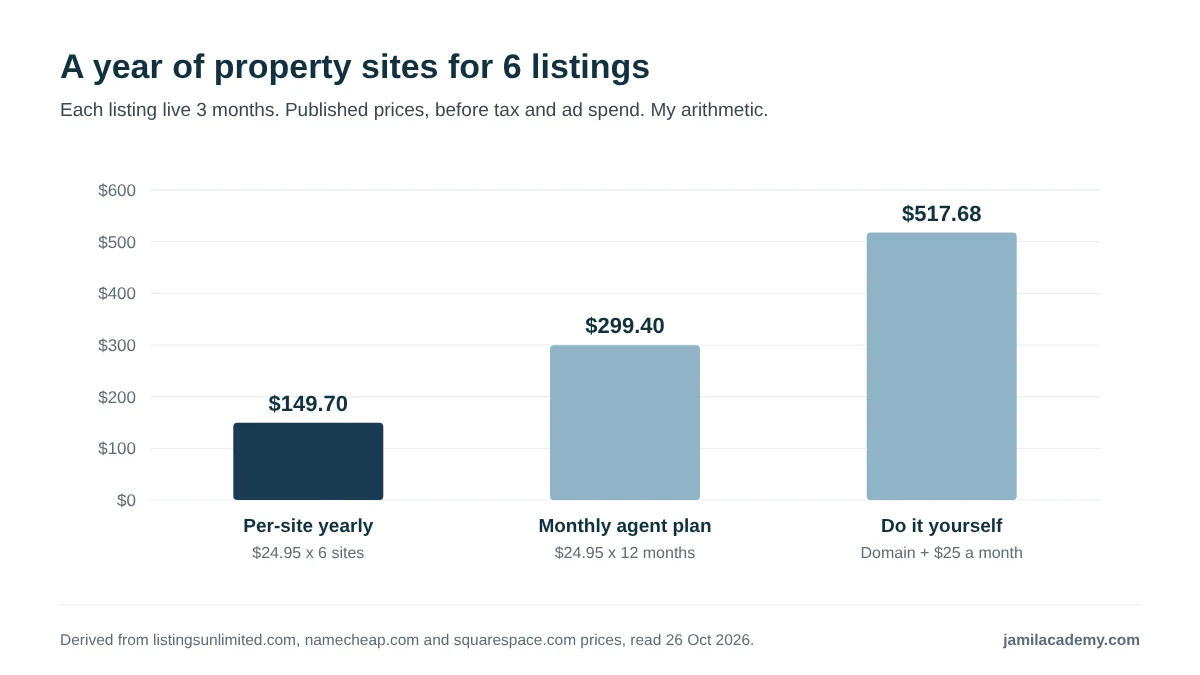
My view: the site itself is cheap. At these prices, the real cost is your time and any ad budget, so pick the route that takes the least work per listing.
Which kind of single property site should you use?
Short answer: use a property site service, an automated listing tool, your main website platform, your photographer's platform or a site you build yourself.
| Route | Examples from the research | Best for | Trade-off |
|---|---|---|---|
| Dedicated property site service | Listings Unlimited | Agents who want a cheap site per listing, fast | Another login and another place for leads to land |
| Automated listing marketing tool | Listings to Leads | Agents who want the site and the ads built from listing data | Monthly fee; prices to confirm |
| Your main website platform | Luxury Presence, Placester, AgentFire | Agents already paying for a full agent website | Site counts vary by plan, and some prices are not published |
| Photographer's platform | Virtuance, HD Photo Hub, Aryeo | Agents whose photographer includes a site | Design and features are set by the photographer's tool |
| Do it yourself | Canva, Wix, Squarespace plus a domain | Agents who want full design control | More time, and usually more cost per listing |
Source: vendor pages listed in the cost section, read 26 October 2026. Route labels are my own.
Automated tools that build the site for you
Some tools build the site from your listing data. Listings to Leads is one. Its homepage feature list includes "Single Property Websites" and "Listing Landing Pages", and its training page says the sites are "Beautiful on smartphones and tablets."
It imports listings from ListHub, not straight from your MLS. Its help center says: "We don't pull the Listings from the MLS we pull them from ListHub." The homepage promises "Auto import & daily update of listings!"
The bigger draw is the ad layer. Its help center covers Facebook and Instagram lead ads and traffic ads for listings, run through the ad account you connect, and Google Ads since November 2023. Leads can flow to Follow Up Boss, Zapier and, since August 2026, GoHighLevel, among other integrations.
What I could not confirm: whether its property sites include a custom domain, analytics or a form on the site itself. The help center has a Domains section, but the homepage only names the feature.
For a closer look at the tool, see my Listings to Leads review. If you want to test it on a real listing, you can start a trial through this Listings to Leads link (affiliate link).
Property pages inside a full agent website
If you already pay for an agent website, check what it includes first. Luxury Presence does not publish prices. Its plan guide lists 3, 10, 20 or 50 property sites by tier.
Placester calls its Agent Premier property landing pages "perfect for running ads". AgentFire's Listings Hub turns a listing into a lead capture page. Its pricing page does not say which plan includes it.
My view: start with whatever your current website or photographer already includes. Pay for a separate tool only when it saves you time on every listing, or runs ads you would not build yourself.
What will your listings cost? Try the calculator
Short answer: up to 12 listings a year, a per-site yearly plan is usually cheapest. Above 12, the monthly plan kept all year costs less.
Defaults use prices read on 26 October 2026: Listings Unlimited's per-site and Single Agent plans, a Namecheap .com sale price and Squarespace Basic billed monthly. Change any price to match a quote you have.
Defaults are vendor prices to confirm, read 26 October 2026. The monthly plan adds $0.89 per listing a month over 25 active. Before tax and the ICANN fee. Option totals exclude ad spend.
How the calculator counts
- Per-site yearly plan: listings times the yearly price, renewed once a year for listings live longer than 12 months.
- Monthly agent plan: the monthly price times the months you keep it, plus $0.89 a month for each listing over 25 live at once, using the average.
- Do it yourself: one domain per listing plus the builder plan for each month the listing is live. Renewals use the first-year domain price.
- Ads: your monthly ad budget times the months live, for every listing. It goes to the ad platform, not the site vendor.
Swap in other prices to test other tools: $49.95 for Listings Unlimited's Office plan, or 0 for the builder to model a free Canva site. The overage stays at the Single Agent rate, so use the Office price only with 25 or fewer listings live.
The calculator leaves out Listings Unlimited's $299 annual subscription for unlimited sites, which costs about the same as a year of the Single Agent plan.
My view: for most solo agents the difference between options is under a few hundred dollars a year. Choose on time saved and lead handling first, then on price.
What should a single property website include?
Short answer: start with what buyers rate most useful: photos, detailed information and floor plans. Then make it easy to contact you, on a phone as well as a laptop.
In NAR's 2025 Profile, buyers who used the internet "found photos (81 percent), detailed information about properties for sale (77 percent)" very useful. They also rated "floor plans (57 percent), real estate contact information (44 percent), and virtual tours (38 percent)" very useful.
Source: NAR, 2025 Profile of Home Buyers and Sellers, read in the Rhode Island Realtors copy on 26 October 2026.
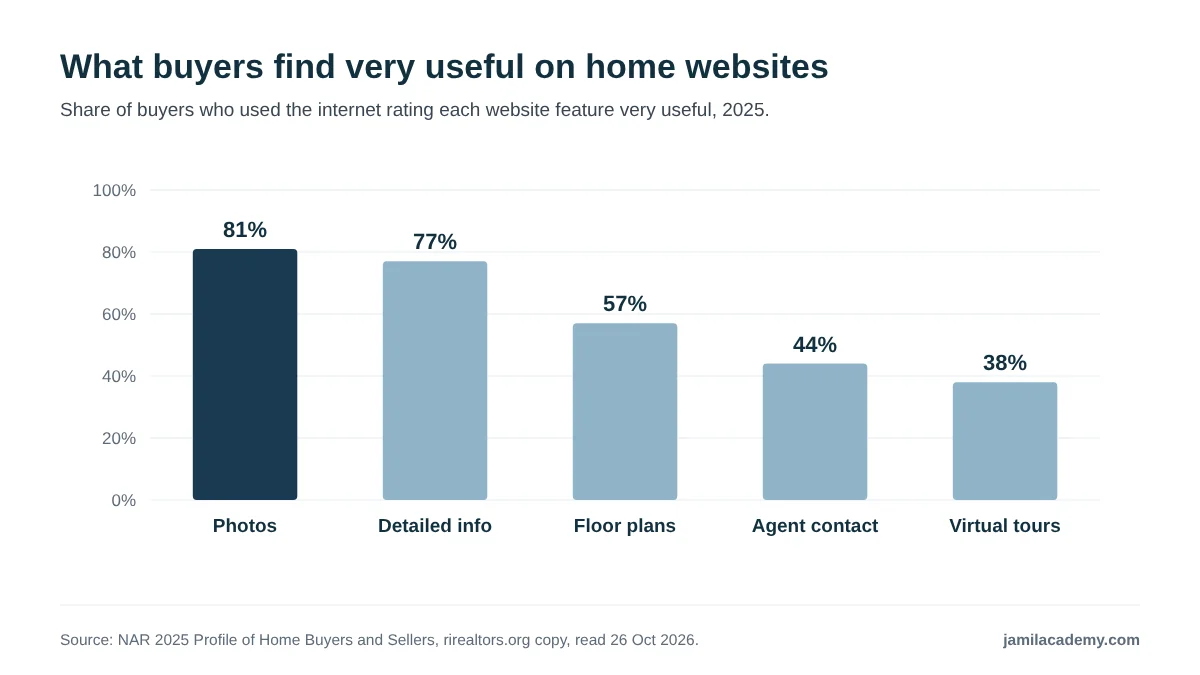
NAR's April 2025 Generational Trends report, from the prior data cycle, shows the same order, with photos at 83 percent.
What to put on the page, in order
- Photos first. The most valued feature in NAR's data.
- Detailed facts. Price, beds, baths, size, lot and other facts you can verify.
- A clear description. Specific, accurate and about the home, not who should live there.
- Floor plan. Rated very useful by 57 percent of internet-using buyers.
- Your contact details. Name, phone, email and brokerage, near the top and again at the bottom.
- Virtual tour or video, if the listing has one, with captions on the video.
- Showing and open house details, plus a map, so a buyer can plan a visit.
- A short form, with labelled fields and consent wording if you will text or call.
For the description, my listing description templates and MLS remarks examples give you a starting draft you can adapt for the site.
If you are deciding whether a 3D tour is worth adding, I priced the options in my breakdown of what a Matterport 3D tour costs.
Build for phones first
NAR reports that 70 percent of buyers used mobile or tablet devices in their search. Check the site on your own phone before you share it: photos should load quickly, and the form and phone number should be easy to tap.
My view: a property site with ten sharp photos, a floor plan and a phone number beats a beautiful template with thin content. Buyers came for the house.
How do you get leads from a single property website?
Short answer: a property site only produces leads if people visit and contacting you is easy. Point every sign, flyer, email and ad to one address, keep the form short, and reply fast.
I found no credible data on how many leads a typical property site produces, so treat these steps as practice to test, not a promise.
1. A form that asks for very little
Ask for a name, an email or phone number and a short message, with a clear button such as "Ask about this home". If you will follow up with automated texts or calls, the consent wording belongs here.
2. Signs, riders and QR codes
In NAR's 2025 Profile, listing agents "posted yard signs (67 percent)". A sign rider or flyer with the site's short address or a QR code gives a passing buyer a way to see inside.
Some tools build this in. Listings Unlimited lists a "QR Code Generator" on every plan, and Listings to Leads describes automated voice response and short code texting. I found no credible data on scan or text rates, so test it.
3. Email and social posts
Share the link on your social profiles and email it to your database, with an opt-out and your postal address. Email blasts count as public marketing under NAR's Clear Cooperation Policy too.
4. Paid ads
Ads send the most predictable traffic, but housing ads on Meta and Google have special targeting limits, set out in the next section.
5. Fast follow-up and CRM routing
Someone asking about a specific home has a question now. Make sure each inquiry reaches your phone and your CRM within moments.
- Alerts: Listings Unlimited lists "Text Message Alerts" on every plan.
- CRM: Listings to Leads lists integrations including Follow Up Boss, Zapier and GoHighLevel.
- DIY: route form emails to your CRM with its email parser or a tool such as Zapier.
- Tag the source: tag each lead with the listing address, so you can see which listings and channels produce.
My view: the form and the follow-up matter more than the design. A plain site that answers within minutes will beat a beautiful one that answers tomorrow.
What are the ad rules for promoting a listing website?
Short answer: on Meta and Google, US housing ads cannot target by age, gender or ZIP code, and Meta also bars lookalike audiences. These rules apply whichever tool builds the ad.
Why the rules exist
In March 2019, HUD charged Facebook. It alleged advertisers could exclude neighborhoods by "drawing a red line around those neighborhoods on a map," and show ads "only to men or only to women."
Source: HUD press release No. 19-035, 28 March 2019.
In June 2022, the Justice Department settled its case with Meta. Meta stopped using its "Special Ad Audience" tool for housing ads, built a "Variance Reduction System", and paid a civil penalty of $115,054. A January 2023 release put Meta under court oversight "through June 27, 2026." I could not verify its status since.
Source: US Department of Justice, United States v. Meta Platforms, page updated 21 January 2025, and US Attorney, SDNY, press release of 9 January 2023, read 26 October 2026.
Meta and Google housing ad limits
| Targeting option | Meta (Facebook, Instagram) | Google Ads |
|---|---|---|
| Category | Must mark the campaign as HOUSING | Housing policy applies in the US and Canada |
| Age | "generally fixed to include ages 18 through 65+" | Cannot target by age |
| Gender | "Specific gender cannot be chosen" | Cannot target by gender |
| ZIP codes | Not supported | Cannot target by ZIP code |
| Location radius | At least 15 miles in the US; no location exclusion | City, state or radius instead of ZIP codes |
| Detailed targeting | Approved interests only; no exclusions | No parental or marital status targeting |
| Lookalike audiences | "unavailable" for housing ads | Not covered in the pages I read |
Sources: Meta Marketing API documentation, "Special Ad Categories" and "Real Estate Ads"; Google Ads policy help, "Housing in personalized advertising" and its FAQ on the October 2020 policy update. Read 26 October 2026.
Old guidance you may still see quoted
In April 2024, HUD issued guidance on housing ads through digital platforms. It has since been withdrawn. A Federal Register notice published on 6 April 2026 lists it among eight withdrawn documents, with withdrawal effective 17 September 2025.
Sources: HUD notice, Federal Register document 2026-06624 and National Low Income Housing Coalition, 13 April 2026.
The Fair Housing Act and HUD's advertising regulation still apply, as the next section shows.
My view: set the special ad category first, then write the ad about the home. Let the radius and the creative do the work that detailed targeting used to do.
Which fair housing, MLS and follow-up rules apply?
Short answer: Fair Housing law covers the site's words and photos, MLS rules cover when it goes live, and consent laws cover how you follow up. This is general information, not legal advice.
Fair Housing: the words and photos
The Fair Housing Act bars any housing ad "that indicates any preference, limitation, or discrimination" based on a protected class.
Source: 42 U.S.C. 3604(c), via govinfo.gov, read 26 October 2026.
HUD's regulation lists, as an example, "Using words, phrases, photographs, illustrations, symbols or forms which convey that dwellings" are or are not available to particular groups.
It also covers "Selecting media or locations for advertising the sale or rental of dwellings which deny particular segments of the housing market information about housing opportunities."
Source: 24 CFR 100.75, eCFR, read 26 October 2026.
The Justice Department lists the protected bases as race or color, religion, sex, national origin, familial status and disability. Describe the home and its features, not the people you imagine living there.
Source: US Department of Justice, The Fair Housing Act, updated 22 June 2023.
Do you need the Equal Housing Opportunity logo?
NC REALTORS said in February 2026: "The fair housing logo is not required by federal law or the Code of Ethics, but it is recommended."
Source: NC REALTORS legal Q&A, 19 February 2026.
Your state or brokerage may still require it, so check.
Clear Cooperation: the one business day clock
NAR's MLS Clear Cooperation Policy says: "Within one (1) business day of marketing a property to the public, the listing broker must submit the listing" to the MLS.
Its list of public marketing includes "digital marketing on public facing websites." A live, public single property website is likely to count, so plan its launch around your MLS submission.
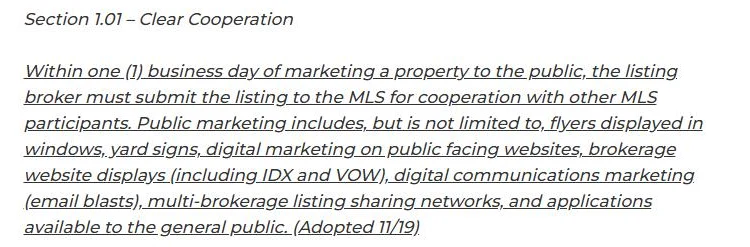
NAR's Multiple Listing Options for Sellers policy, effective 25 March 2025, adds "office exclusive" and "delayed marketing" options, each needing a seller certification. MLSs had to implement it by 30 September 2025.
That policy says it "does not change" the one business day filing requirement. In a 29 May 2026 news item on Clear Cooperation, NAR said it "revisited the policy in 2024 and 2025 and made the decision to retain the policy."
Your local MLS rules decide the details. For the background, see my explainer on how the Clear Cooperation Policy works.
Email and text follow-up
The FTC's CAN-SPAM guide lists core rules, including: "Don't use deceptive subject lines." "Tell recipients where you're located." "Honor opt-out requests promptly."
The guide puts the penalty at up to $53,088 per violating email, a figure adjusted for inflation. The FTC said in September 2026 that its penalty amounts "will remain unchanged during 2026."
Source: FTC, CAN-SPAM Act: A Compliance Guide for Business, read 26 October 2026, and FTC notice, Federal Register document 2026-18853.
For calls and texts, the FCC's rule bars autodialed or prerecorded telemarketing calls to covered numbers without "the prior express written consent of the called party".
That consent means "an agreement, in writing, bearing the signature of the person called" that names the phone number. Do-not-call registrations "must be honored indefinitely, or until the registration is cancelled by the consumer".
Source: 47 CFR 64.1200, eCFR, read 26 October 2026.
If a lead asks you to stop, stop. Under the FCC's revocation rule, consent revoked by "any [reasonable] method" is "considered definitively revoked." A January 2026 order delays to 31 January 2027 only the part covering unrelated messages.
Source: FCC Order DA 26-12, released 6 January 2026.
Accessibility
The Justice Department's ADA guidance covers business offerings "including those offered on the web." Barriers it lists include poor contrast, missing alt text, uncaptioned video and "Inaccessible online forms."
Source: US Department of Justice, Guidance on Web Accessibility and the ADA, 18 March 2022.
It points to WCAG. WCAG 2.2 asks for text alternatives for images, captions for prerecorded video audio, and most text with "a contrast ratio of at least 4.5:1".
Source: W3C, Web Content Accessibility Guidelines 2.2, Recommendation dated 12 December 2024.
My view: write the site as if your broker's compliance officer will read it, because they might. Check state advertising rules too, which this guide does not cover.
Single property website build checklist
Short answer: settle the MLS timing, build the page around photos and facts, wire the form to your CRM, then share one address everywhere. Use this list for each listing.
Before it goes live
- Confirm the seller's marketing choice and your MLS submission timing, including the one business day rule.
- Pick the route, and choose the address: a free subdomain, or a custom domain for signs.
- Load the best photos first, then the floor plan, tour and verified facts.
- Write a specific description about the home, and read it once for Fair Housing wording.
- Add your name, phone, email and brokerage, and any logo your state or broker requires.
- Add alt text and captions, and check the page on your phone.
The form and follow-up
- Keep the form to name, contact and message, with labelled fields.
- Add consent wording if you will use automated texts or calls.
- Send a test inquiry and check it reaches your phone and your CRM, tagged with the address.
After launch
- Put the address or QR code on the sign rider and flyer.
- Share it on social and email it to your database, with an opt-out and postal address.
- If you run ads, set the housing special ad category first.
- Update the status when the home goes under contract or sells, and take the site down or mark it sold.
My view: the first and last steps matter most. Get the MLS timing right, and never leave a sold listing looking available.
When is a single property website not worth it?
Short answer: skip it when the home will sell too fast, when your main website already covers the listing, or when you will not send traffic.
- The listing is off market by design. If the seller chose an office exclusive or delayed marketing option, a public site may clash with that choice. Check with your broker and MLS.
- You expect a very fast sale. A site built after the home is under contract helps nobody.
- Your agent website already builds a property page. Use that page, and avoid two pages competing for the same listing.
- You will not drive traffic to it. A site nobody visits is just a cost, however cheap.
- You cannot answer inquiries quickly. A form that collects questions you answer days later can hurt more than it helps.
It earns its place on homes with a story to tell, and on listings you will promote with signs, open houses or ads.
My view: at $24.95 a listing, cost is rarely the reason to skip one. Time and follow-up are. If you will not share it or answer it, spend the hour on the MLS listing instead.
What I could not verify
These are the gaps I hit while checking sources. Be careful with any page that fills them with a confident number.
- Listings to Leads current prices. Its homepage did not load in a live check, and both published price sets may be out of date.
- Listings to Leads site features. Whether its property sites include a custom domain, analytics or an on-site form, and how ad spend is billed.
- Luxury Presence prices, which are not published, and which AgentFire plan includes its Listings Hub.
- PhotoUp. Its pricing page and its help article give different prices for the same plans, so I left it out.
- HD Photo Hub and Aryeo. Which of their plans include property sites, and the canonical HD Photo Hub price page.
- Zillow. Who receives inquiries from a Zillow listing page.
- QR code and sign rider results. No credible scan or response data.
- Lead benchmarks. No credible figure for leads per property site.
- Meta's court oversight after 27 June 2026.
- State rules on logos, brokerage names and advertising, which vary by state.
- NAR's 2025 Profile figures, which I read from a state association's copy of the report.

Frequently asked questions
What is a single property website?
A website for one listing, usually on its own address, with the home's photos, details and a way to contact the listing agent. It is also called a property website or listing website.
How much does a single property website cost?
Listings Unlimited publishes $24.95 a year for one site, or $24.95 a month for up to 25 active sites. Placester's agent plan with property landing pages, Agent Premier, is $129 a month.
Do single property websites generate leads?
They can, if people visit. Point signs, flyers, emails and ads to one address, keep the form short and reply quickly. I found no credible data on average lead counts.
Does a single property website count as public marketing?
Under NAR's Clear Cooperation Policy, public marketing includes "digital marketing on public facing websites." That starts a one business day MLS submission clock. Check your local MLS rules.
Can I target Facebook ads for a listing by ZIP code?
No. Meta's housing ad rules do not support ZIP code targeting, require at least a 15 mile radius in the US, and do not allow age, gender or lookalike targeting.
Do I need the Equal Housing Opportunity logo on a listing website?
Not under federal law, according to NC REALTORS, though it is recommended. Your state or brokerage may require it, so check before you publish.
Should a single property website have its own domain?
It helps on signs and flyers, but it is optional. Listings Unlimited gives each site a free third-level address and lists a $17.95 custom domain add-on.
What should a single property website include?
Start with what buyers rate most useful in NAR's 2025 Profile: photos (81 percent), detailed information (77 percent) and floor plans (57 percent). Add your contact details and a short form.
Saad Jamil is a top 1 percent Realtor with Samson Properties in Chantilly, Virginia, licensed in Virginia, DC, Maryland and West Virginia since 2013, with more than $500 million in career sales and 900+ homes closed. Reviews and closed sales are on his Zillow profile. He runs Jamil Academy, which sells training to agents. This article is general information, not legal or financial advice, checked on 26 October 2026.
Free: 5 Ways to Get More Listings Without Cold Calling
Five lead strategies that work without cold calls or ad spend, from an agent with $500M sold and 900+ homes closed.
No spam. Unsubscribe any time.
Your Coach