Real Estate Sales Training: The Skills That Actually Close Deals (2026)
Jul 28, 2026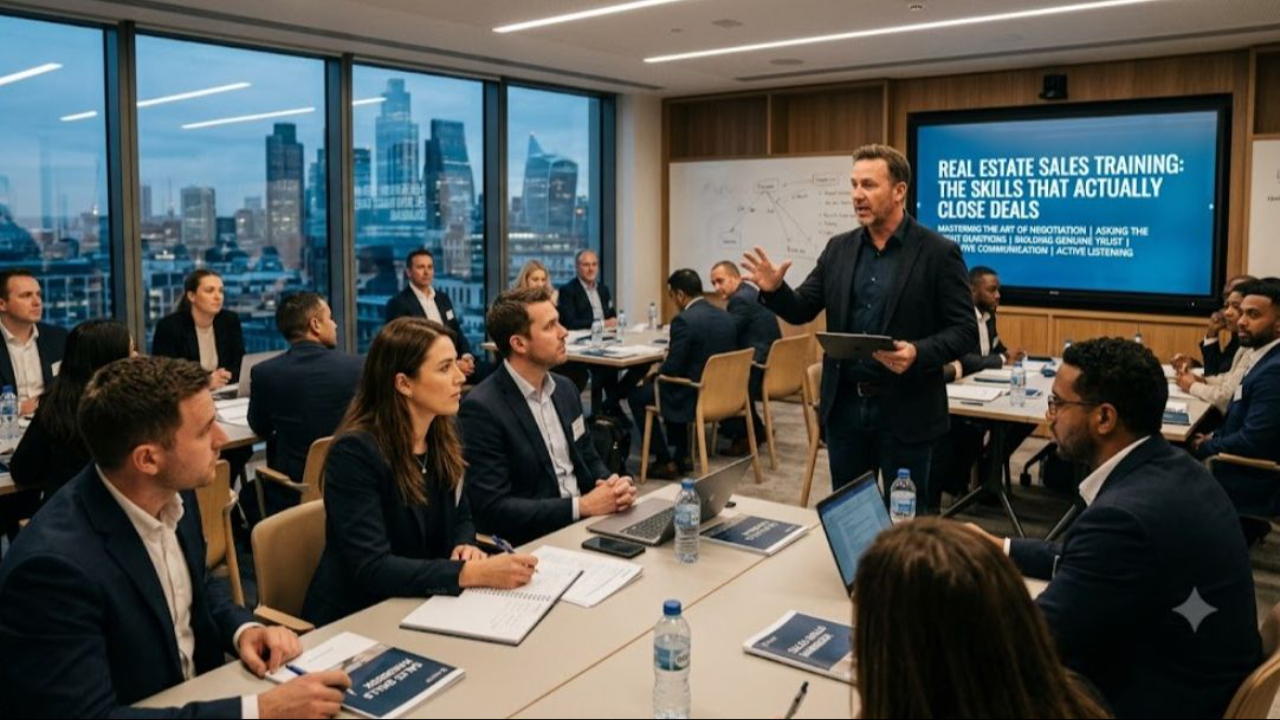
Most real estate sales training hands you scripts and sends you off. Scripts matter, but they are only the words. Two agents can read the exact same script and get opposite results, because selling is a set of skills underneath the words. Those skills are the ability to start a conversation, build trust, uncover what someone truly needs, present value, ease a concern, ask for the business, and follow up until it is time. Master those and the scripts start writing themselves.
I have closed 900+ homes and over $500M in volume, and I can tell you the top producers are almost never the slickest talkers. They are the most skilled and the most consistent. This guide breaks down the seven core sales skills that actually close deals, how to build each one, and where to get the exact scripts and playbooks that go with them. It is the same training I run inside my real estate coaching programs.
Quick Answer
Real estate sales training that works focuses on skills, not just scripts. The seven skills that close deals are prospecting to start conversations, building rapport, discovery through questions and listening, presenting value, handling objections, closing by asking for the business, and following up with persistence. Scripts give you the words, but these skills give you the results, and every one of them is learnable through deliberate practice. Below is how to build each, with the specific playbooks for each skill.
In This Guide
Skill 1: Prospecting
Skill 2: Building rapport
Skill 3: Discovery and listening
Skill 4: Presenting value
Skill 5: Handling objections
Skill 6: Closing
Skill 7: Follow-up
Rate yourself: a sales skills self-audit
How to actually train these skills
Sales mistakes that quietly kill deals
Frequently asked questions

Why skills beat scripts
Here is the truth most training skips. A script is a shortcut for a skill you have not built yet. It is genuinely useful, the same way training wheels are useful, but if you never develop the underlying balance, you fall the moment the conversation goes off-script. And real conversations always go off-script.
The agents who close consistently have internalized the skills, so they can follow a proven framework and still respond like a human when a client says something unexpected. That is the goal of real sales training: not to memorize lines, but to build the abilities that make any line land. We will still point you to the exact scripts for every situation, because scripts accelerate skill-building. Just never mistake the words for the skill.
Skill 1: Prospecting
No skill matters if you never talk to anyone. Prospecting is the ability to consistently start conversations with people who might buy or sell, and to do it without dreading it. It is the most avoided skill in the business, which is exactly why building it sets you apart. The skill is not a magic opener, it is the discipline to make the outreach daily and the calm to handle a cold start.
Build it by choosing a channel, committing to a daily number, and practicing until the fear fades. The words come from proven playbooks. My expired listing scripts, cold calling scripts, and circle prospecting scripts give you exactly what to say, and my lead generation guide covers every channel to prospect.
Skill 2: Building rapport
People buy from and list with agents they trust and like, and rapport is the skill of earning that quickly and genuinely. It is not fake charm or forced small talk. It is showing up prepared, being warm and human, mirroring a client's pace, and proving early that you are competent and on their side. Rapport is what makes everything after it easier.
You build rapport by being genuinely curious about the person in front of you and by delivering small proofs of competence early in the conversation. The right opening words help, and my collection of the best real estate scripts gives you natural language for those first crucial minutes with any lead.
Skill 3: Discovery and listening
This is the skill that separates advisors from salespeople, and most agents are weak at it. Discovery is asking the right questions and then actually listening to the answers, so you understand a client's real motivation, timeline, and fears before you recommend anything. A doctor who prescribes before diagnosing is dangerous, and so is an agent who pitches before understanding.
Build it by talking less and asking better, more open questions, then following up on the answers instead of waiting to talk. The structured way to run this is a real buyer or seller consultation, which I lay out step by step in my buyer consultation script. Master discovery and half your objections disappear before they are ever raised.

Skill 4: Presenting value
Once you understand what a client needs, you have to show them how you deliver it, clearly and confidently. Presenting is the skill of connecting your plan and your value directly to what the client told you they want, so choosing you feels obvious. Weak presenters list features. Strong presenters tie every point back to the client's specific goals.
The highest-stakes presentation is the listing appointment, where this skill wins or loses the business. My listing presentation template and script gives you the full flow, and mastering it is the core of learning to get listings consistently. Practice presenting until it sounds like a conversation, not a pitch.
Skill 5: Handling objections
Objections are not rejection, they are requests for more information or reassurance. The skill is staying calm, acknowledging the concern sincerely, and addressing it without getting defensive or pushy. Agents who fear objections talk over them. Agents with the skill welcome them, because an objection voiced is a concern you can actually resolve.
The technique is consistent across objections: validate, ask a clarifying question, then answer with confidence. The specific responses matter too, so I built dedicated playbooks for the toughest objections. Two of the most common are the your commission is too high objection and the I want to think about it objection. Two more are the we will wait until spring objection and the my friend is in the business objection.
Skill 6: Closing
Closing is the most feared skill and the most misunderstood. It is not a high-pressure trick at the end. It is the simple, confident act of asking for the business once the client is ready, and being comfortable in the silence after you ask. Most agents do all the work and then never actually ask, so the deal drifts. The skill is the willingness to ask, clearly and without apology.
Closing gets easier when the earlier skills are strong, because a well-diagnosed, well-presented client is already most of the way there. For the exact language, my listing presentation closing lines and my negotiation scripts give you word-for-word phrases top agents use to close and to protect the client's bottom line.
Skill 7: Follow-up
This is the skill that quietly separates six-figure agents from everyone else, and almost no one does it well. Most deals close after many touches, yet most agents give up after one or two. Follow-up is the discipline of staying in front of a lead helpfully and consistently, for months or years, until their timing is right. It is unglamorous, and it is where the money is.
The fastest version of this skill is speed: responding to a new lead in minutes, not hours, which my speed-to-lead guide covers. The long version is a system, laid out in my perfect lead follow-up system, with ready-to-send follow-up text templates so no lead ever dies from neglect.
Rate yourself: a sales skills self-audit
Before you train, know where you stand. Read each row honestly and mark whether you are strong or need work. Your weakest skill is usually where your next jump in income is hiding.
Pick the one or two rows where you landed on the right column and make them your training focus for the next 90 days. You do not need to be elite at all seven at once. You need to remove your biggest weakness, then the next.
How to actually train these skills
Reading about skills does not build them. Reps do. Here is how top producers actually turn these into ability, and it is the part most agents skip.
- Role-play out loud. Practice with a partner or into a recorder until the words are automatic. Reading silently is not practice.
- Record and review real calls. Listen back for where you talked too much, missed a question, or failed to ask. It is humbling and it works.
- Track your numbers. Conversations, appointments, and closings. You cannot improve a skill you are not measuring.
- Get coaching or a mentor. An outside ear catches the habits you cannot hear yourself, and shortcuts months of trial and error.
- Practice one skill at a time. Trying to fix everything fixes nothing. Drill your weakest skill for a few weeks, then move on.
Consistency is the whole secret. Fifteen focused minutes of practice a day beats an all-day seminar you never apply. The agents who commit to this pull away from the field fast, especially when most agents are not closing deals. And it shows up directly in your lead conversion numbers.

Sales mistakes that quietly kill deals
Even skilled agents leak deals through a few recurring habits. Catch these and your close rate climbs without a single new lead.
- Talking more than listening. The agent who dominates the conversation almost always understands the client least.
- Pitching before diagnosing. Recommending a path before you know the need feels pushy and misses the mark.
- Fearing objections. Talking over a concern instead of resolving it guarantees it resurfaces later and kills the deal.
- Never asking for the business. Doing all the work and then not closing is the most common and costly miss of all.
- Weak or no follow-up. Most deals live in the follow-up, so silence after the first touch is money left on the table.
- Selling instead of serving. Pressure creates resistance. Genuine help creates trust, and trust closes.
None of these require more leads to fix, only better skills. That is the good news about sales training: it multiplies the value of every lead you already have, which is why it pays back faster than almost anything else you can work on. It pairs directly with learning to succeed as a new agent.
Frequently asked questions
What is the most important sales skill for real estate agents?
If you had to pick one, it is the ability to ask good questions and truly listen. Agents who diagnose what a client actually needs, instead of pitching, build trust fast and recommend the right path, which closes deals on its own. Prospecting gets you the conversation and follow-up keeps it alive, but discovery is the skill that turns a conversation into a client. The best agents talk less than the people they serve.
Can real estate sales skills be learned, or are they natural talent?
They are learned. A naturally outgoing personality helps a little, but the highest producers are usually not the loudest people in the room. They are the most prepared and the most consistent. Every skill in this guide, from handling objections to asking for the business, is a repeatable process you can practice and improve. Treat selling as a craft you train, not a gift you were born with or without.
How do you get better at closing in real estate?
Closing improves when you stop treating it as a dramatic final move and start treating it as the natural next step you calmly ask for. Handle concerns as they come up, confirm the client is ready, then simply ask for the business without flinching. Most lost deals are not lost at the close, they are lost earlier through weak discovery or no follow-up. Fix those and closing gets far easier.
What is the difference between sales scripts and sales skills?
Scripts are the words, skills are the ability behind them. A script tells you what to say on an expired call or at a listing appointment, which is valuable. But two agents can read the same script with completely different results, because one has the skill of rapport, timing, and listening and the other does not. Learn the skills first, then use scripts as training wheels until the right words become your own.
How long does it take to get good at real estate sales?
With deliberate practice, most agents feel real competence within six to twelve months and reach a high level within a couple of years. The variable is not time, it is reps. An agent who has ten real conversations a day improves far faster than one who has ten a month. Role-play, record yourself, track your numbers, and get coaching, and you compress years of learning into months.
Do you have to be pushy to close real estate deals?
No, and the pushy stereotype actually costs deals. Modern real estate selling is consultative: you serve, diagnose, and guide rather than pressure. Confidence and a clear ask are not the same as pushiness. The agents who close the most are usually the calmest and most helpful in the room, because trust closes deals and pressure kills them. Serve well and the close takes care of itself.
About the Author
Written by Saad Jamil, founder of Jamil Academy and a currently producing Top 1% Realtor in Northern Virginia, with $500M+ in career sales and 900+ homes closed. Saad still sells today and teaches agents the exact systems he runs. View Saad’s Zillow profile.
Educational content only, not legal or financial advice. Sales results vary by market, effort, and skill, and nothing here is a promise of earnings. Always follow your brokerage policies and applicable real estate regulations in your client communications.
Free: 5 Ways to Get More Listings Without Cold Calling
Five lead strategies that work without cold calls or ad spend, from an agent with $500M sold and 900+ homes closed.
No spam. Unsubscribe any time.
Your Coach