Listing Presentation Template: Win Every Listing Appointment
Apr 28, 2026
Listing Presentation Template (2026): Win Every Listing Appointment
The exact 7-section listing presentation template I use to win seller appointments in Northern Virginia — including the opening script, the price-objection handling, and the close that gets the signature.
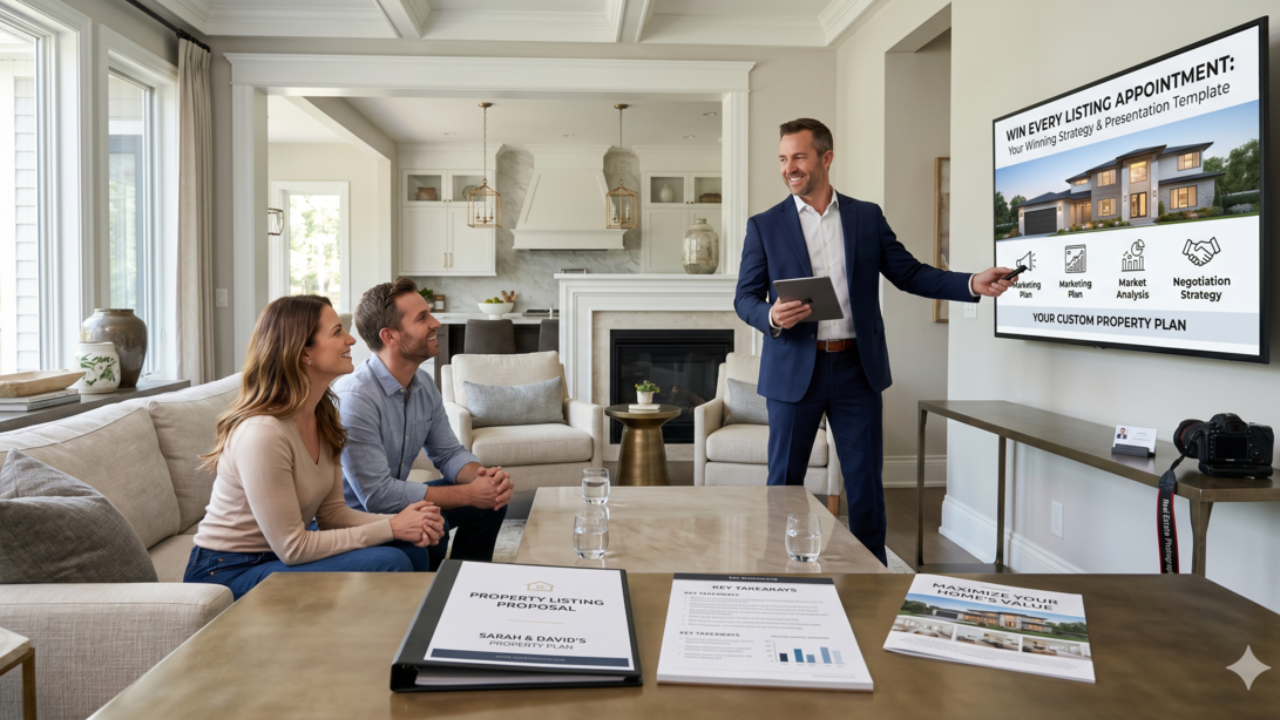
Last quarter I sat down at a kitchen table in Vienna, Virginia, across from a couple who had already interviewed two other agents. Both pitched 6%. Both showed up with a laptop and a slide deck. I walked in with a printed pre-listing book, a one-page net sheet, and a 12-month neighborhood activity report. Forty-two minutes later they signed at my asking commission. The other agents had given them a sales pitch. I gave them a plan. That's the entire difference between losing listings and winning them — and it's exactly what this template will do for you.
Here's the brutal stat most agents have never heard: 59% of sellers hire the very first agent they contact. Not the cheapest. Not the most experienced. Not the one with the slickest brochure. The first one through the door — assuming that agent shows up prepared. The other 41% choose whoever delivered the clearest, most credible plan in the room. If you don't have a repeatable listing presentation template, you're flipping a coin every time you pull into a driveway.
I'm Saad Jamil, founder of Jamil Academy. I've closed over $500M in volume and 900+ homes in NoVA over the last decade — and I still actively sell today. The listing presentation template in this guide isn't theory I pulled from a coaching book. It's the same one my team and I use this month.
In the next 13 minutes you'll get the full 7-section structure, the opening script that builds trust in the first five minutes, how to handle the price objection without flinching, what to send before you arrive, and a 30-day plan to roll the whole system into your business. By the end you'll never walk into a listing appointment underprepared again.
How long should a listing presentation be?
The 7 sections of a winning listing presentation
What to say in the first 5 minutes
How to handle the price objection
The pre-listing package: what to send before you arrive
How to ask for the signature
7 mistakes that cost you the listing
Listing presentation vs. seller pre-qualification
Frequently asked questions
Why the listing presentation still wins listings in 2026
The listing presentation is still the single highest-leverage hour in a real estate agent's week. 59% of sellers hire the first agent they contact, sellers rank "compelling marketing" as their #1 priority at 22%, and "competitive pricing" at 20%. A structured presentation that addresses both — in that order — converts at 60–80% in my market. A pitch that doesn't, converts under 30%.
Most agents quietly believe the listing presentation is dying. They've watched Zillow, Opendoor, and iBuyer ads convince sellers they don't need an agent at all. They've heard sellers ask "can't I just sign electronically?" and assumed the in-home appointment is becoming optional.
It's not. Post-NAR settlement, with mandatory written buyer-agent agreements and increased pricing scrutiny on commissions, sellers are more careful about who they hire — not less. They want to see the plan. They want to feel the agent. They want a reason to pay 5.7% in 2026 commission instead of trying to negotiate it down or going to a discount broker. The listing appointment is where that reason gets delivered. An agent who can't present can't justify their fee.
Here's what NAR research and Zillow's most recent seller survey both confirm: the top three things sellers want from an agent are compelling marketing (22%), competitive pricing strategy (20%), and a fast, clear timeline (18%). 78% specifically expect high-resolution photography, and 75% expect virtual tours or floor plans. Your listing presentation has to address all three priorities in the first 30 minutes — or the seller starts mentally drifting toward the next agent on their list.
How long should a listing presentation be?
A modern listing presentation should run 35 to 50 minutes total. Plan 10 minutes of seller discovery, 20 to 25 minutes of marketing plan and pricing strategy, and 5 to 10 minutes for the close and paperwork. Anything over 60 minutes loses the seller's attention. Anything under 30 minutes feels rushed and undercooked.
The single biggest mistake new agents make is treating the listing presentation as a 90-minute monologue. They build a 60-slide deck, talk about themselves for 25 minutes, then wonder why the seller "needs to think about it." Sellers don't have 90 minutes of attention for anyone. They have about 45.
Here's the time allocation I run on every listing appointment in my market:
Notice what's missing: no 15-minute "about me" section. Your bio belongs in the pre-listing package the seller already read. The room is for them, not you. The agents I coach who shave their presentation from 75 minutes down to 45 see their close rate jump 20–30 points almost immediately. Less is more — assuming the less is the right less.
The 7 sections of a winning listing presentation
Every winning listing presentation includes seven sections in this exact order: discovery questions, market context, the comparable market analysis, the marketing plan, the pricing strategy, the seller net sheet, and the close. Skip any one and you create an opening for the next agent the seller meets to fill the gap.
A listing presentation isn't a slide deck. It's a conversation that follows a structure. Here's the template I've used to win 800+ listings — modify the order to fit your style, but don't drop a section. Each one solves a specific objection that costs you the listing if you skip it.
Discovery Questions
Walk the home. Ask why they're moving, when they need to be out, what they hope to net, and what they liked about the last agent they hired (or didn't). The seller does 80% of the talking. Everything you say after this is shaped by what you heard here.
Market Context
Hyperlocal data on the last 6 months in their zip code: average days on market, list-to-sale ratios, current inventory, recent price reductions. This isn't filler — it frames every pricing recommendation that comes next. Without this section, your CMA looks arbitrary.
Comparable Market Analysis (CMA)
Three actives, three under-contracts, three solds in the past 90 days within a half-mile. Walk through what makes each comp comparable or not. Never just hand them a stack of comp sheets. If you don't narrate the data, the seller picks the highest number on the page and assumes that's their home.
Marketing Plan
Sellers ranked marketing as their #1 priority for a reason — it's the section every other agent breezes past. Spend the most time here. Walk through professional photography (78% expect this), video tours (drives 403% more inquiries), drone shots, twilight photography (76% more views), MLS syndication, paid social, broker tours, and your open house cadence. Show them samples. Make it tangible.
Pricing Strategy
Recommend a price band — a low, a target, and a stretch — instead of a single number. Explain the consequences of each: speed of sale, likelihood of price reduction, buyer pool size. This frames pricing as a strategy decision, not a debate over your number vs. theirs.
Seller Net Sheet
A printed one-page sheet showing what they'll net at each price band, after commission, mortgage payoff, settlement fees, and any seller credits or buyer-agent compensation. This is where commission objections quietly die — when sellers see the actual dollar amount they're walking away with, "your fee is too high" stops being the conversation.
The Close
Don't ask if they want to think about it. Don't pack up your laptop and say "let me know." Pull out the listing agreement and ask: "Where would you like me to start the marketing — at the target price or the stretch price?" Assume the close. Sellers who said yes mentally need a path to the signature, and you're the one holding the pen.
What to say in the first 5 minutes
The first 5 minutes of a listing presentation should be entirely about the seller. Greet them, ask to be shown the home, and use four motivation questions: why are you moving, when do you need to be out, what would have to happen for this to feel like a win, and what worried you about hiring an agent. You're not pitching yet. You're listening.
Here's the actual opening I use, almost verbatim:
"Thanks for having me over. Before I show you anything I prepared, I'd love for you to walk me through the home — the way you'd show it to a friend who's never been here. Then I'll ask you four quick questions, and then we'll sit down and I'll share what I think the right strategy is for this house. Sound good?"
[After the walkthrough, sit down at the kitchen table and ask:]
The four questions I ask, in order:
- Why are you thinking about selling? (Reveals motivation — relocation, downsizing, divorce, equity play)
- When do you need to be in your next place? (Reveals timeline urgency)
- What would have to happen for the next 60 days to feel like a complete win? (Reveals the actual definition of success — usually a price + timeline combination)
- What's the one thing that worried you about picking the wrong agent? (Reveals the objection you have to handle before they even raise it)
Question four is the gold one. Most agents never ask. The answer they get is the exact reason the listing eventually goes to a competitor — communication gaps, hidden fees, surprise price reductions, photos that didn't show up. If they tell you the worry, you can address it directly in your marketing plan section. If you don't ask, you find out later why you didn't get the listing.
Not ready to overhaul your full presentation? Start with the free Real Estate Kickstart eBook.
The exact playbook I give every new agent who joins my team — the systems, scripts, and lead-generation foundations that turn licensed agents into producers. Includes the listing-appointment fundamentals every agent needs before their first sit-down. No credit card. 100% free download.
GET MY FREE E-BOOKHow to handle the price objection
When a seller pushes back on price, never argue your number. Instead, walk them through the cost of overpricing using three real comparable homes that overpriced, sat on market, and sold for less than their original list. The data does the convincing — your job is to narrate it without ego.
The price objection is where most listing presentations die. The seller says "I think it's worth $850K" and the agent who pitched $799K either backs down (loses credibility) or digs in (loses rapport). Both are losing moves. There's a third option that wins almost every time: let the data do the disagreeing.
Here's the script I use when a seller pushes back:
"I hear you — and I want to make sure we list at the right number. So let me show you what's happened in this neighborhood over the last 12 months when sellers started higher than the data supported. These three homes all listed within $50K of where you'd like to start. Look at how long each one sat, how many price reductions they took, and what they finally closed at."
"My job isn't to talk you out of a number. My job is to make sure you don't lose $40K to a stale listing. So before we lock in a price — which one of these patterns do you want yours to follow?"
This works because you're not fighting the seller. You're handing them three real-world examples and letting them decide. 92% of the time, they pick your number on their own — because they don't want to be the fourth name on the list of overpriced homes that sat for 90+ days. And in the 8% of cases where they still want to test the higher price, you've earned the right to set a 14-day check-in for the first price reduction.
The pre-listing package: what to send before you arrive
A pre-listing package is materials sent 24 to 48 hours before the appointment so the seller arrives prepared, not skeptical. Include a personalized welcome video, your bio with recent sales, three local case studies, the buyer-agent compensation explanation post-NAR settlement, and a one-page meeting agenda. Sellers who pre-read close 30 to 40% faster in the room.
Most agents walk into listing appointments cold — the seller knows their name and that's about it. The result: the first 20 minutes get burned on credibility-building that should have happened before you arrived. The pre-listing package is how you turn a 75-minute appointment into a 45-minute close.
Here's exactly what goes in mine, sent via email 24–48 hours before the appointment:
Personal welcome video
90-second BombBomb or Loom recording. Greet them by name, reference the property address, and tease one thing you're excited to walk through.
Two-page bio
Recent sales with prices, neighborhood expertise, your team structure, and 3–5 testimonials. Front-loads credibility so you don't have to talk about yourself in the room.
3 local case studies
Recent sales within a half-mile, with photos, timelines, and outcomes. Show them what your marketing actually produced for similar homes.
NAR settlement explainer
One page on how buyer-agent compensation works post-Aug 2024. Sellers are confused about this. Explaining it before the meeting earns trust before you arrive.
Meeting agenda
A one-page agenda showing the four phases (discovery, marketing, pricing, close) and the time you'll spend on each. Sets expectations and prevents the meeting from running long.
Pre-meeting questionnaire
5 short questions: timeline, target net, must-haves in next home, recent improvements made, and any liens or HOA dues. Lets you arrive with answers, not questions.
A seller who reviewed your pre-listing package walks into the appointment already 70% sold. You're not pitching anymore — you're confirming. The agents I coach who add a real pre-listing package to their workflow report close rates jumping from the high 30s to the high 60s within 60 days. It's the single highest-leverage change you can make this month.
How to ask for the signature
Never ask "would you like to think about it?" Instead, use the assumptive close: pull out the listing agreement, set it on the table, and say "where would you like me to start the marketing — at the target price or the stretch price?" The seller's brain shifts from "should I list?" to "which option do I prefer?" — and the answer to either is yes.
"Let me know what you decide" might be the four most expensive words in real estate. Sellers who walk away to "think about it" disappear into the next agent's funnel — usually whoever calls them first the next morning. The close isn't aggressive. It's professional. If you don't ask for the signature, you're outsourcing the close to your competition.
Here are three closing scripts I rotate depending on the seller's energy in the room:
"Based on what you shared about your timeline, I'd recommend listing at the target price next Thursday so we capture the spring buyer pool. Where would you like me to send the photographer first — kitchen or primary bedroom?"
"Everything I just walked through — does that feel like the plan you want running for your sale? If yes, let's get the agreement signed and I'll have the photographer here Tuesday."
"That's smart — picking the wrong agent is an expensive mistake. Here's what I'd ask the next person you meet: how many homes have they sold in this exact zip code in the last 12 months, what's their average days-on-market, and can they show you their marketing samples on the spot? If their answers feel weaker than mine, I'd love to be the one helping you sell."
The reframe close is the one I use most often when a seller wants to talk to other agents. It positions you as confident, not desperate, and arms the seller with questions that — if they ask other agents — will almost certainly send them back to you. I've had sellers cancel their next two interviews and sign on the spot because of that single line about marketing samples. Most agents can't show them anything specific.
The listing presentation is one piece. The Top Realtor Playbook is the whole system.
A great listing presentation only matters if you have appointments to run. The Top Realtor Playbook walks you through the same 4-module system I've used to close 900+ homes: Operational Excellence, Script Mastery, Lead Generation Secrets, and Marketing Mastery. Includes the full listing-presentation template, downloadable scripts, lifetime access, and a 14-day money-back guarantee.
Explore the Top Realtor Playbook →7 mistakes that cost you the listing
I've debriefed hundreds of lost listings — both my own and agents I've coached. The reasons rhyme. Read these before your next appointment, not after you've blown another one wondering why the seller went with someone else.
Talking about yourself for 20 minutes
The seller doesn't care about your awards. Cut the bio section. Put it in the pre-listing package.
Showing up without a CMA
"I'll send you pricing tomorrow" loses the listing 90% of the time. Pricing is the room.
No marketing samples
Sellers want to see your photos, video, and floor plans — not hear about them. Bring printed samples.
Caving on commission
If you discount the moment they push, you confirm your fee was negotiable. Anchor with the net sheet.
Ignoring NAR settlement questions
Sellers are confused about buyer-agent compensation. Address it before they ask, with a clear one-pager.
Not asking for the signature
"Let me know" is how you donate listings to your competition. Always close in the room.
No follow-up after a soft "no"
Sellers who pick another agent often regret it within 30 days. Send a check-in note at day 14. Listings switch.
Know your real take-home before you walk into the next listing presentation.
Confidence in the room comes from knowing your numbers cold. The Commission Split Calculator shows you exactly what you'll net from any deal — after brokerage split, fees, and caps. Use it to build accurate net sheets for sellers, and to know your own margin before you decide what's negotiable on commission.
Calculate Your Real Take-Home →Listing presentation vs. seller pre-qualification
A pre-qualification call happens before the listing appointment to confirm the seller is ready, motivated, and has realistic expectations. The listing presentation is the in-home meeting where you walk through pricing, marketing, and contracts. Skipping pre-qualification means showing up to homes that aren't actually for sale — wasting an hour you could have spent with a serious seller.
The agents who run their schedules best don't take every listing appointment that comes their way. They pre-qualify on a 15-minute phone call first. The math is simple: an unqualified appointment costs you 90 minutes of drive time + 60 minutes of presentation = 2.5 hours you could have spent on a real lead.
My pre-qual call is five questions: when do you want to be sold by, where are you moving next, what do you owe on the home, what price are you hoping to get, and have you spoken to other agents yet? If any answer is "I'm not really sure," I push the appointment two weeks until they figure it out. Showing up to "I'm just thinking about it" is how new agents burn 80 hours a quarter on appointments that were never going to close.
Your 30-day implementation plan
If you've read this far, you're not the agent who's going to forget this in a week. So here's exactly what to do in the next 30 days — no overthinking required.
- Week 1: Build your pre-listing package — bio, two-page case studies of three recent sales, NAR settlement explainer, agenda, pre-meeting questionnaire. Use Canva or any template platform.
- Week 2: Build the listing presentation deck or printed book in the 7-section structure above. Cap it at 25 slides. Run through it out loud three times.
- Week 3: Implement the 15-minute pre-qualification call for every new seller lead. Script the five questions. No pre-qual = no in-home appointment.
- Week 4: Run your next two listing appointments using the full template, including the assumptive close. Track your conversion rate before and after.
Then the hard part: do this exact same routine for the next 12 months. The agents I coach who hold the line on the template see their listing-appointment-to-signed-agreement conversion jump from 35–45% to 65–80% by month three. The ones who freelance the structure stay flat. Discipline beats talent in this business — and the listing presentation is where it pays off most.
Written by Saad Jamil — Founder of Jamil Academy and Top 1% Realtor nationwide with $500M+ in career sales and 900+ homes closed in Northern Virginia. Saad shares the exact systems he uses daily to help agents become top producers. View Saad's Zillow profile →
Need More Listing Appointments to Run? Start Here.
A great listing presentation only matters if you have appointments on the calendar. The LeadFlow Activation System gives you the seller outreach templates, scripts, and tracker my team uses to fill our calendar with listing appointments — without cold calling, paid leads, or fancy tech. Used by agents across the country. Yours for $7.
Get the LeadFlow System — $7Instant access. Actionable in under 30 minutes.
Frequently asked questions
How long should a listing presentation be?
A modern listing presentation should run 35 to 50 minutes total — 10 minutes of seller discovery, 20 to 25 minutes of marketing plan and pricing strategy, and 5 to 10 minutes for the close and paperwork. Anything over 60 minutes loses the seller's attention. Anything under 30 minutes feels rushed and undercooked.
Should I bring a printed listing presentation or use a tablet?
Use a tablet or laptop as the primary visual, and leave a printed leave-behind that summarizes pricing strategy, marketing plan, and net-sheet numbers. Sellers want the digital experience during the meeting and a physical document to reference after you leave. Doing only one or the other costs listings.
What should I send before the listing appointment?
Send a pre-listing package 24 to 48 hours before the appointment. Include a personalized welcome video, your bio with recent sales, three local case studies, the buyer-agent compensation explanation post-NAR settlement, and a one-page agenda. Sellers who review materials in advance close 30 to 40% faster in the room.
How do I handle the "I want to interview other agents" objection?
Acknowledge it, then reframe. Say: "I'd want you to interview other agents — picking the wrong one is an expensive mistake. But 59% of sellers hire the first agent they meet, and most of the rest hire whoever was most prepared. Can we walk through the plan together so when you compare, you know exactly what to ask the next person?" This handles the objection without pressure.
What's the difference between a listing presentation and a pre-qualification call?
A pre-qualification call happens before the listing appointment to confirm the seller is ready, motivated, and has realistic expectations. The listing presentation is the in-home meeting where you walk through pricing, marketing, and contracts. Skipping pre-qualification means showing up to homes that aren't actually for sale — wasting an hour you could have spent with a serious seller.
Free: 5 Ways to Get More Listings Without Cold Calling
Five lead strategies that work without cold calls or ad spend, from an agent with $500M sold and 900+ homes closed.
No spam. Unsubscribe any time.
Your Coach