Door Knocking Scripts: What to Say When You Knock to Get Listings
Apr 29, 2026Door Knocking Scripts (2026): What to Say When You Knock to Get Listings
The exact words I use at the door — and the ones I tell my agents to never say. Eleven scripts, four objection rebuttals, and the 12-week cadence that turns conversations into listing appointments.
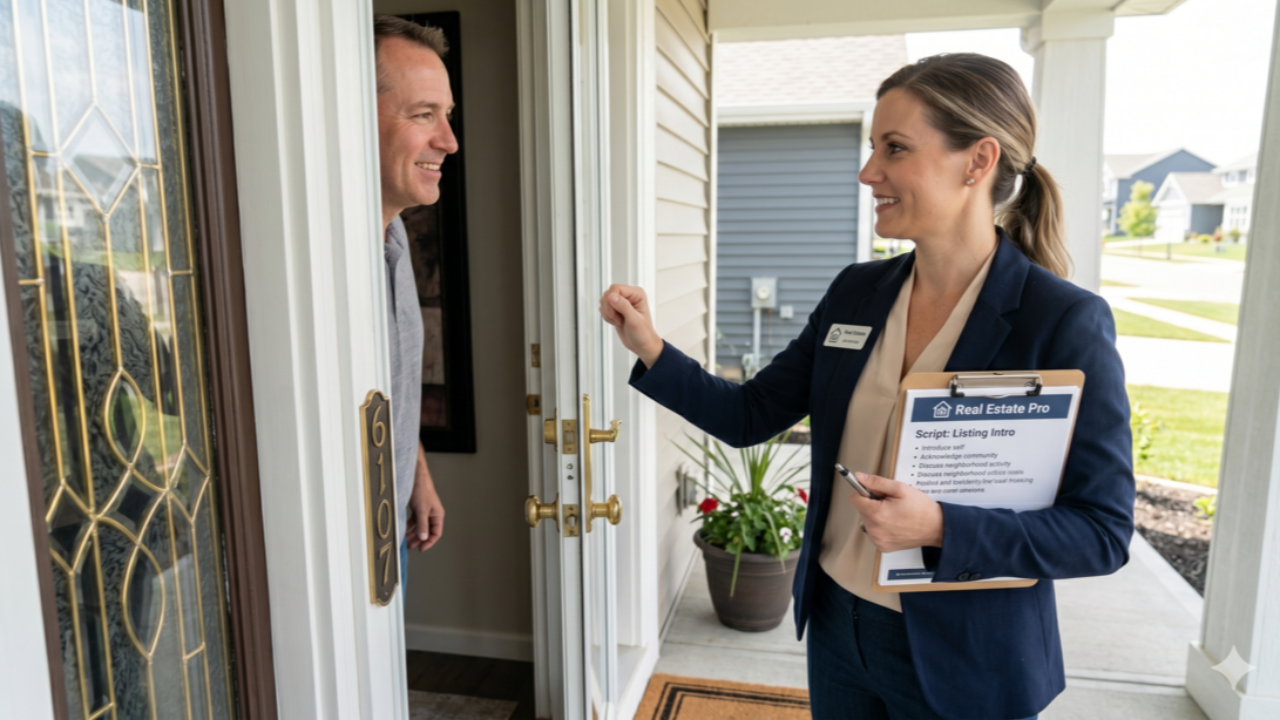
I knocked on a door in Reston three Septembers ago. The owner cracked it three inches, told me she wasn't selling, and shut it. I left a door hanger. Twenty-two months later she called me — her father had passed, she was inheriting his house in Loudoun, and the only agent's name she remembered was the guy who'd shown up in person when no one else did. That phone call closed at $1.4M. Total cost of the original knock: a printed door hanger and twelve minutes of walking.
Every agent I coach asks me the same thing: "Does door knocking actually work, or am I just going to embarrass myself?" Then they tell me about the $1,500 a month they're burning on Zillow leads who don't pick up the phone. Three CRMs. Two failed Facebook campaigns. Nothing's converting.
My answer: door knocking still works. It's just done badly by 97% of agents — only 3% of agents consistently knock despite its proven response rate. The ones who do it right knock to have a conversation, not to win a listing on the welcome mat. They use real scripts. They follow up. They show up again. And in suburban farms with the right setup, roughly 1 in every 50 doors generates a lead, and roughly 2% of conversations turn into listing appointments — multiples better than cold calling at scale.
I'm Saad Jamil, founder of Jamil Academy. I've closed over $500M in volume and 900+ homes in Northern Virginia, and I still actively sell today. Door knocking has been part of my prospecting mix from year one — and the scripts in this guide are the exact ones I use, not theory pulled from a 2008 book.
In the next 14 minutes I'll give you the eleven scripts I rotate, how to handle the four objections you'll hear most, the time of day that actually produces conversations, the follow-up cadence that turns "not selling right now" into a listing appointment, and the mistakes that quietly kill 90% of door-knocking campaigns. By the end you'll have a system you can launch this Saturday.
The 5 golden rules of door knocking that actually work
11 door knocking scripts (word-for-word)
How to handle the 4 objections you'll hear most
How to pick the right neighborhood to knock
When to knock (the day and hour that actually work)
What to leave behind on every door
The 30-day follow-up cadence after the knock
7 mistakes that kill your door knocking ROI
Your 30-day door knocking launch plan
Frequently asked questions
Does door knocking still work in 2026?
Yes — door knocking still works in 2026 because almost no one does it. Roughly 20% of doors lead to a real conversation, around 2% of conversations convert to a listing appointment, and only 3% of agents do it consistently. That's why agents who knock 100+ doors a week see a measurable lift in listing appointments compared to digital-only agents.
Walk through any neighborhood in your market on a Saturday morning. Count how many real estate agents you see actually knocking on doors. The answer is almost always zero. That vacuum is the entire opportunity. Homeowners are getting flooded with the same templated Instagram Reels, AI-generated postcards, and Facebook ads from every agent in your zip code. Their inbox is destroyed. Their feed is noise. The one place no one is showing up — physically, in person, with real eye contact — is the doorstep.
The numbers are real. About 1 in every 5 door knocks results in a meaningful conversation, and roughly 1 in every 50 door knocks ultimately produces a lead. That sounds small until you do the math: knock 200 doors a week and you'll have 4 active leads in your pipeline within 14 days. Stack that for 12 weeks and you're sitting on a working seller pipeline. None of which costs you per click.
Here's what changed and what didn't. What changed: digital saturation made the inbox and the feed essentially unwinnable for new agents. What didn't change: human beings still trust the agent whose face they recognized at their door over the agent whose Instagram ad they swiped past. That trust gap is widening, not shrinking. The agents quietly winning Northern Virginia listings in 2026 aren't the loudest on social. They're the ones I keep seeing in the same farms, on the same Saturday mornings, knocking the same blocks.
The 5 golden rules of door knocking that actually work
Before any script works, five rules have to be in place: knock to start a conversation (not close a deal), have a specific reason for being there, lead with a question — never a pitch, leave something behind on every single door, and follow up within 24 hours. Get these wrong and the best script in the world won't save you.
Most of the bad door knocking advice on the internet skips straight to scripts. That's why most agents fail. The script doesn't matter if the foundation is wrong. Read these five rules before you knock a single door — they'll do more for your conversion rate than memorizing the perfect line.
Your goal is a conversation, not a contract
Listings are never signed on a welcome mat. The job at the door is to plant a seed: get a name, get permission to follow up, and leave a brand impression. Agents who pitch on the doorstep get doors slammed. Agents who ask one good question and listen get invited back.
Have a specific reason for being there
"I was just in the area" is a wasted opener. Use a specific anchor every single time: a just-sold down the street, a market update for the zip code, an open house this weekend, a homeowner survey. The anchor is what makes you a neighbor with information, not a stranger with a pitch.
Lead with a question, never a pitch
A question puts the homeowner in control and lowers their defense. A pitch raises it. Every single one of the eleven scripts below opens with a question for that exact reason. The first 5 seconds at the door decide whether the conversation continues or ends — questions buy you those 5 seconds.
Always leave something behind
Roughly 60-80% of homes won't answer. That's not a failure — that's still 60-80% of the doors you're branding. Leave a door hanger or flyer on every single one. Agents who only "count" answered doors are throwing away the majority of their effort. The hanger is what closes the loop when the door doesn't open.
Follow up within 24 hours, then for 12 months
Roughly 80% of real estate sales require five or more follow-up contacts after the initial conversation. The agent who knocks once and never circles back is invisible by month three. The agent who knocks, mails, texts, and shows up at the next neighborhood event is the one whose name comes up at the kitchen table when it's time to sell.
11 door knocking scripts (word-for-word)
The eleven door knocking scripts that work in 2026 are: just-sold script, just-listed script, market update script, FSBO conversion script, expired listing script, open-house invite script, neighborhood survey script, equity-check script, value-add script, absentee owner script, and the no-soliciting-sign script. Use them as starters, not word-for-word recitations — read the door, then pick the script.
Scripts give you a foundation, not a cage. The agents I coach who do well at the door treat these like jazz — they know the melody so well they can improvise without losing the structure. Memorize them, then say them like you'd say them to a neighbor across the fence.
The Just-Sold Script
"Hi, I'm Saad with Samson Properties — I'm not sure if you saw, but I just helped sell the house at 1234 Maple Lane in 6 days for $42,000 over asking. We had three other neighbors come out of the woodwork curious about their own home values, so I wanted to swing by yours too. Have you ever thought about what your home would sell for in this market?"
Why it works: Specific numbers (6 days, $42K over) create instant credibility. The "three neighbors" framing gives social proof. The closing question is open-ended — they can say no without slamming the door.
The Just-Listed Script
"Hey there — I'm Saad, your local agent. I just listed the home at 567 Oak Court for $865K and I'm expecting a lot of buyer foot traffic this weekend. I wanted to give the immediate neighbors a heads-up in case parking gets tight, and ask — do you know anyone thinking about moving into the neighborhood? Sometimes the best buyer is a friend or family member of someone who already lives here."
Why it works: You're not asking them to sell — you're asking for a referral, which is a much lower-pressure ask. You also plant the seed that you have buyers actively searching their neighborhood.
The Market Update Script
"Hi, I'm Saad — I publish a quarterly market report for [neighborhood name]. Homes here sold 4 days faster on average this quarter than last, and the median sale price is up 6.2%. I'm dropping off this one-pager to homeowners on this block. Did you want a copy, or do you already have an agent who keeps you updated on numbers like this?"
Why it works: You're delivering value, not asking for value. The closing question quietly qualifies whether they have an existing agent relationship — and almost no one says "yes" because most homeowners don't have a current agent.
The FSBO Script
"Hi — I noticed your For Sale by Owner sign and I just wanted to introduce myself. I'm Saad, and I sell homes in this neighborhood. I'm not here to convince you to list with me. But if you ever have a buyer who needs financing help or you run into a low appraisal, I'd be happy to be a resource. Mind if I drop my card and a one-page seller's checklist on what most FSBOs miss at closing?"
Why it works: Most FSBOs are getting hammered by agents trying to convert them. By openly NOT pitching, you separate yourself instantly. The "checklist" gives them a reason to take your card. About 87% of FSBOs end up listing with an agent eventually — your job is to be the agent they already know.
The Expired Listing Script
"Hi, I'm Saad. I noticed your home was on the market and is no longer listed — I want to be upfront that I'm a real estate agent. I'm not here to pitch you. I work with sellers whose homes didn't sell the first time around, and the pattern I see most often is one of three things: pricing, photos, or marketing. If you ever want a free outside opinion on which one was the issue for your home, I'd be happy to do that — no obligation, no listing pitch. Mind if I leave my card and a one-page guide?"
Why it works: Expired sellers are tired of being hunted. Naming the elephant in the room ("I'm an agent, I'm not pitching you") is what separates you from the 30 other agents calling them. Then you offer a diagnostic, not a service.
The Open House Invite Script
"Hey, I'm Saad — I'm hosting an open house this Saturday at 432 Birch Drive from 1-3pm. Most of the buyers walking through are going to ask me about other homes nearby that might come on the market. I wanted to swing by the neighbors first and ask if you've thought about moving — even casually — so if a buyer asks, I can mention it. Either way, you're welcome to swing by Saturday and check out the listing."
Why it works: You give them a reason to be flattered (you came to them first) and a low-stakes way to engage (just stop by). This script also doubles as social proof — they now know you're listing real homes in their area.
The Neighborhood Survey Script
"Hi — I'm Saad, a local agent. I'm doing a quick 90-second neighborhood survey: I'm asking what people love most about living here, and what they'd change if they could. The reason I ask is so I can speak to it accurately when I talk to buyers thinking about moving in. Got 90 seconds for me?"
Why it works: You're asking for their opinion, not their business. Roughly 25% of homeowners report feeling lonely and welcome a brief friendly conversation — this script invites exactly that. You also walk away with intel you can use in marketing for years.
The Equity Check Script
"Hi, I'm Saad with Samson Properties. Most homeowners on this block have gained around $97,000 in equity over the past three years — and most don't know it because Zillow estimates can be off by 10-15%. I do free, no-pressure home value reports for homeowners on this street. It takes about 6 minutes and you don't have to be planning to sell. Want me to put one together for your address?"
Why it works: You're appealing to curiosity, not transaction intent. Almost everyone wants to know what their home is worth. The "no pressure / not planning to sell" framing kills the wall they were building when they opened the door.
The Value-Add Script
"Hey, I'm Saad — I'm dropping off a free fall maintenance checklist to homeowners on this block. It's the same one I give my clients before winter — gutters, HVAC, weather stripping, the things that quietly cost you thousands if you skip them. No pitch. Just here to be useful. Want a copy?"
Why it works: Pure value, zero ask. The agents who win at door knocking aren't the ones with the slickest pitch — they're the ones homeowners actually look forward to seeing. Run this script every season.
The Absentee Owner Script (left at door)
"Hi — I'm Saad, a local agent. I noticed this property is owned by someone who doesn't currently live here. Rentals and inherited homes have one thing in common: rising property taxes, maintenance, and tenant turnover quietly eat into returns. I help owners like you weigh whether selling now beats holding through another tax cycle. If that's a conversation worth having, my number is on the back of this card. No pressure either way."
Why it works: Absentee owners are statistically more likely to sell, but you'll usually be talking to a tenant — not the owner. So the "script" is actually a printed letter or door hanger left for the renter to forward, or mailed directly to the owner's tax-record address.
The "No Soliciting" Sign Script
Don't knock. Leave a door hanger that says: "I respect your no-soliciting sign — that's exactly why I left this hanger and didn't ring your bell. If you ever want a no-pressure home value update, my number's on the back. — Saad"
Why it works: Respecting the sign is itself a brand statement. Roughly 10% of homeowners would report an agent who ignored a no-soliciting sign — that one slip can damage your reputation in the entire neighborhood. The hanger lets you brand without trespassing.
Not ready to knock yet? Start with the free Real Estate Kickstart eBook.
The exact playbook I give every new agent who joins my team — the systems, scripts, and lead-generation foundations that turn licensed agents into producers. No credit card. 100% free download.
GET MY FREE E-BOOKHow to handle the 4 objections you'll hear most
The four objections you'll hear at the door 90% of the time are: "We're not selling," "We already have an agent," "We're not interested," and "How did you get my address?" Each has a one-line rebuttal that keeps the door open without sounding defensive — and the goal is never to overcome the objection, just to leave a friendly impression.
Objections aren't rejections — they're reflexes. Most homeowners say one of these four things automatically the second they realize you're an agent. Your job isn't to argue. Your job is to disarm and exit gracefully so they remember you positively. Here are the four lines I rotate.
"We're not selling."
"Totally understood — most of the homeowners I talk to aren't selling right now. I just leave my card so when you do think about it someday, you've got a local agent in your phone. Mind if I leave my market report too in case you're curious where prices are?"
"We already have an agent."
"Great — that's how it should be. Quick question, do they live in this neighborhood specifically? The reason I ask is I focus only on this zip code, so I sometimes catch local market shifts faster. I'll leave my info just in case you ever need a second opinion. No pressure."
"We're not interested."
"No problem at all, sorry to bother you. Real quick — do you know any neighbors thinking about selling? I'd much rather hear about it from someone on the block than chase the wrong door. Either way, here's my card. Have a great day."
"How did you get my address?"
"Public property records — same way Zillow gets it. I'm only knocking houses on this block today as part of my farm area. Totally fine if you'd rather not be contacted again — just let me know and I'll take you off my list."
How to pick the right neighborhood to knock
A profitable door knocking neighborhood has 250-1,000 homes, at least 6% annual turnover, no incumbent agent (no agent should own more than 20% of listings), and a 70%+ owner-occupied rate. Pick the neighborhood before you knock a single door — the wrong farm cannot be saved by good scripts.
Most agents fail at door knocking before they ever knock — because they pick the wrong neighborhood. They chase the prestigious zip code, the one they wish they lived in, or whatever's closest to their house. Then they knock for a month, see zero results, and quit. The neighborhood does most of the work. Your job is to pick a winner before you start.
Here's the four-part filter I use to evaluate any farm before committing:
- Size: 250 to 1,000 homes. Smaller and you don't get enough at-bats. Larger and you can't physically knock through it on a quarterly cycle.
- Turnover rate: Pull MLS data — total annual sales divided by total homes. You want at least 6%. Anything less and even perfect execution can't generate enough deals.
- Competition: Run MLS data on listing agents over the past 24 months. If one agent has 25%+ of listings, find another farm. They've already won the trust war and you'll spend a year losing it.
- Owner-occupied rate: Aim for 70%+ owner-occupied. Renter-heavy neighborhoods waste your time — renters can't list a home they don't own.
In Northern Virginia I've watched agents try to door-knock 5,000-home zip codes and quit in three months because the math collapsed. Meanwhile a friend on my team picked a 480-home neighborhood with 8% turnover, no incumbent, and a $740K average sale price. By month 14, he was the recognized agent in the neighborhood and had closed five listings there. The neighborhood he picked did most of the work — he just had to keep showing up.
When to knock (the day and hour that actually work)
The two highest-response windows for door knocking are Saturday mornings between 10 AM and 12 PM (about 35% answer rate) and weekday evenings between 4:30 PM and 6:30 PM. Avoid weekday mornings, dinner hours after 7 PM, and Sunday mornings. Knock 100-200 doors per session for the cleanest weekly cadence.
Time of day is one of the biggest variables nobody talks about. Knock the wrong neighborhood at the wrong hour and you'll burn through 200 doors talking to nobody. Knock the same neighborhood at the right hour and you'll have 20-25 real conversations from the same effort. Here's the cadence I run:
My rule: Saturday mornings are non-negotiable. One Saturday session of 200 doors will produce roughly 40 conversations, 4-8 leads, and within 90 days, 1-2 listing appointments. That's a single morning per week. Block the calendar.
What to leave behind on every door
Always leave a door hanger or printed flyer on every door — answered or not. The leave-behind should include your name, photo, phone number, a QR code, and one specific value piece (market report, just-sold sticker, or seasonal checklist). Roughly 60-80% of homes won't open the door, so the hanger is doing the majority of the brand work.
Most agents only count the doors that opened. That's the wrong scoreboard. Every door you knock is a touch — answered or not. The leave-behind closes the loop on the unanswered ones.
Here's what should be on every single piece you leave behind:
Your photo
Small, professional, consistent across every piece for 12+ months. Face recognition is the entire game.
A specific number
"Just sold for $42K over asking." "Median price up 6.2%." Specific beats generic 100% of the time.
One CTA — only one
"Scan for your home value" or "Text VALUE to my number." Multiple CTAs = zero CTAs.
QR code with UTM tracking
Goes to a campaign-specific landing page so you can track which neighborhoods convert.
Trackable phone number
A dedicated phone (Google Voice or CallRail) so you know which calls came from door knocking vs. other channels.
A piece of value
Market report, fall maintenance checklist, school rankings, or local restaurant guide. Useful = saved. Saved = remembered.
Door knocking is one channel. The Top Realtor Playbook is the whole system.
Door knocking works best when it's plugged into a complete operation — lead generation, scripts, follow-up cadence, and marketing across every channel. The Top Realtor Playbook walks you through the same 4-module system I've used to close 900+ homes: Operational Excellence, Script Mastery, Lead Generation Secrets, and Marketing Mastery. Lifetime access, downloadable templates, and a 14-day money-back guarantee.
Explore the Top Realtor Playbook →The 30-day follow-up cadence after the knock
After a meaningful door knock conversation, follow up within 24 hours with a personalized handwritten note, add the contact to your CRM with a "door knock" source tag, send a value email at day 7, a market update postcard at day 14, and a check-in text at day 30. Listings happen at month 6-18, not week 2 — the cadence is what makes the seed sprout.
The agent who knocks once and never circles back is invisible by month three. About 80% of real estate sales require five or more follow-up contacts after the first conversation — the data is consistent on this. Here's the cadence I run my team on after every door knock conversation:
- →Day 0 (same day): Log every conversation in your CRM with full notes, address, name, and any personal details mentioned. Tag the source as "Door Knock" — this is non-negotiable.
- →Day 1 (within 24 hours): Handwritten thank-you note mailed to the address. Short — 3 sentences. Reference something specific from the conversation. This single touch alone separates you from 99% of agents.
- →Day 7: Email or text with the home value report you promised, or a relevant market data point.
- →Day 14: Postcard mailed with a just-sold or just-listed in their neighborhood. Reinforces local expertise.
- →Day 30: Check-in text. "Hey, [Name] — Saad here, we chatted at your door a few weeks back. Saw a home down the street go under contract — wanted to share the comp in case it's useful. No need to reply unless you want it."
- →Months 2-12: Monthly market report mailer or email. Quarterly value-add (recipe, contractor referral, seasonal checklist). This becomes your farming cadence.
Know what you'll actually net from every listing you win.
Door knocking pays off in listings — but the real number that matters is your take-home after splits, fees, and caps. Use the Commission Split Calculator to see exactly what each closing puts in your pocket so you can budget your prospecting effort against your actual net.
Calculate Your Real Take-Home →7 mistakes that kill your door knocking ROI
I've watched dozens of agents start door knocking and quit. The reasons rhyme. Read these before you knock your first door — not after you've burned through three Saturdays wondering why nothing converted.
Quitting after 2-3 sessions
It takes 5+ touches before recognition kicks in. Two Saturdays isn't a campaign — that's barely a warm-up.
Pitching on the doorstep
Listings aren't won at the welcome mat. Pitching gets the door slammed. Conversations get the second meeting.
Skipping the leave-behind
60-80% of doors don't open. If you don't leave anything, that's 60-80% of your effort wasted. Always leave something.
No follow-up system
Knocking without a CRM and a follow-up cadence is throwing every conversation in the trash. The follow-up is where the listings live.
Picking the wrong neighborhood
Wrong size, low turnover, or an incumbent agent who already owns 30% of listings — three reasons to knock somewhere else.
Wrong day, wrong hour
Tuesday 11 AM is empty homes. Saturday 10 AM is gold. Wrong window = wasted Saturday.
Reading the script verbatim
Memorize the script, then say it like a neighbor. Robotic recitation triggers the "I'm being sold to" alarm in 3 seconds flat.
Your 30-day door knocking launch plan
If you've read this far, you're not the agent who's going to forget this in a week. So here's exactly what to do in the next 30 days — no overthinking, no perfectionism, just execution.
- Week 1: Pick a 400-700 home neighborhood using the four-part filter (size, turnover, no incumbent, owner-occupied). Pull MLS data on listing agents over the past 24 months to verify no one owns 25%+ of listings. Drive the neighborhood once — get a feel for the streets.
- Week 2: Order door hangers (Wise Pelican, Vistaprint, or local printer), set up a tracking phone number, build a basic landing page for QR code scans, and create a CRM source tag for "Door Knock." Memorize three of the eleven scripts above.
- Week 3: Knock your first 100-200 doors on a Saturday morning (10 AM – 12 PM). Goal: 4-8 conversations. Don't worry about leads — focus on getting comfortable. Leave a hanger on every single door.
- Week 4: Run your follow-up cadence on every conversation from Week 3. Knock 200 more doors. Set a recurring Saturday 10 AM – 12 PM block on your calendar for the next 12 months. Don't move it.
Then the hard part: do it for 12 months without quitting. Most agents won't. The ones who do will own the neighborhood by next year.
Written by Saad Jamil — Founder of Jamil Academy and Top 1% Realtor nationwide with $500M+ in career sales and 900+ homes closed in Northern Virginia. Saad shares the exact systems he uses daily to help agents become top producers. View Saad's Zillow profile →
© 2026 Jamil Academy. All rights reserved. Content is educational and reflects current real estate prospecting practices. Always check local solicitation laws and HOA rules before door knocking. Respect "no soliciting" signs at all times.
Ready to Build a Complete Lead System — Not Just Door Knocks?
Door knocking gets you in front of homeowners. The LeadFlow Activation System gives you the seller outreach letters, conversation scripts, and lead tracker to convert those conversations into appointments — in under 30 minutes. Used by agents across the country. Yours for $7.
Get the LeadFlow System — $7Instant access. Actionable in under 30 minutes.
Frequently asked questions
Is door knocking still effective for real estate agents in 2026?
Yes. Door knocking is one of the highest-trust prospecting channels available because almost no one does it consistently — only about 3% of agents do. Roughly 20% of doors lead to a real conversation, around 1 in 50 doors generates a lead, and listing appointments build cumulatively over 6-18 months as recognition compounds. The reason most agents say it doesn't work is because they quit after 2-3 sessions, long before the cumulative effect kicks in.
How many doors should I knock to get a listing?
Plan for 100-200 doors per Saturday session over a 12-month period in the same neighborhood. That's roughly 5,000-10,000 total knocks over the year. Industry data consistently shows real estate prospecting takes 5+ touches before recognition begins, and listing appointments typically start landing in months 6-15 as cumulative familiarity builds. Agents who knock 100+ doors per week see a measurable lift in listing appointments compared to digital-only agents.
What's the best opening line when door knocking?
A specific, neighborhood-anchored question — never a pitch. The highest-converting opener references something concrete: "I just helped sell the home at 1234 Maple Lane in 6 days for $42,000 over asking — wanted to swing by yours and ask if you've ever wondered what your home would sell for." Specific numbers + open question + zero pressure = the door stays open long enough for a real conversation.
Is door knocking considered soliciting?
It depends on the local jurisdiction. Many cities and HOAs have specific rules around door-to-door soliciting, and "No Soliciting" signs are sometimes legally enforceable as trespass notices. Always check your local municipal code before launching a campaign, never ignore "No Soliciting" signs, and avoid gated communities or HOAs that explicitly prohibit it. When in doubt, leave a door hanger and don't ring the bell — that's branding, not soliciting.
What should I wear when door knocking?
Dress one notch above the neighborhood's typical Saturday casual — never below, rarely above. In most suburban neighborhoods that means clean jeans or chinos, a branded polo or button-down with your name and brokerage, and comfortable walking shoes. Avoid full suits (looks like you're selling something expensive) and avoid t-shirts and shorts (looks unprofessional). The goal is to look like a competent local professional, not a corporate executive or a door-to-door salesman.
Free: 5 Ways to Get More Listings Without Cold Calling
Five lead strategies that work without cold calls or ad spend, from an agent with $500M sold and 900+ homes closed.
No spam. Unsubscribe any time.
Your Coach