Real Estate Broker vs Agent (2026): Licenses, Pay and What Each Can Do
Oct 15, 2026
A real estate agent, called a salesperson in the laws of Virginia, Maryland, DC and West Virginia, must work under a broker. A broker holds a higher license that lets them run a firm, supervise agents and handle client money.
Getting there takes time. In Virginia you need 36 months of active work as an agent in the last 48, plus 180 hours of broker courses. Maryland asks for 3 years, DC for 2.
Brokers do tend to earn more. The Bureau of Labor Statistics put the median wage at $73,220 for brokers and $52,830 for sales agents in May 2025. Those figures leave out the self-employed, who are more than half of the field.
This guide explains the license types, what each can legally do, the pay data and the path in Virginia, Maryland, DC and West Virginia. Sources were checked on 15 October 2026.
Where I stand: I am a Realtor with Samson Properties in Virginia, and I run Jamil Academy, which sells training to agents. The one product block near the end is my own.
Quick answer
- Agent: a licensed salesperson who must work for, and be paid through, a broker.
- Broker: holds a higher license, can run a firm, supervise agents and be responsible for escrow accounts.
- Associate broker: holds a broker license but works under another broker, like an agent.
- Pay: BLS median wages in May 2025 were $73,220 for brokers and $52,830 for sales agents.
- Path in Virginia: 36 months active in the last 48, 180 hours of broker courses, then the broker exam.
- What is the difference between a real estate broker and an agent?
- Is a Realtor the same as an agent or a broker?
- What are principal, associate and supervising brokers?
- What can a broker do that an agent cannot?
- How is a broker's day different from an agent's?
- How are agents and brokers paid?
- Do brokers earn more than agents?
- How do you become a broker in Virginia, Maryland, DC and West Virginia?
- How long does it take to become a broker in Virginia?
- Is a broker license worth it for you?
- Can you hold a broker license and still work as an agent?
- Should you stay an agent, become an associate broker or open a firm?
- Where do real estate teams fit in?
- Do clients care whether you are a broker or an agent?
- Why do some states call every licensee a broker?
- What extra costs and duties come with a broker license?
- Which should a new licensee aim for first?
- What should you ask before you upgrade your license?
- What I could not verify
- Frequently asked questions
What is the difference between a real estate broker and an agent?
Short answer: a broker can work on their own and supervise others. An agent cannot. Both can list and sell homes.
The BLS puts it simply: "Although brokers and agents do similar work, brokers are licensed to manage their own real estate businesses."
It adds: "Sales agents must work with a real estate broker."
| Agent (salesperson) | Broker | |
|---|---|---|
| Can list, show and sell homes | Yes, for a broker | Yes |
| Must work under a broker | Yes | No, unless working as an associate broker |
| Can open and run a firm | No | Yes |
| Can supervise other licensees | No | Yes |
| Paid directly by clients | No, paid through the broker | The firm is paid, under the broker |
| Responsible for escrow accounts | No | Yes, the principal broker |
Sources: BLS Occupational Outlook Handbook and Virginia's real estate regulations, read 15 October 2026. Details vary by state.
How Virginia law defines each
Virginia's statute defines a broker as a person or business that, "for compensation or valuable consideration," sells, buys, negotiates, leases or rents real estate, or deals in real estate contracts.
It defines a salesperson as someone "employed either directly or indirectly by," or "affiliated as an independent contractor with," a real estate broker to do that work.
Source: Va. Code § 54.1-2100.
My view: for most agents, the day-to-day work does not change much with a broker license. What changes is responsibility, and what you are allowed to run.
Is a Realtor the same as an agent or a broker?
Short answer: neither. Realtor is a membership, not a license. An agent or a broker can be a Realtor.
NAR describes REALTOR® as "a federally registered collective membership mark" for real estate professionals who are members of NAR and subscribe to its Code of Ethics.
So a licensed agent who does not join NAR is still an agent, but cannot use the Realtor name. Your state license decides what you may do. NAR membership decides whether you may call yourself a Realtor.
What NAR members look like
NAR's 2026 Member Profile, based on 2025 data, reported a median gross income of $59,200 for its members. The typical member had 13 years of experience and nine transaction sides.
It also found that 86 percent of members are independent contractors at their firms. NAR's public summary does not split income by license type.
My view: clients rarely know the difference between these titles. Explain yours in one plain sentence on your website and business card.
What are principal, associate and supervising brokers?
Short answer: they are roles a broker can hold. The principal broker runs compliance for the firm. An associate broker works under them. A supervising broker oversees a branch or team.
Virginia's definitions
- Principal broker: "the individual broker designated by each firm to ensure compliance" with Virginia's real estate law and to receive notices from the Board.
- Associate broker: "any individual licensee of the board holding a broker's license" who is not the principal broker.
- Supervising broker: "the individual broker designated by the principal broker to supervise the provision of real estate brokerage services" at branch offices or teams.
Source: 18VAC135-20-10, Virginia Administrative Code.
A firm can hold a broker license too
Virginia's definition of a real estate broker covers "any individual or business entity," including partnerships, corporations and limited liability companies.
So a brokerage firm is licensed as a business, and an individual principal broker answers for it. That is why your license is tied to a firm, not just to you.
Maryland, DC and West Virginia
Maryland law describes an associate real estate broker as someone who qualifies for a broker license but works for another broker.
The statute says they provide brokerage services "on behalf of a licensed real estate broker with whom the associate real estate broker is affiliated."
DC's code says a broker may employ associate brokers, salespersons and property managers, and remains accountable for their day-to-day activities.
West Virginia uses "designated broker" for the person a company appoints "to be responsible for the acts of the business."
Its associate brokers and salespersons act under a broker's direct supervision.
My view: if you join a firm as an associate broker, ask who your principal and supervising brokers are. They are the people you will answer to.
What can a broker do that an agent cannot?
Short answer: run a firm, supervise agents, control escrow and receive commissions on the firm's behalf. Agents can do none of these alone.
Get paid directly
Virginia's regulations limit who can pay a salesperson or associate broker. They may not accept compensation "from any person or entity except the licensee's principal broker or supervising broker."
The exception is when the principal broker gives prior written consent.
Source: 18VAC135-20-280, Virginia Administrative Code.
Hold client money
In Virginia, each firm must keep federally insured escrow accounts. "The principal broker will be held responsible for these accounts, including having signatory authority on these accounts."
Maryland's law says the broker "shall deposit trust money in an account that is maintained by the real estate broker." Agents must pass trust money to their broker promptly.
Sources: 18VAC135-20-181 and Md. Code, Business Occupations and Professions § 17-502.
Pay only licensed people for licensed work
Virginia's rules also prohibit paying anyone not licensed in Virginia or any other jurisdiction "for services that require a real estate license."
That applies to every licensee, so agents cannot pass part of a commission to an unlicensed helper for licensed work.
Run an office
Virginia's rules say: "Every principal broker must have the following readily available to the public in the primary place of business," followed by a list of licenses: the firm license, the principal broker license and the license of every salesperson and broker active with the firm.
Agents do not carry that duty. They work out of their broker's licensed office or offices.
Supervise others
Virginia's rules require a supervising broker to "Provide supervision of brokerage services in a timely manner" and to supervise unlicensed staff tied to the firm.
My view: these powers come with liability. A broker answers for other people's mistakes, not just their own.
How is a broker's day different from an agent's?
Short answer: an agent spends most of the day on clients. A broker who runs a firm also spends it on people, compliance and money.
The BLS says many brokers "operate a real estate office, handling business details and overseeing the work of sales agents." Agents focus on finding, serving and closing clients.
A typical agent's work
- Finding clients, by phone, online, through referrals and at open houses.
- Showing homes, pricing listings and writing offers.
- Negotiating and managing deals to closing.
- Following up with past clients for repeat business.
What a principal broker adds
- Reviewing contracts and files that agents submit.
- Managing escrow accounts and the firm's money.
- Recruiting, training and supervising agents.
- Answering to the state for the firm's compliance.
An associate broker who does not manage anyone usually works much like an agent. The license changes what they could do, not what they must do.
My view: if you love the sales side, think hard before taking on a firm. Many great agents become unhappy brokers because the job is different.
How are agents and brokers paid?
Short answer: the firm is paid the commission, and then pays its agents their share. The broker or firm keeps the rest, or charges fees instead.
The BLS notes that commissions are often split among the agents, brokers and firms involved in a sale. In Virginia, agents and associate brokers are paid through their principal or supervising broker.
A simple example
Here is a made-up example, not any firm's plan. A $10,000 commission comes in to the firm. On a 70/30 split, the agent receives $7,000 and the firm keeps $3,000.
On a flat-fee model, the agent might keep most of the $10,000 and pay the firm a set fee. Either way, the money passes through the broker first.
Independent contractors
NAR's 2026 Member Profile found that 86 percent of its members are independent contractors at their firms. Most agents are not paid a salary, so their income depends on closed deals.
The same release says the typical member reported nine transaction sides in 2025, and 53 percent work at an independent company. The median time at their current firm is 6 years.
My view: before you compare broker and agent pay, compare models. A great split at a good firm can matter more than the license you hold.
Do brokers earn more than agents?
Short answer: by median wage, yes. The BLS median wage in May 2025 was $73,220 for brokers and $52,830 for sales agents.
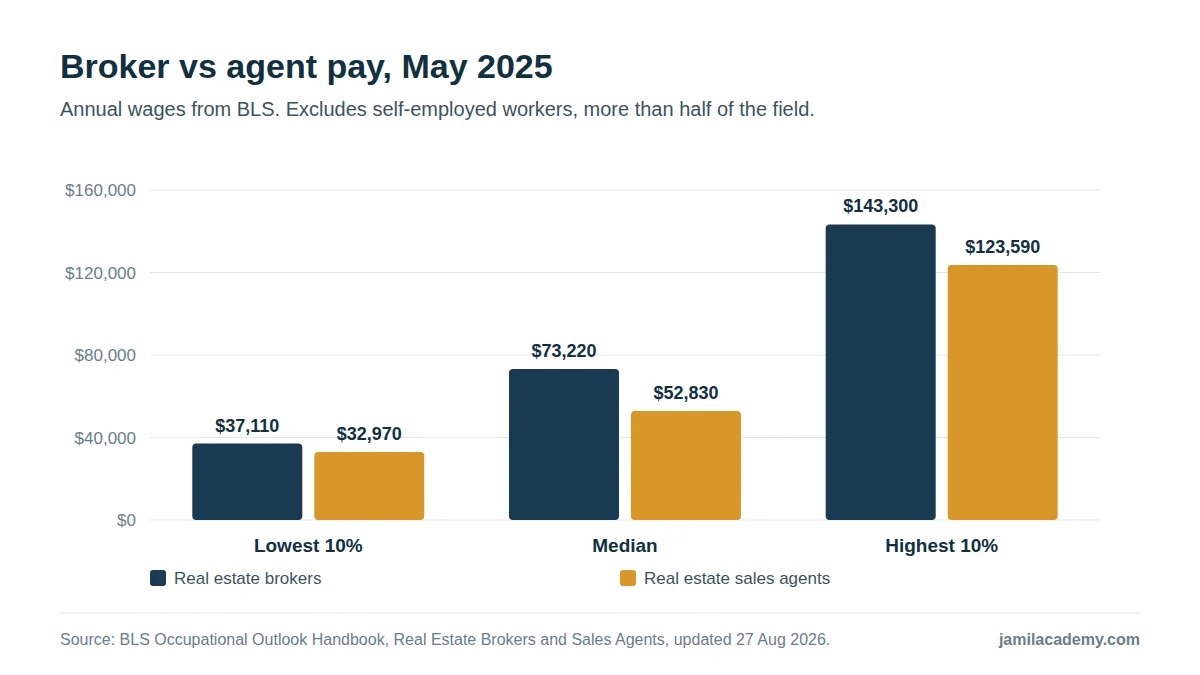
| Brokers | Sales agents | |
|---|---|---|
| Lowest 10% earned less than | $37,110 | $32,970 |
| Median wage | $73,220 | $52,830 |
| Highest 10% earned more than | $143,300 | $123,590 |
| Jobs in 2025 | About 103,500 | About 427,000 |
| Self-employed | 55% | 54% |
Source: BLS Occupational Outlook Handbook, Real Estate Brokers and Sales Agents, updated 27 August 2026.
Read the BLS numbers carefully
- They leave out the self-employed. The BLS says its pay data "does not include pay for self-employed workers." More than half of brokers and agents are self-employed.
- Brokers are often more experienced. Most states require years as an agent first, so part of the gap likely reflects experience, not the license itself.
- Data years differ between reports. My salary guide cites an earlier BLS year. I use the May 2025 figures here.
The BLS counts 530,600 broker and agent jobs in 2025. The real estate and rental and leasing industry employs 40 percent of brokers and 37 percent of agents. Most of the rest are self-employed; construction employs 3 percent of agents.
The BLS projects jobs for brokers and agents combined to grow 2 percent from 2025 to 2035, slower than average. It expects about 40,400 openings a year.
Why other sources show different numbers
NAR reported a $59,200 median gross income for its members in 2025. That figure covers NAR members of every license type, most of them independent contractors, and it is gross income before business costs.
The BLS figures cover only wage and salary workers. Neither source is wrong. They measure different groups, so always say which one you are quoting.
For commission-based income by experience, see how much real estate agents make.
My view: the license does not raise your income by itself. More sales, a better split or income from other agents does.
How do you become a broker in Virginia, Maryland, DC and West Virginia?
Short answer: more education, usually two to three years of experience (or, in West Virginia, 40 closed deals), then a broker exam. The details differ by jurisdiction.
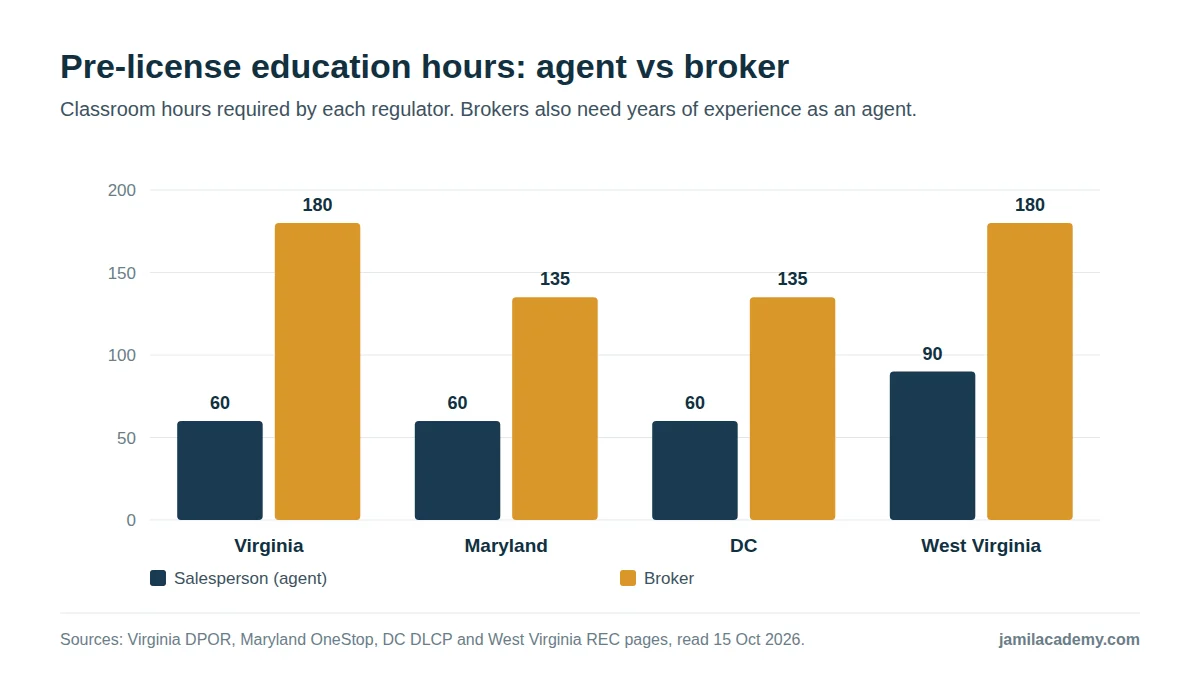
| Jurisdiction | Agent education | Broker education | Broker experience |
|---|---|---|---|
| Virginia | 60 hours | 180 hours (12 semester hours) | Active 36 of the 48 months before applying |
| Maryland | 60 hours | 135 hours, including 3 hours of ethics | At least 3 years |
| DC | 60 hours | 135 hours | 2 years as a licensed salesperson |
| West Virginia | 90 hours | 180 hours | 2 years and 20 closed deals, or 40 closed deals |
Sources: Virginia DPOR licensing guide; Maryland OneStop broker license page; DC Real Estate Commission; West Virginia REC education page and W. Va. Code chapter 30, article 40. Read 15 October 2026.
The broker exam
Virginia's licensing guide says exams have national and state portions, given through PSI. Maryland's broker page also names PSI as its exam provider.
Ask your course provider or regulator which exam you need, which topics it covers and how to register.
Other conditions
- Virginia: exam scores expire after one year, so plan the exam close to your application.
- Maryland: salesperson applicants must be at least 18, and must affiliate with a broker after licensure.
- DC: the 2 years as a salesperson must come immediately before the broker application.
- West Virginia: applicants must be at least 18.
Fees I could confirm
Maryland's OneStop pages list an estimated $190 for the original broker license and $90 for the salesperson license.
DC's Real Estate Commission page lists a $65 application fee and a $170 broker license fee, with $130 for a salesperson. I could not confirm current fees for Virginia or West Virginia.
West Virginia's closed-deal rule
West Virginia is the only one of the four that counts deals. You need at least 20 closed transactions as a licensed salesperson in the 2 years before you apply, or 40 closed transactions regardless of years.
A broker applicant who already holds a West Virginia salesperson license needs an additional 90 clock-hours instead of the full 180.
The state code says the courses must be completed within 3 years before you apply, but the Real Estate Commission's education page says 5 years. Confirm with the Commission before you plan.
My view: start tracking your closed deals and active months from your first year. You will need them verified when you apply.
How long does it take to become a broker in Virginia?
Short answer: at least three years. You need 36 months of active work as a salesperson within the 48 months before you apply.
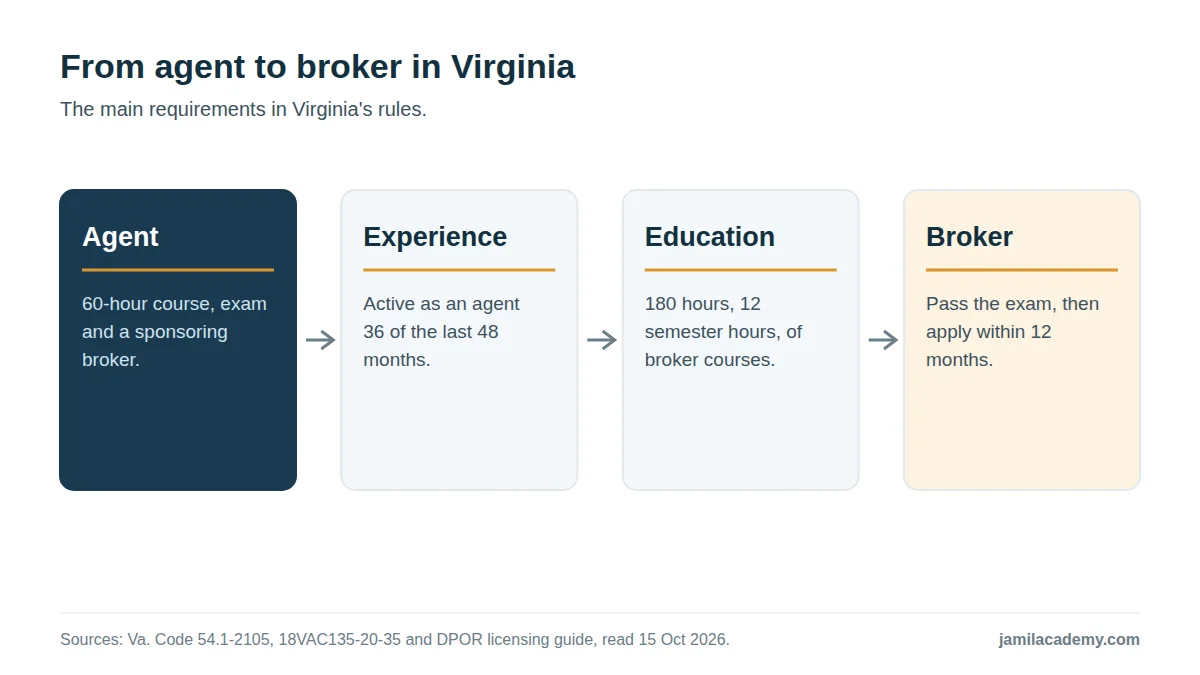
- Experience: "actively engaged" as a salesperson for "36 of the 48 months immediately preceding application." The principal or supervising broker you worked under at the time must verify it.
- Education: at least 12 semester hours covering brokerage, finance, appraisal and law. DPOR describes this as 180 hours.
- Exam: you must pass it within 12 months before you submit a complete application.
Sources: 18VAC135-20-35, Va. Code § 54.1-2105 and the DPOR licensing guide.
Virginia's regulation defines "actively engaged" as active licensure with a firm, performing brokerage activities for an average of at least 40 hours a week. DPOR's guide calls this full-time.
If you work part-time, ask DPOR how your months will be counted before you plan.
Continuing education goes up too
Brokers carry more continuing education than salespersons in Virginia, including broker management and supervision hours. I list the current hours in how to become a real estate agent in Virginia.
My view: if you plan to get a broker license, ask your school and DPOR whether you can take the broker courses during your third year. Then you can sit the exam once your 36 months are in.
Is a broker license worth it for you?
Short answer: only if it raises your income or lets you do something you want. Price the cost against the gain.
The calculator compares the one-time cost of upgrading with any yearly gain. The starting numbers are examples only, not quotes from a school, a regulator or a brokerage.
Example values only. Replace them with real quotes from your school and the regulator, and the split your broker will actually offer. If your broker pays the same split either way, your gain is zero.
What to put in the boxes
- Split with a broker license: ask your broker in writing. If nothing changes, enter your current split.
- Other yearly income: management pay, a share of team income or your own firm's profit.
- Your time: 135 to 180 course hours in these four jurisdictions is a real cost, even if you study at night.
My view: if the only gain is a title, the license may still be worth it for credibility. Just be honest with yourself that it is not a raise.
Can you hold a broker license and still work as an agent?
Short answer: yes. That is what an associate broker is. You hold a broker license but work under another broker's firm.
Virginia defines an associate broker as "any individual licensee of the board holding a broker's license" other than the principal broker. Maryland and West Virginia use the same idea.
As an associate broker, you still list and sell. You still answer to your principal or supervising broker. In Virginia, you are still paid through them.
Why agents choose it
- It keeps the option of opening a firm without starting from scratch.
- Some brokerages give brokers management or team roles.
- Some sellers and agents see the higher license as a sign of experience.
My view: an associate broker license is a good middle step. It costs time, but it does not commit you to running a firm.
Should you stay an agent, become an associate broker or open a firm?
Short answer: it depends on whether you want to sell, lead or own. Each path has different work, risk and pay.
| Path | What you do | What changes |
|---|---|---|
| Stay an agent | List and sell under a broker | Nothing. Lowest cost and responsibility. |
| Associate broker | Same as an agent, with a broker license | Credibility, and the option to lead later. Your split changes only if your broker agrees. |
| Supervising or managing broker | Oversee a branch or team for a firm | Management duties and possibly management pay, set by the firm. |
| Principal broker with your own firm | Run the business and supervise everyone | Full responsibility for compliance, escrow and agents. Income from the firm, not only your sales. |
Owning a firm is a different job
A principal broker answers for the firm's compliance, escrow accounts and the agents it supervises. That is real work and real legal exposure.
Many agents who want more control choose a different route: a brokerage with a low flat fee. I compare those in 100% commission brokerages compared.
Before you open your own firm
- Who will review every contract and file, and how fast?
- How will you set up and reconcile escrow accounts?
- What will you pay for E&O, office space and technology?
- How will you recruit and train agents, if you want them?
When an associate broker license helps
- You want to keep the option of opening a firm later.
- Your brokerage offers a better split, a management role or team leadership to brokers.
- You want the credibility of the higher license with sellers or other agents.
My view: get a broker license when you have a specific use for it. Getting it "someday" costs months of study you could spend selling.
Where do real estate teams fit in?
Short answer: a team works inside a brokerage, under a broker.
Virginia's definition of a supervising broker includes the broker designated to supervise agents "assigned to branch offices or real estate teams." So teams still answer to a broker.
NAR's 2026 Member Profile found that 21 percent of members work on a team. How team members are paid is set by the team and the brokerage, so get it in writing.
Do you need a broker license to lead a team?
Rules on who may lead a team vary by state and by brokerage. Check your state's team rules and your firm's written policy before you build one.
My view: leading a team is a common step up for agents who want more income without running a firm. It needs leadership skills more than a license.
Do clients care whether you are a broker or an agent?
Short answer: rarely, in my experience. Most clients care more about your results, your local knowledge and how quickly you respond.
In my experience, some sellers do ask about titles, especially for higher-priced homes. A broker license can help you explain your experience in one line.
How to describe your license
- Use the exact title your state uses, such as salesperson or associate broker.
- Name your brokerage, because your client's agreement is with the firm.
- Explain what the license means in plain words, if asked.
Never call yourself a broker unless you hold a broker license. Advertising is regulated too: Virginia, for example, requires the firm's licensed name on all advertising (18VAC135-20-190).
Check your state's advertising rules before you print anything.
My view: put your effort into a record clients can see, such as reviews and closed sales. That persuades more people than a title.
Why do some states call every licensee a broker?
Short answer: because each state names its licenses differently. In some states, the entry-level license is itself called a broker license.
In Illinois, Indiana, Oregon and Washington, the entry license is titled "Broker."
Colorado and New Mexico use "Associate Broker," and North Carolina uses "Provisional Broker." Tennessee uses "Affiliate Broker" and South Dakota "Broker Associate."
Those newer brokers still work under a managing or designated broker. So the title is different, but the supervised role is similar to a salesperson's elsewhere.
I list the license title and hours for every state in how long real estate school takes.
My view: if you move states, check what the new state calls each license and what it lets you do. Do not assume the title carries the same powers.
What extra costs and duties come with a broker license?
Short answer: more education, sometimes higher dues and much more responsibility.
- Courses and exam: 135 to 180 hours in the four jurisdictions in this guide, plus a broker exam.
- License fees: Maryland lists an estimated $190 for a broker license and $90 for a salesperson. DC lists $170 and $130, plus a $65 application fee.
- Continuing education: Virginia brokers carry extra broker management and supervision hours.
- Association dues: ask your local association whether dues or assessments differ for a managing or designated broker.
- Liability: a principal broker answers for escrow, compliance and the agents under them.
Time is the biggest cost
At 10 hours a week, 180 hours of broker courses take about 18 weeks. At 5 hours a week, they take about 36 weeks. That is time you are not prospecting or serving clients.
I break down dues, MLS fees and E&O in what it costs to be a Realtor.
My view: the license fee is the smallest cost. The time and the responsibility are the big ones, so plan for both.
Which should a new licensee aim for first?
Short answer: the salesperson license, and a good first broker to work under. In Virginia, Maryland, DC and West Virginia, the normal path is to start as a salesperson.
The standard route to a broker license in these four runs through experience as a licensed salesperson. DC allows equivalent experience the Board accepts, and Virginia's Board can waive requirements, but those are exceptions.
So your first decision is which broker to work for, not which license to hold.
What to look for in your first broker
- Training and a mentor for your first deals.
- A broker or manager who answers questions quickly.
- A split and fee plan you understand in writing.
- Help tracking your active months and closed deals for a future broker application.
My Virginia license guide, linked earlier, walks through the agent license steps. The broker license can wait until you know you need it.
My view: spend your first two years getting very good at sales. The broker license is easier to use well once you know the business.
What should you ask before you upgrade your license?
Short answer: ask what the license will change for you, in writing.
- Ask your broker: will my split, role or pay change if I hold a broker license?
- Ask your regulator: do my past months count as "actively engaged"? Who verifies them?
- Ask the school: which courses count, how long they stay valid and what they cost?
- Ask yourself: do I want to manage people, or do I want to sell more?
- If opening a firm: who will handle escrow, compliance and E&O, and at what cost?
Keep records from day one
Every broker application here asks you to prove experience. Keep a simple log of your active months, your closed deals and the broker who supervised each one.
If you change firms, ask your old broker to confirm your dates before you leave. It is much harder to rebuild those records years later.
My view: the best reason to upgrade is a plan you can describe in one sentence. If you cannot, keep selling and revisit next year.
What I could not verify
These are the gaps I hit while checking sources. Be careful with any page that fills them with a confident number.
- Income by license type from NAR. It sits in NAR's paid report, not its public summary.
- BLS state-level wages for brokers and agents. Those pages did not load for me.
- Current license fees in Virginia and West Virginia. Not confirmed.
- West Virginia's course window. The state code says 3 years; the Commission's education page says 5 years.
- Typical splits for associate brokers. I found no primary source.
- Maryland's salesperson course name. One state page calls it a "broker course," which looks like an error. Confirm with the Maryland Real Estate Commission.

Frequently asked questions
Is a real estate broker higher than an agent?
Yes. A broker holds a higher license that lets them run a firm and supervise agents. Agents must work under a broker.
Do brokers make more money than agents?
By median wage, yes. BLS median wages in May 2025 were $73,220 for brokers and $52,830 for agents, excluding the self-employed.
How long does it take to become a broker in Virginia?
At least three years. You need 36 months of active work in the 48 before applying, plus 180 hours of broker courses.
What is an associate broker?
Someone with a broker license who works under another broker, the principal broker, much like an agent does.
Can a real estate agent work without a broker?
No. A salesperson must work under a broker. In Virginia, a salesperson is paid through the principal or supervising broker unless the principal broker gives prior written consent.
Is a Realtor a broker?
Not necessarily. Realtor means a member of NAR. Both agents and brokers can be Realtors.
How many hours is broker school in Maryland and DC?
135 hours in both. Maryland also requires 3 years of experience, and DC requires 2 years.
Does West Virginia require closed deals for a broker license?
Yes. You need 2 years and 20 closed transactions as a salesperson, or 40 closed transactions.
Should every agent get a broker license?
No. It makes sense if you want to manage, own a firm or gain a better split. Otherwise it is time and cost without a raise.
Saad Jamil is a Realtor with Samson Properties in Chantilly, Virginia, licensed in Virginia, DC, Maryland and West Virginia. His sales record and client reviews are on his Zillow profile. He runs Jamil Academy, which sells training to agents. This is general information, not legal advice, checked on 15 October 2026.
Free: 5 Ways to Get More Listings Without Cold Calling
Five lead strategies that work without cold calls or ad spend, from an agent with $500M sold and 900+ homes closed.
No spam. Unsubscribe any time.
Your Coach