How Long Is Real Estate School? Every State's Hours and Real Timeline (2026)
Aug 17, 2026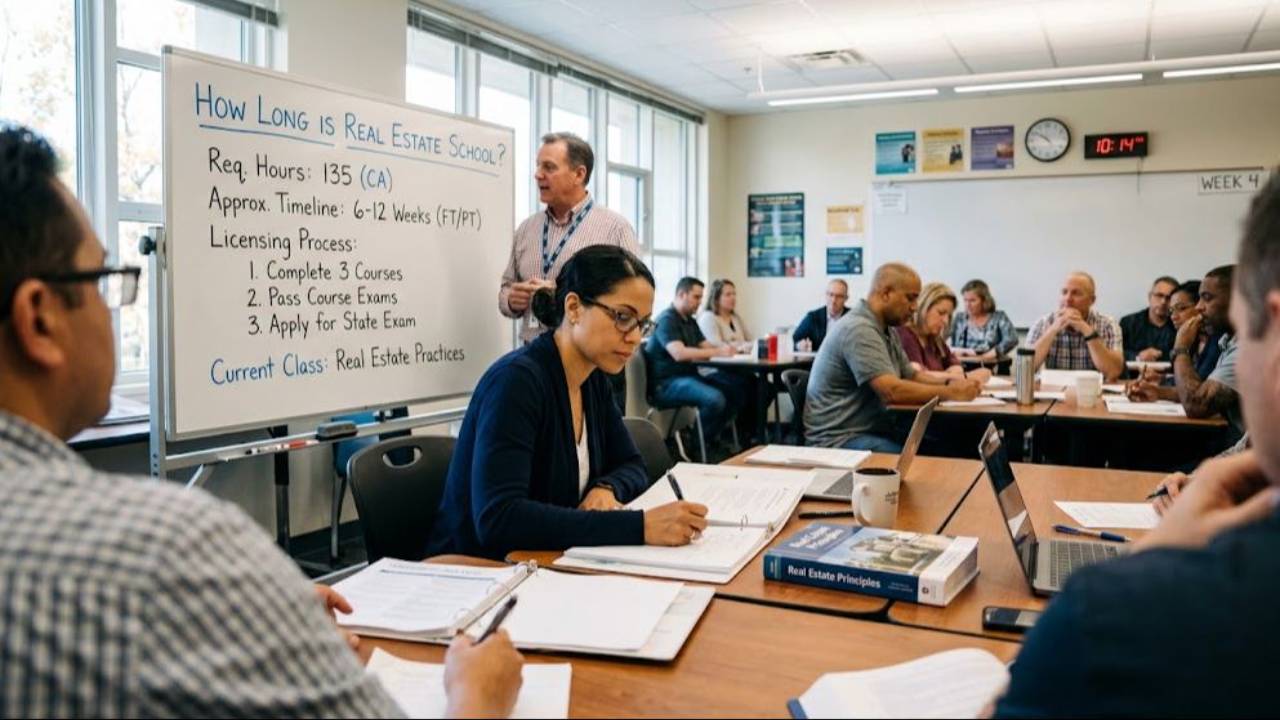
Real estate school runs from 40 hours to 180 hours depending on where you live. Five jurisdictions sit at the floor with 40: Alaska, Massachusetts, Michigan, New Hampshire and Vermont. Texas sits alone at the top with 180. The median across all 51 US jurisdictions is 75 hours, about eight weeks at ten hours a week. And here is the part almost nobody says plainly: the course is usually not the slow part of getting licensed.
I am Saad Jamil. I have closed more than $500M and over 800 homes in Northern Virginia, I am licensed with Samson Properties in Chantilly, Virginia, and I have been licensed since 2007. Two interests you should know about. I run a coaching program that competes with other people selling to new agents, and Jamil Academy carries a continuing education partner link to The CE Shop. Because of that link this article does not recommend or rank any school. It sticks to state requirements and timelines.
Everything below comes from state regulators, statutes and administrative codes, exam vendor bulletins, and where nothing official exists a named school source, flagged as one. Where a figure could not be verified I say so. I sell real estate coaching for brand new agents, not courses. If you are still deciding, read whether real estate is a good career first.
Quick Answer
Real estate school is 40 hours at the low end, in Alaska, Massachusetts, Michigan, New Hampshire and Vermont, and 180 hours in Texas. The median across all 51 US jurisdictions is 75 hours and the mean is 82.45, so the median state is roughly eight weeks of coursework at ten hours a week. The coursework is the part you control. The state exam, the fingerprint and background check, the application queue and, in several states, a sponsoring broker acting on your file are the parts you do not, and together they typically add another 2 to 16 weeks.
In This Guide
Every state's requirement, in its own words
Seat time caps make the weekend promise arithmetically false
Plan your own timeline, state by state
The exam, and why no national pass rate exists
The application is quick. The background check is not.
Sponsoring broker timing splits the states in two
Fifteen jurisdictions have no salesperson licence at all
Numbers competing pages still get wrong
How long does real estate school take online
The schooling that starts after you are licensed
Where this data is weak, said out loud
A realistic end to end timeline
Frequently asked questions
The real range, and where your state sits
Across the 51 US jurisdictions the pre-licensing requirement runs from 40 hours to 180. Five sit at the floor: Alaska, Massachusetts, Michigan, New Hampshire and Vermont. Texas sits alone at the top with 180 classroom hours across six 30-hour courses. The median is 75 hours and the mean is 82.45.
The most common single figure is 90 hours, required by 11 states: Idaho, Indiana, Louisiana, Minnesota, New Mexico, North Dakota, Oklahoma, South Carolina, Tennessee, Washington and West Virginia. Eight states require 60. Only four jurisdictions require more than 120: California at 135, Oregon at 150, Colorado at 168 and Texas at 180.
The unit is a trap in the two largest states. California publishes no clock hours at all. It requires three college-level courses, and the DRE line that each approved course is a minimum of 45 hours in length is the only legitimate basis for the 135 figure. Texas statute says at least 12 semester hours, or equivalent classroom hours, while TREC publishes six 30-hour courses. Same requirement, different units.
Several totals are sums the state never prints as one number. Arizona is 90 hours plus a separate 6-hour contract writing course. The District of Columbia is 60 plus two 3-hour courses. Missouri is 48 then 24, in that order. Tennessee and South Carolina are 60 before the exam and 30 more before it issues. Iowa is 60 plus three 12-hour courses. Nebraska is 90 plus 6.
At ten hours a week the median state is about eight weeks of coursework.
Every state's requirement, in its own words
Every jurisdiction is worded the way its regulator words it, with the name the state gives the entry level licence and a short note on what is most likely to trip you up. Two rows are marked LOW CONFIDENCE, and I explain why below.
| State | Requirement as the state words it | Entry licence name | Note |
|---|---|---|---|
| Alabama | 60 clock hour course approved by the Commission | Salesperson | 30-hour post-license course inside 6 months |
| Alaska | 40 classroom hours of approved pre-licensing education | Salesperson | Licence lapses if post-license hours are not filed |
| Arizona | 90-hour Salesperson Pre-licensing Course plus a 6-hour Contract Writing Course | Salesperson | 90 hours plus a separate 6-hour course |
| Arkansas | 60 classroom hours, of which 30 must be basic principles of real estate | Salesperson | Certificate never expires; apply within 90 days |
| California | three college-level courses: Principles, Practice, plus one elective | Salesperson | Courses, not hours; the DRE 45-hour floor gives 135 |
| Colorado | 168 hours of qualifying education across six named courses | Broker (Associate Broker) | No salesperson tier; entry is Associate Broker |
| Connecticut | 60-hour Real Estate Principles and Practices course | Salesperson | Two full years to activate after passing |
| Delaware | 99-hour Delaware salesperson's pre-licensing course | Salesperson | 12 post-license hours inside 90 days |
| District of Columbia | 60 hours of pre-licensing education plus a 3-hour Fair Housing course and a 3-hour Property Management course | Salesperson | Not a flat 60; two 3-hour courses added |
| Florida | 63-Hour Pre Licensure Course based on the FREC I syllabus, inclusive of exam | Sales Associate | Medium confidence; 45 post-license hours are separate |
| Georgia | a minimum of 75 instructional hours | Salesperson | Figure sits in Rule 520-2-.04(4)(c) |
| Hawaii | 60 hour Hawaii salesperson prelicensing course | Salesperson | Medium confidence; hours appear only in a PDF flowchart |
| Idaho | 90 hours: Salesperson Prelicense Module 1 (45) and Module 2 (45) | Salesperson | 100 percent attendance, 70 percent module pass mark |
| Illinois | 75 hours: 60 hours of Real Estate Topics plus 15 hours of Applied Real Estate Principles | Broker | No salesperson tier; entry is Real Estate Broker |
| Indiana | an approved 90 hour real estate pre-licensing course | Broker | No salesperson tier; entry licence is Broker |
| Iowa | 60-hour pre-license course plus 12 hours each of Buying Practices, Listing Practices and Developing Professionalism and Ethical Practices | Salesperson | 96 before licensure; the extra 36 are pre-license |
| Kansas | 60 hours: 30-Hour Principles of Real Estate plus 30-Hour Kansas Practice Course | Salesperson | Two courses, two staggered expiry clocks |
| Kentucky | 96 hours of Commission-approved pre-license instruction, or 6 academic credit hours at an accredited college | Sales Associate | Hours or college credit, no conversion published |
| Louisiana | ninety (90) hours of real estate education in LREC-approved courses | Salesperson | 30 of the 90 must be Louisiana law |
| Maine | Sales Agent Course, course length 55 hours | Sales Agent | Medium confidence; 2-year non-renewable licence |
| Maryland | the 60-hour pre-licensing course, including a 3 clock hour Commission-approved ethics course | Salesperson | Statute is a ceiling; ethics course named separately |
| Massachusetts | forty (40) hours of pre-licensure salesperson education | Salesperson | Certification expires 24 months after the education |
| Michigan | 40 hours of approved prelicensure education, including at least 4 hours of civil rights law and equal opportunity in housing | Salesperson | 4 of the 40 hours are civil rights |
| Minnesota | 90 hours: Course I, Course II and Course III, 30 hours each | Salesperson | Course I before the exam, II and III after |
| Mississippi | a minimum of sixty (60) hours in courses in real estate | Salesperson | First licence is temporary until post-license is done |
| Missouri | 48-hour Salesperson Pre-Examination Course plus 24-hour Missouri Real Estate Practice Course | Salesperson | 48 then 24, in that order |
| Montana | 70 hours of approved pre-licensing education completed within the past 24 months | Salesperson | Hard 24-month recency window on coursework |
| Nebraska | 96 hours total: 90 clock hours in three courses plus 6 clock hours in Professional Practice and Standards | Salesperson | Commission total is 96, not the printed 90 |
| Nevada | 120 hours in four courses: Principles 45, Law 45, Contracts 15, Agency 15 | Salesperson | State publishes its own college credit equivalence |
| New Hampshire | 40 hours of pre-licensing education, of which no more than 8 may be distance education | Salesperson | LOW CONFIDENCE: regulator returned 403, school figure |
| New Jersey | 75-hour prelicensure course at a licensed school | Salesperson | Full attendance plus a school final exam |
| New Mexico | 90 prelicensure education hours in three commission-approved 30-hour courses | Associate Broker | Entry licence is Associate Broker |
| New York | 77 hours of approved qualifying education | Salesperson | 77 hours, not the older 75 |
| North Carolina | 75-hour Broker Prelicensing Course | Provisional Broker | 75 pre-license; the quoted 90 is postlicensing |
| North Dakota | at least ninety hours in commission-approved courses of study | Salesperson | Exam may be sat before education is finished |
| Ohio | 100 hours of approved real estate education in four courses (40 + 40 + 10 + 10) | Salesperson | 100 hours since 30 September 2025, not 120 |
| Oklahoma | ninety (90) clock hours of basic real estate instruction | Provisional Sales Associate | Non-renewable Provisional Sales Associate |
| Oregon | Complete 150 hours of broker pre-license education | Broker | Seven courses; entry licence is called broker |
| Pennsylvania | 75 hours (5 credits) of basic real estate courses | Salesperson | A real estate degree or JD exempts entirely |
| Rhode Island | forty-five (45) classroom hours | Salesperson | Separate 3-hour lead certificate sits outside the 45 |
| South Carolina | 60 hours Unit I Fundamentals of Real Estate plus 30 hours Unit II Advanced Real Estate Principles | Salesperson | Only Unit I, 60 hours, sits the exam |
| South Dakota | a minimum of 116 hours (116-Hour Prelicensing Course) | Broker Associate | Entry is broker associate; 116 is a floor |
| Tennessee | 60 hours of real estate principles before the examination plus the 30-hour Course for New Affiliates | Affiliate Broker | The 30-hour affiliate course is pre-license |
| Texas | 180 classroom hours in six 30-hour courses | Sales Agent | Statute says semester hours, TREC says 180 |
| Utah | 120 hours of approved education at a certified Real Estate Pre-License School | Sales Agent | Strict one-year and 90-day clocks |
| Vermont | at least forty hours of Commission-approved instruction | Salesperson | 8 post-license hours inside 90 days |
| Virginia | 60 class/clock hours of a Board-approved Pre-License Course | Salesperson | 30 post-license hours across nine topics |
| Washington | 90 hours: a 60-hour Real Estate Fundamentals course and a 30-hour Real Estate Practices course | Broker | Entry is broker; very heavy first renewal |
| West Virginia | 90 clock-hours (equivalent to 6 college credit hours) | Salesperson | Per-subject 70 percent pass mark |
| Wisconsin | Board-approved 72-hour pre-license program, or 10 academic semester hour credits | Salesperson | 72-hour program or 10 semester credits |
| Wyoming | Salesperson Course I, Salesperson Course II and a Wyoming Law Course (school sources: 68 hours) | Salesperson | LOW CONFIDENCE: no state page publishes hours |
Seat time caps make the weekend promise arithmetically false
Several states cap how many hours of instruction you can take in a day, and one caps the week. Where those caps exist the state sets the minimum length of your course, not you and not the school.
North Carolina is the clearest case. 21 NCAC 58H .0208(e) says class meetings shall not exceed seven and a half instructional hours per day and shall not exceed 30 instructional hours over any seven day period. The prelicensing course is defined as at least 75 hours. At 30 hours per seven day period, 75 hours cannot be delivered inside fewer than three overlapping seven day windows. Three weeks is the floor.
Texas caps daily course segments at 12 hours under 22 Tex. Admin. Code section 535.65(g)(1)(B)(iv). Pennsylvania caps instructor led learning at 7.5 clock hours per day under 49 Pa. Code section 35.358, bars more than 90 consecutive minutes without a break, and requires a prelicensure student to be physically present for at least 80 percent of the classroom instruction. On 75 hours that is 10 instruction days minimum.
Florida does something different and arguably worse. Rule 61J2-3.008 defines the requirement as 63 hours of 50 minutes each, inclusive of examination, and sets no minimum elapsed days. But a student who fails the school end of course examination must wait at least 30 days from the original examination to retest, and within one year may retest a maximum of one time.
Read that Florida rule twice. One failed school exam, before you have been near the state exam, costs a calendar month. Two failures inside a year cost you the year. That rule is a bigger time risk than the 63 hours of coursework.

Plan your own timeline, state by state
The tool below does the arithmetic, then shows the part that is not. Pick your state, say how many hours a week you can genuinely study, and it divides. Where a state publishes a seat time ceiling it applies the ceiling and says so.
The exam, and why no national pass rate exists
There is no official national real estate exam pass rate. PSI does not publish one, Pearson VUE does not publish one, and neither ARELLO nor NAR publishes one. Any national figure you see quoted is somebody's estimate dressed as data.
What exists is state data on incompatible bases. Florida's is the most useful because DBPR splits first time from repeat takers. In June 2025, 2,102 first time takers passed at 49 percent while 2,131 repeat takers passed at 30 percent, an overall 39 percent. May 2025 ran 47 against 32. January 2025 ran 50 against 33. Read that carefully: repeat takers do worse, not better.
California publishes a single blended rate instead. Through June 2026 the DRE had administered 30,063 salesperson examinations in fiscal year 2025/26 at a 53 percent pass rate, with June alone at 2,612 exams and 52 percent.
Getting back into the chair is quick. Pearson VUE tells Florida candidates to wait 24 hours before rescheduling. PSI bulletins for Colorado, Georgia and Massachusetts all say a candidate who fails on a Wednesday can call the next day and retest as soon as Friday, subject to space. Results are usually on screen, though Oregon posts in three business days and New York will not give them by phone. Texas says three failures triggers more education.
The application is quick. The background check is not.
Texas publishes the best hard number in the country. Its September 2025 staff report records sales agent initial applications processed in an average of 4.18 calendar days against a published target of 14 days, on 2,595 applications received that month.
Then read the caveat on TREC's own processing times page: those times do not apply to applications referred for additional review due to background check results. The same page reports DPS technical issues with FBI fingerprint based criminal history results, with no resolution timeline announced. The form is not the risk. The check is.
California's Department of Justice says 80 percent of electronic fingerprint checks clear in three business days, and names the causes of delay: poor print quality, criminal information in the record, birthdates before 1920, and incorrect data on the transaction. Florida publishes three to five business days, Washington 14, Idaho one to six weeks. Texas publishes no figure at all.
Queues vary as widely. Utah says turnaround is currently 30 days and Idaho asks for a minimum of 10 business days. A California board snapshot dated 9 February 2026 showed applications received between 20 January and 3 February still in process, a backlog of six to 20 days.
The deadlines between steps are where people lose months. Virginia is the clearest case of a regulator contradicting itself. Three current DPOR forms, including salesperson form A490-0225SLIC revised 1 July 2026, give you 90 calendar days from the Board receiving your fingerprint results to file a complete application, or you pay to be printed again. An undated DPOR sheet still says 45 days. Confirm with the Board. I walked that sequence through in how to become a real estate agent in Virginia. Georgia gives three months from the exam to apply or you pay double, and 12 months before you sit it again.
Sponsoring broker timing splits the states in two
In one group the licence cannot be issued at all until a broker acts on your file. In the other the state issues an inactive licence that then waits, indefinitely, for you.
New York is the clearest example of the first. The Department of State says your principal broker must log on to their personal online account and authorize your application, and that upon broker approval the licence is generated that week. Ohio requires the principal or management level broker to accept and approve. Tennessee requires the PSI examination application to be signed by your principal broker. Oregon issues when the background check clears and your managing principal broker adds the pending licence into the business.
Texas is the clearest example of the second. TREC says that after you have met all the licence requirements you will receive an inactive licence, and that to work as a sales agent you must be sponsored by an active Texas licensed broker. Georgia lets you apply for an active or inactive licence outright. Illinois treats sponsorship as a notification after the fact, due in 24 hours.
So in New York, Ohio, Tennessee and Oregon, choosing a brokerage is a licensing step with a deadline. In Texas and Georgia it is not, which is a freedom and a trap. I set out what to look at in how to choose the right brokerage as a new agent.

Fifteen jurisdictions have no salesperson licence at all
Thirty six of the 51 jurisdictions call the entry level credential a salesperson. Fifteen do not, and the difference is not cosmetic.
Nine use a broker title. Colorado and New Mexico issue an Associate Broker. Illinois, Indiana, Oregon and Washington issue a Broker. North Carolina issues a Provisional Broker, Tennessee an Affiliate Broker, South Dakota a Broker Associate. Six use another family: Maine, Texas and Utah say Sales Agent, Florida and Kentucky say Sales Associate, Oklahoma says Provisional Sales Associate.
This matters the moment you compare hour counts. Colorado's 168 hours is entry level broker education and Oregon's 150 is the same. Setting those against a 60-hour salesperson course compares unlike things.
Two of these credentials expire by design. Maine's Sales Agent licence runs two years and is non-renewable: the licensee must move up to Associate Broker with a further 60-hour course and two years of active practice. Oklahoma's Provisional Sales Associate is likewise non-renewable, and 45 clock hours must be filed before it expires.
Numbers competing pages still get wrong
Ohio is 100 hours, not 120. The statute effective 30 September 2025 requires 40 hours of real estate practice, 40 hours covering Ohio law and civil rights law, 10 hours of appraisal and 10 hours of finance. Appraisal and finance were each cut from 20 to 10. Pages printing 120 are quoting repealed law.
Nebraska is 96, not 90. The Commission's own page reads 96 hours total: 90 clock hours across three courses plus 6 clock hours in Professional Practice and Standards, course 0003. New York is 77, not 75. Holders of the legacy 75-hour course have to add a two hour fair housing or implicit bias course to reach the current standard.
North Carolina's 75 hours is prelicensing. The 90-hour figure that gets quoted is postlicensing, three 30-hour courses due within 18 months of licensure. Different requirement, different stage.
Iowa requires 96 hours on the original licence application, not 60. Sixty hours qualifies you to sit the exam. Three further 12-hour courses in Buying Practices, Listing Practices and Developing Professionalism and Ethical Practices are required for the original licence, live instruction only, and the state's own bulletin places them on the application rather than after it.
Two numbers I will not print. Texas's 90 hour Sales Apprentice Education figure could not be verified from TREC, because the first renewal page is blocked to automated retrieval and only school pages assert it. The widely repeated California 18-day rule could not be located in any DRE document, so it is not stated here as fact.
How long does real estate school take online
Online removes the schedule. It does not remove the hours, and in several states it does not remove the caps. North Carolina's 30 hours per seven day period applies whatever the format. Pennsylvania requires distance delivery to be approved by ARELLO or an equivalent body. Texas requires providers to ensure the student taking all topics is the student receiving credit, that an instructor is available, and that all modules were completed.
The platforms run a real clock too. The CE Shop's state filed catalogue puts it plainly: after 20 minutes of inactivity, the timer will stop.
The other constraint is the access window your school sells you, which is contractual rather than regulatory. Kaplan's terms grant online access for up to six months from purchase, with an 18-month maximum. Colibri gives six months per course with the timer restarting each time, except in Colorado where a six course package must finish within one year. The CE Shop's Washington catalogue puts pre-licensing between six and 12 months and offers expired students a repurchase at 50 percent.
Treat school headline claims as claims. AceableAgent markets as little as 8 weeks online against at least 4 to 6 months in a classroom, about 14.5 weeks for California and 12 weeks for Florida. The CE Shop markets four to six months for the education alone. Those are the schools' own numbers, not regulators'. The format differences are in how real estate programs are structured.
The schooling that starts after you are licensed
Getting licensed and being finished with school are two different dates. Post licensing is a second block of mandatory education after the licence issues, and it is not continuing education.
In two states it rivals the pre-licence course. Florida requires 45 classroom hours of 50 minutes each before the first renewal, and the statute is blunt: the licence of a sales associate who does not complete it shall be considered null and void, meaning you retake the prelicensure course and the state exam. North Carolina requires 90 hours in three courses within 18 months, or the licence goes inactive.
Elsewhere it is smaller but the clocks are short. Virginia requires 30 hours across nine prescribed topics within one year of the last day of the month of issuance, with automatic inactive status if missed. Delaware requires 12 hours in 90 days and Vermont eight. Alaska requires 30 within a year plus an affidavit within 30 days after, or the licence lapses. Georgia requires 25, Alabama 30, Nevada 30, Illinois 45.
Tennessee is the counter example that causes half the confusion here. Its 30-hour Course for New Affiliates goes in with the licence application, so an identically named new licensee course is genuinely pre-licence there.
Budget for it in your first year, in money and calendar. What you do in those months matters more than the course did, which is the argument in how to succeed as a new real estate agent, and it is why I sell real estate coaching for your first year rather than education.
Where this data is weak, said out loud
Forty nine of the 51 table figures come from a state regulator, statute or administrative code. Two do not.
New Hampshire is low confidence because the regulator could not be reached. Every Office of Professional Licensure and Certification page returned HTTP 403 and the General Court statute servers failed to resolve. The 40-hour figure, with no more than eight hours by distance education, comes from a commercial school. Confirm it with the Commission before you enrol.
Wyoming is low confidence because the Commission defines the requirement by course rather than by hours. Its rule chapters and course outlines sit on Google Drive and were not retrievable, and no state page publishes an hour figure. The 68 hours, a 40-hour Course I plus a 21-hour Course II plus a 7-hour Wyoming Law Course, comes from schools. Two firm state facts survive: coursework must be completed within one year prior to the application date, and an applicant may challenge an approved course by passing its exam.
Three more are medium confidence for reasons of source age rather than source type. Florida's education requirements PDF carries a 2018 revision date. Hawaii's hour count appears only in a Commission flowchart PDF. Maine's 55 hours comes from a course outline approved in 2013.
Several things are not published anywhere. No regulator publishes an end to end time to licence estimate. Nobody publishes what share of people start a course and never get licensed. There is no authoritative national list of which states use PSI and which use Pearson VUE.

A realistic end to end timeline
No state regulator in this research publishes a total. The defensible way to build one is to add up the components states do publish, which is what the planner does.
Course, whatever your hours divided by your honest weekly pace produces, subject to any seat time ceiling. Then up to seven days for your school to send the completion record to the exam vendor, which is Washington's published figure. Then the appointment, same day by phone in Florida and about two days in the PSI states. Then results, usually on screen. Then fingerprints and the background check, three business days for 80 percent in California, up to 14 business days in Washington, one to six weeks in Idaho. Then the application queue, 4.18 days on average in Texas and 30 days in Utah. Then, where required, a broker.
Added up, that is roughly 2 to 16 weeks on top of your coursework, and I would plan for the upper half of it.
The things that blow the estimate are few and known. A background check referral, which removes you from the normal queue entirely. Unreadable fingerprints, which in Texas triggers a manual FBI name search. Fingerprints expiring before the application lands, a clock Virginia measures from the day the Board receives your results. Failing the Florida school exam, which costs 30 days. Failing the state exam twice, which the Florida data says is likelier than failing once. A course window expiring. Waiting on a broker.
None of that should put you off. It should stop you believing an 8-week promise, then feeling like a failure by week 14.
Frequently asked questions
How long is real estate school?
Real estate school runs from 40 hours to 180 hours depending on the state. Alaska, Massachusetts, Michigan, New Hampshire and Vermont are lowest at 40. Texas is highest at 180 classroom hours across six 30-hour courses. The median across all 51 US jurisdictions is 75 hours, about eight weeks at ten hours a week.
How long does it take to get a real estate license?
The coursework is only the first component. States also publish up to seven days for a school to send completion records to the exam vendor, same day to two day exam scheduling, three business days to six weeks for a background check, and application processing of 4.18 days on average in Texas or 30 days in Utah. Together those typically add another 2 to 16 weeks.
Can you finish real estate school in a weekend?
Not in several states. North Carolina caps instruction at seven and a half hours a day and 30 hours over any seven day period, so its 75-hour course cannot be delivered in under three weeks. Texas caps daily course segments at 12 hours and Pennsylvania caps instructor led learning at 7.5 clock hours a day. Where those caps exist the state sets the minimum length of your course.
How long does real estate school take online?
Online changes the schedule, not the hour count, and it does not remove state seat time caps. It adds a deadline of its own. Kaplan grants access for up to six months from purchase with an 18-month maximum, Colibri six months per course, and The CE Shop puts pre-licensing at six to 12 months. Most students are limited by their own pace, not the platform.
What is the real estate exam pass rate?
There is no official national pass rate. PSI, Pearson VUE, ARELLO and NAR do not publish one, and the states that do publish differ sharply. Florida recorded 49 percent for first time takers and 30 percent for repeat takers in June 2025. California recorded a blended 53 percent across 30,063 salesperson examinations in fiscal year 2025/26 through June 2026.
Do you get your license as soon as you pass the exam?
It depends on the state. In New York, Ohio, Tennessee and Oregon a sponsoring broker has to act before the licence can be issued at all. In Texas you receive an inactive licence once you have met the requirements, and it waits until a sponsoring broker accepts the request. Georgia lets you hold an active or inactive licence from the start.
About the Author
Written by Saad Jamil, founder of Jamil Academy and a currently producing Top 1% Realtor in Northern Virginia with $500M+ in career sales and 800+ homes closed. Licensed since 2007, practising with Samson Properties in Chantilly, Virginia. Jamil Academy carries a continuing education partner link to The CE Shop, which is why no school is ranked here. View Saad’s Zillow profile.
Hour requirements were taken from state regulators, statutes and administrative codes on 17 August 2026, except New Hampshire and Wyoming, which are school sourced and flagged low confidence. Processing times, pass rates and deadlines are what those agencies published at that date and change without notice. Educational content only, not legal advice. Confirm every requirement with your own state commission before you enrol.
Free: 5 Ways to Get More Listings Without Cold Calling
Five lead strategies that work without cold calls or ad spend, from an agent with $500M sold and 900+ homes closed.
No spam. Unsubscribe any time.
Your Coach