100% Commission Brokerages Compared (2026): Real Fees, Caps and Math
Oct 14, 2026
A 100% commission brokerage lets you keep your whole commission and charges flat fees instead of taking a percentage. You pay a monthly fee, a fee per deal, or both.
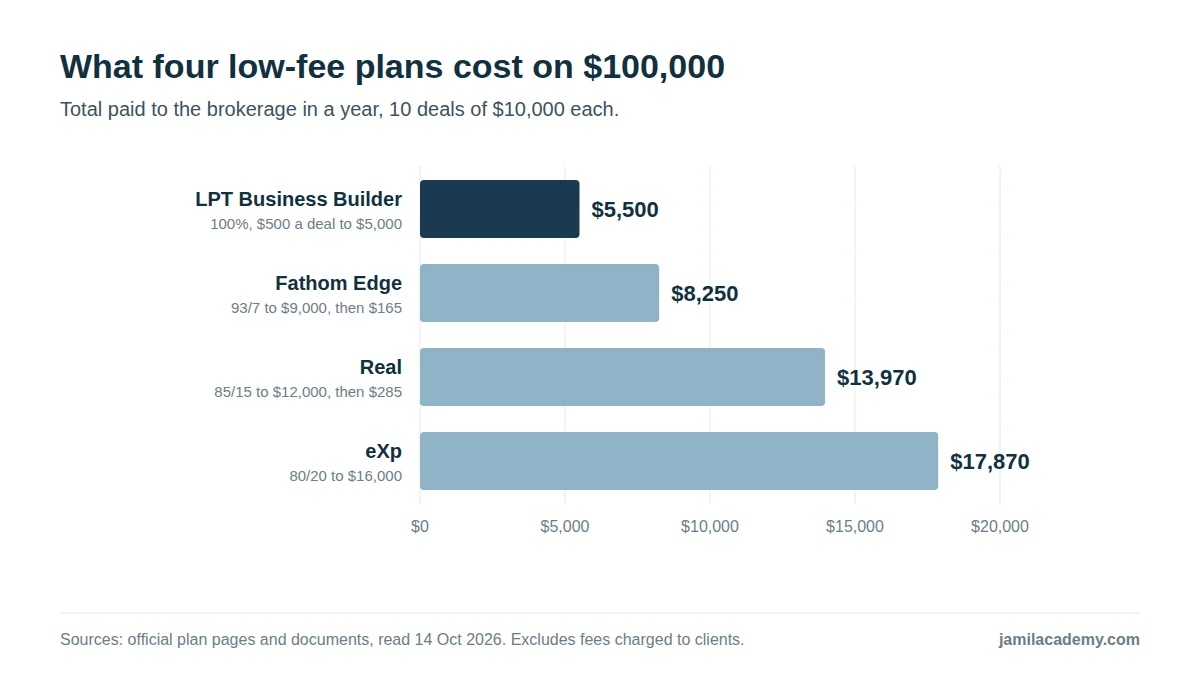
The catch is in the fees. Of the plans I priced, the cheapest flat-fee plan cost $5,500 a year on $100,000 of commission. A capped split cost $17,870. Some brands that advertise 100 percent do not publish full fee schedules.
This guide compares the plans that print real numbers, shows the yearly cost at every income level, and explains what you give up. Sources were checked on 14 October 2026.
Where I stand: I am a Realtor with Samson Properties, which is not one of these brokerages, and I run Jamil Academy, which sells training to agents. No brokerage paid to be mentioned. The one product block near the end is my own.
Quick answer
- The model: you keep your commission and pay flat fees, instead of giving the brokerage a share of each deal.
- True 100% plans with published fees: LPT Realty's Business Builder plan, $500 a deal to a $5,000 yearly cap, from a 2023 plan document.
- Near-100% plans: Fathom's Edge plan takes 7 percent to a $9,000 cap, then $165 a deal.
- Unpublished: HomeSmart, United Real Estate and Realty ONE Group describe 100% models but do not print full national fee schedules.
- On $100,000: yearly costs ran from $5,500 to $17,870 across four published plans, in my math.
- What is a 100% commission brokerage?
- Do you really keep 100 percent?
- Which brokerages offer 100% commission in 2026?
- How do flat-fee plans compare with capped splits?
- Does your deal size change the winner?
- Which plan keeps more for you?
- Why do the first deals of the year matter most?
- How do Realty ONE Group, HomeSmart and United price 100 percent?
- What do you give up for 100% commission?
- How do teams work on these plans?
- Is a 100% commission brokerage good for new agents?
- How are you paid at a 100% brokerage in Virginia?
- How should you choose between flat-fee and capped plans?
- What costs does a 100% brokerage leave to you?
- How do you switch to a 100% brokerage?
- What should you ask before you join a 100% brokerage?
- What I could not verify
- Frequently asked questions
What is a 100% commission brokerage?
Short answer: a brokerage that charges flat fees instead of taking a split. The brokerage earns from fees, not from a percentage of your commission.
I found no neutral definition from NAR or a state agency. The definitions in circulation come from the brokerages themselves:
- Realty ONE Group says it "operates on a 100% commission model, meaning agents keep 100% of their earned commissions rather than splitting with the brokerage."
- United Real Estate describes a "100%-commission model that allows agents to keep all of their gross commission earnings," for a flat fee.
- HomeSmart wrote in 2023 that agents keep their commission "minus a small transaction fee and other standard fees like errors and omissions insurance."
Three ways a brokerage gets paid
| Model | How the brokerage earns | Example |
|---|---|---|
| Traditional split | A share of every commission, often with no cap | 70/30 or 80/20 |
| Split to a cap | A share until it reaches a yearly cap, then small fees | eXp, Real, Fathom Edge |
| 100% or flat fee | Flat monthly or per-deal fees, sometimes capped | LPT Business Builder |
The line between the last two is blurry. Once you hit a cap, a capped plan works like a 100% plan for the rest of the year.
My view: the label matters less than the yearly total. Price every plan as one number: what you pay the brokerage in a year at your income.
Do you really keep 100 percent?
Short answer: no. You keep 100 percent of the commission, minus fees. Those fees can be small or large, depending on the plan and your income.
Every plan I read charges something. Typical items include:
- A fee per deal, often a few hundred dollars.
- A monthly or yearly fee for technology, office or support.
- E&O or risk fees, per deal or per year.
- Fees charged to the client, such as LPT's $195 transaction fee, which its plan document says is a "charge to customer."
If a client refuses a fee meant for them, ask who pays it. Often it is you.
Fees that change after a cap
Capped plans swap the split for smaller fees once you reach the cap. Real charges $285 a sale after its cap. Fathom's fee drops to $165 a deal. eXp says standard transaction and broker review fees still apply.
So even after the cap, you do not keep every dollar. Count post-cap fees when you compare.
Where 100 percent is not 100 percent
In my review of one franchise brand, one office ran a capped split under the 100% banner. I cover the franchise brands further down.
My view: ask for the fee schedule and your independent contractor agreement before you sign. The agreement controls, not the recruiting page.
Which brokerages offer 100% commission in 2026?
Short answer: several, but only a few print their fees. Here is what each brokerage's own pages or documents say.
| Brokerage | Model | Published terms | Source date |
|---|---|---|---|
| LPT Realty: Business Builder | 100% with a per-deal fee to a cap | $500 a deal to a $5,000 cap. $195 per deal charged to the customer. $500 a year for technology and E&O. | Plan document valid through March 2023 |
| Fathom Realty: Edge | 7% split to a cap | 7% to a $9,000 cap, then $165 a deal. $350 minimum per deal, $35 E&O per sale, $75 a month. | Plan page, read 14 October 2026 |
| Fathom Realty: Elevate | 20% split, no cap | 20% on every deal. $350 minimum, $35 E&O, $75 a month. | Plan page, read 14 October 2026 |
| HomeSmart | 100% commission | "Starting at $25 a month." Monthly, transaction and risk fees, amounts not published. | Join page, 2026 |
| United Real Estate | 100% commission and a flat fee | Fee amount not published. | Company article, June 2025 |
| Realty ONE Group | 100% commission model | Fees set by each office (per office pages in my Realty ONE Group review). No national figures. | Join page, 2026 |
Sources: help.lptrealty.com plan PDF, fathomcareers.com/commission-plan, join.homesmart.com, unitedrealestate.com and realtyonegroup.com/join, read 14 October 2026.
Two capped plans for comparison
| Brokerage | Split and cap | Fees |
|---|---|---|
| Real Brokerage | 85/15 to a $12,000 cap ($6,000 for team members) | $249 to join, $900 a year, $50 a deal, then $285 a sale after the cap. No monthly fee. |
| eXp Realty | 80/20 to a $16,000 cap | $149 to join, $85 a month, $25 plus $60 a deal. |
Sources: Real's fee page updated 31 August 2026 and exprealty.com/income, read 14 October 2026.
Notes on the fine print
- LPT's only official numbers are from 2023. Its join page shows no figures and says the contractor agreement "supersedes all information provided here."
- Fathom's commercial deals count first toward a separate $5,000 commercial cap.
- Epique runs an 85/15 split with caps it says decline, a 0.1% transaction fee and fees "As low as $99/month." Its join page prints team caps, not an individual cap.
- eXp says agents in its Mentor Program pay an additional 20% split on their first three transactions.
- Fathom charges $120 on a residential lease and says it has "No annual membership fees."
- Real lets you close up to three personal deals a year at $250 each, and charges $125 per lease after the cap.
- eXp says that after the cap you keep 100 percent, "subject to standard transaction and broker review fees."
I price each of these in more depth in my LPT Realty review and my Fathom Realty review.
How do flat-fee plans compare with capped splits?
Short answer: with $10,000 deals, the flat-fee plan cost least at every income I tested. Caps shrink the gap as a share of income, but in dollars it keeps growing.
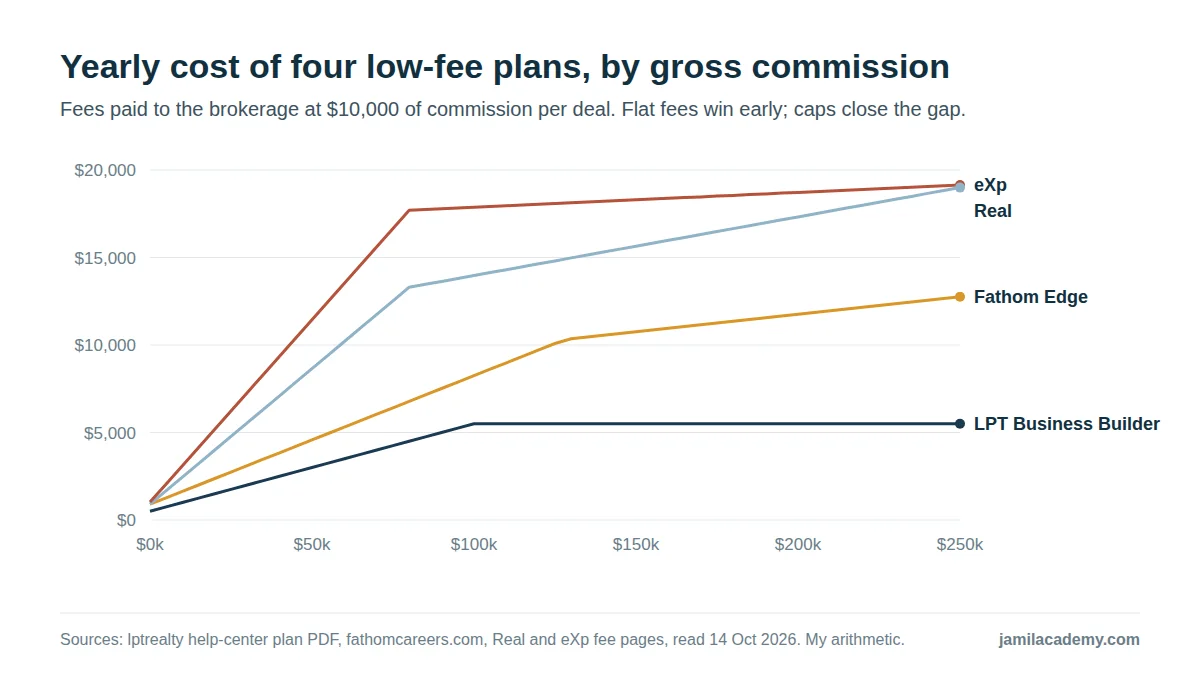
| Gross commission | LPT Business Builder | Fathom Edge | Real | eXp |
|---|---|---|---|---|
| $50,000 | $3,000 | $4,575 | $8,650 | $11,445 |
| $100,000 | $5,500 | $8,250 | $13,970 | $17,870 |
| $200,000 | $5,500 | $11,755 | $17,320 | $18,720 |
Total paid to the brokerage in a year, at $10,000 of commission per deal. Excludes one-time join fees and fees charged to clients.
How I did the math
- LPT: $500 a deal until $5,000, plus the $500 yearly fee. The $195 per-deal fee is left out because LPT's document says it is charged to the customer.
- Fathom Edge: 7 percent of each deal, at least $350, until $9,000. Then $165 a deal. Plus $35 E&O per deal and $75 a month.
- Real: 15 percent until $12,000, $50 a deal, $900 a year, then $285 a sale after the cap.
- eXp: 20 percent until $16,000, $85 a deal and $85 a month. eXp says post-cap deals carry "standard transaction and broker review fees" but prints no post-cap amount, so I counted only the $85.
Fathom's two plans compared
Fathom's Elevate plan takes 20 percent of every deal with no cap, and adds what Fathom calls a "Tiered Concierge Service." On $100,000 at $10,000 a deal, that is $20,000 in split alone, against Edge's $7,000 before fixed fees.
Elevate only makes sense if the extra service saves you more time or money than the difference. Ask Fathom exactly what the concierge service includes.
What about Epique?
Epique publishes an 85/15 split, a 0.1 percent transaction fee and caps it says decline. Its join page prints team caps but not the individual cap.
Without the individual cap, I left Epique out of the chart. Ask Epique for its current individual plan in writing and enter it in the calculator.
Why the gap stays open
Caps limit the split, but the per-deal fees keep running. At $200,000, Real's post-cap fee and eXp's per-deal fees still add thousands.
LPT's plan stops at $5,500 because its per-deal fee is capped too. If you close many small deals, that cap matters most.
My view: the cheapest plan on paper is not the cheapest for everyone. Revenue share, stock, training and leads differ by brokerage, and I cover those next.
Does your deal size change the winner?
Short answer: yes. Small deals favor percentage plans with low minimums, and large deals favor per-deal fees.
A per-deal fee costs the same on a $3,000 commission as on a $15,000 one. A percentage grows with the deal. So the number of deals behind your income matters.
| Your year | LPT Business Builder | Fathom Edge | Real | eXp |
|---|---|---|---|---|
| 10 deals of $3,000 ($30,000) | $5,500 | $4,750 | $5,900 | $7,870 |
| 20 deals of $5,000 ($100,000) | $5,500 | $8,600 | $15,040 | $18,720 |
| 10 deals of $10,000 ($100,000) | $5,500 | $8,250 | $13,970 | $17,870 |
| About 6.7 deals of $15,000 ($100,000) | $3,833 | $8,133 | $13,423 | $17,587 |
Yearly cost to the brokerage, my arithmetic from the published terms in this guide.
What the table shows
- With small deals, Fathom beat LPT. LPT's $500 fee is a big share of a $3,000 commission. Fathom's $350 minimum is smaller.
- With large deals, LPT pulled further ahead. Fewer deals mean fewer $500 fees.
- Real and eXp cost more when deals are small because more deals carry per-deal fees before and after the cap.
If your market's prices are high, as in much of Northern Virginia, your average deal may be well above $10,000. Run the calculator with your real number.
My view: count your deals, not just your income. Two agents with the same income can have very different best plans.
Which plan keeps more for you?
Short answer: the one with the lowest yearly total at your income. Enter your numbers and any two plans.
The calculator starts with LPT's Business Builder plan and Fathom's Edge plan. It works deal by deal, so minimum fees, caps and post-cap fees all apply in the right order.
Starting values are two published plans in this guide. For a 100% plan, set your split to 100 and enter the flat fee per deal. For a capped split, enter the split and the cap. Fees are before tax and your own costs.
How to use it
- Enter last year's income and your real average commission per deal.
- Use the minimum field for plans with a minimum fee per deal, such as Fathom's $350.
- Use the after-cap field for post-cap fees, such as Real's $285 or Fathom's $165.
- Add fees charged to clients to the per-deal field if you expect to pay them yourself.
Board, association and MLS dues are usually the same wherever you hang your license, so they are left out.
Why do the first deals of the year matter most?
Short answer: before you hit a cap, the split costs the most. A flat fee costs the same on your first deal as on your last.
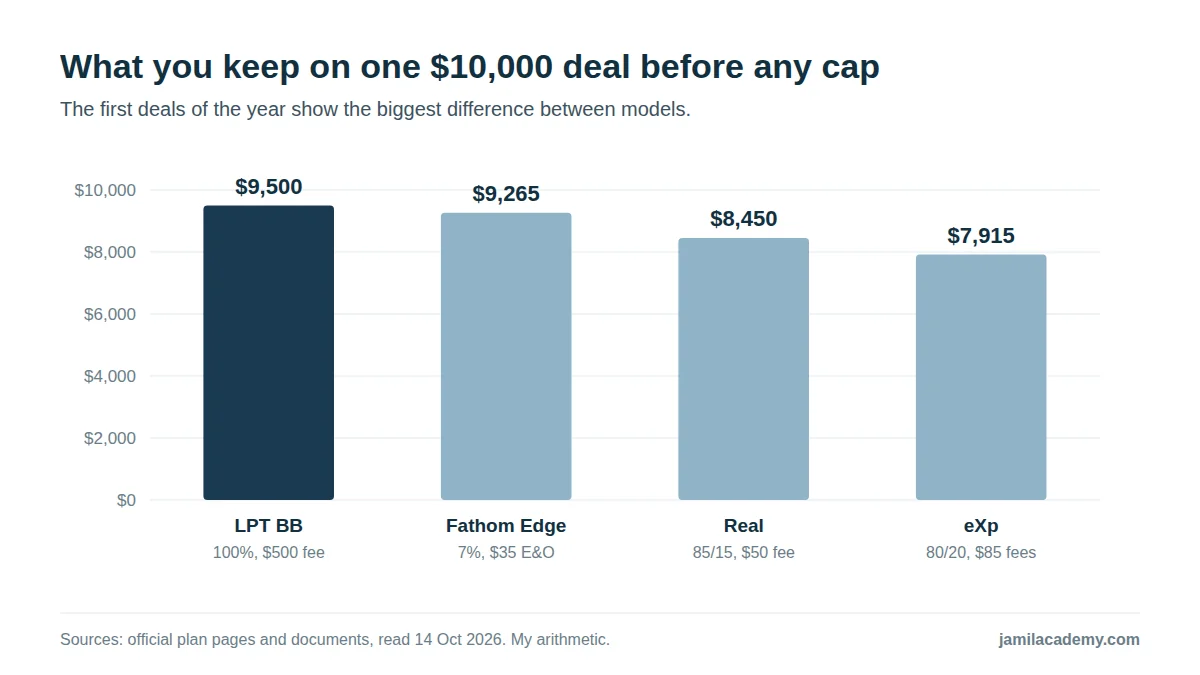
On one $10,000 deal, per-deal charges alone run from $500 at LPT to $2,085 at eXp, a $1,585 difference before monthly and yearly fees. In a slow year, you may never reach the cap, so that gap repeats on every deal.
Small deals and minimum fees
Minimum fees hit small deals hardest. On a $3,000 commission, Fathom's 7 percent is $210, but its $350 minimum applies. That is almost 12 percent of the commission.
At LPT, an April 2025 reply in the comments on its help-center fee article said deals under $2,500 of commission are treated as low-GCI: "the standard fees do not apply" and "a 20% risk management fee is collected."
A June 2024 reply from a support lead said agents can opt out of the 20 percent and pay the full fees instead. These are comment replies, not the plan document, so confirm with LPT.
When your cap year starts
Caps reset once a year. Fathom and eXp both describe their caps by anniversary year, the year that starts when you join.
If you join just before your busy season, you may hit the cap sooner. If you join in a slow month, more of your early deals pay the full split.
My view: if you work a lot of rentals or low-priced homes, price your typical small deal on every plan. It can change the winner.
How do Realty ONE Group, HomeSmart and United price 100 percent?
Short answer: none publishes a national fee schedule. Realty ONE Group and HomeSmart fees vary by office or market, and United does not print its flat fee. Ask the local office for its plan.
Realty ONE Group
Realty ONE Group's join page says agents keep 100 percent of their earned commissions. It prints no fees. Its offices are franchises.
When I priced office pages for my Realty ONE Group review, monthly fees ran from $0 to $300 and transaction fees from $200 to about $1,700.
The same review found E&O charges of $450 at one office and $895 at another. One office ran a 93/7 split to an $11,111 cap, and another offered a 90/10 option.
Those are office examples from August 2026, not brand-wide terms. Your local office may differ.
HomeSmart
HomeSmart calls itself the "Nation's Top 100% Commission Brokerage." Its franchise page lists "25,000+ agents" and brokerages in 48 states, each "independently owned & operated."
Its FAQ says it has "over 250 branch offices."
Its join page says plans start "at $25 a month." Agents pay a monthly fee, a flat transaction fee and a risk reduction fee. HomeSmart does not publish those amounts and asks agents to request local plans.
United Real Estate
United said in June 2025 that it charges "a flat fee to provide agents with marketing, training and development." It reported over 22,000 agents and 170 offices in 35 states.
I found no United fee amount on an official page. Local offices may publish their own.
My view: a franchise 100% model can be a great deal or an average one. The local owner decides. Get the schedule in writing and run it through the calculator.
What do you give up for 100% commission?
Short answer: usually some support, and sometimes revenue share. Lower fees leave the brokerage less to spend on you.
Revenue share and stock
- LPT: its 2023 plan document says "Business Builders do not receive income from Revenue Share Pool." That pool is shared among eligible upline agents. The document's revenue-share plan is its 80/20 Rev Share Partner plan.
- Fathom: its revenue share is based on the 7 percent split, with five levels.
- eXp: its income page says "The median revenue share for a typical (Tier 1) agent is $0."
- Real: it runs a revenue share program on its capped plan, which I cover in my Real Broker review.
eXp also offers an ICON award of "Up to $16,000 in stock" for top producers. Its income page adds: "Most agents earn limited or no equity."
Revenue share depends on recruiting other agents. For most agents, eXp's own disclosure suggests it adds little. Price the plan without it first.
Training, leads and office support
A traditional split pays for things: an office, a manager, training, and sometimes leads. A flat-fee plan expects you to bring your own business.
Ask each brokerage what the fee includes. Who answers your contract questions on a Saturday? Who reviews your files? How fast?
Brand
A strong local brand can help win listings. A flat-fee brokerage may be less known to sellers in your area. Whether that matters depends on how you get clients.
My view: if most of your business comes from your sphere and repeat clients, a flat-fee plan can make sense. If you rely on the brokerage for leads or training, it often does not.
How do teams work on these plans?
Short answer: most brokerages give team members a lower cap. The team leader usually sets the member's split on top of that.
- Fathom Edge: team leader cap $9,000, team member cap $4,500. A two-person Partner Team shares one $9,000 cap and one $75 monthly fee.
- Real: $12,000 cap for agents and team leaders, $6,000 for team members.
- Epique: Traditional and Family Teams get a $10,000 cap and a $99 monthly fee. Power Teams get a $5,000 cap, with at least $40 million in volume or 140 transactions a year.
- LPT, HomeSmart, United and Realty ONE Group: I found no published team terms.
The brokerage's team cap is only half the picture. Your team leader may take a share of each deal before the brokerage's fees apply. Ask for both in writing.
My view: a team can make sense if it gives you leads. If it does not, a solo flat-fee plan usually leaves you more.
Is a 100% commission brokerage good for new agents?
Short answer: often not in year one. New agents usually need training and help with contracts more than a low fee.
In a first year with a few deals, the dollar gap between plans is smaller than it looks. On $30,000 of commission, my numbers put LPT at $2,000 and eXp at $7,275 a year.
That eXp figure leaves out its Mentor Program, which adds a 20% split on the first three deals for agents in it.
That $5,275 matters. But one lost deal from a contract mistake can cost more. Pick the brokerage that will help you close your first deals.
Watch the new-agent rules
- eXp says agents in its Mentor Program pay an additional 20% split on their first three transactions.
- Minimum fees hurt small first deals, such as rentals.
- Some brokerages require experience for their best plans. Century 21 Redwood's policy manual says of its cap plan: "This is for experienced Agents only."
My view: a new agent should choose for training first and price second. Revisit the decision after 12 months, when you know your real numbers.
How are you paid at a 100% brokerage in Virginia?
Short answer: through your principal broker, like any other Virginia agent. A client cannot pay you directly unless your principal broker gives prior written consent.
Virginia's regulations list some payments as improper dealings. A salesperson or associate broker may not accept a commission "from any person or entity except the" licensee's principal broker or supervising broker.
The exception is "the prior written consent of the licensee's principal broker." Principal brokers must also ensure "proper supervision and accountability over the firm's day-to-day financial dealings."
Sources: 18VAC135-20-280 and 18VAC135-20-260, Virginia Administrative Code, read 14 October 2026.
So at a 100% brokerage, your commission still goes to the brokerage first. It then pays you, less its fees. Ask how fast that happens after closing.
Virginia also sets duties for supervising brokers in 18VAC135-20-165. A flat-fee firm must meet the same supervision rules as any other.
Maryland and DC have their own rules. Check with your state's real estate commission before you rely on any arrangement.
My view: a low-fee brokerage still has to supervise you properly. Ask who your principal broker is and how to reach them.
How should you choose between flat-fee and capped plans?
Short answer: decide by income, deal count and the support you need. Here is how the numbers in this guide sort out.
If you earn under about $50,000 a year
The gap between the cheapest and dearest plan was about $5,300 at $30,000 and $8,400 at $50,000 in my math. Support and training still matter more. A brokerage that helps you close one more deal can cover that.
If you earn $50,000 to $150,000
This is where most agents feel the difference. On $100,000, the published plans in this guide ranged from $5,500 to $17,870 a year. Check your deal size before choosing.
If you earn over $150,000
The dollar gap is largest here: at $200,000, the plans ranged from $5,500 to $18,720. As a share of income it is smaller. Revenue share and team terms may decide it.
My view: write down the three things you need most from a brokerage. Then pick the lowest-cost plan that gives you all three.
What costs does a 100% brokerage leave to you?
Short answer: most of the costs of finding and serving clients. A low brokerage fee often means you pay for more yourself.
Before you compare plans, list what your current brokerage pays for. Then check whether the new one covers it. Common items include:
- Marketing: signs, photos, print and online ads.
- Lead generation: any paid leads or portals.
- Software: a CRM, e-signature and transaction tools.
- Help with files: a transaction coordinator, if the brokerage has none.
- Office space: a place to meet clients, if you need one.
- Training and coaching: classes or a coach you buy yourself.
Board, association and MLS dues stay the same wherever you go, in most markets. E&O may be included in a brokerage fee or billed on its own.
My view: add your own yearly costs to each plan's total. A $5,000 fee saving can vanish if you now pay $6,000 for things the old brokerage covered.
How do you switch to a 100% brokerage?
Short answer: plan your pending deals and listings first, then move your license. The order matters, because listings and pending deals usually belong to your current broker.
- Read your current contract. Check notice periods and what happens to pending deals.
- List every active listing and pending deal. Ask how each will be handled and paid.
- Get the new brokerage's agreement and fee schedule in writing before you resign.
- Transfer your license through your state's real estate board, and update your MLS and association.
- Tell your clients in a short, professional note once the move is final.
Do not take files, client lists or listing materials that belong to the brokerage without permission. Ask your managing broker what you may keep.
My view: most agents who lose money in a move lose it on pending deals, not fees. Settle those terms in writing first, and keep a dated copy of every agreement you sign.
What should you ask before you join a 100% brokerage?
Short answer: ask for the full fee schedule and the contractor agreement. Then ask these questions.
- What do I pay per deal, and is there a yearly cap on it?
- What do I pay each month or year, and what does it include?
- Is there a minimum fee per deal? What about small deals and rentals?
- Which fees are charged to clients, and who pays if the client refuses?
- How is E&O billed?
- Do I earn revenue share or stock on this plan?
- Who supervises me, and who reviews my files?
- How fast am I paid after closing?
- What happens to my listings and pending deals if I leave?
Compare every answer with a capped plan such as eXp before you decide. The calculator above does the math.
My view: the best 100% brokerage answers all of this in writing, without pressure. Vague answers about fees are a warning sign.
What I could not verify
These are the gaps I hit while checking sources. Be careful with any page that fills them with a confident number.
- A current, dated LPT fee schedule. The only official figures are in a document valid through March 2023.
- HomeSmart, United and Realty ONE Group national fees. None is published.
- Epique's individual cap and exact individual monthly fee. Its join page prints team caps only.
- A neutral definition of 100% commission. I found only brokerage definitions.
- JPAR and EXIT terms. Their pages did not load or were blocked for me.
- Whether Fathom's $350 minimum counts toward its cap. I assumed it does.
- Whether LPT's $195 fee continues after its cap. Not stated.
Frequently asked questions
What does 100% commission mean in real estate?
You keep your whole commission and pay the brokerage flat fees instead of a percentage. Fees are per deal, monthly, or both.
Which brokerage has the lowest fees?
Of the four published plans I priced, LPT's Business Builder cost least, $5,500 on $100,000. Its official figures date from 2023.
Is Fathom a 100% commission brokerage?
Not exactly. Its Edge plan takes 7 percent of each deal until a $9,000 cap, then $165 a deal.
Is eXp a 100% commission brokerage?
No. eXp is 80/20 until a $16,000 cap. After the cap you keep 100 percent, minus per-deal fees.
Is Realty ONE Group really 100% commission?
Its join page says agents keep 100 percent. Each office sets its own fees, so ask for the local schedule.
How much does HomeSmart charge?
HomeSmart says plans start at $25 a month, plus transaction and risk fees. It does not publish the amounts.
Is a 100% commission brokerage good for new agents?
Often not in year one. Training and help with contracts usually matter more than a lower fee.
Do you get revenue share at a 100% brokerage?
It depends. LPT's 2023 plan document says Business Builders do not receive revenue share.
Can a client pay a Virginia agent directly?
Not without your principal broker's prior written consent. Virginia rules say a salesperson may accept pay only from their principal or supervising broker unless the principal broker consents in writing beforehand.
Saad Jamil is a Realtor with Samson Properties in Chantilly, Virginia, licensed in Virginia, DC, Maryland and West Virginia. His sales record and client reviews are on his Zillow profile. He runs Jamil Academy, which sells training to agents. He is not affiliated with any brokerage in this guide. This is general information, checked on 14 October 2026.
Free: 5 Ways to Get More Listings Without Cold Calling
Five lead strategies that work without cold calls or ad spend, from an agent with $500M sold and 900+ homes closed.
No spam. Unsubscribe any time.
Your Coach