How to Become a Realtor (2026): Steps, Hours by State, and What It Costs to Start
Nov 02, 2026
To become a Realtor, you first get a real estate license from your state. Then you join a local Realtor association, which makes you a member of the National Association of REALTORS® (NAR). Only NAR members can call themselves Realtors.
The license is the bigger job. In the 14 jurisdictions in this guide, pre-licensing education runs from 40 hours in Michigan to 180 hours in Texas. Then you pass a state exam, clear any background check and work under a sponsoring broker.
Every fact below comes from NAR, the Bureau of Labor Statistics (BLS), state licensing agencies, state statutes or exam bulletins that a state links to. All were read on 2 November 2026 unless I say otherwise.
Where I stand: I am a Realtor with Samson Properties, licensed in Virginia, DC, Maryland and West Virginia, and I run Jamil Academy, which sells training to agents. This guide is built from official pages. The one product block near the end is my own.
Quick answer
- Realtor vs agent: a licensed agent holds a state license. A Realtor is a licensed agent, or a licensed or certified appraiser, who also belongs to NAR.
- Minimum age: 18 in all 14 jurisdictions covered here.
- Pre-licensing hours: 40 (Michigan) to 180 (Texas). Virginia, Maryland and DC each require 60.
- Exam: a state exam, often run by a vendor such as PSI or Pearson VUE. California and New York run their own.
- Broker: in the states that say so, you must be sponsored by or affiliated with a licensed broker to practice.
- NAR dues for 2026: $156 national dues plus a $45 Consumer Advertising Campaign assessment. Local and state dues are separate.
- After you join: NAR requires a Code of Ethics orientation of at least 2 hours 30 minutes, plus fair housing training.
- Realtor vs real estate agent: what is the difference?
- How to become a Realtor: the steps most states share
- How many pre-licensing hours does each state require?
- How long will your course take? Try the license path planner
- What deadlines and time limits do states set?
- What is the licensing exam like, and who runs it?
- Do you need a background check or fingerprints?
- How do you choose a sponsoring broker?
- How do you join NAR and become a Realtor?
- What comes after the license: post-licensing and first renewal
- What does it cost to start?
- How many real estate jobs are there, and what does the work pay?
- What I could not verify
- Frequently asked questions
Realtor vs real estate agent: what is the difference?
Short answer: a real estate agent is anyone holding a state license to help people buy and sell property. A Realtor is a licensed professional who has also joined NAR and agreed to its Code of Ethics. Every Realtor who sells homes is an agent, but not every agent is a Realtor.
NAR defines the word as a trademark, not a job title:
NAR, Membership Marks Manual, definition of REALTOR
In short: "Only members of NAR can call themselves a REALTOR®."
| Licensed real estate agent | Realtor | |
|---|---|---|
| Granted by | Your state's licensing agency or commission | NAR, through a local Realtor association |
| What it takes | Pre-licensing course, state exam and an application, plus a background check in some states | A state license (or appraiser license or certification), then association membership and dues |
| Ethics rules | State license law | State license law plus NAR's Code of Ethics |
| Needed to practice? | Yes. BLS: "All states require real estate brokers and sales agents to be licensed." | No. It is a membership you choose after licensing |
Sources: NAR Membership Marks Manual, definition of REALTOR (published 4 May 2017), NAR "How to Become a REALTOR" page (published 1 January 2025) and the BLS Occupational Outlook Handbook (last modified 27 August 2026), read 2 November 2026.
Why the ethics part matters
NAR's how-to page says: "NAR members agree to abide by NAR's Code of Ethics." It adds that agents who are not members "aren't obligated to adhere to the same ethical standards as REALTORS®."
How big is NAR?
NAR reported that "As of June 18, NAR membership stood at 1,439,163," in an article dated 25 June 2026. It said this was "down only slightly from 1,463,352 a year ago." That is about 1.44 million members.
That is a member count, not a count of working agents. I explain why it differs from BLS job figures further down.
Source: NAR, "Even in a tougher market, Realtors are holding their ground," 25 June 2026, read 2 November 2026.
Agent, salesperson, broker: the license names differ
States use different names for the entry license. Most call it a salesperson license. Texas says sales agent and Florida says sales associate. Illinois calls its entry license a broker license, and North Carolina calls it a provisional broker.
For how an agent license differs from a full broker license, see my guide to real estate broker vs agent.
My view: plan around the license first. NAR membership is a later decision, and it only matters once you can legally practice.
How to become a Realtor: the steps most states share
Short answer: finish a state-approved course, pass the exam, clear any background check, apply with a sponsoring broker, then join a Realtor association. The details vary by state.
BLS says: "Minimum requirements for candidate licensure vary by state but typically include being at least age 18," and "having a high school diploma or equivalent, completing prelicensing courses, and passing an exam."
BLS adds: "Some states have additional requirements, such as passing a background check."
Source: BLS Occupational Outlook Handbook, Real Estate Brokers and Sales Agents, last modified 27 August 2026, read 2 November 2026.
The eight steps, with an official example of each
- 1. Meet the minimum age. Texas: "18 years of age or older." New York: "Be 18 years old." Georgia: "Must be at least 18 years of age."
- 2. Meet any education rule. Georgia: "Must be a high school graduate or the holder of a certificate of equivalency." Florida also asks for a high school diploma.
- 3. Finish pre-licensing education. New York: "Have successfully completed 77 hours of approved qualifying education."
- 4. Clear a background check, where required. California: "Applicants must also be fingerprinted at a Live Scan service provider."
- 5. Pass the state exam. Virginia: "pass the state and national portions of the examination."
- 6. Find a sponsoring broker. Texas: "A sales agent must be sponsored by a licensed Broker in order to perform any act of real estate services."
- 7. Apply for the license within your state's deadline. Georgia gives you three months from the exam date.
- 8. Join a local Realtor association if you want to be a Realtor. That is NAR's own step 2: "Join Your Local REALTOR® Association."
Sources: TREC, New York DOS, Georgia Real Estate Commission, Florida Real Estate Commission, California DRE, Virginia DPOR and NAR, read 2 November 2026.
Some states add a step after the license: a post-licensing course you must finish within a set time after licensing. That is covered further down.
My view: line up a broker while you study. It is the step people leave to last, and it can hold up an otherwise finished application.
How many pre-licensing hours does each state require?
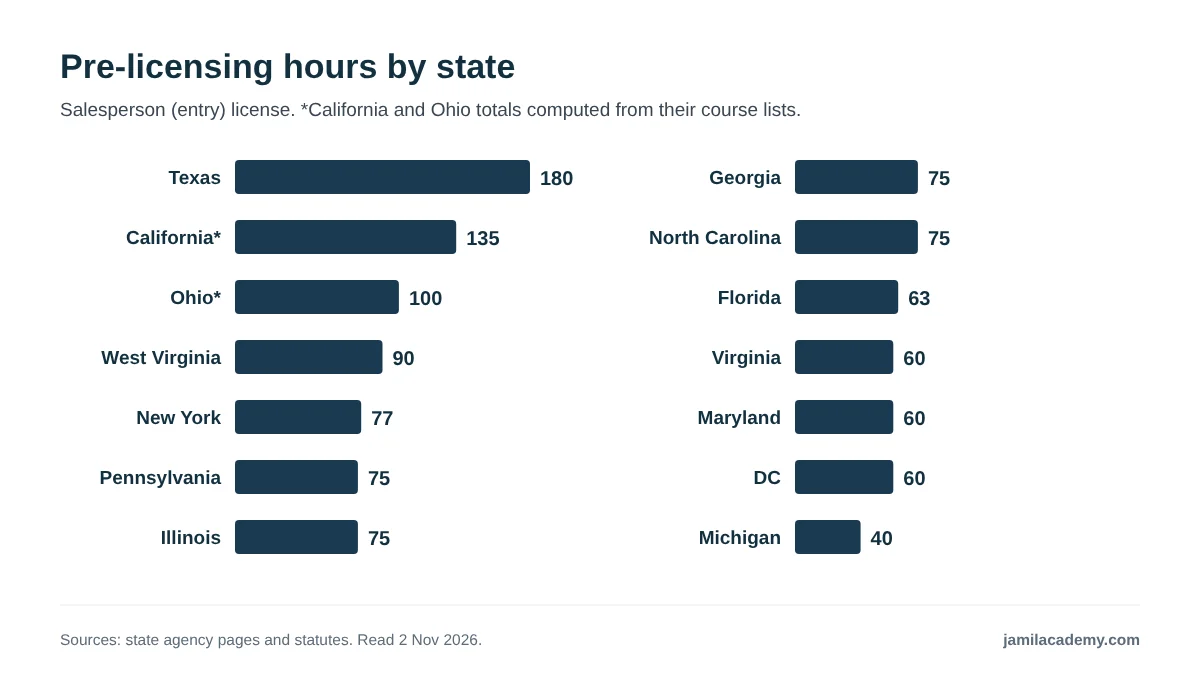
Short answer: between 40 and 180 hours across the 14 jurisdictions below. Nine of them sit at 60 to 77 hours. Texas and California ask for the most.
| Jurisdiction | Pre-licensing hours | Entry license | Exam vendor (official page) |
|---|---|---|---|
| California | 135 (computed) | Salesperson | Not named on the official page (the DRE runs the exam) |
| Texas | 180 | Sales agent | Pearson |
| Florida | 63 | Sales associate | Pearson VUE |
| New York | 77 | Salesperson | Not named on the official page (the Department of State gives the exam) |
| Pennsylvania | 75 | Salesperson | Pearson VUE |
| Illinois | 75 | Broker | PSI |
| Ohio | 100 (computed) | Salesperson | Not named on the official page |
| Georgia | 75 | Salesperson | PSI |
| North Carolina | 75 | Provisional broker | PSI/AMP |
| Michigan | 40 | Salesperson | PSI |
| Virginia | 60 | Salesperson | PSI |
| Maryland | 60 | Salesperson | PSI |
| District of Columbia | 60 | Salesperson | PSI |
| West Virginia | 90 | Salesperson | Not named on the official page |
Sources: California DRE, TREC, Florida Real Estate Commission, New York DOS, Pennsylvania, Illinois IDFPR, Ohio Commerce, ORC 4735.09, Georgia Real Estate Commission, NCREC, Michigan LARA and Virginia DPOR, read 2 November 2026.
Also Maryland MREC, DC Real Estate Commission, West Virginia REC and PSI's Illinois bulletin, read 2 November 2026. Maryland's vendor comes from my October 2026 check of MREC's exam page.
Notes on the numbers
- California, 135 hours (computed). The DRE requires "three college-level courses" and says each approved course "is a minimum of 45 hours in length." The DRE does not print 135.
- Ohio, 100 hours (computed). Ohio lists four courses: 40 hours of principles and practices, 40 of Ohio real estate law, 10 of appraisal and 10 of finance. Neither the agency page nor the statute prints a total, and neither supports 120.
- Texas, 180 hours: six 30-hour qualifying courses.
- Illinois, 75 hours. IDFPR says "The pre-license education requirement is now 75 hours." An older IDFPR instruction sheet from 2018 still says 90 hours and age 21. The newer sources say 75 hours and age 18.
- Michigan, 40 hours, which "includes at least 4 hours of civil rights law and equal opportunity in housing."
- West Virginia, 90 hours: "ninety (90) clock-hours, equivalent to six (6) college credit hours."
Every one of the 14 sets 18 as the minimum age. Illinois says applicants must be at least 18 years old, "previously 21."
Guides for Virginia, Maryland and DC
Virginia, Maryland and DC each require 60 hours, and each has its own rules on exams, deadlines and reciprocity. My detailed guides: my step-by-step Virginia licensing guide, my guide to the Maryland real estate license and my guide to getting a DC real estate license.
My view: hours are not the same as difficulty. A 60-hour course still needs serious exam prep, so budget study time beyond the classroom hours.
How long will your course take? Try the license path planner
Short answer: at 10 study hours a week, Virginia's 60-hour course takes about 6 weeks and Texas's 180 hours about 18 weeks. Pick your state and enter the hours you can study each week.
Hours, vendors and post-licensing rules from official pages read 2 November 2026 (some Maryland and DC items in October 2026); California and Ohio totals computed from their course lists. Weeks are hours divided by your weekly hours, rounded up. They cover course time only, not exam prep, the exam or processing. Schools may set their own pace rules.
Weeks are rounded up to a whole week, so 135 hours at 10 a week shows 14 weeks. No official source I read says how many weeks a course should take, so this measures your own pace, not a legal limit.
My view: be honest about your weekly hours. Five steady hours a week beats twenty planned hours you never find.
What deadlines and time limits do states set?
Short answer: no official source I found gives a typical start-to-finish time. States do set deadlines for individual steps. Those deadlines matter more than any average.
| Jurisdiction | Time limit | Source |
|---|---|---|
| Texas | "You have one year from the date your application is filed to meet all the license requirements." | TREC sales agent page |
| California | Two years from when the DRE receives your application to qualify and pass the exam, or it expires (paraphrase) | DRE exam and license page |
| Georgia | Apply "within three months from the date of the examination" | GREC Rule 520-1-.04 |
| Florida | The pre-licensing course is valid for 2 years after you finish it (paraphrase) | Florida RESL requirements |
| Maryland | Pass both exam portions within 1 year of finishing the course, then apply within 1 year of passing | MREC, checked October 2026 |
| DC | Pass a failed portion within 6 months; apply within 6 months of passing | DCREC and PSI, checked October 2026 |
| North Carolina | License "should be received in the mail within seven days of the examination date" after passing and clearing character review | NCREC licensing FAQ |
Sources: TREC, California DRE, Georgia Real Estate Commission Rule 520-1-.04, Florida Real Estate Commission and NCREC licensing FAQ, read 2 November 2026. Maryland and DC limits come from my October 2026 checks of their official pages.
Course length is fixed in hours, from 40 in Michigan to 180 in Texas. Your calendar time depends on your pace, the school's schedule and how quickly you book and pass the exam.
For what that looks like in practice, see my guide to how long real estate school takes.
My view: write your state's deadlines on a calendar the day you enroll. Missing an application window can mean sitting the exam again.
What is the licensing exam like, and who runs it?
Short answer: a state licensing exam, usually run by a testing vendor the state names. PSI is the most common vendor in this guide. California and New York run their own exams.
Who runs the exam in each jurisdiction
- PSI: Illinois, Georgia, Michigan, Virginia, Maryland and DC. North Carolina's commission says "schedule your exam with PSI/AMP online or by phone."
- Pearson VUE: Florida, whose Department "has retained the services of Pearson VUE to schedule, administer, score and report the results," and Pennsylvania.
- Pearson: Texas. TREC says "License exams are administered by Pearson, a testing service company."
- The state itself: California, where "DRE normally conducts examinations in public buildings," and New York, where the Department of State gives the exam through eAccessNY.
- Not named: Ohio says "The testing vendor will send a Candidate Information Bulletin." West Virginia says "you will receive an email from the testing vendor." Neither page names it.
Sources: state agency pages listed under the hours table, Florida's sales associate exam CIB (effective January 2025) and PSI's Illinois bulletin (6/24/2026), read 2 November 2026.
Older documents can name a different vendor. A 2012 Georgia education manual names AMP, and a 2018 Illinois sheet also names AMP. Current official pages for both say PSI.
What the exam covers
Formats differ by state. Virginia, for example, requires you to "pass the state and national portions of the examination." Check the candidate bulletin your state links to for the question count, time limit and passing score.
Before you book, work through a set of practice exam questions to find your weak topics.
Do many people fail?
Yes, official data show many candidates do not pass on a given attempt. I found three official figures. They measure different things, so they cannot be compared with each other.
| Jurisdiction | Figure | What it measures |
|---|---|---|
| California | 64% passed | First-time salesperson candidates, FY 2023/24 (14,713 candidates) |
| Florida | 52% first-time, 34% repeat, 44% overall | Sales associate exams in one month only, March 2024 |
| Maryland | 36% pass rate | All salesperson exam attempts, FY 2026 (14,641 exams) |
Sources: California DRE 2024 Sunset Review Report (Table 8), Florida March 2024 exam summary and MREC July 2026 minutes, read 2 November 2026.
California counts first-time candidates over a year. Florida's figure covers one month and splits first-timers from repeaters. Maryland's counts every attempt, so repeat sittings are included.
California's first-time rate was 61% to 65% in each of the three years before. Texas publishes pass rates by school, but its statewide figure did not load when I checked.
My view: treat a first-attempt pass as a goal, not a given. Budget time for a possible retake so it does not push you past an application deadline.
Do you need a background check or fingerprints?
Short answer: it depends on the state. Eight of the 14 jurisdictions require fingerprints or a criminal history report; for others I found no such rule on the pages I read. Check your own state's application before you enroll.
| Jurisdiction | What the official source says |
|---|---|
| California | "Applicants must also be fingerprinted at a Live Scan service provider." |
| Texas | "You are required by law to have fingerprints on file with the Texas Department of Public Safety (DPS)" |
| Florida | "Submit a completed application, electronic fingerprints, and appropriate fee." |
| New York | Not mentioned on the Department of State salesperson page or FAQ |
| Pennsylvania | A recent Criminal History Records Check (CHRC), "dated within 180 days of the date the application is submitted" |
| Illinois | Not mentioned on the IDFPR page or the PSI bulletin I read |
| Ohio | "You must complete state and FBI criminal records checks." |
| Georgia | A criminal history or GCIC report, obtained "No more than 60 days prior to making application" and brought to the PSI test center |
| North Carolina | Criminal history "obtained within 6 months prior to license application" |
| Michigan | Not mentioned; the guide asks a good moral character question and about past criminal judgments |
| Virginia | Check the current DPOR salesperson application. The DPOR web pages I read do not mention fingerprints |
| Maryland | No fingerprint requirement found in the statute, regulations or MREC pages. A July 2026 MREC meeting noted the idea is being monitored for a future legislative session |
| DC | No official source found that requires fingerprints |
| West Virginia | "Complete National Criminal Background Check" and "Submit fingerprints for national criminal history check." |
Sources: California DRE, TREC, Florida Real Estate Commission, Pennsylvania, Ohio Commerce, Georgia Real Estate Commission, NCREC, Michigan LARA and West Virginia REC, read 2 November 2026. Maryland and DC from my October 2026 checks.
"Not mentioned" means only that the pages I read did not say. It does not mean those states never check. Application forms often ask about convictions even where no fingerprint step is listed.
Timing matters
Some reports expire. Pennsylvania's must be dated within 180 days of your application. Georgia's within 60 days, and North Carolina's within 6 months. Order yours too early and you may pay twice.
My view: if you have any record, ask your state agency how it is reviewed before you pay for a course. It is cheaper to learn the answer first.
How do you choose a sponsoring broker?
Short answer: in the states whose rules I quote here, a new licensee needs a licensed broker to sponsor them before they can practice. Pick one for training and support, not just the split.
Texas says: "A sales agent must be sponsored by a licensed Broker in order to perform any act of real estate services." Michigan says: "You are required to have a licensed individual broker or broker company sponsor you to become licensed."
Can you get licensed without a broker?
In some states, yes, but your license is inactive. Virginia's application asks: "Are you applying for active license status with a licensed real estate firm or sole proprietor?" If you answer no, the license is issued inactive.
Florida says to "Activate the license, otherwise the license is issued in an inactive status." Pennsylvania sends your license to "your broker's main office in 7-10 business days after date of issue."
Sources: TREC, Michigan LARA guide (revised 1/26/2026), Virginia DPOR application (07/01/2026), Florida Real Estate Commission and Pennsylvania, read 2 November 2026.
Most agents work as independent businesses
BLS reports that 54% of real estate sales agents and 55% of brokers are self-employed.
Source: BLS Occupational Outlook Handbook, last modified 27 August 2026, read 2 November 2026.
I go through what to compare, and the questions to ask in interviews, in my guide to choosing the right brokerage as a new agent.
My view: as a new agent, weigh training, mentoring and access to a managing broker above the commission split. A better split on no deals is worth nothing.
How do you join NAR and become a Realtor?
Short answer: once licensed, join your local Realtor association and pay the dues. That brings state and national membership with it. Then complete NAR's Code of Ethics orientation and fair housing training.
NAR's how-to page lists three steps:
- "Become a Licensed Real Estate Agent or Licensed / Certified Real Estate Appraiser"
- "Join Your Local REALTOR® Association"
- "Pay Membership Dues"
The page says joining a local association also gives you state and national membership (my paraphrase).
NAR dues for 2026 and 2027
| Year | National dues | Consumer Advertising Campaign assessment | Source |
|---|---|---|---|
| 2026 | $156 | $45 | NAR Board of Directors report, 5 June 2025 |
| 2027 | $156 | $45 | NAR dues page; NAR news, 18 June 2026 |
Sources: NAR's 5 June 2025 board report, its dues information page and its 18 June 2026 dues article, read 2 November 2026.
For 2026, the board kept "dues at $156." The same report refers to "the $45 Consumer Advertising Campaign assessment." For 2027, NAR says "The National Association of REALTORS® dues are $156 per member."
Local and state association dues are separate from NAR's national dues. I found no NAR page that gives those amounts, so ask the local association you plan to join.
NAR's how-to page still shows only 2023 and 2024 dues ($150 and $156, plus $45), so rely on the newer board reports.
Training NAR requires
| Requirement | Minimum time | When |
|---|---|---|
| Code of Ethics orientation (new members) | 2 hours 30 minutes | On joining; NAR's page states no deadline in days |
| Code of Ethics training (existing members) | 2 hours 30 minutes | Every three years; current cycle 1 January 2025 to 31 December 2027 |
| Fair Housing / Anti-Bias training | 2 hours | On becoming a member, then every three years; first deadline 31 December 2027 |
Sources: NAR's ethics training pages for new and existing members, its training cycles page (1 January 2025) and its fair housing page (4 September 2024), read 2 November 2026.
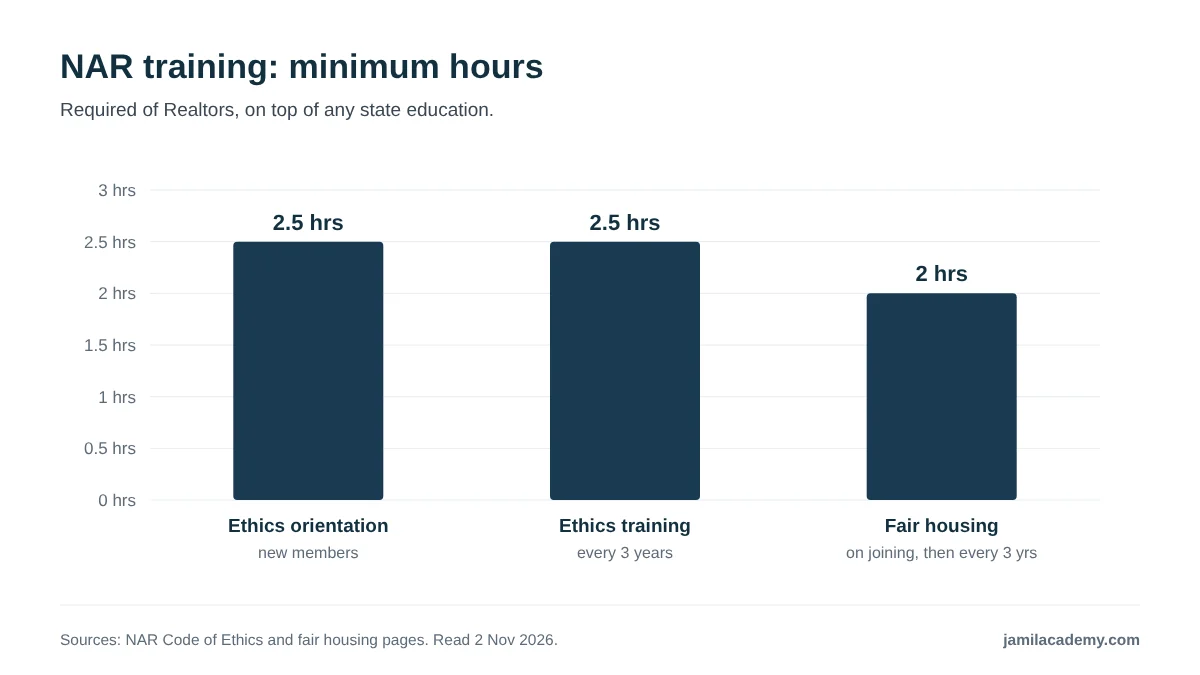
NAR says the orientation must be "not less than 2 hours and 30 min. of instructional time." A member who finishes the orientation during a cycle does not need more ethics training until the next three-year cycle starts.
Fair housing is a separate requirement: "REALTORS® are required to complete Fair Housing / Anti-Bias Training upon becoming a member," then every three years.
My view: if your broker and local market expect Realtor membership, join once licensed. Treat the dues as a yearly business cost and ask what your local association adds on top.
What comes after the license: post-licensing and first renewal
Short answer: nine of the 14 jurisdictions here set a post-licensing course or special first-renewal education. Deadlines vary: the first year in Ohio and Georgia, 18 months in North Carolina, and a set date or first renewal in others. Missing one can put your license on inactive status, suspend it or let it lapse, depending on the state.
BLS puts it simply: "In most states, brokers and agents must complete continuing education courses to renew their license." It adds that "State licenses typically must be renewed every 2 to 4 years."
| Jurisdiction | Post-licensing or first-renewal rule |
|---|---|
| California | First renewal: 45 clock hours of DRE-approved continuing education, including ethics, agency, trust fund handling, risk management, fair housing and implicit bias courses. Licenses are issued for four years. |
| Texas | First renewal: 98 hours, made up of a 30-hour brokerage course, two 30-hour qualifying courses and 8 hours of TREC Legal Update I and II. TREC says these hours cannot be deferred. |
| Florida | A post-licensing course of at least 45 classroom hours, finished before your initial sales associate license expires. |
| New York | No post-licensing course found. Continuing education: 22.5 hours, including 3 hours of fair housing. |
| Pennsylvania | No post-licensing course in the sources I read. Continuing education: 14 hours in each 2-year license period. |
| Illinois | 45 hours of post-license education. Brokers first licensed on or after 1 November 2025 must finish it by 30 April 2028. |
| Ohio | 20 hours of post-licensing instruction within 12 months of the license being issued, or the license is suspended automatically. |
| Georgia | A 25-hour salesperson postlicense course in your first year. If you miss it, the license lapses. |
| North Carolina | 90 hours of postlicensing education, three 30-hour courses, within 18 months of initial licensure. |
| Michigan | No post-licensing course found. Continuing education: at least 18 clock hours in each 3-year cycle. |
| Virginia | 30 hours of post-license education instead of continuing education for your first renewal. If your license is active, finish it within your first year. |
| Maryland | Maryland does not recognize post-licensing education. Your first renewal needs 15 hours of continuing education in set topics. |
| District of Columbia | No DC post-licensing requirement found. Salespersons need 15 hours of continuing education per cycle; the current cycle ends 31 August 2027. |
| West Virginia | No post-licensing or first-renewal rule found on the pages I read. |
Sources: California DRE, TREC renewal page, Florida RESL requirements, New York DOS FAQ, Pennsylvania, IDFPR CE fact sheet, ORC 4735.09 and Georgia Real Estate Commission, read 2 November 2026.
Also N.C. G.S. 93A-4, Michigan LARA, Virginia Real Estate Board and its post-license page, read 2 November 2026. Maryland (MREC) and DC from my October 2026 checks.
Virginia's 30-hour post-license program
Virginia's board says: "All salespersons (active or inactive) renewing their licenses for the first time must complete 30 hours of post-license education (instead of continuing education)."
The program is nine courses, from 2 to 6 hours each, covering topics such as fair housing, agency law, contract writing and escrow. Active new salespersons finish "within one year from the last day of the month in which the license was issued" or go inactive.
Texas: why you may see 270 hours
Texas's first renewal needs a 30-hour brokerage course, two more 30-hour qualifying courses and 8 hours of Legal Update I and II. That is 98 hours by my count.
TREC's FAQ mentions "a total of 270 hours of qualifying course hours." That is the 180 pre-license hours plus the 90 qualifying hours for first renewal. The 8 Legal Update hours come on top.
Maryland's first-renewal topics
For those licensed on or after 1 October 2023, the first renewal needs 15 hours in set topics, including contracts, brokerage relationships, property management and financing. MREC states: "Maryland does not recognize post-licensing education."
My view: book your post-licensing course in your first few months, while the exam material is fresh. It is easy to put off once deals start.
What does it cost to start?
Short answer: it depends on your state and your choices, so I do not give one national number here. The main costs are the course, the exam, the license fee, any background check, and Realtor dues if you join.
- Pre-licensing course: priced by each school.
- Exam: paid to the state's vendor or the state itself.
- License application: paid to your state agency.
- Background check or fingerprints: only where your state requires them.
- Realtor dues: $156 in NAR national dues plus a $45 assessment for 2026, plus local and state association dues.
- Ongoing costs: post-licensing or continuing education, renewal fees, and any fees your brokerage charges.
I break these down, with the fees I could verify, in my guide to what it costs to be a Realtor.
My view: budget for the first year, not just the license. Dues, education and marketing arrive before your first commission does.
How many real estate jobs are there, and what does the work pay?
Short answer: BLS counted 530,600 real estate broker and sales agent jobs in 2025. The median annual wage for sales agents was $52,830 in May 2025. Pay ranges widely.
| Measure | Figure (BLS) |
|---|---|
| Real estate sales agent jobs, 2025 | About 427,000 |
| Real estate broker jobs, 2025 | About 103,500 |
| All broker and sales agent jobs, 2025 | 530,600 |
| Median annual wage, sales agents, May 2025 | $52,830 |
| Lowest 10% of sales agents earned less than | $32,970 |
| Highest 10% of sales agents earned more than | $123,590 |
| Median annual wage, brokers, May 2025 | $73,220 |
| Median pay, brokers and agents combined, 2025 | $57,400 a year ($27.59 an hour) |
| Projected job growth, 2025 to 2035 | 2% (slower than average), about 8,300 jobs |
| Projected openings each year | About 40,400 |
| Typical entry-level education | High school diploma or equivalent |
Source: BLS Occupational Outlook Handbook, Real Estate Brokers and Sales Agents, last modified 27 August 2026, read 2 November 2026.
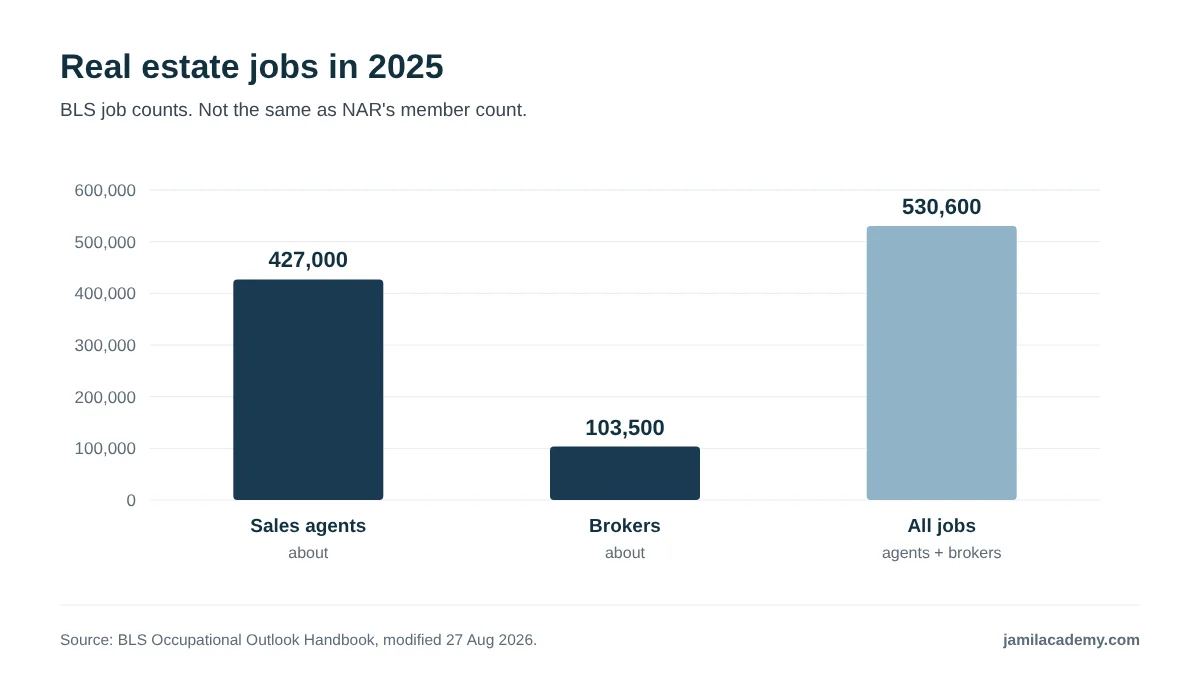
BLS says employment is "projected to grow 2 percent from 2025 to 2035." It also projects "about 40,400 openings for real estate brokers and sales agents" each year, on average, over the decade.
Why these numbers differ from NAR's
BLS counts jobs. NAR counts members, about 1.44 million as of June 2026, and its members include brokers, appraisers and people not actively selling. The two figures measure different things, so do not read either as the number of working agents.
A median is the middle figure, so half of sales agents earned more than $52,830 and half earned less.
My view: plan your first year as a business launch. Income depends on how fast you build a client base, so have savings to cover several months, because commission income can take time to arrive.
What I could not verify
These are the gaps I hit while checking sources. Treat any page that fills them with a confident number with care.
- Local and state Realtor dues. No NAR page I read gives the amounts or says how they are set.
- NAR's deadline for the ethics orientation. NAR's page sets the minimum hours but no number of days after joining.
- NAR's monthly member count file. It was blocked to my research tool, so I used NAR's June 2026 article.
- Virginia fingerprints. The DPOR web pages I read do not mention them. Check the current DPOR application.
- Illinois statute. The Illinois General Assembly page was blocked to my research tool, so Illinois facts come from IDFPR and PSI's bulletin.
- Pass rates for most states. Only California, Florida and Maryland figures were found. Texas's statewide figure did not load.
- Exam vendors for Ohio and West Virginia. Their official pages do not name one.
- New York details. The passing score, any fingerprint step and the first-term agency hour rule were not on the pages I read.
- West Virginia and Michigan post-licensing. None found on the pages I read.
- A typical start-to-finish timeline. No official source gives one.
- School, exam and license fees. Not covered here; see the cost guide linked above.
- Page dates. Most state pages show no date, so I give dates only where a page shows one.

Frequently asked questions
What is the difference between a Realtor and a real estate agent?
A real estate agent holds a state license. A Realtor is a licensed agent or appraiser who also belongs to the National Association of REALTORS® and agrees to its Code of Ethics.
Do you need a real estate license to become a Realtor?
Yes. NAR's first step is to become a licensed real estate agent, or a licensed or certified appraiser. Then you join a local Realtor association and pay dues.
How many hours of pre-licensing education do you need?
It depends on the state. In the 14 jurisdictions I checked, it ranges from 40 hours in Michigan to 180 hours in Texas. Virginia, Maryland and DC each require 60 hours.
How much are NAR dues in 2026?
NAR's national dues are $156 for 2026, plus a $45 Consumer Advertising Campaign assessment. Local and state association dues are separate, so ask the association you plan to join.
Who runs the real estate license exam?
It varies by state. PSI runs it in Illinois, Georgia, Michigan, Virginia, Maryland and DC, Pearson VUE in Florida and Pennsylvania, and Pearson in Texas. California and New York run their own.
Do all states require fingerprints for a real estate license?
No. Of the 14 jurisdictions I checked, eight require fingerprints or a criminal history report. For others I found no such rule on the official pages, so check your state's application.
Do you have to work under a broker?
To practice, generally yes. Texas says a sales agent must be sponsored by a licensed broker. Some states, such as Virginia and Florida, issue an inactive license if you have no broker.
What training does NAR require of new Realtors?
A Code of Ethics orientation of at least 2 hours 30 minutes, and at least 2 hours of fair housing training on joining. Both then recur in NAR's three-year cycles.
How much do real estate agents make?
BLS reports a median annual wage of $52,830 for real estate sales agents in May 2025. The lowest 10 percent earned less than $32,970 and the highest 10 percent more than $123,590.
Saad Jamil is a top 1 percent Realtor with Samson Properties in Chantilly, Virginia, licensed in Virginia, DC, Maryland and West Virginia since 2013, with more than $500 million in career sales and 900+ homes closed. Reviews and closed sales are on his Zillow profile. He runs Jamil Academy, which sells training to agents. This article is general information, not legal or financial advice, checked on 2 November 2026.
Free: 5 Ways to Get More Listings Without Cold Calling
Five lead strategies that work without cold calls or ad spend, from an agent with $500M sold and 900+ homes closed.
No spam. Unsubscribe any time.
Your Coach