Realtor Closing Gifts for Buyers (2026): Ideas, Budget, and the Rules That Apply
Nov 02, 2026
The best closing gifts for buyers are useful in the first month, personal to the client, or lasting in the home. Give one as a thank-you after closing, not as a promise made to win the business.
Realtor closing gifts also come with rules. The IRS caps the business gift deduction at $25 per person per tax year. Gifts to lenders or title agents raise RESPA questions, and state rules differ.
I read IRS Publication 463 (2025 edition), the CFPB's RESPA guidance, NAR's Code of Ethics, state commission pages and NAR's 2025 buyer and seller data on 2 November 2026.
Where I stand: I am a Realtor with Samson Properties in Virginia, and I run Jamil Academy, which sells training to agents. The gift ideas below are my opinion, with no brands or prices. The rules come from official sources, and none of this is tax or legal advice.
Quick answer
- Pick by purpose: useful in the first month, personal, lasting, or seen by guests. These ideas are my view.
- Budget: I found no official amount. My view: one standard amount per closing that you can afford on your smallest deal.
- Tax: per IRS Publication 463 (2025 edition), you can deduct no more than $25 for business gifts to each person during your tax year.
- Incidental costs such as wrapping and mailing are generally not counted toward the $25, if they add no substantial value.
- Referral partners: the CFPB says there is no RESPA Section 8 exception "solely based on the value of the gift or promotion."
- States differ: Colorado and Iowa expressly allow gratuitous gifts after closing that were not promised as an inducement. Maryland bars prizes and contests to influence a party.
- Alcohol: never mail it through USPS. Federal law makes intoxicating liquors nonmailable.
- Why do closing gifts for buyers matter?
- What makes a good realtor closing gift?
- Closing gift ideas for buyers, sorted by purpose
- How much should you budget for closing gifts?
- When and how should you deliver a closing gift?
- What should happen after the closing gift?
- Are realtor closing gifts tax deductible? The IRS $25 rule
- Is it a gift or entertainment for tax purposes?
- Closing gift budget and deduction check (calculator)
- Can you send gifts to lenders, title agents and referral partners?
- Do state rules limit closing gifts for buyers?
- Can you thank a past client for a referral with a gift?
- Can you give alcohol as a closing gift?
- What I could not verify
- Frequently asked questions
Why do closing gifts for buyers matter?
Short answer: most buyers use an agent, and many find one through a referral or a past relationship. A closing gift is one way to stay in that relationship. The data does not show that gifts cause referrals.
NAR's 2025 Profile of Home Buyers and Sellers, released 4 November 2025, covers transactions from July 2024 to June 2025. It is the latest edition I found.
| Figure | What it measures, exactly | Source |
|---|---|---|
| 88% | All home buyers who used an agent or broker | NAR press release |
| 91% | Sellers who used an agent | NAR press release |
| 91% | Buyers who "would use their agent again or recommend them to others" | NAR press release |
| 43% | Buyers who used an agent they found through a referral | Virginia REALTORS summary |
| 18% | Buyers who chose an agent they had worked with in the past | Virginia REALTORS summary |
| 66% | Sellers who found their agent through a referral or used an agent they had worked with before (one combined figure) | Virginia REALTORS summary |
| 5% | Recent home sales that were FSBO, "a historic low" | Virginia REALTORS summary |
Sources: NAR press release on the 2025 Profile (4 November 2025), and the Virginia REALTORS summary of NAR's 2025 Profile by Sejal Naik (8 December 2025), both read 2 November 2026.
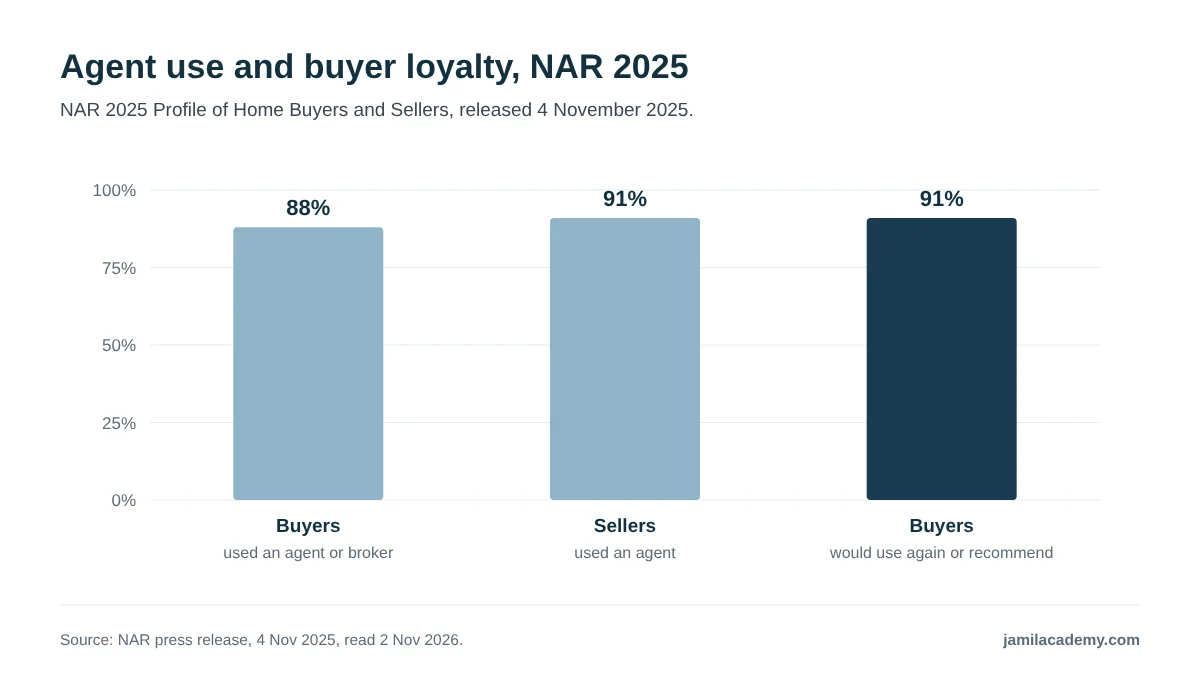
What these numbers mean, and what they do not
- The 91% is an intention. NAR's wording is "would use their agent again or recommend them to others." It is not a count of referrals made.
- Wording differs by source. The Virginia REALTORS summary leaves out "or recommend." I use NAR's own wording.
- 43% and 18% are separate groups of buyers. The source does not combine them, so I do not either.
- The 66% is one combined figure for sellers, not split into referrals and repeat clients. The source does not say who made the referrals.
- Repeated in 2026. NAR's Generational Trends release of 15 April 2026 again reported 91% saying they would use their agent again or recommend them.
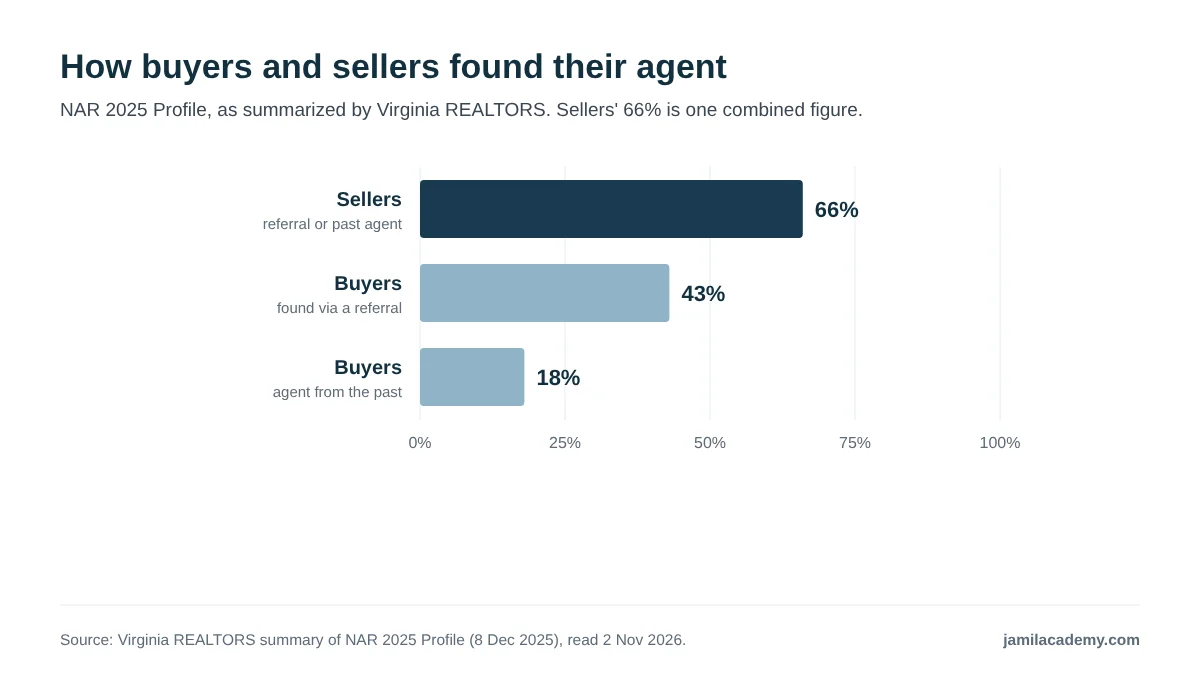
Source: Virginia REALTORS, Key Takeaways from NAR's 2025 Profile of Home Buyers and Sellers (8 December 2025), read 2 November 2026. NAR's own pages I read did not give this breakdown.
Nothing in this data measures closing gifts. It tells you where business comes from, not what makes a past client refer a friend.
My view: treat the closing gift as the first step of your follow-up, not the whole plan.
What makes a good realtor closing gift?
Short answer: in my view, a good closing gift has a clear purpose, fits the client, and creates no rule problem. I sort ideas by four purposes, because the purpose tells you what to buy and when to give it.
| Purpose (my framework) | What it does | Question to ask yourself |
|---|---|---|
| Useful in the first month | Solves a real move-in problem | Will they use this in the first 30 days? |
| Personal | Shows you listened during the search | Could I give this exact gift to any other client? |
| Lasting | Stays in the home for years | Will it still be there at the first anniversary? |
| Shareable | Gets seen by guests and starts conversations | Would a visitor notice it and ask about it? |
Clues to note during the transaction
My view: keep a short note in your CRM as you go, so the gift is not a guess at the end. Note what excited them about the home, who is moving in, including pets, and what they plan to do first.
What I would avoid
- A gift that is mostly your logo. It reads as marketing, not thanks.
- A gift promised up front to win the business. That makes it an inducement, and some states regulate inducements.
- Perishables when the move date is uncertain. Food left on a porch for days helps no one.
- Alcohol by default. Not every client drinks, and shipping it has rules of its own.
My view: the handwritten card matters as much as the item. Name one real moment from the search, and thank them for trusting you with a big decision.
Closing gift ideas for buyers, sorted by purpose
Short answer: these client gift ideas for realtors are mine, grouped by purpose, with no brands and no prices. They are opinions, not tested results. Pick one idea that fits the client, and write the card first.
Useful in the first month
- A move-in kit: light bulbs, a basic tool set, a tape measure, picture-hanging hardware and cleaning supplies.
- A first-night box: paper plates, cups, trash bags and a few snacks that keep.
- A home records binder with tabs for closing papers, warranties, appliance manuals and service contacts.
- A local guide in your own words: nearby places to eat, the closest hardware store, and where to find the trash and recycling schedule.
- A gift card to a local business near the new home.
Personal
- For the gardener: hand tools, gloves or seeds for the yard they fell for.
- For the cook: a cutting board engraved with the family name or the new address.
- For pet owners: an ID tag with the new address.
- For families with young children: a picture book about moving to a new home.
- For anyone: a custom address stamp or return-address labels.
Lasting
- A framed sketch or print of the home, made from a photo you take or the buyer shares.
- A door knocker or a doormat with the family name.
- A tree or shrub for the yard, if the season suits planting.
- A keepsake box for the first key and the closing photo.
A door knocker is not a random example. Iowa's rule on gifts to buyers, which I read in a third-party copy, uses "flowers or a door knocker" as its examples of a gratuitous gift.
Shareable, which can help referrals
A shareable gift is one guests see. When a visitor asks about it, your client tells the story of the purchase, and maybe your name.
- Something on display: the framed home sketch, or a welcome sign for the entry.
- A housewarming kit: a serving board, napkins and blank invitations.
- Notecards printed with the new address, so they can share the news.
Shareable means visible, not conditional. Never offer a gift in exchange for a referral. The referral section below explains why.
My view: if you are unsure, pair one useful item with a personal card. Prices change by market, so set your amount first and choose the idea that fits inside it.
How much should you budget for closing gifts?
Short answer: I found no official source that sets a right amount for closing gifts. My view: pick one standard amount per closing that you can afford on your smallest likely deal, then budget separately for follow-up.
- Count your closings for last year, or use this year's goal.
- Choose one amount per closing, based on your smallest likely commission, so you never skip a gift on a small deal.
- Add incidental costs: wrapping, shipping and engraving add up across a year.
- Log every gift with the recipient's name, the date and the cost, so your CPA can apply the per-person limit.
A standard amount is easier to plan and avoids comparing clients. It also helps if you ever offer a gift up front. Maryland says inducements to obtain a listing, a buyer/broker agreement or a purchase "must be offered to all consumers on the same basis."
The deduction cap is not a spending cap
The $25 figure limits the deduction, not what you spend. Anything above it is just not deductible as a business gift. In the IRS gift basket example, $240 was spent and $75 could be deducted.
My view: decide what the gift is worth to the relationship first. Treat the tax deduction as a small offset, not the reason for the amount.
When and how should you deliver a closing gift?
Short answer: in my view, at closing or within the first weeks after, delivered in person when you can. Give it as an unannounced thank-you, not as a promise made while you are winning the business.
| Timing (my view) | Upside | Watch out for |
|---|---|---|
| At the closing table | A clear thank-you moment, in person | Buyers are juggling papers and keys; big items are awkward |
| Move-in day or the first week | A useful kit arrives when it is needed | Do not intrude on a hectic day |
| Two to four weeks after closing | A natural reason to visit and ask how the home is going | Wait too long and it feels disconnected |
| First home anniversary | A second touch that shows you remember | A follow-up, not a replacement for a closing gift |
These timing options are my opinion. I found no official source on when to give a closing gift.
Why "not promised" matters
Colorado's Real Estate Commission describes "Gratuitous gifts to a seller or buyer after closing and not promised or offered as an inducement to buy." It says "Such gifts would not require disclosure and consent."
That is Colorado's rule, not a national one. It still shows the difference between a thank-you after closing and an offer made to win a client.
Delivery details
- In person beats shipping when you can manage it. It gives you a few minutes of real conversation.
- If you ship, confirm the move-in date first, so the box does not sit outside an empty house.
- Shipping and wrapping are incidental costs under IRS Pub 463, generally not counted toward the $25 limit if they add no substantial value.
A gift ordered the night before closing usually looks like it. My view: add the order date and the card to your contract-to-close checklist, next to the final walk-through, and write the card while the details are fresh.
What should happen after the closing gift?
Short answer: a planned series of touches. In my view, the gift opens the post-closing relationship, and the follow-up keeps it going. The schedule below is my opinion, not a rule.
| When (my view) | Touch | Purpose |
|---|---|---|
| Closing day | Gift and handwritten card | Thank them for the trust |
| Weeks 1 to 4 | A short call or visit | Help with any early problem |
| Once they have settled | A review request, kept separate from the gift | Ask for feedback while it is fresh |
| First few months | Pop-bys or useful local information | Stay helpful, not salesy |
| Every year after | Your regular sphere of influence plan | Stay in mind for the next move or a referral |
My view: ask for the review in its own message once the buyer has settled in, not in the gift box. My system and scripts for getting more reviews covers the wording and the timing.
A closing gift is one touch. What keeps you in mind for years is the contact after it. My 36-touch sphere of influence plan lays out the system, with scripts.
Small in-person visits fit between those touches. These pop-by ideas that are not a waste of money work well in the first year after a purchase.
Are realtor closing gifts tax deductible? The IRS $25 rule
Short answer: partly. Per IRS Publication 463 (2025 edition), "You can deduct no more than $25 for business gifts you give directly or indirectly to each person during your tax year." This is not tax advice. Confirm with your CPA.
| Rule | What Pub 463 (2025 edition) says |
|---|---|
| Incidental costs | "Incidental costs, such as engraving on jewelry, or packaging, insuring, and mailing," "are generally not included in determining the cost of a gift for purposes of the $25 limit." |
| What counts as incidental | "A cost is incidental only if it doesn't add substantial value to the gift." Gift wrapping is the IRS's example. |
| Packaging that is not incidental | An ornamental basket for packaging fruit is not incidental "if the value of the basket is substantial compared to the value of the fruit." |
| $4 imprinted items | An item costing $4 or less, with your name "clearly and permanently imprinted," and one of a number of identical items you widely distribute, is not a gift for the $25 limit |
| You and your spouse | "If you and your spouse both give gifts, both of you are treated as one taxpayer." |
| A customer's family | A gift to a member of a customer's family "is generally considered to be an indirect gift" to the customer |
Source: IRS Publication 463 (2025), Travel, Gift, and Car Expenses, Gifts chapter, for use in preparing 2025 returns, read 2 November 2026.
The IRS gift basket example
In Pub 463's example, you and your spouse "gave the local company three gourmet gift baskets to thank them for their business." You "paid $80 for each gift basket, or $240 total."
Three executives "took the gift baskets home for their families' use." The result: "You and your spouse can deduct a total of $75 ($25 limit × 3) for the gift baskets."
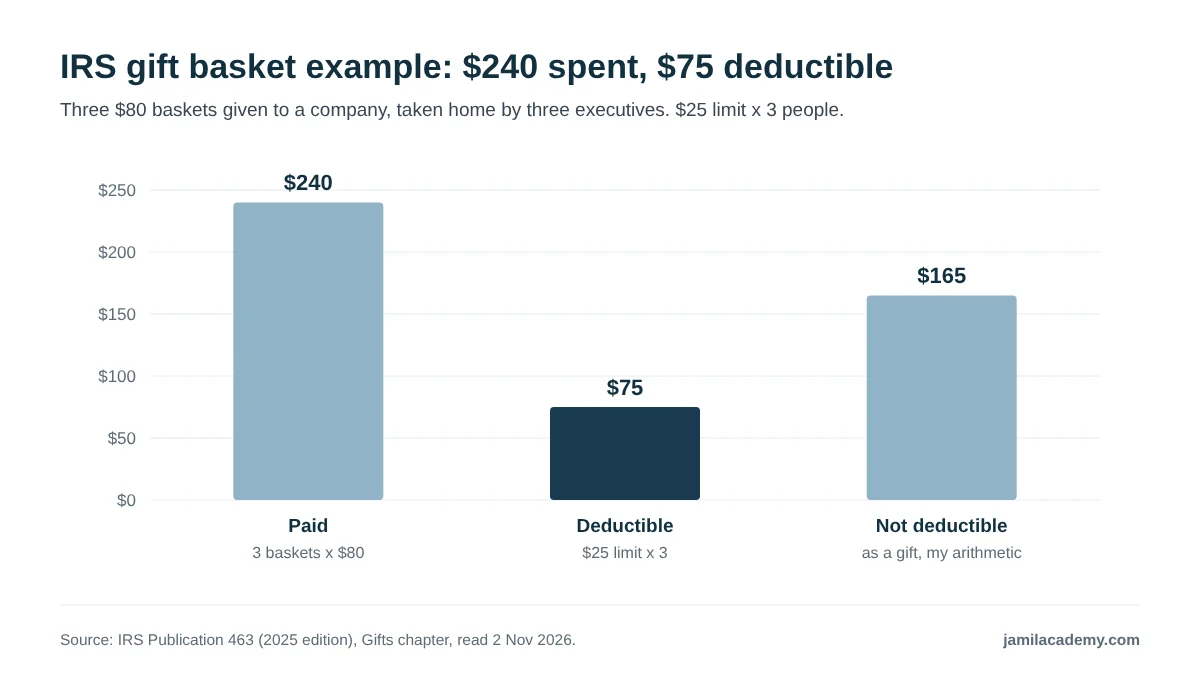
Two lessons sit in that example. A gift to a company meant for particular people counts as an indirect gift to each of them. And the limit applies per person, not per basket.
The spouse rule is about you, not your buyers
If you and your spouse both give gifts, Pub 463 treats you as one taxpayer. "It doesn't matter whether you have separate businesses, are separately employed," "or whether each of you has an independent connection with the recipient."
What about a married couple buying together?
This is the question I could not settle. Pub 463 does not say directly whether a gift to two married co-buyers is one $25 limit or two.
It does say a gift to a member of a customer's family is "generally considered to be an indirect gift" to the customer. The exception needs "a bona fide, independent business connection with that family member" and a gift that "isn't intended for the customer's eventual use."
My view: do not assume each spouse gets a separate limit. Ask your CPA how to count a gift addressed to both buyers, and keep the answer in your notes.
These quotes are from Publication 463 (2025), revised 27 February 2026. I found no 2026 edition on 2 November 2026. The IRS FAQ on business gifts (last reviewed 16 October 2026) gives the same $25 limit.
Is it a gift or entertainment for tax purposes?
Short answer: if an item could be either, Pub 463 says it "will generally be considered entertainment." It also says "In general, entertainment expenses are nondeductible." Packaged food or drink for later use is treated as a gift.
| Item type | How Pub 463 (2025 edition) treats it |
|---|---|
| Item that could be a gift or entertainment | "Any item that might be considered either a gift or entertainment will generally be considered entertainment." |
| Packaged food or beverages for later use | "if you give a customer packaged food or beverages you intend the customer to use at a later date, treat it as a gift." |
| Game tickets used together with a client | In a chapter 2 example, A buys baseball tickets for A and client B. The cost "is an entertainment expense and isn't deductible by A." |
| Tickets you give but do not attend | Not addressed in the 2025 Gifts chapter |
Source: IRS Publication 463 (2025 edition), chapters 2 and 3, read 2 November 2026.
The Gifts chapter of the 2025 edition does not mention tickets at all. I found no current IRS text that treats tickets you give away, but do not attend, as a gift. Ask your CPA before you plan around them.
My view: for the closing gift itself, choose an item the client keeps or uses later. It is simpler to record, and it lasts longer than an evening out.
Closing gift budget and deduction check (calculator)
Short answer: enter your closings and gift cost to see your annual spend and how much of it sits within the $25 per recipient limit. It is an estimate, not tax advice.
The default gift cost of $80 matches the cost per basket in the IRS example. It is not a recommendation. Change every field to match your own plan.
Estimate, not tax advice. "Within the $25 limit" is the most the IRS gift rule could allow, if each recipient is a separate person who gets no other business gifts from you that tax year. Incidental costs are shown separately because Pub 463 generally does not count them toward the $25. Your CPA decides what you deduct.
"Within the $25 limit" is a ceiling, not a promise of a deduction. "Referral deals" divides your annual spend by the commission you enter. It sizes the budget; it is not a forecast.
With the defaults, 12 gifts a year at $80 plus $10 of incidentals cost $1,080. Up to $300 of gift cost falls within the limit, $660 is over it, and $120 is incidental.
My view: if one referral deal would cover a year of gifts, the budget is easy to justify. Just do not expect the gift alone to produce that referral.
Can you send gifts to lenders, title agents and referral partners?
Short answer: be careful. Gifts tied to referrals of settlement service business are a RESPA Section 8 issue. The CFPB says "There is no exception to RESPA Section 8 solely based on the value of the gift or promotion." This is a separate question from a gift to your buyer.
The statute, 12 U.S.C. 2607(a), says: "No person shall give and no person shall accept any fee, kickback, or thing of value" under an agreement or understanding that settlement service business will be referred.
| Point | What the source says |
|---|---|
| "Thing of value" is broad | Regulation X says it includes "monies, things, discounts, salaries, commissions, fees," "trips and payment of another person's expenses" |
| The agreement can be unwritten | It "need not be written or verbalized but may be established by a practice, pattern or course of conduct." |
| Gifts count | The CFPB says "gifts and promotions generally are "things of value"" |
| No dollar safe harbor | "There is no exception to RESPA Section 8 solely based on the value of the gift or promotion." |
| Penalties | Fines of "not more than $10,000" or prison of "not more than one year," plus civil liability of "three times the amount" of the settlement service charge |
Sources: 12 U.S.C. 2607 (U.S. Code, 2022 edition), Regulation X, 12 CFR 1024.14 (current version, no date shown) and the CFPB RESPA FAQs (entries updated 7 October 2020), read 2 November 2026.
The promotional exception and its two conditions
Regulation X allows "Normal promotional and educational activities that are not conditioned on the referral of business." The CFPB's FAQs set two conditions:
- "The activities are not conditioned on referral of business."
- "The activities do not involve defraying expenses that otherwise would be incurred by the referral source."
Its factors include "Whether the item or activity is targeted to referral sources" and "How often the item or activity is given to the referral source." The answer "depends on the facts and circumstances."
When a partner offers to pay for your client gifts
If a lender or title company pays for your closing gifts, it pays an expense you would otherwise have. That is the second condition above. My view: pay for your own gifts unless your broker has reviewed the arrangement in writing.
Virginia adds its own anti-kickback law
Virginia Code section 55.1-1009.1 covers anyone acting as a "real estate agent" incident to a settlement or sale. They may not "pay or receive, directly or indirectly, any kickback, rebate, commission, thing of value, or other payment" tied to referrals.
Its exceptions include "Expenditures for bona fide advertising and marketing promotions" permitted under RESPA, and "The provision of educational materials or classes."
Source: Code of Virginia, section 55.1-1009.1 (page dated 1 November 2026), read 2 November 2026.
Agent-to-agent referrals are a different case
Both the statute and Regulation X carve out "cooperative brokerage and referral arrangements or agreements between real estate agents" and brokers. My guide to how real estate referral fees work covers that side.
My view: keep partner gifts out of your closing gift plan. If you want to thank a partner, ask your broker first, and never link the thank-you to the number of deals sent.
Do state rules limit closing gifts for buyers?
Short answer: some do, and the rules differ. Colorado and Iowa expressly allow gratuitous gifts after closing that were not promised as an inducement. Maryland bars prizes and contests to influence a party. I checked only the states below.
| State | What I found | Source |
|---|---|---|
| Colorado | "Gratuitous gifts to a seller or buyer after closing and not promised or offered as an inducement to buy" "would not require disclosure and consent." | Colorado Real Estate Commission, Commission Position 4 |
| Iowa | "A licensee may present a gratuitous gift, such as flowers or a door knocker, to the buyer or tenant" when "not promised or offered as an inducement to buy or lease" | Iowa Admin. Code r. 193E-11.6(3), read in a Cornell LII copy (third-party host) |
| Maryland | A licensee may not "offer a prize or conduct a contest in order to influence a party in the sale of real property." Inducements "must be offered to all consumers on the same basis." | Maryland Real Estate Commission, Incentives and Rebates page |
| Virginia | No Real Estate Board regulation specifically on closing gifts, prizes or inducements to buyers was found | Virginia Administrative Code, 18VAC135-20 |
Sources: Colorado Commission Position 4 (recodified 7 June 2022); Iowa rule 193E-11.6 on Cornell LII (amended 14 August 2024); Maryland Commission Incentives and Rebates page (guidance dated 14 December 2010); Virginia Administrative Code, chapter 20 (page dated 1 November 2026). All read 2 November 2026.
Maryland in more detail
- "There cannot be a contest where a seller or buyer is offered a chance to receive a prize or a cash payment."
- An open-house drawing is not viewed as a contest if "the only action a consumer has to take is to attend the open house."
- A drawing may not include someone "based on referrals he or she has made to the licensee."
- Payments to a party "should be disclosed to the other party to the transaction."
None of the Maryland rules quoted here addresses thank-you gifts after closing. The Commission page covers inducements, prizes, contests and rebates, so read it before you promise anything up front.
Colorado: a rebate is not a gift
Colorado says a rebate to a buyer with financing "must be disclosed to the lender, included on the settlement statement, and approved by the lender." It warns an undisclosed one "may constitute loan fraud."
Virginia: what I did not find
None of the section titles in chapter 20 of the Real Estate Board's regulations mentions inducements, rebates, gifts or prizes. That is not a green light. It means I found no Virginia rule written specifically about closing gifts.
NAR's Code of Ethics, for REALTOR members
Standard of Practice 12-3 says inducements to list, sell, purchase or lease are "not, in itself, unethical." REALTORS "must exercise care and candor" so people have a "clear, thorough, advance understanding of all the terms and conditions of the offer."
Source: NAR 2026 Code of Ethics and Standards of Practice (effective 1 January 2026), web version, read 2 November 2026. The PDF version could not be reached.
My view: closing gifts are not treated the same way in every state. Check your state commission and your broker's policy before you build a gift program.
Can you thank a past client for a referral with a gift?
Short answer: it depends on your state, and in Virginia I could not find an official answer. Ask your principal broker before you send a gift to thank anyone for a referral.
Virginia's regulation 18VAC135-20-280 lists "Improper financial transactions and dealings." The first is "Offering to pay, paying, or providing valuable consideration to any person not licensed in this or any jurisdiction" "for services that require a real estate license."
Source: 18VAC135-20-280, Virginia Administrative Code (last amended effective 1 April 2026), read 2 November 2026.
I found no official Virginia source saying whether a thank-you gift to a past client for a referral falls under this rule. So I am not telling you to send referral gifts in Virginia.
- Maryland: a drawing may not include someone "based on referrals he or she has made to the licensee."
- Iowa (third-party copy): "A licensee cannot pay a commission, any part of a commission, or valuable consideration to an unlicensed third party" in the circumstances the rule describes.
- CFPB, for settlement service providers: "giving an incentive to a consumer in exchange for the consumer referring other business" is a prohibited example.
The CFPB example is about settlement service business. I found no official source applying it to a past client who refers a friend to an agent, so I will not stretch it.
My view: a handwritten thank-you note is the simplest way to say thanks. For anything more, get your principal broker's answer in writing, and never promise a gift in exchange for a referral.
Can you give alcohol as a closing gift?
Short answer: if you do, never mail it through USPS. USPS Publication 52 says "Intoxicating liquors and taxable liquors" are "nonmailable." If you send wine or beer, use a seller licensed to ship to your client's state.
| Point | What the source says |
|---|---|
| USPS | The ban is in federal law, "U.S. Code Title 18 Section 1716" |
| State law governs shipments | TTB says the Webb-Kenyon Act "prohibits shipments of alcohol beverages from one State into another State in violation of any law of the receiving State" |
| Who to ask | TTB says to "contact the appropriate State alcohol regulatory authority" |
| Virginia | "Any winery, brewery or retailer in or out of state who holds a Virginia ABC shipper's license may sell and ship," up to "two cases of wine or two cases of beer per month" |
| Tax treatment | Packaged beverages "you intend the customer to use at a later date" are treated as a gift under Pub 463 |
Sources: USPS Publication 52, section 424 (no date shown); TTB direct shipping page (last updated 6 June 2024); Virginia ABC direct shipment page (no date shown), all read 2 November 2026.
The TTB page is written for industry members, not gift senders. The Virginia ABC page does not address non-licensees shipping alcohol as a gift, or age checks on delivery.
My view: make a non-alcoholic gift your default. Choose wine or beer only when you know the client would enjoy it, buy from a licensed seller, or hand-deliver it.
What I could not verify
Be careful with any page that fills these gaps with a confident answer.
- Gifts to a married couple. IRS Pub 463 does not directly say whether two co-buyers get one $25 limit or two. Ask your CPA.
- Tickets you give but do not attend. I found no current IRS text on them, so I made no claim.
- A safe dollar amount for partner gifts. None exists in what I read. The CFPB says there is no exception based solely on value, and I found no official minimum, federal or Virginia.
- Virginia referral thank-you gifts. I found no official answer on whether 18VAC135-20-280 covers them. Ask your principal broker.
- DC and West Virginia rules on gifts and inducements to buyers. I did not research them in depth.
- Maryland's COMAR 09.11.02.01H. The Commission page cites it for written buyer rebates; I did not open the rule itself.
- Iowa's official text. I read the rule on Cornell's Legal Information Institute, a third-party host.
- NAR's 2026 Profile. I found none as of 2 November 2026, so the 2025 Profile is the latest data here.
- NAR's own referral breakdown. The 43%, 18% and 66% figures come from the Virginia REALTORS summary, not an NAR page.
- Timing rules. I found no official source on when to give a closing gift. The timing advice here is opinion.

Frequently asked questions
What is a good closing gift for buyers?
In my view, one that is useful in the first month, personal to the client, or lasting in the home. A handwritten card naming a moment from the search matters as much as the item.
Are realtor closing gifts tax deductible?
Partly. Per IRS Publication 463 (2025 edition), you can deduct no more than $25 for business gifts to each person during your tax year. This is not tax advice; confirm with your CPA.
Do wrapping and shipping count toward the $25 limit?
Generally no. Pub 463 says incidental costs such as engraving, packaging, insuring and mailing are generally not included, if they do not add substantial value to the gift.
Is a gift to a married couple $25 or $50?
Pub 463 does not say directly. It says a gift to a customer's family member is generally an indirect gift to the customer. Ask your CPA before counting $50.
Can I give a closing gift to the lender or title agent?
Be careful. The CFPB says gifts are generally things of value under RESPA, with no Section 8 exception based solely on value. Keep partner gifts separate and ask your broker first.
Are closing gifts allowed in every state?
Rules differ. Colorado and Iowa expressly allow gratuitous gifts after closing that were not promised as an inducement. Maryland bars prizes and contests to influence a party. Check your own commission.
Can I mail a bottle of wine as a closing gift?
Not through USPS. Its Publication 52 says intoxicating liquors are nonmailable under federal law. If you send wine, use a seller licensed to ship to your client's state.
Are game tickets a deductible closing gift?
I found no current IRS text saying so. Pub 463 says an item that could be a gift or entertainment is generally entertainment, and entertainment is generally not deductible.
When should I give a closing gift?
In my view, at closing or within the first weeks after, in person if you can. Give it as a thank-you, not as a promise made to win the business.
Saad Jamil is a top 1 percent Realtor with Samson Properties in Chantilly, Virginia, licensed in Virginia, DC, Maryland and West Virginia since 2013, with more than $500 million in career sales and 900+ homes closed. Reviews and closed sales are on his Zillow profile. He runs Jamil Academy, which sells training to agents. This article is general information, not legal or financial advice, checked on 2 November 2026.
Free: 5 Ways to Get More Listings Without Cold Calling
Five lead strategies that work without cold calls or ad spend, from an agent with $500M sold and 900+ homes closed.
No spam. Unsubscribe any time.
Your Coach