Real Estate Pop-By Ideas That Are Not a Waste of Money (2026)
Sep 25, 2026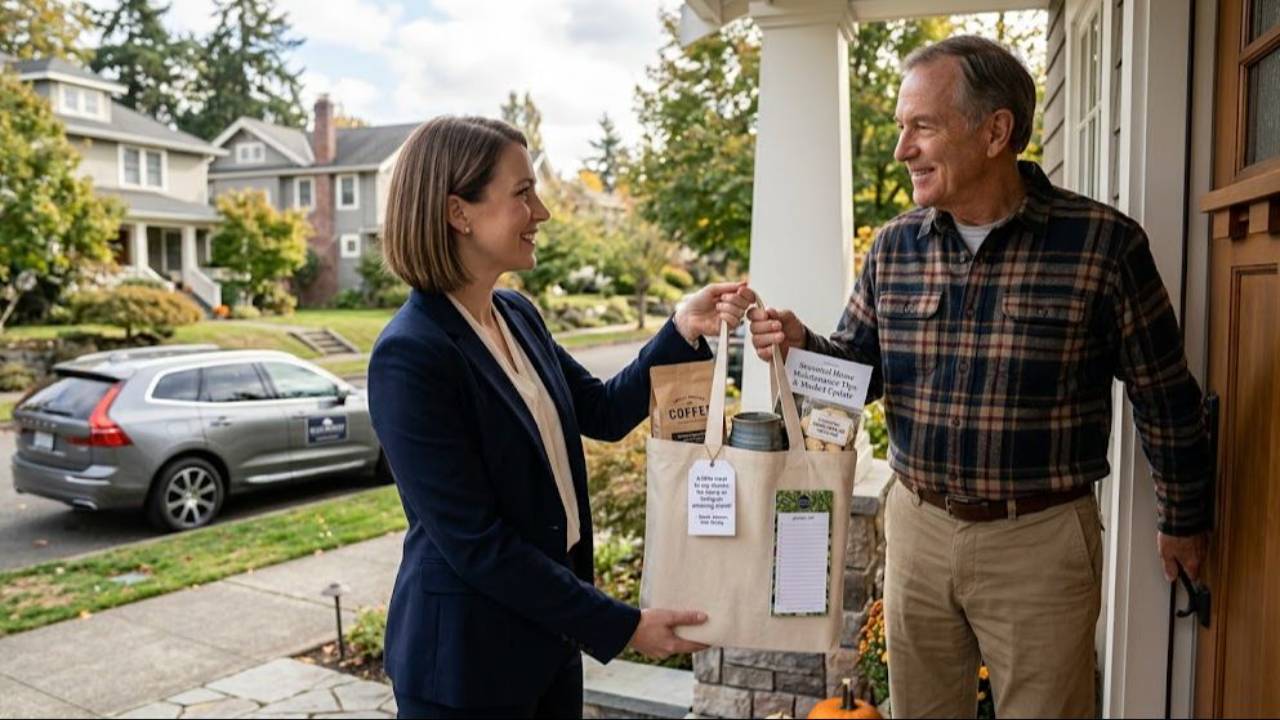
A pop-by is a small, cheap gift you drop off in person to a past client or someone in your sphere, with a short note and your name on it. The point is not the gift. The point is a two minute conversation at the door, and being the agent they think of when a neighbor mentions moving.
Nearly every top ranking list of pop-by ideas is published by a company selling something to agents, so nobody asks the obvious question: does it pay? A pop-by that gets left on a porch, with no conversation, sent to people who barely know you, is a waste of money. A pop-by that gets you in front of your best past clients four times a year is one of the cheapest ways I know to stay remembered.
Below is a calculator for what a year of pop-bys really costs, including the mileage everyone forgets, and how few referrals it takes to pay for itself. Then the ideas with real prices I checked this week, a month by month calendar, what to say at the door, and three rules the idea lists skip: the mailbox law, the $25 IRS gift limit, and why you should never hand out a gift as a reward for a referral.
Where I stand: I run Jamil Academy, which sells coaching, and the blocks below sell my own products. I do not sell pop-by kits, tags or gifts, and nothing here is an affiliate link. This is information, not tax or legal advice.
Quick answer
What works: a gift under $5 that gets used in the home (pie pumpkins, seed packets, popcorn, a calendar magnet), dropped to your A and B contacts about four times a year, with a knock and a short conversation.
What wastes money: pop-bys to strangers, gifts with no name on them, leaving it on the porch when nobody answers and never following up, and spending more per drop than the relationship is worth.
The math: 50 households, four drops a year at $3.50 each and 40 miles a round comes to about $820 a year. At a $9,000 net commission, one referred closing every eleven years pays for it.
The rules: never put anything in or on a mailbox (federal law and Postal Service rules). The IRS only lets you deduct $25 of gifts per person per year. And give gifts to everyone on the same schedule, not as a reward for sending you business.
- What a real estate pop-by is, and what it is for
- When a pop-by is a waste of money
- The pop-by math: what a year costs, and what it has to return
- Real estate pop-by ideas under $5, with real prices
- A 12-month pop-by calendar (pick four)
- When to spend more on a pop-by, and on whom
- What to say at the door
- Pop-by rules most lists skip: mailboxes, taxes and referral gifts
- How to tell if your pop-bys are working
- What I would actually do with $1,000 and 50 households
- What I could not verify
- Common questions about pop-bys
What a real estate pop-by is, and what it is for
The name is usually credited to Brian Buffini's coaching company. Its own blog calls it "what we at Buffini & Company call the real estate Pop-By", which is a fair way to put it. Plenty of agents dropped off pies before anyone named it, but the version most coaches teach today is Buffini's: a small item, a pun or a note, and a face to face moment.
It exists because of a gap in the numbers. NAR's 2025 Profile of Home Buyers and Sellers found that 91% of buyers would use their agent again or recommend them to others. The same report put the median time a seller had lived in the home at 11 years, an all time high.
So most of your past clients like you, and many of them will not move again for years. The business in between comes from their friends, coworkers and neighbors. The same national report, as summarized by Virginia REALTORS, found that 43% of buyers found their agent through a referral and 18% used an agent they had worked with before. On the seller side, 66% used a referral or a previous agent.
A pop-by does one job in that gap: it keeps your face and name fresh for the moment someone at a barbecue says "we are thinking of selling". It is a reminder, not a sales pitch. That is why the gift can be cheap and why the conversation matters more than the item.
What a pop-by is not
- A closing gift. That is a one-time thank you at settlement. A pop-by is the small, repeated touch in the years after.
- Farming. Dropping gifts on strangers' doorsteps in a neighborhood you want to win is a different activity with different math. More on that below.
- A referral reward. A pop-by goes to everyone on your list on the same schedule, whether they have sent you anyone or not. That is both better manners and, as the rules section explains, safer.
Pop-bys sit inside a wider referral plan, alongside calls, texts, notes and a client event. On their own they are a nice gesture. Combined with a call list and a CRM, they are a system.
When a pop-by is a waste of money
Most of the money wasted on pop-bys is wasted in the same six ways. If your current plan does any of these, fix that before you buy a single tag.
1. Giving them to people who do not know you
A pie pumpkin from a stranger is a flyer with a stem. The whole mechanism depends on a relationship that already exists. For a farm, a door knock with a market update does the introduction far more cheaply; save the pop-bys for once people know your face.
2. Leaving it on the porch and walking away
If nobody is home, a tag on the door is fine. But if you never knock, you have paid for a delivery service. The conversation is the product. Go when people are likely to be home: late afternoon on a weekday, or a Saturday morning.
3. Sending them to everyone equally
Pop-bys cost time, and time is the scarce part. Your top 30 to 50 relationships, the people who have referred you or would, deserve four drops a year. The rest of the database gets calls, texts and email. The work of sorting your database into A, B and C comes first for exactly this reason.
4. A gift nobody uses, or one that forgets your name
Items that end up in a drawer do nothing. Items that get used in the kitchen or garden, with your name and number on the tag or the item itself, keep working after you leave. A calendar magnet on a fridge is looked at every day for a year.
5. A monthly subscription you did not choose
Pre-packaged pop-by boxes save time, but you pay for the assembly and the shipping, and you end up giving whatever the vendor had in stock. Price out the kit against the same items from a big box store before you sign up.
6. Tracking nothing
If you cannot say how many referrals came from the people on your pop-by list last year, you cannot say if it worked. The fix takes a few fields in your CRM, covered below.

The pop-by math: what a year costs, and what it has to return
Nobody selling pop-by supplies shows you this part. The item is the cheap bit. The drive, the tags and your time add up, and the only return that counts is a closed referral. So the useful question is not "is $3 a lot for a pumpkin?" but "how many closings a year does this list have to produce to pay for itself?"
Put in your own numbers. The defaults are a realistic starting list: 50 households, four drops a year, a $3 item with 50 cents of packaging, and a 40 mile loop.
Mileage uses the IRS business rate of 76 cents a mile from July 1, 2026 (it was 72.5 cents before that). The tax line is a rough guide to the $25 gift limit, not tax advice.
The $25 limit is per recipient per year. A gift to a client's family member generally counts as a gift to the client, so this treats each household as one recipient, which is the cautious reading. Tags, bags and wrapping are incidental costs that do not count toward the $25. Mileage is usually deducted as business driving rather than as part of the gift. Ask your accountant how it applies to you.
What the defaults tell you
Fifty households at four drops a year is 200 stops. At $3.50 each that is $700 in gifts and tags. Four 40 mile rounds at 76 cents a mile adds $121.60. The year costs about $822, or $16.43 a household.
At $9,000 net per closed side, that is paid for by one referred closing every eleven years. That is a very low bar. If the 50 people who know you best cannot produce one referral in a decade, the problem is not the pie.
Where it stops making sense
Change two numbers and the picture flips. Send the same drops to 500 farm households and the gifts and tags alone come to $7,000, before you count the extra driving. Now you need nearly one closing a year from people who have never met you. Or keep 50 households but switch to a $15 gift monthly: the gifts alone are $9,000, and $7,750 of that is over the $25 per person tax limit.
The time line matters too. About 20 hours a year at the door is fine for 50 households. At 500, you are looking at 200 hours, which is five working weeks that could have gone to calls and appointments.
Pop-bys pay when the list is small and warm. Keep it to the people who already like you, keep the item under $5, and spend the time on the conversation. If you want to reach strangers, that is a farming budget, and it needs its own math.
Real estate pop-by ideas under $5, with real prices
The best pop-by ideas share three things: they cost under $5, they get used inside the home rather than put in a drawer, and they give you an easy reason to knock. Seasonal items do the last part for you, because "I brought you a pumpkin" needs no explaining.
These are the prices I found on the retailers' own sites on 25 September 2026. Prices and pack sizes differ by store and change often, so treat them as a guide, not a quote.
| Pop-by idea | Price found | Per drop | A tag line that works |
|---|---|---|---|
| Mini pumpkin pie, 4 inch, 3 oz (Walmart bakery) | $0.85 each | $0.85 | "Thanks for a sweet year." |
| Pie pumpkin (Walmart) | $2.62 each | $2.62 | "Pick of the patch. Happy fall." |
| Vegetable seeds (Burpee, at Home Depot) | $1.99 to $2.79 a packet | About $2.40 | "Here's to a great season in the yard." |
| Succulents (Home Depot, 20 pack) | $30.94 for 20 | $1.55 | "Low maintenance, like a good agent should be." |
| Microwave popcorn (Orville Redenbacher, 12 count, Target) | $7.19 for 12 | $1.20 for two bags | "Movie night is on me." |
| Hot cocoa (Swiss Miss, 8 packets, Walmart) | $3.27 for 8 | $0.82 for two | "Stay warm this winter." |
| Hand sanitizer, 1 oz (Purell, 12 pack, Walmart) | $15.99 for 12 | $1.33 | "For the lunchbox or the car." |
| Sunscreen, 1 oz (Banana Boat Sport SPF 30, 24 pack, Walmart) | $39.19 for 24 | $1.63 | "Enjoy the summer." |
| Three wick jar candle, 11.5 oz (Mainstays, Walmart) | $3.96 each | $3.96 | "Hope home feels like home." |
| Calendar magnet with your name (4imprint) | $0.77 each for 250, $0.55 for 1,000, plus a $10 setup | About $0.80 | Your name and number are on it all year |
Prices from walmart.com, target.com, homedepot.com and 4imprint.com, checked 25 September 2026. Tax and shipping not included.
Three that cost almost nothing
- A one page value update. What homes on their street sold for this year, printed and in an envelope. Homeowners read this more closely than anything else you hand them.
- Your list of trusted trades. The plumber, electrician and roofer you would call yourself. People keep it on the fridge for years. Take nothing from the trades for being on it.
- A local events card. Farmers market days, the fireworks date, the fall festival.
What I would avoid
- Anything that needs the fridge, left on a porch. FoodSafety.gov says never to leave perishable food out of refrigeration for more than two hours, or one hour above 90°F. Check the label on any baked goods; if it says refrigerate, hand it over or skip it.
- Wine or beer on a doorstep. Hand alcohol to the adult you know, or do not bring it. In Virginia, giving alcohol to anyone under 21 is a Class 1 misdemeanor.
- Homemade food for people you do not know well. Allergies are common and you will never hear that the cookies went in the bin.
- Branded junk. Pens, stress balls and koozies are fine at a booth. On a doorstep they say "I ordered 500 of these".
A 12-month pop-by calendar (pick four)
Twelve drops a year is too many for most agents to keep up, and too many for most clients to want. Four, roughly one a quarter, is a pace you can hold for years. The calendar below gives you an option for every month so you can pick the four that fit your area and your schedule.
| Month | Occasion | Pop-by idea | About per drop |
|---|---|---|---|
| January | New year | Calendar magnet | $0.80 |
| February | Cold snap | Two hot cocoa packets | $0.82 |
| March | Spring planting | A packet of seeds | $2.40 |
| April | Spring cleanup | A succulent | $1.55 |
| May | Start of summer | A travel size sunscreen | $1.63 |
| June | Summer nights | Two bags of popcorn for movie night | $1.20 |
| July | Fourth of July | A local events card with fireworks times | Under $0.50 |
| August | Back to school | A 1 oz hand sanitizer | $1.33 |
| September | Fall market | A one page value update for their street | Under $0.50 |
| October | Fall | A pie pumpkin | $2.62 |
| November | Thanksgiving | A mini pumpkin pie, handed over in person | $0.85 |
| December | Holidays | A candle | $3.96 |
A good set of four
March seeds, June popcorn, October pumpkins and a December candle comes to about $10.18 a household for the year in items. With 50 cents of tag and bag each time, it is $12.18. That is well inside the $25 IRS limit and gives you a reason to knock in every season.
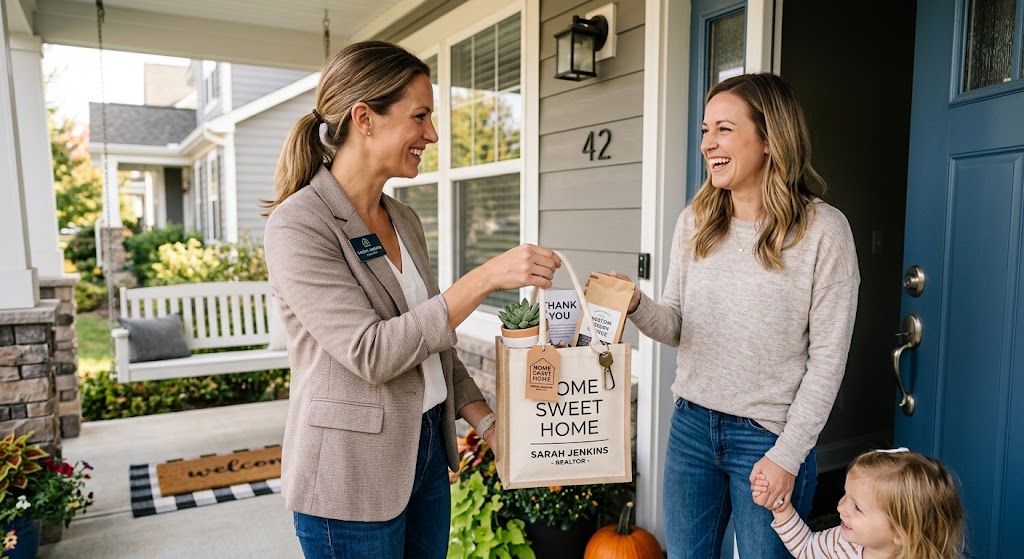
Two tips on timing. First, October is the most crowded pop-by month, because every agent who has heard of a pop-by is buying pumpkins. If your clients get three pumpkins from three agents, the seeds in March will stand out more. Second, pick dates and put them in your calendar now. Pop-bys that depend on having a free afternoon never happen.
Pop-bys work best as the in person layer of the rest of your sphere plan, which also covers the calls, texts and mail that go out between drops.
When to spend more on a pop-by, and on whom
Most of the time, spending more on a pop-by buys you nothing. A $20 gift does not get you a better conversation at the door than a $2 one. But there are three cases where a bigger gift makes sense.
1. The first home anniversary
The year after closing is when a client is most likely to talk about you, because friends are still asking about the new house. A slightly better gift on the one year anniversary, such as a 12 oz bag of good coffee ($8.99 for Target's Good & Gather house blend), is a natural reason to stop by. Give it to every client on their anniversary, not only the ones who have sent you someone.
2. Your closest past clients
The handful of people you are friends with already get more of your time. It is fine to set a higher tier for them. Set the tier by the relationship, decide it in advance, and apply it to everyone in that tier. What you should not do is pay out by the referral. The rules section explains why.
3. When the gift does a job
A furnace filter in the right size for a client you sold a home to, a smoke detector battery pack in October, a snow brush for the car. These cost a little more, but they are useful and they show you remember the house.
Whatever you spend, the IRS only lets you deduct $25 of gifts per person per year. An $8.99 coffee plus four $3 pop-bys is $20.99, which fits. Two $15 gifts a year is $30, and $5 of it is not deductible. Tags, bags and wrapping do not count toward the $25.
What to say at the door
Agents skip pop-bys because the door feels awkward, not because of the cost. The fix is to decide in advance what you will say, keep it under two minutes, and make it about them. You are a friend dropping something off, not a salesperson with a gift.
When they answer the door
The two minute version
That is it. Most visits should end there. You have been helpful, you have been seen, and you have not asked for anything.
The referral line, once in a while
Every second or third visit, and only if the conversation is warm, you can add one line before you leave:
Said once, lightly, on the way out
Do not open with it, do not ask "do you know anyone?", and do not ask if they are thinking of selling. The first sounds like the gift was bait. The second puts them on the spot. If they are thinking of moving, they will tell you.
When nobody is home
Hang the bag on the door handle or leave it on the step by the door, out of the sun. Then send a short text so it does not look like a drive-by:
The follow-up text
If they text back, you have your conversation. If they do not, you have still been remembered, and next time you can try a different time of day.

Pop-by rules most lists skip: mailboxes, taxes and referral gifts
None of the top ranking pop-by lists I read mentions the $25 IRS limit, and only one mentions the mailbox rule, without citing it. There is a third rule that matters more than either: how you thank people for referrals.
1. Never put a pop-by in or on a mailbox
Federal law makes it an offence to put unstamped mail matter in a mailbox to avoid postage. The statute, 18 U.S.C. 1725, reads:
18 U.S.C. 1725
And hanging it on the box does not get around it. The Postal Service's Domestic Mail Manual, section 508.3.1.3, says no part of a mail receptacle may be used for any matter not bearing postage, "including items or matter placed upon, supported by, attached to, hung from, or inserted into a mail receptacle." That includes the flag and anything hung from or taped to the box itself. Use the door.
2. The IRS lets you deduct $25 of gifts per person per year
This is the rule most agents have never heard of. Section 274(b) of the tax code says:
26 U.S.C. 274(b)(1)
What that means for pop-bys, based on the statute and IRS Publication 463:
- It is $25 per person for the whole year, not per gift. Four $8 pop-bys to the same client is $32, and $7 of it is not deductible.
- Treat a household as one recipient. Publication 463 says a gift to a member of a customer's family is generally an indirect gift to the customer, so a couple who bought from you is safest treated as sharing one $25. (The statute's "husband and wife shall be treated as one taxpayer" is about the giver: if you and your spouse both give gifts, you share one $25.)
- Tags, bags, wrapping and delivery do not count toward the $25, according to Publication 463, as long as they do not add much value to the gift.
- Packaged food counts as a gift. Treasury regulations treat packaged food or drink "intended for consumption at a later time" as a gift, not entertainment. So a pie is subject to the $25 limit.
- Items of $4 or less with your name printed on them are left out. The statute excludes an item costing $4 or less "on which the name of the taxpayer is clearly and permanently imprinted and which is one of a number of identical items distributed generally". A calendar magnet qualifies. A pumpkin with a tag tied on does not.
- The limit applies to you and your spouse together. If you both give gifts to the same client, the two of you share one $25.
At under $5 a drop and four drops a year, most agents never reach the limit. It starts to matter when you add a bigger holiday or anniversary gift. The calculator above flags it, and the rest of an agent's deductions are covered in a separate guide. Ask your accountant how it applies to you.
3. Thank everyone the same way. Do not pay for referrals
Pop-bys are gifts for being a client. They become a problem when they turn into a reward for sending you business.
Under RESPA, the federal settlement law, real estate brokerage is a settlement service. The Consumer Financial Protection Bureau's guidance says RESPA Section 8 "does not prohibit a lender or other settlement service provider from giving a consumer a gift or an incentive (e.g., a discount, refund of fees, chance to win a prize, etc.) for doing business with that entity." What it prohibits is giving things of value in exchange for referrals of other business. In one CFPB example, a drawing open to all previous customers "regardless of whether the prior customer ... has made or will make a referral" is described as more likely to qualify as a normal promotional activity.
State license law is stricter still. In Maryland, the Real Estate Commission said in guidance dated December 2010 that a referral is "the provision of real estate brokerage services, and thus an activity that requires a license if compensation in any form is involved", that "a drawing may not include an individual based on referrals he or she has made to the licensee", and that "inducements must be offered to all consumers on the same basis."
Virginia's regulations forbid "offering to pay, paying, or providing valuable consideration to any person not licensed in this or any jurisdiction for services that require a real estate license" (18VAC135-20-280). DC can fine a licensee up to $2,500 for paying unlicensed people. I did not find a small gift exception in Virginia, Maryland or DC.
- Give pop-bys on a schedule to everyone on the list, whether or not they have referred anyone.
- Thank a referral with a handwritten note and a phone call, not a gift card or a gift sized to the deal.
- Never promise anything of value for a referral, in writing or out loud.
- If you want to do something bigger, run it past your broker first.
How to tell if your pop-bys are working
You will never prove that one pumpkin caused one referral. But you can tell, over a year, whether the people on your pop-by list send you more business than the people who are not. That takes five fields in your CRM and ten minutes each January.
| CRM field | What to record |
|---|---|
| Pop-by list | Yes or no. Tag it so you can pull the list in one click. |
| Last pop-by | The date of the most recent drop. |
| Talked at the door | Yes or no for each drop. This is the number that matters. |
| Referred by | On every new client, the name of the person who sent them. |
| Closed referral | Date and your net, when a referred client closes. |
If you have not built your tags and smart lists yet, how to set up the CRM itself is its own job, and worth doing before you buy the first tag.
The three numbers to check once a year
- Door rate. Conversations divided by drops. Under a third means you are going at the wrong times, or the list is too big to visit properly.
- Referrals from the list. How many new clients named someone on your pop-by list, compared with the year before you started.
- Cost per closed referral. The year's pop-by cost from the calculator, divided by the referrals from the list that closed. If it is a small fraction of your net per side, keep going.
A fair test: pick 50 households for pop-bys and keep another group of similar past clients on calls and email only. After a year, compare the two groups. It is not a scientific study, but it is far better than a feeling.
Give it a full year before you judge it. People buy and sell on their own schedule, and a referral often shows up months after the visit that earned it.
What I would actually do with $1,000 and 50 households
If I were starting pop-bys from scratch with a $1,000 budget for the year, this is the plan. It fits the budget with room to spare, and it takes about three afternoons a quarter.
The plan
- Pick 50 households. Past clients and the people in your sphere who would send you business. Not strangers, not the whole database.
- Put four dates in the calendar now. March seeds, June popcorn, October pumpkins, December candles. About $12 a household for the year including tags.
- Knock every time. Weekdays from about 4 to 7 pm, or Saturday mornings. Use the two minute script. Ask about them.
- Text when nobody is home, the same day.
- Log it before you drive to the next house. Date, and whether you talked.
- Use what is left for anniversaries. About $730 goes on the four rounds and the mileage. The remaining $270 or so covers a better gift on each recent client's one year home anniversary.
- Thank referrals with a note and a call, never with a reward.
- Review in January. Door rate, referrals from the list, cost per closed referral. Drop the households you never reach and add the new clients.
What I would not do: buy a subscription box, send pop-bys to a farm of strangers, or leave anything on a mailbox. And I would not expect pop-bys alone to build a business. They keep the relationships you have warm. The business still comes from calls, follow-up and doing a good job on the deals you get.
If you do it this way for a year and the list has produced nothing, that is useful information too. Either the list is wrong, the conversations are not happening, or those relationships were weaker than you thought.

What I could not verify
- The "70% of buyers forget their agent's name" figure. It appears on Luxury Presence's pop-by page, credited to ReminderMedia, which sells client marketing. I could not find the study behind it, so I have not used it.
- Any independent study of pop-by returns. I found none. The calculator is break-even math, not a prediction of what you will get.
- Whether the store mini pies need refrigeration. The product page did not say. Check the label before you leave one on a porch.
- Local no-soliciting rules and HOA rules. These vary by town and community. Visiting your own clients is not the same as knocking on strangers' doors, but check if your area has a strict ordinance.
- West Virginia's position on referral gifts. I read the Virginia, Maryland and DC rules but did not find specific guidance from West Virginia.
Common questions about pop-bys
What is a pop-by in real estate?
A pop-by is a small, inexpensive gift an agent drops off in person to a past client or someone in their sphere, usually with a tag or note carrying the agent's name. The goal is a short face to face visit that keeps the agent top of mind for referrals, not the gift itself.
How much should I spend on a real estate pop-by?
Under $5 per drop is plenty. Items like pie pumpkins, seed packets, popcorn and hot cocoa cost under $3 a drop at big box stores. A more expensive gift rarely gets you a better conversation, and the IRS only lets you deduct $25 of gifts per person per year.
How often should I do pop-bys?
About four times a year, roughly once a quarter, is a pace most agents can keep up for years. Twelve a year is too many for most agents to sustain and more than most clients want. Spend the time on the conversation at the door rather than on more drops.
Can I leave a pop-by gift in a mailbox?
No. Federal law, 18 U.S.C. 1725, prohibits putting unstamped mail matter in a mailbox to avoid postage, and the USPS Domestic Mail Manual also bans items placed on, attached to or hung from a mail receptacle. Hang it on the door handle or leave it by the front door instead.
Are pop-by gifts tax deductible?
Business gifts are deductible only up to $25 per recipient per year, and a gift to a client's family member generally counts toward the client's $25. Packaging and delivery costs generally do not count toward the $25, and items of $4 or less with your name permanently printed on them are left out entirely. Ask your accountant how the rules apply to you.
Can I give a client a gift for referring someone to me?
Be careful. RESPA allows gifts to clients for doing business with you, but not things of value in exchange for referrals, and state license laws such as Maryland's add their own limits. The safe approach is to give pop-bys to everyone on the same schedule and thank referrals with a handwritten note and a call.
Saad Jamil is a top 1 percent Realtor with Samson Properties in Chantilly, Virginia, licensed in Virginia, DC, Maryland and West Virginia since 2013, with more than $500 million in career sales and 900+ homes closed. His reviews are on his Zillow profile. He runs Jamil Academy, which sells coaching. This is information, not tax or legal advice. Prices and rules quoted here were checked on 25 September 2026.
Free: 5 Ways to Get More Listings Without Cold Calling
Five lead strategies that work without cold calls or ad spend, from an agent with $500M sold and 900+ homes closed.
No spam. Unsubscribe any time.
Your Coach