Real Estate Newsletter (2026): Ideas, a Free Template, and the Rules for Email and Mail
Nov 04, 2026
A real estate newsletter is a regular email or printed piece that an agent sends to past clients, their sphere and sometimes a farm area. Its job is to keep you in mind for the next move or referral. It can go out by email, by mail through USPS Every Door Direct Mail (EDDM), or both.
Below you get real estate newsletter ideas for 12 months, a free fill-in template and a cost planner. Then come the rules: CAN-SPAM, Gmail and Yahoo sender policies, state advertising rules, the NAR Code of Ethics and fair housing.
Every legal fact and price comes from the page named under it, all read on 4 November 2026. Vendor prices and survey summaries are labelled as third party or secondary. Where I could not verify something, I say so.
Where I stand: I am a Realtor with Samson Properties, licensed in Virginia, DC, Maryland and West Virginia, and I run Jamil Academy, which sells training to agents. The one product block near the end is my own.
Quick answer
- What it is: a regular email or print piece for past clients, your sphere or a farm area.
- Email law: CAN-SPAM requires no opt-in, but every marketing email needs your postal address, a working opt-out and honest subject lines. Penalty: up to $53,088 per violating email.
- Unsubscribes: the law allows 10 business days. Gmail and Yahoo expect bulk senders to act within 2 days.
- Print by EDDM: $0.26 a piece at Retail, a time-limited USPS price through January 17, 2027. Minimum 200 pieces per ZIP Code per day.
- State rules: Virginia and Maryland treat a newsletter as advertising. In DC, check 17 DCMR 2615 with your broker.
- What is a real estate newsletter, and why send one?
- Email, print or both: which format fits?
- Plan your budget with the cost planner
- Real estate newsletter ideas: a 12-month calendar
- A free real estate newsletter template
- What does CAN-SPAM require of an email newsletter?
- What do Gmail and Yahoo expect from senders?
- Can you send your newsletter by text?
- State advertising rules: Virginia, Maryland and DC
- What do the NAR Code and fair housing rules add?
- Can you use other brokers' listings, photos or articles?
- How do you build a newsletter list the right way?
- How do you measure whether it works?
- What I could not verify
- Frequently asked questions
What is a real estate newsletter, and why send one?
Short answer: it keeps you in touch with people between transactions. The case for it rests on NAR findings: most clients use an agent, most would use or recommend theirs, and sellers stay in their homes a long time.
| NAR finding | Exact meaning |
|---|---|
| 91% of buyers | "would use their agent again or recommend them to others" (again OR recommend) |
| 88% of buyers | "used an agent or broker" |
| 91% of sellers | "used an agent", "equal to the highest percentage on record" |
| 11 years | Sellers' median time in the home before selling |
Sources: NAR newsroom release on the 2025 Profile of Home Buyers and Sellers (4 November 2025) and Jessica Lautz, "Top 10 Takeaways from NAR's 2025 Profile" (3 November 2025), on nar.realtor, read 4 November 2026.
The survey covers transactions from July 2024 to June 2025, with 6,103 responses from buyers who live in the home they bought.
Referrals and repeat clients
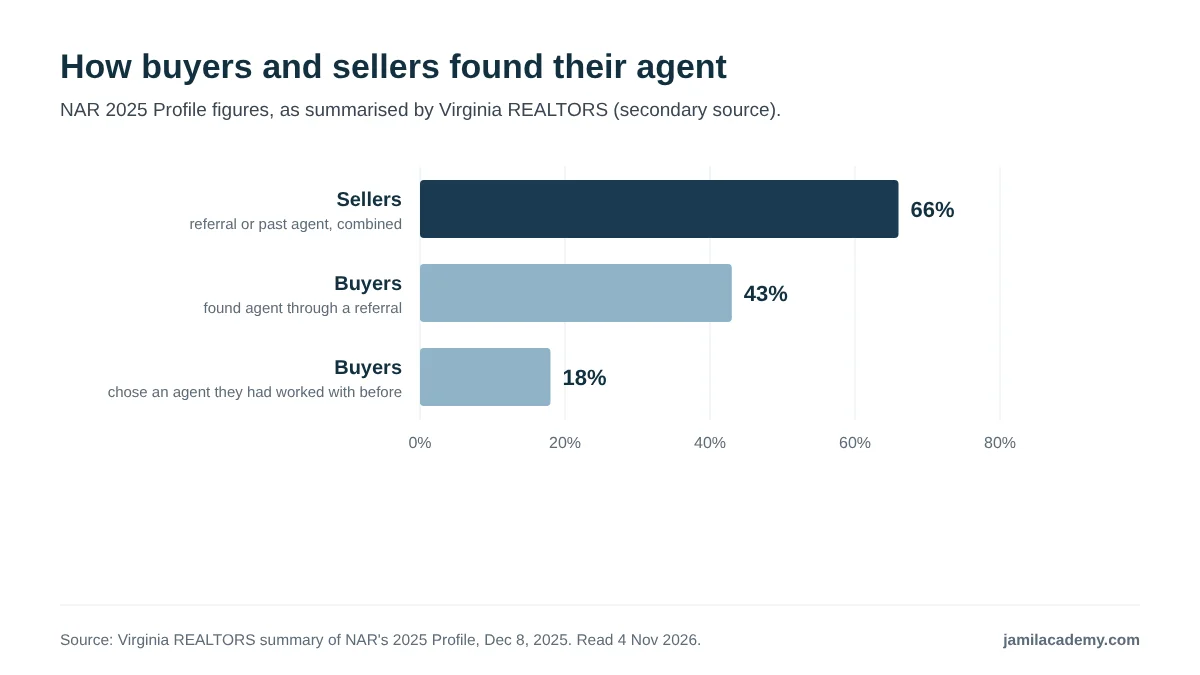
A Virginia REALTORS summary of the same report gives referral figures. I could not read them on NAR's own pages, so treat them as secondary.
- 43% of buyers "used an agent that they found through a referral."
- 18% of buyers "chose to purchase through an agent they had worked with in the past."
- 66% of sellers "found their agent through a referral or used an agent they had worked with in the past." That is one combined figure.
Source: Virginia REALTORS, "Key Takeaways from NAR's 2025 Profile of Home Buyers and Sellers" (8 December 2025), read 4 November 2026. Secondary source.
A seller's next move may be a decade away. A newsletter is one way to stay in touch across that gap. My 36-touch sphere of influence plan shows where it fits beside calls, notes and visits.
My view: a newsletter will not replace a phone call. It keeps your name in front of people so the call, when it comes, is not from a stranger.
Email, print or both: which format fits?
Short answer: email is the cheaper way to reach people you know, and print by EDDM reaches addresses on the mail routes you choose. One sensible split is email for your sphere and print for a farm area.
| Point | Email newsletter | Print by EDDM Retail |
|---|---|---|
| Who gets it | People on your list | Addresses on the mail routes you pick |
| Addressing | Each subscriber's email | "Postal Customer" |
| Main cost | Platform plan, if you outgrow a free tier | Printing plus $0.26 a piece postage |
| Main rules | CAN-SPAM; Gmail and Yahoo policies | USPS size, weight and quantity rules |
Email: what the platforms charge
| Platform | Free plan | Lowest paid plan shown | Not shown |
|---|---|---|---|
| Mailchimp | 250 contacts; 500 emails a month | Essentials $13 a month for 12 months; Standard $20 a month for 12 months | Price after 12 months; contact tier for $13 |
| Kit | Up to 10,000 subscribers | Creator $33 a month, $390 billed yearly, for 1,000 subscribers | Monthly-billing price |
| Constant Contact | Not shown | No readable price | Any price |
Sources: Mailchimp, Kit and Constant Contact pricing pages, read 4 November 2026. Third-party vendor prices; they change often.
Mailchimp's free plan warns: "Sending will be paused if contact or email send limit is exceeded." For lead magnets and follow-up sequences, see my guide to email marketing for lead generation.
Print: how EDDM Retail works
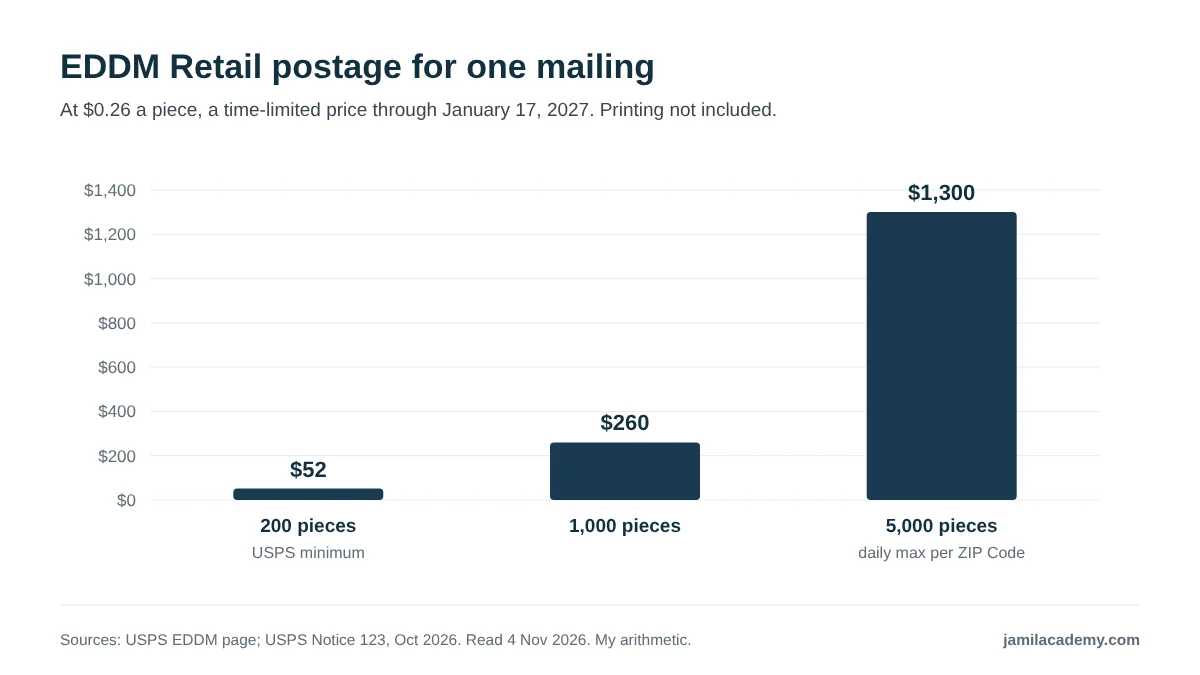
- Price: "EDDM Retail® USPS Marketing Flats currently $0.26 per piece." USPS Notice 123 lists $0.260 as a time-limited price from October 4, 2026 through January 17, 2027.
- Through a Business Mail Entry Unit: "currently as low as $0.259 per piece."
- Quantity: "Send at least 200 and up to 5,000 pieces per day per ZIP Code."
- No permit and no names: "No special mailing permit needed." USPS says pieces are simply addressed to "Postal Customer."
- Size: no more than 3.3 ounces, and longer than 10-1/2 inches, taller than 6-1/8 inches or thicker than 1/4 inch. Maximum 15 inches long, 12 inches high and 3/4 inch thick.
Sources: USPS Every Door Direct Mail page on usps.com, USPS Notice 123 (effective October 4, 2026) and Domestic Mail Manual sections 143 and 101.2.1 on pe.usps.com, read 4 November 2026.
To mail named past clients, you need addressed mail. USPS Marketing Mail needs "200 pieces or 50 pounds of mail" and "a Business Mail Permit." I did not verify permit fees or letter prices.
Source: USPS FAQ, "What is USPS Marketing Mail?" on faq.usps.com, read 4 November 2026.
For mailed copy and offers, see my farming letter templates and the direct mail guide for agents.
My view: start with email to people who know you. Add a quarterly EDDM piece only when you have chosen a farm and can afford to keep mailing it.
Plan your budget with the cost planner
Short answer: an email-only newsletter to 200 people can cost $0 a year on a free plan, while EDDM print adds $0.26 a piece in postage plus printing. Enter your own plan price and printer's quote to see your estimate.
Estimate only. The $0.26 default is the EDDM Retail price read on 4 November 2026 on usps.com, a time-limited USPS price through January 17, 2027. Email platform and printing prices are yours to enter. Not included: design, your time, sales tax, any permit or mail house fees, and texting tools.
How the planner counts
- Email: sends are contacts times sends per month times 12. Platform cost is your monthly price times 12.
- Print: pieces per mailing times mailings per year times postage, and the same again for printing.
- Cost per contact reached: the total divided by email contacts plus EDDM pieces per mailing, assuming the same routes each time. If the two overlap, your real cost per person is higher.
- Deals to cover cost: the total divided by your average commission. It shows only when you enter one.
My view: plan the mailing you could keep up for a full year, not your best month.
Real estate newsletter ideas: a 12-month calendar
Short answer: give each month one useful theme, and keep a few sections the same in every issue. The calendar is my own suggestion, not a rule. Fill every number from your MLS or a named source, and never make up market figures.
| Month | Feature idea (my suggestion) | What you fill in |
|---|---|---|
| January | Last year in your area | [number of sales from your MLS], [your local median price from your MLS] |
| February | Where to keep closing papers and warranties | Your own checklist |
| March | Spring exterior checklist | Your checklist |
| April | Thinking of selling? A pre-listing to-do list | The steps you use with sellers |
| May | Local business spotlight | A business that agreed to be featured |
| June | Mid-year market check | [first-half figures from your MLS] |
| July | Reader question of the month | A real question, shared without names |
| August | Moving checklist | Your own checklist |
| September | Fall maintenance checklist | Your checklist |
| October | A recent sale and what made it work | Only your own deal, with the client's permission |
| November | Thank you issue | A note, or an event you are really holding |
| December | Year in review | [your MLS figures for the year]; no forecasts you cannot source |
On October's idea: NAR Standard of Practice 12-7 lets only the listing or cooperating broker in a deal claim to have "sold" the property.
Evergreen sections for every issue (my suggestion)
- Market snapshot: two or three numbers for one area, with the month and source. Check your MLS rules on sold data first.
- Featured home: your own listing, or another broker's only with written permission.
- Homeowner tip: one practical item tied to the month.
- Local spotlight: a park, event or business, with your own photo.
- Personal note and one call to action: a few lines in your own voice, then one clear ask.
My view: one useful thing per issue beats five thin ones. If a reader learns something in a minute on a phone, the issue has done its job.
A free real estate newsletter template
Short answer: copy the template below into your email platform or print layout and replace every bracket. Keep the footer in every issue, and confirm your state's rules with your principal broker before you send.
[one honest line that matches the content, e.g. October in Your Town: prices, a checklist and a local favorite]
[one sentence that sums up the issue]
[firm's licensed name, written out in full, not only a logo] · [your name], [REALTOR® if you are a member] · [licensed real estate salesperson or broker]
[team name, if any] [of / from / with / at] [brokerage name] · [office or broker phone number] · [your phone and email, if your broker allows]
[two or three sentences in your own voice, with one personal detail you are happy to share]
[neighborhood or ZIP Code], [month]: median sale price [your local median price from your MLS]; homes sold [number from your MLS]; median days on market [from your MLS].
Source: [MLS name], pulled [date]. [check your MLS rules before you publish sold data]
[your own listing, or one with the listing broker's written permission]: [area], [price], [three plain facts]. Status as of [date].
[this month's checklist from the idea calendar]
[business, park or event]: [why you like it]. [your own photo, or one used with permission]
Q: [a real client question, without names] A: [your short answer]
[one clear ask, e.g. "Reply with your address for a home value estimate" or "Reply if a friend is thinking of moving"]
[firm's licensed name] · [office address and office phone number]
[your name], [license type], licensed in [state or states]
Mailing address: [valid physical postal address: a street address, a PO box registered with USPS, or a private mailbox registered with a commercial mail receiving agency]
[advertisement notice, e.g. "This email is an advertisement" (CAN-SPAM: "Identify the message as an ad.")]
[unsubscribe link] [one-click unsubscribe header, set up in your email platform]
[optional: why they receive it, e.g. "You bought or sold a home with me"]
[any other disclosure your principal broker's written policy requires]
Before you send, confirm your state's rules and your firm's written policy with your principal broker. The template is a starting point, not legal advice.
Why each footer line is there
| Footer line | Rule it helps you meet | Source |
|---|---|---|
| Firm's licensed name | Virginia: name must be "clearly and legibly displayed." Maryland: full business name, "not a logo." NAR SoP 12-5: firm name disclosed | 18VAC135-20-190; Md. Code BOP 17-527.2; NAR Code 2026 |
| Office contact information | Virginia: disclosure must include "the office contact information." Maryland: the broker's or branch office manager's phone must appear if you list your own phone or email | 18VAC135-20-190 B.1; COMAR 09.11.02.01G(3) |
| Physical postal address | CAN-SPAM: "Your message must include your valid physical postal address." | FTC CAN-SPAM guide |
| Advertisement notice | CAN-SPAM: "Identify the message as an ad." | FTC CAN-SPAM guide |
| Unsubscribe link | CAN-SPAM opt-out; Gmail and Yahoo one-click unsubscribe for bulk senders | FTC guide; Google; Yahoo |
| Your status as an agent | NAR Article 12: status as a real estate professional "readily apparent" | NAR Code 2026 |
Sources: 18VAC135-20-190, Md. Code, Bus. Occ. & Prof. § 17-527.2, COMAR 09.11.02.01, FTC CAN-SPAM compliance guide and NAR's 2026 Code of Ethics on nar.realtor, read 4 November 2026.
My view: the optional "why they receive it" line is not a legal requirement I found. It is worth adding because it reminds people they know you.
What does CAN-SPAM require of an email newsletter?
Short answer: CAN-SPAM does not require consent before you send a marketing email, but it does require honest headers and subjects, an ad notice, your postal address and a working opt-out. It covers every commercial email, not only bulk mail.
The FTC says: "Despite its name, the CAN-SPAM Act doesn't apply just to bulk email." On consent, it says: "While you don't need to get members' consent to send them marketing emails," they can opt out. Your platform and mailbox providers may ask for more.
The seven requirements
- 1. Headers: "Don't use false or misleading header information."
- 2. Subject lines: "Don't use deceptive subject lines."
- 3. Ad notice: "Identify the message as an ad."
- 4. Address: "Your message must include your valid physical postal address." A PO box registered with USPS, or a registered private mailbox, also counts.
- 5. Opt-out notice: "Tell recipients how to opt out of receiving future marketing email from you." It must work for at least 30 days after you send.
- 6. Honor opt-outs: "You must honor a recipient's opt-out request within 10 business days." No fee, no extra personal information, no more than a reply email or one web page visit.
- 7. Others acting for you: "Monitor what others are doing on your behalf." The company promoted and the sender both "may be held legally responsible."
Source: FTC, CAN-SPAM Act: A Compliance Guide for Business (August 2023, page modified 22 July 2025), read 4 November 2026.
Newsletters mix content: the primary purpose test
The FTC says "the primary purpose of the message is the deciding factor." A newsletter that mixes market news with a pitch for your services falls under 16 CFR 316.3(a)(3): commercial content plus content that is not transactional or relationship content.
Such an email is commercial if the subject line points that way, or if "A recipient reasonably interpreting the body of the message would likely conclude" its primary purpose is commercial.
The factors include "the placement of content", "the proportion of the message dedicated to such content; and how color, graphics, type size, and style are used to highlight commercial content."
Sources: 16 CFR 316.3 (eCFR) and the FTC CAN-SPAM guide, read 4 November 2026.
Do not assume useful content makes your newsletter exempt. My advice: follow all seven requirements in every issue.
Co-marketing with a lender? If one email promotes more than one marketer and the designated sender does not comply, "all marketers in the message may be held liable as senders."
The penalty
The FTC guide says: "Each separate email in violation of the CAN-SPAM Act is subject to penalties of up to $53,088." That figure took effect on January 17, 2025.
An FTC notice filed in September 2026 says its "civil penalty amounts will remain unchanged during 2026," because October 2025 inflation data was not produced during the government shutdown.
Sources: FTC CAN-SPAM guide, FTC civil penalty adjustments, 90 FR, January 17, 2025 and FTC, FR Doc. 2026-18853, read 4 November 2026.
My view: the penalty is per email, so one careless template sent to a few hundred people is a large exposure. Build the compliant footer once and reuse it.
What do Gmail and Yahoo expect from senders?
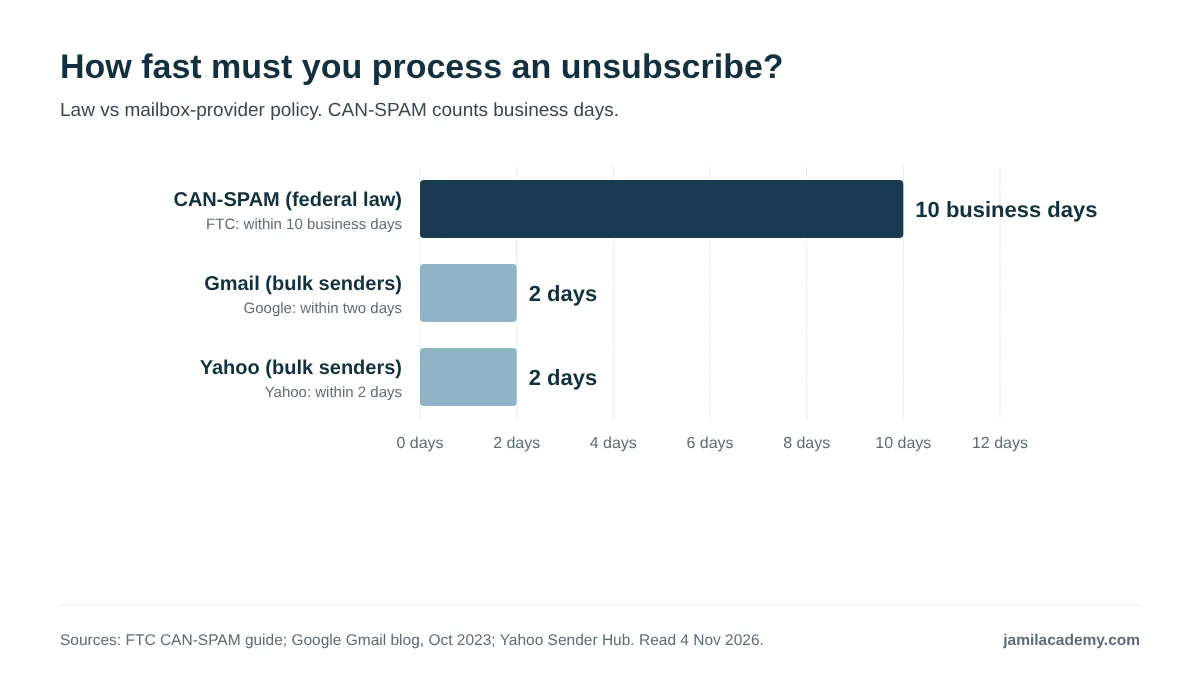
Short answer: Gmail and Yahoo expect bulk senders to authenticate their email, offer one-click unsubscribe and process unsubscribes within 2 days. That is mailbox-provider policy, not law, and it is stricter than CAN-SPAM's 10 business days.
| Rule | Set by | Law or policy? | Deadline |
|---|---|---|---|
| Honor opt-outs | FTC, under CAN-SPAM | Federal law | Within 10 business days |
| Process unsubscribes | Gmail, bulk senders | Provider policy | "within two days" |
| Honor unsubscribes | Yahoo, bulk senders | Provider policy | "within 2 days" |
Sources: FTC CAN-SPAM guide; Google, "New Gmail protections for a safer, less spammy inbox" (3 October 2023, blog.google); Yahoo Sender Hub best practices (senders.yahooinc.com). Read 4 November 2026.
Gmail: Google's 2023 post defines bulk senders as those sending "more than 5,000 messages to Gmail addresses in one day." It requires them to "strongly authenticate their emails," offer one-click unsubscribe, and stay under "a clear spam rate threshold," with no number given.
Yahoo: all senders should "Implement SPF or DKIM at a minimum" and "Keep your spam rate below 0.3%". Bulk senders need both SPF and DKIM, a DMARC policy of "at least p=none", and a one-click list-unsubscribe header. Yahoo gives no bulk volume number.
Yahoo also asks for "a clearly visible unsubscribe link in the email body." SPF, DKIM and DMARC are email authentication settings; ask your email platform how to set them up.
My view: pick a platform that removes unsubscribes instantly and adds the one-click header for you. Then both deadlines take care of themselves.
Can you send your newsletter by text?
Short answer: be careful. Under federal rules a text counts as a call, and the Do-Not-Call Registry covers texts. My caution, not a rule I verified: get written consent first, and ask your broker or an attorney before starting a text newsletter.
The FCC's January 2024 rule says that under the Telephone Consumer Protection Act, "texts are included in the term" "call." It says "the National Do-Not-Call (DNC) Registry's protections extend to text messages," and defines prior express written consent as "an agreement, in writing."
Source: FCC rule, 89 FR, January 26, 2024 (effective March 26, 2024), read 4 November 2026.
An older FCC fact sheet, last reviewed in 2016, says: "Businesses must have your prior express written consent before making telemarketing robocalls."
Source: FCC consumer fact sheet on robocalls (last reviewed 23 February 2016), read 4 November 2026. Older source, used only for the basic rule.
I could not read the FCC's current consumer pages or 47 CFR 64.1200, and I did not research state texting laws.
My view: send the newsletter by email, and keep texts for individual conversations with people who asked you to text them.
State advertising rules: Virginia, Maryland and DC
Short answer: in Virginia and Maryland a newsletter is advertising, so it must show your firm's licensed name and follow your broker's rules. For DC, check 17 DCMR 2615 with your broker.
Virginia
Virginia defines advertising as "all communication disseminated through any medium to consumers for any purpose related to licensed real estate activity." Email and print both fit.
- Firm name: "The firm's licensed name must be clearly and legibly displayed on all advertising."
- Disclosure: it must include "(i) the firm's name and (ii) the office contact information."
- Broker policy: "All advertising by an affiliated licensee must be done under the policies of a principal or supervising broker."
- Keep listings current: update ads "in a timely manner whenever there is a material change to the listing status or property descriptions."
Sources: 18VAC135-20-10 and 18VAC135-20-190 (amended effective April 1, 2026), read 4 November 2026.
Maryland
Maryland's statute names the word: an advertisement includes "correspondence, mailing, newsletter, brochure, business card," and similar items.
- Names: your licensed name must be "meaningfully and conspicuously included," and the brokerage name must be "the full name of the business and not a logo used by the business."
- True picture: "The licensee in advertising shall be especially careful to present a true picture."
- Your own phone or email: allowed only if the broker's or branch office manager's number "also appears in the advertisement."
- Electronic ads: disclosures go "On the first 25 percent of the main page" of the ad.
- Teams: only "of", "from", "with" or "at" may sit between the team name and the brokerage name.
Sources: Md. Code, Bus. Occ. & Prof. § 17-527.2 and COMAR 09.11.02.01G, read 4 November 2026.
The rule does not say how the 25 percent applies to an email. The safe habit is the brokerage name and broker phone in the header of every issue.
District of Columbia
DC's rule is 17 DCMR 2615, "Advertising Requirements." Its text would not load, so I make no claims about it. Check 17 DCMR 2615 with your broker before mailing DC consumers.
Source: DC Municipal Regulations, Chapter 17-26 rule list, read 4 November 2026.
My view: write one header and footer that meets the strictest rule you work under, and use it everywhere.
What do the NAR Code and fair housing rules add?
Short answer: REALTORS must be truthful, show their firm name and make clear the newsletter comes from a real estate professional. Fair housing rules bar ads that show a preference, and bar choosing where to advertise in a way that denies people information because of a protected class.
Article 12 of NAR's 2026 Code says: "REALTORS® shall be honest and truthful in their real estate communications." It adds that they "shall ensure that their status as real estate professionals is readily apparent."
- SoP 12-4: "REALTORS® shall not offer for sale/lease or advertise property without authority."
- SoP 12-5: disclose your firm's name "in a reasonable and readily apparent manner," which in electronic ads can be "via a link to a display with all required disclosures."
- SoP 12-10: no "presenting content developed by others without either attribution or without permission."
- SoP 10-3: no statement or advertisement indicating a discriminatory preference or limitation.
Source: NAR, 2026 Code of Ethics and Standards of Practice (effective January 1, 2026), on nar.realtor, read 4 November 2026.
Fair housing
HUD's rule, 24 CFR 100.75, bars any advertisement for a dwelling that "indicates any preference, limitation or discrimination because of race, color, religion," "sex, handicap, familial status, or national origin." Section (c)(1) covers "words, phrases, photographs, illustrations, symbols or forms."
Section (c)(3) matters most here. It covers "Selecting media or locations for advertising the sale or rental of dwellings which deny particular segments" of the market information because of a protected class.
Source: 24 CFR 100.75 (eCFR), read 4 November 2026.
My caution: think about that when you pick EDDM routes, or decide which list segments get listing emails. Choose for business reasons you could explain, and note why. That is a habit I suggest, not a test or safe harbor in the rule. For real cases, see fair housing violations that get agents sanctioned.
My view: read each issue once as a stranger would. If a photo, phrase or mailing choice suggests who is welcome, change it.
Can you use other brokers' listings, photos or articles?
Short answer: feature another broker's listing only with that broker's permission, and use photos and articles only when you have the right to. Linking to another broker's site is different, and NAR says it needs no permission.
NAR's 2021 explainer on Article 12 is direct about advertising a competitor's listing: "Not without permission of the listing firm." It quotes model MLS rule 2.7: no listing may be advertised by any participant other than the listing broker without "the prior consent of the listing broker."
Source: NAR, "Code Comprehension: Article 12 Display of Competitors' Listings on Social Media Websites" (2021), on nar.realtor, read 4 November 2026.
That page is from 2021 and is about social media. I could not check NAR's current MLS policy pages, which need a login, or local MLS rules. Ask your MLS whether listing or sold data may go in a newsletter.
Photos and articles
The US Copyright Office says "Courts evaluate fair use claims on a case-by-case basis." They weigh four factors: the purpose of the use, the nature of the work, how much is used, and the effect on the work's market.
There is no safe amount: "There are no legal rules permitting the use of a specific number of words, a certain number of musical notes, or percentage of a work." Its advice: "in cases of doubt, the Copyright Office recommends that permission be obtained."
Sources: US Copyright Office, fair use index (updated July 2026) and Copyright Office fair use FAQ, read 4 November 2026.
My view: use your own photos and words. Summarize an article in a sentence and link to it, rather than pasting it in.
How do you build a newsletter list the right way?
Short answer: start with people who know you, record where each address came from, and make leaving easy. CAN-SPAM does not require opt-in for email, but I would get written consent before texting, and mailbox providers watch spam complaints.
Past the legal points, this section is my view. I found no official data on which list sources work best for agents, so I give no numbers.
- Past clients: they know your name, so the newsletter is expected.
- Your sphere: tell friends and contacts it is coming and how to leave it.
- Sign-ups: a website or open house form that says what they will get and how often.
- Your farm: reach it by EDDM print, which needs no list, rather than emailing strangers.
I would not buy an email list. CAN-SPAM does not require opt-in, but Yahoo asks all senders to "Keep your spam rate below 0.3%", and strangers are more likely to complain.
Note where and when you got each address. Keep text consent separate: an email sign-up is not "an agreement, in writing" to receive marketing texts.
My view: send new subscribers a short welcome saying what the newsletter covers, how often it comes and how to leave. A small list of people who know you beats a big list of strangers.
How do you measure whether it works?
Short answer: track replies, clicks, unsubscribes and, above all, the deals and referrals you can trace to the newsletter. Treat open rates with care, because Apple's Mail Privacy Protection can distort them.
Mailchimp, an email vendor, publishes benchmarks, but its current page has no real estate row. Its All Users figures are below.
| Measure (all industries) | Mailchimp figure |
|---|---|
| Open rate: "the percentage of recipients who open an email" | 35.63% |
| Click rate: clicks divided by emails delivered | 2.62% |
| Unsubscribe rate | 0.22% |
Source: Mailchimp, "Email Marketing Benchmarks" (data as of December 2023), read 4 November 2026. Third-party vendor data, all industries, not real estate.
Mailchimp says: "We only tracked campaigns that went to at least 1,000 subscribers." It warns that open rates "may be impacted by Apple's privacy changes and their Mail Privacy Protection (MPP) feature." An "open" may not mean a person read the email.
I found no real estate email benchmark with a stated method. Compare each issue with your own past issues instead.
- Replies: each one is a conversation. Count them per issue.
- Clicks by section: they show what to keep.
- Unsubscribes: a jump after one issue means something missed.
- Source of each deal: ask every new client how they thought of you, and write it down.
My view: give a newsletter a full year before you judge it. Sellers in NAR's data had owned their home for a median of 11 years, so most readers are not moving this month.
What I could not verify
These are the gaps I hit while checking sources. Be careful with any page that fills them with a confident number.
- DC's advertising rule. 17 DCMR 2615 exists, but its text would not load. Check it with your broker.
- Current FCC pages. The FCC consumer pages and the text of 47 CFR 64.1200 were unreachable. I relied on the January 2024 rule and a 2016 fact sheet.
- State texting laws. Virginia and Maryland texting rules were not researched.
- MLS rules for newsletters. NAR's MLS policy pages need a login, and I did not check local MLS rules on IDX or sold data in email.
- Referral figures from NAR itself. Only the Virginia REALTORS summary was readable. I found no seller "use again or recommend" percentage.
- Real estate email benchmarks. None with a stated method. Constant Contact's benchmark page was unreachable.
- Prices. Mailchimp's price after 12 months and the contact tier for its $13 plan, Kit's monthly-billing price, and any Constant Contact price.
- Google's sender guidelines page. It would not load, so Gmail's spam-rate numbers and DMARC details are not confirmed.
- EDDM after January 17, 2027. The $0.26 price is time-limited. I also did not verify permit fees or Marketing Mail letter prices.
- Maryland's 25 percent rule for email. How COMAR 09.11.02.01G(4) applies to an email newsletter is not stated.
- Credit versus permission. The Copyright Office pages I read do not say whether giving credit is enough.

Frequently asked questions
What should a real estate newsletter include?
A short personal note, a market snapshot from your MLS, one useful tip, a local spotlight and one call to action. The footer needs your firm's licensed name, office contact, postal address and an unsubscribe link.
How often should a real estate agent send a newsletter?
I found no rule that sets a frequency. My view: monthly by email and quarterly in print is a pace you can keep up. Consistency matters more than volume.
Do I need permission to email my newsletter to past clients?
CAN-SPAM does not require prior consent for marketing email, but it requires a working opt-out, your postal address and honest subject lines. Your platform's terms and Gmail and Yahoo policies may ask for more.
How fast do I have to process an unsubscribe?
CAN-SPAM allows 10 business days. Gmail and Yahoo expect bulk senders to process unsubscribes within 2 days, with one-click unsubscribe. That is provider policy, not law.
What is the penalty for breaking CAN-SPAM?
Up to $53,088 for each email that violates the law, according to the FTC. That 2025 inflation-adjusted figure stays unchanged for 2026.
How much does it cost to mail a newsletter with EDDM?
EDDM Retail postage is $0.26 a piece, a time-limited USPS price through January 17, 2027. You need at least 200 pieces per ZIP Code per day. Printing is extra.
Can I put other agents' listings in my newsletter?
Only with the listing broker's permission. NAR's guidance says "Not without permission of the listing firm," and model MLS rule 2.7 requires the listing broker's prior consent.
Is a real estate newsletter considered advertising?
In Virginia and Maryland, yes. Maryland's statute names "newsletter" in its definition of advertisement. Show your firm's licensed name and follow your broker's written policy.
Saad Jamil is a top 1 percent Realtor with Samson Properties in Chantilly, Virginia, licensed in Virginia, DC, Maryland and West Virginia since 2013, with more than $500 million in career sales and 900+ homes closed. Reviews and closed sales are on his Zillow profile. He runs Jamil Academy, which sells training to agents. This article is general information, not legal or financial advice, checked on 4 November 2026.
Free: 5 Ways to Get More Listings Without Cold Calling
Five lead strategies that work without cold calls or ad spend, from an agent with $500M sold and 900+ homes closed.
No spam. Unsubscribe any time.
Your Coach