Real Estate E&O Insurance (2026): What It Covers, What It Costs, and Which States Require It
Nov 03, 2026
Real estate E&O insurance, short for errors and omissions insurance for real estate agents, is professional liability coverage for claims about your work as a licensee. Fifteen states require licensees to carry it, in most cases while the license is active.
Those states are Alaska, Colorado, Idaho, Iowa, Kentucky, Louisiana, Mississippi, Montana, Nebraska, New Mexico, North Dakota, Rhode Island, South Dakota, Tennessee and Wyoming. Published state group premiums for one-year terms run from $149 in Louisiana to $450 in Alaska.
Three states price a two-year term instead: Tennessee at $220, Kentucky at $256 plus taxes and surcharge, and Nebraska at $268. A two-year price is not an annual price, and I label it every time.
I read each state's commission pages, laws and group policy documents on 3 November 2026. Where I read a law only on a third-party copy, I say so.
Where I stand: I am a Realtor with Samson Properties in Virginia, and I run Jamil Academy, which sells training to agents. I do not recommend a carrier here. This is general information, not legal or insurance advice.
Quick answer
- What it is: professional liability insurance for claims about your real estate services.
- Who must carry it: licensees in 15 states. Several of them expressly exempt inactive licensees.
- Cost: 14 states run a group plan. Rhode Island has none, so licensees buy their own. I quote no private-carrier prices.
- Who publishes the prices: Louisiana's commission and Montana's board publish theirs. Every other premium comes from Rice Insurance Services (RISC), the program administrator.
- Two-year terms: Tennessee ($220), Kentucky ($256 plus taxes and surcharge) and Nebraska ($268) price two years at a time.
- Not covered: on Iowa's 2026 group form, fraud, bodily injury, fines, commission disputes and unreturned escrow money are among the exclusions.
- Virginia, Maryland, DC and West Virginia: I found no requirement on the official pages I checked. Ask your brokerage what it carries.
- What is real estate E&O insurance?
- Which states require E&O insurance for real estate agents?
- What does real estate E&O insurance cost in each state?
- State E&O cost check (calculator)
- Do states cap what the group E&O policy can cost?
- What minimum limits and deductibles do states set?
- Can you buy your own E&O policy instead of the state plan?
- What does real estate E&O insurance cover?
- What does real estate E&O insurance not cover?
- Why do claims-made policies and coverage gaps matter?
- What do the E&O claims figures show?
- Do Virginia, Maryland, DC and West Virginia require E&O?
- No state mandate? Questions to ask your brokerage about E&O
- What I could not verify
- Frequently asked questions
What is real estate E&O insurance?
Short answer: it is insurance for claims that arise from your professional services as a broker or salesperson. The policies I read pay defense costs and damages, subject to limits, deductibles and a long list of exclusions.
Montana's board calls it "professional liability insurance." Iowa's 2026 group policy form covers "services performed by the Licensee as a real estate broker or real estate salesperson."
Sources: Montana Board of Realty Regulation; Iowa 2026 group policy sample (Declarations 1 January 2026), published by RISC, the state-contracted administrator. Both read 3 November 2026.
Group plan or private policy
In the mandatory states with a group plan, you either join it or, in most of them, buy an equivalent policy and prove it to the commission.
Every state group plan I found is administered by Rice Insurance Services (RISC). Each RISC state page names the insurer as "Continental Casualty Company, a CNA insurance company."
RISC is a private company, not a government agency. I use its numbers because most commissions name it or link to it, and I label each one.
My view: the word "insurance" makes people think of accidents. E&O is about your advice, paperwork and handling of a deal, so read it as protection for your professional judgment.
Which states require E&O insurance for real estate agents?
Short answer: 15 states require E&O insurance for real estate licensees. They are Alaska, Colorado, Idaho, Iowa, Kentucky, Louisiana, Mississippi, Montana, Nebraska, New Mexico, North Dakota, Rhode Island, South Dakota, Tennessee and Wyoming.
| State | What the official source says | Where I read it |
|---|---|---|
| Alaska | "You must provide proof of E&O insurance to the REC in order for your renewal to become effective." | Alaska REC E&O FAQ |
| Colorado | "shall have in effect a policy of errors and omissions insurance to cover all acts requiring a license" | Colorado Division of Real Estate |
| Idaho | Active licensees must carry E&O as a condition of licensing (paraphrase) | Idaho Code 54-2013 |
| Iowa | "all real estate licensees," "except those who hold inactive licenses, carry errors and omissions insurance" | Iowa Code 543B.47 |
| Kentucky | "All real estate licensees, except those whose licenses are in inactive status" | KRS 324.395 |
| Louisiana | Active licensees "are mandated to carry errors and omissions insurance" | RS 37:1466 |
| Mississippi | Active licensees must submit proof (paraphrase) | Miss. Code 73-35-16 |
| Montana | "required to maintain continuous professional liability insurance" | Montana Board of Realty Regulation |
| Nebraska | "Every licensee under the Nebraska Real Estate License Act, except an inactive broker or salesperson," | Neb. Rev. Stat. 81-885.55 |
| New Mexico | "every active New Mexico real estate broker shall have in effect a policy of errors and omissions insurance." | 16.61.5.8 NMAC |
| North Dakota | Proof "through the group plan or through certification of equivalent coverage." | N.D. Admin. Code 70-02-05 |
| Rhode Island | All broker and salesperson licensees must carry E&O (paraphrase) | R.I. Gen. Laws 5-20.5-25 |
| South Dakota | Required "for all active brokers, broker associates, property managers," auctioneers, rental agents and salespeople | South Dakota DLR |
| Tennessee | "all active individual real estate licensees carry and maintain uninterrupted errors and omissions (E&O) insurance" | TREC Fall 2024 newsletter |
| Wyoming | Law titled "Real estate agents-errors and omissions insurance," signed in 2007 | Wyoming Legislature digest |
Sources: the official pages linked in the table, read 3 November 2026. Several show no page date.
Where my source for the law was weaker
In four states an official page confirms the requirement, but I read the statute or rule text itself on a third-party copy.
- Wyoming: the commission's Chapter 7 rule file would not load, so I read the rules on a Justia copy. The commission rules page lists "Chapter 7 - Errors and Omissions Insurance."
- Tennessee: statute read only on FindLaw. Two official TREC newsletters confirm the requirement.
- Alaska: statute read on a third-party copy. The commission's FAQ and insurance page confirm it.
- Colorado: statute read on a third-party copy. The Division's page and E&O instructions confirm it.
Tennessee shows the rule has teeth: "For any affiliate, broker, or principal broker without E&O coverage on file, suspension procedures automatically begin."
Source: TREC Summer 2026 newsletter (no date shown), read 3 November 2026.
Why some lists online show 14 states
Insurance seller Pearl Insurance lists 14 states and leaves out Alaska, which I verified on the Alaska commission's own pages. Lists drift: a 2002 North Carolina commission bulletin said a committee studied "thirteen states." North Carolina later tabled its own proposal.
Inactive licensees and other exemptions
| State | Exemption in the statute, rule or official instructions |
|---|---|
| Colorado | "If you are requesting that we issue your license on inactive status, you are not required to obtain E&O insurance." |
| Iowa | Inactive licensees "do not need to carry errors and omissions insurance." |
| Kentucky | Exempt if inactive, after obtaining "extended reporting period coverage insurance for one (1) year." |
| Louisiana | Inactive applicants and renewals "may do so without the required coverage." |
| Mississippi | "Individuals whose licenses are on inactive status are not required to carry errors and omissions insurance." |
| Nebraska | "except an inactive broker or salesperson" |
| Tennessee | "shall not apply to acquisition agents" (statute read on a third-party copy) |
Sources: Colorado E&O instructions, Iowa rules, KRS 324.395, RS 37:1466, Miss. Code 73-35-16, Neb. Rev. Stat. 81-885.55 and T.C.A. 62-13-112, read 3 November 2026.
New licensees should plan for it. Colorado asks for an "E&O Insurance Certificate of Independent Coverage" form with the application if you insure outside the group plan. Add it to the other steps to become a Realtor.
My view: put your E&O renewal date on the same calendar as your license renewal. Several of these rules treat a lapse as a licensing problem, not just an insurance one.
What does real estate E&O insurance cost in each state?
Short answer: published state group premiums run from $149 to $450 for a one-year term. Tennessee, Kentucky and Nebraska sell two-year terms at $220, $256 plus taxes and surcharge, and $268. All are per licensee, for base coverage.
Only two prices come from a state body. Louisiana's commission publishes $149, a $142 premium plus a $7 LREC transaction fee. Montana's board hosts the policy showing $185. Every other figure comes from RISC, whose pages show no publication date.
| State | Group premium per licensee | Term | Whose number |
|---|---|---|---|
| Louisiana | $149 ($142 + $7 LREC fee) | 1 year from 1 Jan 2026 | Commission (LREC) |
| Mississippi | $155 | 1 year from 1 Jul 2026 | RISC |
| Iowa | $158 | 1 year from 1 Jan 2026 | RISC |
| Idaho | $163 | 1 year from 1 Oct 2026 | RISC |
| Montana | $185 (term ended) | 1 Nov 2025 to 1 Nov 2026 | Board-hosted policy |
| North Dakota | $187 | 1 year from 1 Jan 2026 | RISC |
| South Dakota | $196 (RISC page shows $197) | 1 year from 1 Jan 2026 | RISC |
| Wyoming | $225 (January enrollment) | 1 year from 1 Jan 2026 | RISC |
| Colorado | $250 | 1 year from 1 Jan 2026 | RISC |
| New Mexico | $380 | 1 year from 1 Jan 2026 | RISC |
| Alaska | $450 residential only; $642 expanded | 1 year from 1 Jan 2026 | RISC |
| Tennessee | $220 | 2 years from 1 Jul 2026 | RISC |
| Kentucky | $256 plus taxes and surcharge | 2 years from 1 Apr 2026 | RISC |
| Nebraska | $268 | 2 years from 1 Jan 2027 | RISC |
| Rhode Island | No group plan | Buy independently | Not applicable |
Sources: LREC errors and omissions page; Montana board-hosted 2025 policy; RISC state pages and sample declarations (state-contracted administrator, not a government page). All read 3 November 2026.
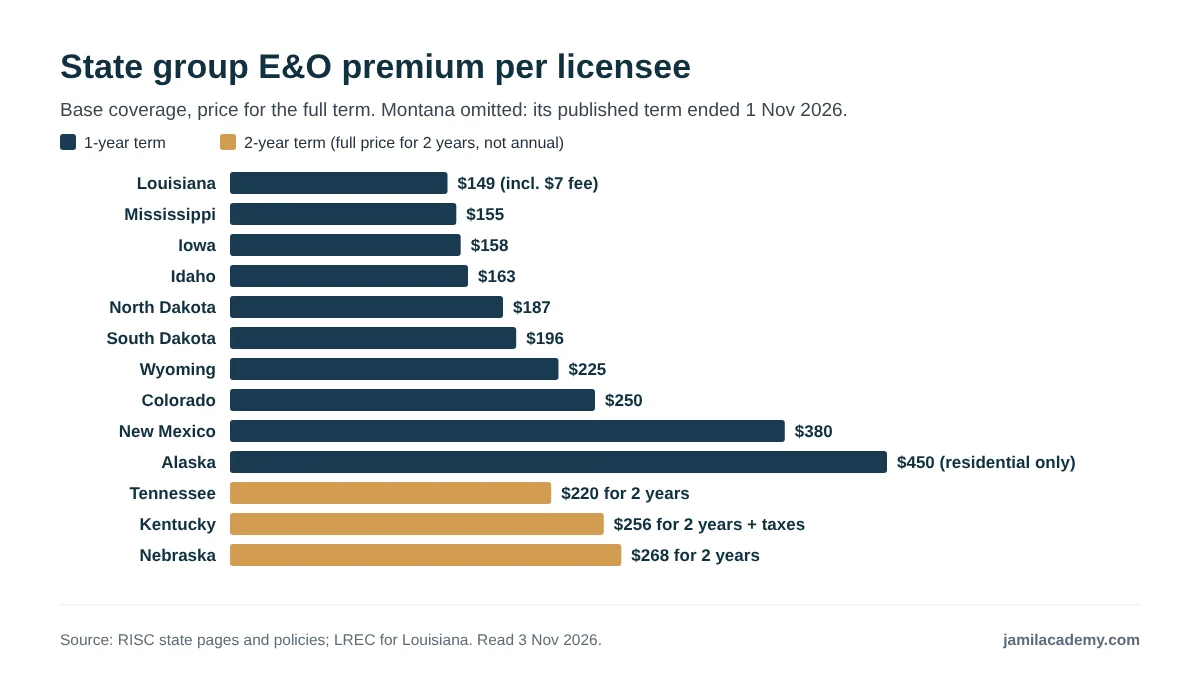
Notes you need before using these numbers
- Two-year terms are not annual prices. Halved, Tennessee is about $110 a year, Kentucky about $128 before taxes and surcharge, and Nebraska about $134. That is my arithmetic, not a published figure.
- Montana's published term has ended. The $185 policy ran to 1 November 2026. I did not find the next term's premium.
- South Dakota: the 2026 declarations say "$196.00 per year per Licensee." RISC's page shows $197. I use the policy figure.
- Idaho and Kentucky: RISC's pages still show older tables. I use the 2026 declarations: Idaho "$163 per year per Licensee," and Kentucky "$256.00 per two-year policy period per Licensee, plus taxes, surcharge, and any applicable endorsement premium."
- Nebraska: the commission's 2026 page lists a two-year term from 1 January 2026. RISC prices the term from 1 January 2027 to 1 January 2029 at $268. I did not find the 2026 term's price.
- Wyoming: the $225 is RISC's January enrollment figure. I did not capture the exact line, so confirm it.
- Louisiana: a RISC policy file labelled 2026 shows a 2027 term at the same $142 plus $7. The price matches; the term label does not.
- Alaska: $450 buys "Residential Sales Coverage ONLY." "Expanded Professional Services" is $642.
Several RISC pages list prices by enrollment month, so joining mid-term may cost a different amount. I recorded full-term or January figures only.
Term lengths change too. Tennessee's previous term was "eighteen (18) months for One Hundred Sixty-Five Dollars ($165.00)," per its Fall 2024 newsletter. The 2026 term returned to 24 months.
E&O is one line in a longer budget. For the rest, see my breakdown of what it costs to be a Realtor.
My view: in a mandatory state, the group premium is the floor for your budget, not the ceiling. Add taxes, surcharges and any options, and check the price at each renewal.
State E&O cost check (calculator)
Short answer: pick your state and the number of licensees to see the published group premium, the term, and the total for your team. It covers the 15 mandatory states, with every figure taken from the sources above.
Base group coverage only, per licensee, from commission pages, statutes, rules and RISC documents read 3 November 2026. RISC is the state-contracted administrator, not a government page. Mid-term enrollment, taxes, surcharges and optional coverage can change the price. Private-carrier prices were not researched.
With the defaults, Colorado at one licensee shows $250 for a one-year term. Pick Tennessee with three licensees and it shows $660 for the two-year term, about $330 a year by my arithmetic.
The "About per year" box only halves a two-year price. It does not mean a one-year option exists.
My view: if you run a team in a mandatory state, check each member's renewal date too. Group terms start on fixed dates, and a new hire may join mid-term.
Do states cap what the group E&O policy can cost?
Short answer: five states write a price ceiling into the law. In substance, if the group policy cannot be bought at or below it, the requirement does not apply. Current group premiums sit under each ceiling, with Kentucky's compared before taxes and surcharge.
| State | Ceiling, exact wording | Current group premium |
|---|---|---|
| Idaho | "not to exceed two hundred fifty dollars ($250) per year, per licensee" | $163 for one year |
| Kentucky | "not to exceed two hundred dollars ($200) per year for required insurance coverage" | $256 for two years, plus taxes and surcharge |
| Louisiana | "not to exceed five hundred dollars" | $149 for one year, including the $7 fee |
| Mississippi | "no more than Two Hundred Fifty Dollars ($250.00) per twelve (12) months' policy period" | $155 for one year |
| Nebraska | "at a reasonable premium not to exceed five hundred dollars" | $268 for two years |
Sources: Idaho Code 54-2013(7), KRS 324.395, RS 37:1466(H), Miss. Code 73-35-16(6)(e) and Neb. Rev. Stat. 81-885.55; premiums from RISC and LREC. All read 3 November 2026.
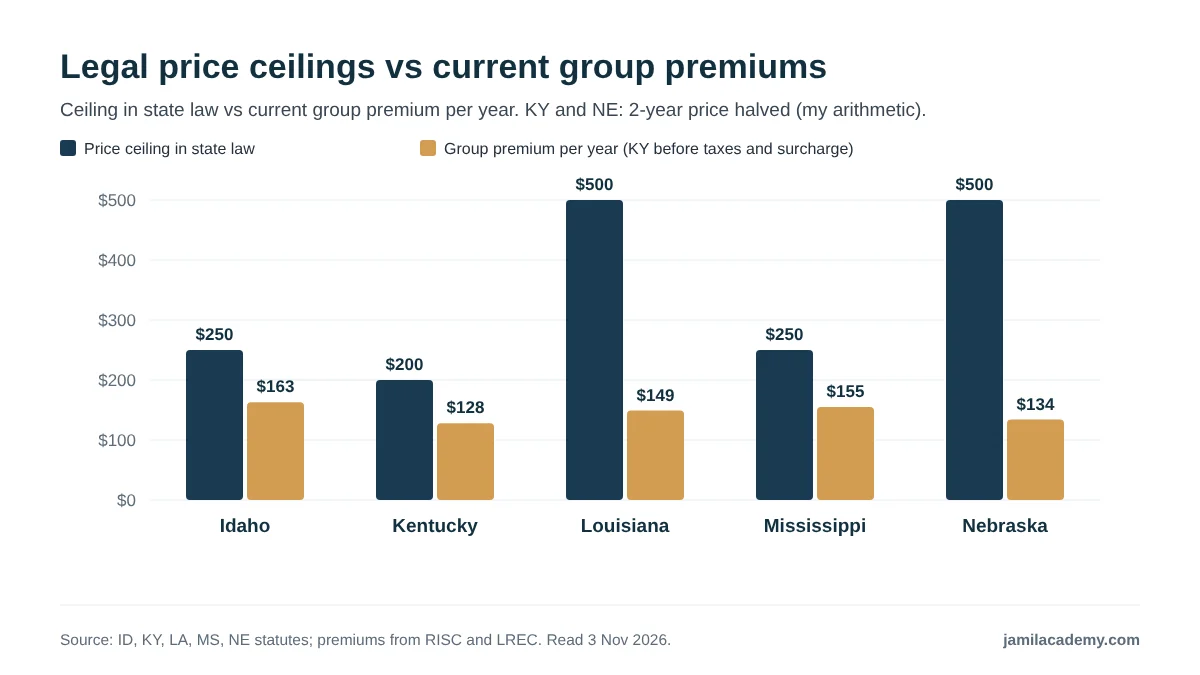
To compare Kentucky and Nebraska, I halved their two-year prices: about $128 and $134 a year by my arithmetic, with Kentucky's before taxes and surcharge. The Louisiana and Nebraska text I quoted states no period, but both premiums are far below $500 for the whole term.
Ceilings can come under pressure. A 2016 Alaska commission public notice said a 2015 bid drew "little to no interest." It proposed raising the maximum annual premium "up to $2,500." Alaska's $450 and $642 are the highest premiums I found.
My view: the ceilings are a safety valve, not a price promise. Budget from the current premium.
What minimum limits and deductibles do states set?
Short answer: the rules I read require at least $100,000 per claim, with annual aggregates from $100,000 to $1,000,000. Deductible caps run from $1,000 to $5,000. Several states leave the numbers to commission rules I could not read.
| State | Per claim | Aggregate | Deductible cap | Source |
|---|---|---|---|---|
| Alaska | $100,000 | $300,000 | $5,000 | 12 AAC 02.510 (third-party copy) |
| Idaho | $100,000 individual; $500,000 firm | $300,000 individual; $1,000,000 firm | $3,500, including defense | IDAPA 24.37.01 |
| Iowa | $100,000 | $100,000 | Private policy: no more than the group policy's | Iowa rules |
| Kentucky | $100,000 | $1,000,000 | $2,500 judgment or settlement; $1,000 defense | 201 KAR 11:220 |
| Mississippi | $100,000 | $100,000 | $2,500 per claim for damages | Miss. Code 73-35-16(5) |
| Nebraska | $100,000 | $300,000 | No greater than the group policy's | NREC 2026 fact sheet |
| New Mexico | $100,000 | $500,000 | $1,000; none for defense | 16.61.5.9 NMAC |
| North Dakota | $100,000 | $500,000 | Not in the text I quoted | 70-02-05-03 |
| Wyoming | $100,000 | $500,000 | $1,000 | Rule 7-4 (third-party copy) |
| Rhode Island | $50,000 | $150,000 | Not found | RI REALTORS (association-reported) |
Sources: IDAPA 24.37.01, Iowa rules, 201 KAR 11:220, Mississippi license law, NREC 2026 fact sheet, NMAC 16.61.5, N.D. Admin. Code 70-02-05 and RI REALTORS (21 January 2024); Alaska and Wyoming rules on Justia copies. All read 3 November 2026.
Colorado, Tennessee, Montana and South Dakota leave the dollar minimums to commission rules I did not read in official text. Louisiana's statute says the commission sets "the minimum limits of coverage, the permissible deductible, and permissible exemptions." For those states I show only what the group policy provides.
Rhode Island's figures come from the state Realtor association, citing 230-RICR-30-20-2, Section 28. I could not read that official rule, so confirm the limits with the Department of Business Regulation.
Individual and firm limits
Idaho sets higher limits for firms: $500,000 per claim and $1,000,000 aggregate. New Mexico applies its $100,000 per claim to "each licensed individual and entity."
Whether to run your business through an entity is a separate decision, covered in my guide on whether agents should form an LLC or S corp. Ask your commission how its E&O rule treats the entity.
Kentucky's limits come from 201 KAR 11:220, effective 16 December 2019. The legislature's page shows a 7-year expiration date of 16 December 2026, and I did not check whether it has been re-adopted. After that date, confirm the regulation is still in force.
My view: the legal minimum is a floor. If your deals are large, ask whether higher limits are available, and read how the deductible applies to defense costs.
Can you buy your own E&O policy instead of the state plan?
Short answer: in most mandatory states, yes, if your policy meets the state's minimums and you file proof. Rhode Island requires it, because there is no group plan. Montana's board page did not say.
The statute, rule or commission page allows an independent policy in Alaska, Colorado, Idaho, Iowa, Kentucky, Louisiana, Mississippi, Nebraska, New Mexico, North Dakota, South Dakota, Tennessee and Wyoming. I read Alaska's and Wyoming's text on third-party copies.
| State | Condition worth knowing |
|---|---|
| Iowa | "Self-insurance does not comply with the provisions of the Iowa errors and omissions insurance law." |
| South Dakota | The provider "must be an admitted carrier" |
| New Mexico | Certificate; carrier licensed in New Mexico and rated "B" or better by A.M. Best (paraphrase) |
| Colorado | File the "E&O Insurance Certificate of Independent Coverage" form |
| Tennessee | Allowed if "coverage meets state requirements and proof of coverage is provided to TREC" |
| Louisiana | Must meet "the minimum requirements established by the commission" |
Sources: Iowa rules, South Dakota DLR page, NMAC 16.61.5, Colorado E&O instructions, the TREC Fall 2024 newsletter and RS 37:1466(D). All read 3 November 2026.
I did not collect private-carrier prices, so I cannot say whether a private policy costs more or less than the group plan.
My view: compare a private quote on limits, deductible, exclusions and prior-acts coverage, not just price. A cheaper policy that leaves a gap can cost far more later.
What does real estate E&O insurance cover?
Short answer: claims arising from your licensed services, with damages paid up to the policy limits and, under Iowa's rule, defense costs paid on top. The details depend on the policy form, so I quote the documents rather than generalize.
| What is covered | Exact wording | Document |
|---|---|---|
| Your services as a licensee | "services performed by the Licensee as a real estate broker or real estate salesperson" | Iowa 2026 group policy form |
| Property management | The definition includes "the Licensee's Property Management Services" | Iowa 2026 group policy form |
| Every licensed activity | "All activities contemplated under Iowa Code chapter 543B are included as covered activities;" | Iowa rule 2019.2(4)(a) |
| Defense costs on top of damages | "Defense costs are to be payable in addition to damages;" | Iowa rule 2019.2(4)(e) |
Sources: Iowa 2026 group policy sample (RISC, state-contracted administrator); Iowa rules. All read 3 November 2026.
Sublimits: smaller caps for certain claims
Some claim types get a smaller limit than the main $100,000. RISC's Iowa page lists these damages sublimits, per claim and aggregate. I paraphrase them from the page; defense is shown as unlimited.
| Claim type (Iowa group program) | Damages sublimit, per claim / aggregate |
|---|---|
| Fair housing and discrimination | $25,000 / $25,000 |
| Earnest money and escrow | $5,000 / $10,000 |
| Environmental | $10,000 / $20,000 |
| Lock box | $5,000 / $10,000 |
| Regulatory complaint defense | $2,500 / $5,000 |
Source: RISC Iowa page (state-contracted administrator, not a government page; no date shown), read 3 November 2026.
Read sublimits together with the exclusions. The Iowa form excludes discrimination and pollutants in general terms, yet the page shows these sublimits. The policy wording decides how they fit.
Property management is not excluded across the board
Iowa's and Idaho's forms include property management in "Professional Services." Colorado's 2026 form excludes work as "a property manager which do not require a real estate license" (wording as written).
If you manage rentals, read the definition and exclusions in your own policy before you assume either way.
My view: the coverage list is short and the exclusion list is long. Spend more of your reading time on what the policy will not pay for.
What does real estate E&O insurance not cover?
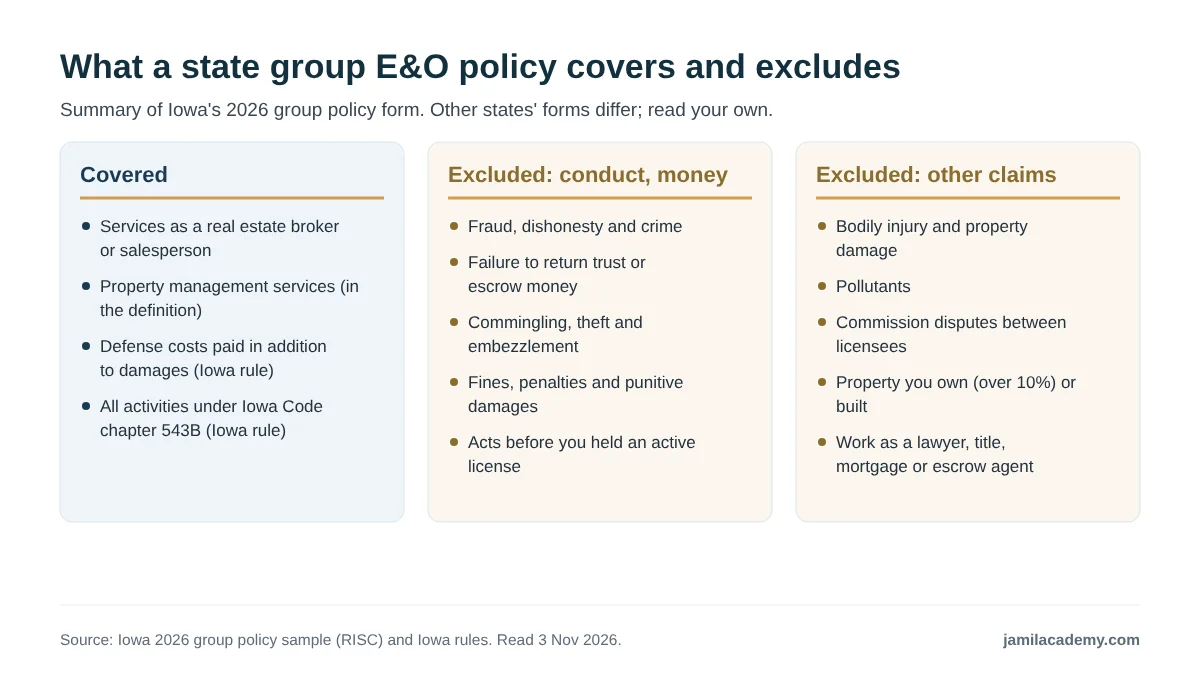
Short answer: on Iowa's 2026 group form, fraud, crime, bodily injury, property damage, fines, commission disputes and unreturned escrow money are all excluded, among others. Other states' forms can differ, as Colorado's property management wording shows.
The exclusion list opens, on the older Tennessee form, with "This insurance does not apply to any Claim alleging, arising from or related to:"
| Exclusion | Exact wording (Iowa 2026 form unless noted) |
|---|---|
| Fraud and crime | "fraudulent, dishonest, criminal, or malicious acts committed by the Insured" |
| Money not paid or returned | "the failure to pay, collect, or return insurance premiums, trust monies, escrow monies" |
| Bodily injury | "bodily injury, sickness, disease, mental anguish, pain or suffering, emotional distress" |
| Property damage | "physical injury to, destruction of, or loss of use of tangible property" |
| Discrimination | "discrimination on the basis of race, color, creed, national origin, sex, religion, age" (see the $25,000 sublimit above) |
| Your own property | "Professional Services relating to property in which any of the following had more than a 10%" interest |
| Property you built | "Professional Services relating to property developed or constructed by any of the following" |
| Other licensed roles | "a lawyer, title agent, mortgage banker, mortgage broker or correspondent, escrow agent, Construction" |
| Contract liability | "liability assumed by any Insured under any contract, indemnity agreement, purchase agreement" |
| Pollutants | "the actual, alleged, or threatened emission, discharge, dispersal, seepage, release, or escape of Pollutants" |
| Commission disputes | "disputes over commissions or fees between real estate brokers, salespersons, and/or property managers" |
| Acts before licensing | Acts "committed or alleged to have been committed either (1) prior to the date the Insured received an active real estate license" |
| Fines and punitive damages | "any fines, penalties, assessments, punitive damages, exemplary damages, multiplied damages" |
| Theft and commingling | "any conversion, misappropriation, commingling, defalcation, embezzlement, theft, disappearance" |
| Employment disputes (Tennessee form) | "the wrongful termination of employment, breach of an employment contract, or other employment disputes" |
Sources: Iowa 2026 group policy sample (Policy No. 26 EO 0032IA, form Ed. 08-2020), published by RISC, the state-contracted administrator; Tennessee sample policy on tn.gov (2005 to 2007 policy period, older form). Both read 3 November 2026.
What the states allow insurers to exclude
North Dakota's rule 70-02-05-04 lists 14 categories a policy may limit or exclude. They include criminal, dishonest, fraudulent or willful acts, discrimination, fines, bodily injury, pollutants and prior acts.
Its last item: "Other standard exclusions that are typical in the professional liability insurance industry may be permitted."
New Mexico's rule requires coverage for all licensed acts "except those illegal, fraudulent or other acts which are normally excluded from such coverage."
Sources: N.D. Admin. Code 70-02-05 and NMAC 16.61.5, read 3 November 2026.
Three exclusions agents trip over
- Your own deals. If you hold more than a 10% interest in the property, the Iowa form excludes it. Investor-agents should read this line twice.
- Escrow and trust money. Failing to return escrow money is excluded, and so is commingling. Your trust account process has no backup here.
- Commission fights. A dispute with another agent over a fee is excluded on the Iowa form.
My view: the exclusions make the case for a tight transaction process. Deadlines, deposits and disclosures are where a written system helps, and my contract-to-close checklist for agents is built for that.
Why do claims-made policies and coverage gaps matter?
Short answer: a bulletin hosted by Colorado's Division says most E&O policies are claims-made and reported, and that a coverage gap will cost you coverage for professional services. Continuous coverage is the rule to live by.
Colorado Division of Real Estate, continuous coverage bulletin
The bulletin warns that "failure to maintain continuous coverage will cause you to lose coverage for professional services."
Source: Colorado Division bulletin on maintaining continuous E&O coverage (no date shown), read 3 November 2026.
My reading, in plain terms: the policy in force when the claim arrives is the one that matters, not the one you had when you did the work. Confirm how your own policy defines this.
Where coverage gaps show up
- Going inactive. Kentucky exempts inactive licensees only after they obtain "extended reporting period coverage insurance for one (1) year."
- Missing a renewal. Tennessee starts suspension procedures. Iowa's agency page says licensees "must carry uninterrupted" coverage.
- Switching between the group plan and a private policy. Ask the new insurer how it treats your prior work before the old policy ends.
- Work before you were licensed. The Iowa form excludes acts before the insured "received an active real estate license."
Sources: KRS 324.395, TREC Summer 2026 newsletter, Iowa DIAL E&O page (updated 9 July 2026) and the Iowa 2026 group policy sample, read 3 November 2026.
My view: never let a policy lapse to save a month's premium. Renew first, then shop if you want to.
What do the E&O claims figures show?
Short answer: the only claims totals I found are RISC's own cumulative figures. They are the administrator's published numbers, not government statistics.
| State program | RISC's cumulative figure | Period |
|---|---|---|
| Tennessee | "Over $41.7+ Million in defense costs and damages" | Since 2003, as of 31 January 2026 |
| Louisiana | "Over $30+ Million in defense costs and damages" | 2003 through 30 June 2026 |
| Iowa | "Over $13 Million in defense costs and damages" | Since 2003, as of 31 August 2024 |
Source: RISC state pages (state-contracted administrator, not a government page), read 3 November 2026. Each says Continental Casualty Company incurred the amounts.
These totals span more than 20 years of each program. They do not show how many claims there were, how many agents were sued, or the average claim. I found no official state claims report, and no statute I read states a purpose for the mandate.
The only survey I found is old. North Carolina's 2002 bulletin said "77% of the 1300 persons responding to the survey have E&O insurance." That is one state in 2002, not a current national figure.
My view: the totals show that defense costs and damages add up over time. They do not predict your own risk, so use them as a reason to read your policy.
Do Virginia, Maryland, DC and West Virginia require E&O?
Short answer: I found no requirement on the official pages I checked for Virginia, Maryland, DC or West Virginia. That is not proof that none exists, and West Virginia's check was inconclusive.
| Jurisdiction | What I checked | What I found |
|---|---|---|
| Virginia | Real Estate Board Regulations (18 VAC 135-20, updated 1 October 2022) and the Board home page | "Errors and omissions," "E&O" and "professional liability" do not appear. "Insurance" appears only for fees, title insurance and flood insurance education. |
| Maryland | MREC Licensing FAQs and original license pages | "Insurance" does not appear. I did not search the statute. |
| DC | DC Real Estate Commission page | Only a navigation link, "Insurance Education Center." |
| West Virginia | Salesperson license page and the July 2025 License Act and Rules book | No insurance requirement listed, but much of the book's text was garbled. Not conclusive. |
Sources: Virginia Real Estate Board Regulations, Virginia Real Estate Board, MREC Licensing FAQs, MREC original license page, DC Real Estate Commission and West Virginia salesperson license page, read 3 November 2026.
I did not search Virginia Code Title 54.1, Chapter 21. None of these four appears on any mandatory-state list I found.
I am licensed in all four. My view: no state mandate does not mean no exposure. It means the state leaves the question to you and your brokerage.
No state mandate? Questions to ask your brokerage about E&O
Short answer: ask your brokerage what coverage it carries and how it applies to you. My research did not cover brokerage practices, so I cannot say what is typical. These questions come from the policy terms above.
- Does the brokerage carry an E&O policy, and am I covered under it? Ask to see the declarations page.
- Is it claims-made and reported? If so, what happens to claims about my past deals after I leave?
- What are the per-claim limit, aggregate and deductible? Compare them with the state minimums above.
- Who pays the deductible if a claim comes from my transaction, and is that in my agreement?
- Are there sublimits for escrow, fair housing, environmental or lock box claims?
- Is property management, referral work or work on my own property covered?
- Is there a per-agent charge for E&O, and when is it billed?
If the answers do not fit your business, ask whether you should buy your own policy, then compare quotes term by term.
E&O covers claims about your professional work. It is not health coverage, and the Iowa form excludes bodily injury. For the personal side, see my guide to health insurance options for real estate agents.
My view: ask these questions before you sign with a brokerage, not after a client complains, and keep the answers in your file.
What I could not verify
These are the gaps I hit while checking sources. Treat any page that fills them with a confident number with care.
- Private-carrier prices. None collected, so I quote none.
- Montana. The only price, $185, is for the term that ended 1 November 2026. Its statute and independent-coverage rule were not read.
- Nebraska's 2026 to 2028 term price. The commission lists that term; RISC prices 2027 to 2029.
- Legal minimums in Colorado, Tennessee, South Dakota and Rhode Island. Not read in official text.
- Wyoming's official Chapter 7 rules and Alaska's statute. Read only on third-party copies.
- Mississippi's and New Mexico's administrator. Confirmed only through RISC documents.
- North Dakota and Wyoming policy files. Unreachable, so their prices come from RISC's state pages.
- West Virginia, Maryland and Virginia statutes. WV's book was largely garbled; the Maryland statute and Virginia Code Title 54.1 were not searched.
- Kentucky's regulation after 16 December 2026. Re-adoption was not checked.
- Brokerage practices. No source found, so I frame them as questions to ask.

Frequently asked questions
What is real estate E&O insurance?
Errors and omissions insurance is professional liability coverage for claims about your services as a broker or salesperson. Iowa's 2026 group form covers those services and excludes fraud, bodily injury, fines and commission disputes.
Which states require E&O insurance for real estate agents?
Fifteen: Alaska, Colorado, Idaho, Iowa, Kentucky, Louisiana, Mississippi, Montana, Nebraska, New Mexico, North Dakota, Rhode Island, South Dakota, Tennessee and Wyoming. Several exempt inactive licensees.
How much does real estate E&O insurance cost?
Published state group premiums run from $149 in Louisiana to $450 in Alaska for one year. Tennessee ($220), Kentucky ($256 plus taxes and surcharge) and Nebraska ($268) price two-year terms. I did not research private prices.
Does Virginia require E&O insurance for real estate agents?
I found no requirement on the official Virginia Real Estate Board pages I checked, including its full regulations. Ask your brokerage what coverage it carries.
Can I buy my own E&O policy instead of the state group plan?
In most mandatory states, yes, if it meets the state minimums and you file proof. Rhode Island has no group plan, so licensees there buy independently. Montana's board page did not say.
Does E&O insurance cover property management?
It depends on the form. Iowa's 2026 group form includes property management services. Colorado's 2026 form excludes property manager work that does not require a real estate license. Read your own policy.
Does E&O insurance cover commission disputes?
Not on Iowa's 2026 group form. It excludes "disputes over commissions or fees between real estate brokers, salespersons, and/or property managers."
Do inactive licensees need E&O insurance?
Often not. Colorado, Iowa, Kentucky, Louisiana, Mississippi and Nebraska exempt inactive licensees in their statutes or rules. Kentucky first requires one year of extended reporting period coverage.
What does claims-made mean for real estate E&O?
A Colorado Division bulletin says most E&O policies are "claims-made and reported." It warns that failing to keep continuous coverage will cause you to lose coverage for professional services.
Saad Jamil is a top 1 percent Realtor with Samson Properties in Chantilly, Virginia, licensed in Virginia, DC, Maryland and West Virginia since 2013, with more than $500 million in career sales and 900+ homes closed. Reviews and closed sales are on his Zillow profile. He runs Jamil Academy, which sells training to agents. This article is general information, not legal or financial advice, checked on 3 November 2026.
Free: 5 Ways to Get More Listings Without Cold Calling
Five lead strategies that work without cold calls or ad spend, from an agent with $500M sold and 900+ homes closed.
No spam. Unsubscribe any time.
Your Coach