Real Estate Coaching vs Training: What's the Difference?
Jul 27, 2026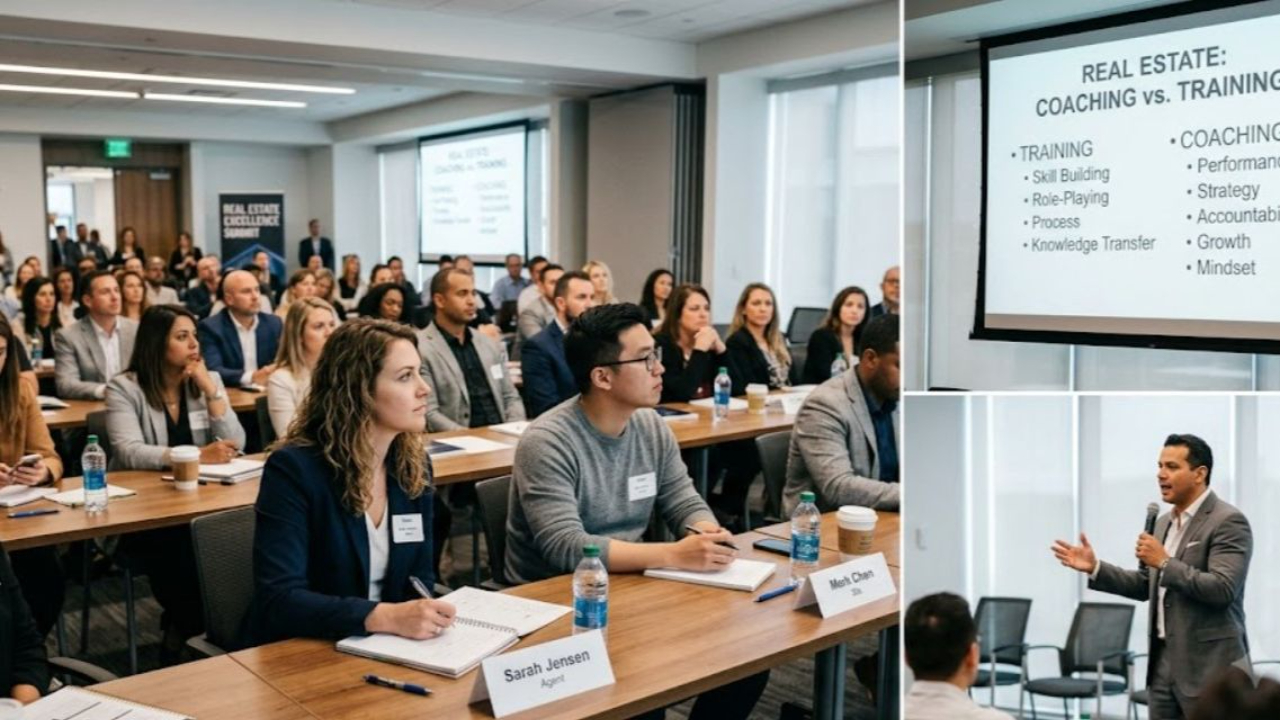
Ask ten agents whether they need coaching or training and most cannot tell you the difference. They use the two words like they mean the same thing. They do not. One teaches you the skills. The other makes sure you actually use them. Confusing the two is how agents waste money on the wrong thing. They sit through a course when they needed accountability, or hire a pricey coach when they had no foundation to coach in the first place.
I am Saad Jamil, founder of Jamil Academy, and after $500M and 900+ homes closed in Northern Virginia I still sell today, and I still pay for real estate coaching in my own business. This guide breaks down what training is, what coaching is, when each one is worth your money, and why the best agents in any market end up using both. No hard sell. Just the honest version, so you can spend on the thing that will actually move your income this year.
Quick Answer
Real estate training teaches you what to do; real estate coaching helps you actually do it. Training is content: courses, workshops, and scripts that build the skills every agent needs, and it works one to many. Coaching is personal: a real estate coach reviews your specific business, holds you accountable, and fixes the habits and mindset that content alone cannot. New agents usually need training first to build a foundation, then coaching to break through plateaus and scale.
In This Guide
What real estate coaching actually is
The real difference at a glance
When you need real estate training
When you need real estate coaching
The types of real estate coaching
The types of real estate training
How much real estate coaching and training cost
Do you actually need a coach?
How to choose a real estate coaching program
Why the best agents use both
Mistakes people make choosing between them
Frequently asked questions

What real estate training actually is
Real estate training is content. It is the courses, videos, workshops, scripts, and templates that teach you the skills the job requires. Training is built to scale, so one instructor can teach a thousand agents the same material at once. You consume it, you practice, and you keep the parts that work.
Good training answers the what and the how. What goes into a listing presentation? How do you handle a price objection? How do you run an open house that produces leads instead of small talk? It hands you the playbook. Most training flows in one direction, from the expert to you, and it does not know or care about the details of your specific business.
Here is what solid training usually covers:
- Skills and scripts. Prospecting, listing presentations, buyer consultations, negotiation, and objection handling, practiced until they feel natural.
- Systems and process. How to run a pipeline, a follow-up cadence, and a transaction from contract to close without dropping the ball.
- Marketing and lead generation. How to run ads, build a database, and get your name in front of the right people. If that is your gap, start with how to generate real estate leads.
- The business basics. Pricing, contracts, compliance, and how the money actually works. A real estate business plan is training you build for yourself.
The strength of training is efficiency. It is the fastest, cheapest way to go from knowing nothing to knowing the fundamentals. The weakness is that knowing is not doing. A shelf full of courses has never closed a single deal. That gap between what you know and what you do is exactly where coaching lives.
What real estate coaching actually is
Real estate coaching is a relationship, not a product. A real estate coach looks at your specific business, your numbers, your market, and your habits, and helps you get better at the things that matter for you. Where training is one to many, coaching is one to one, or at most one coach to a small group.
A coach does three things a course cannot. First, they personalize: instead of general best practices, they tell you what to fix next based on your actual pipeline. Second, they hold you accountable: you commit to actions and report back, which changes behavior in a way no video ever will. Third, they work on mindset: the fear, the avoidance, and the head trash that keep smart agents from doing work they already know how to do.
Notice what coaching does not do. A good coach rarely teaches you brand new information for the first time. Most agents already know they should prospect daily and follow up faster. They just do not. Coaching is less about new knowledge and more about consistent execution of the knowledge you have. That is why coaching without any foundation tends to fail, and why training without accountability tends to stall.
The real difference at a glance
Here is the cleanest way to hold the two apart. Training changes what you know. Coaching changes what you do. One is information, the other is behavior. You can get real value from each on its own, but they solve different problems, and buying the wrong one for your problem is the most common mistake agents make.
The numbers below frame the stakes. Most agents do not fail because they lack information. Information has never been cheaper or more available. They fail because they cannot execute consistently in a commission-only job with no boss. That is the exact problem coaching is built to solve, and it is why understanding the difference is worth real money.
87%
of new agents leave the business within 5 years
$300 to $2K
typical monthly cost of one-on-one real estate coaching
1-to-many
how training scales; coaching is one-to-one
Both
what most top producers actually use
When you need real estate training
Training is the right first spend far more often than agents think. If any of the following describe you, buy the course or attend the workshop before you hire a coach. Paying a coach to teach you things a $200 course already covers is a waste of both of your time.
- You are brand new. Your first job is a foundation: scripts, systems, and the basic mechanics of a deal. Pair training with the survival guide in how to succeed as a new real estate agent.
- You have a specific skill gap. You are fine overall but weak on one thing, say listing presentations or negotiation. A targeted course closes a narrow gap fast.
- You are switching niches. Moving into luxury, investors, or new construction means new knowledge. Training is the efficient way to get it before you start.
- You are still deciding on the business. If you are not even sure real estate is for you, do not spend on a coach yet. Read whether real estate is a good career and take some training first.
- You cannot yet name your problem. If you do not know what is broken, a coach cannot help. Training gives you the vocabulary and the map so you can spot the real issue.
The honest test is this: if the thing holding you back is that you do not know how, you need training. It is cheaper, it is faster, and it builds the base that any future coaching will stand on.
When you need real estate coaching
Coaching earns its higher price when knowing is no longer your problem. You have the information. Something else is in the way. These are the signals that you have outgrown courses and need a real estate coach.
- You have plateaued. You did 12 deals last year and 12 the year before. You know what would grow the business, you just are not doing it. That gap is a coaching problem, not a training one.
- You lack accountability. No boss, no schedule, no one checking your numbers. If your discipline slips the moment nobody is watching, a coach fixes that directly. A daily schedule for agents plus a coach is a strong pairing.
- You are scaling. Building a team, hiring help, or moving from solo agent to business owner brings problems no course anticipates. A coach who has done it saves you years of guessing.
- Your mindset is the bottleneck. Call reluctance, fear of the ask, self-sabotage after a good month. Mindset is coaching territory, and it is often the real reason most agents fail.
- The market turned. When deals dry up, most agents freeze. A coach keeps you in action while others wait. See how to thrive when most agents are not closing.
The pattern is simple. If the thing holding you back is that you know what to do but you are not doing it, no amount of new training will fix that. You need a person, not another playlist.

The types of real estate coaching
Coaching is not one format. The right one depends on your budget, your stage, and how much personal attention you actually need. Here are the main options, from most personal to most hands-off.
- One-on-one coaching. The most personal and the most expensive. A single coach works only on your business, your numbers, and your goals. It is the fastest path if you can afford it. Here is how we run 1-on-1 coaching.
- Group coaching. A coach plus a small cohort on regular calls. You get most of the accountability at a fraction of the price, and you learn from other agents solving the same problems you are.
- Mastermind. A room of agents at or above your level who push each other and share what is working right now. Less teaching, more peer pressure in the best sense.
- Accountability coaching. Lighter and cheaper. Someone checks your numbers and your commitments on a set schedule. It will not teach you much, but it will keep you honest between deals.
- Team or brokerage coaching. Some brokerages fold coaching into your split. It can be excellent or an afterthought, so judge the actual coach and the schedule, not the brochure.

The types of real estate training
Training comes in almost as many formats. The best one depends on how you learn and how much time you have. None of these is automatically better than the others; they just fit different people and different gaps.
- Self-paced online courses. Recorded lessons you work through on your own schedule. Cheap, flexible, and easy to abandon halfway, which is their one real risk.
- On-demand video libraries. A subscription to a deep catalog you can search when a specific problem comes up. Great as a reference, weak on structure and follow-through.
- Live workshops and bootcamps. A few intense days on one topic. The energy is high and the focus is real, though retention fades fast without a plan to apply it.
- Brokerage and franchise training. Built into many brokerages. Quality ranges widely, so weigh it seriously when you choose a brokerage rather than assuming it is good.
- Books, podcasts, and free content. The cheapest training on earth and often excellent. The catch is that free content is broad, not personal, and it rarely holds you to anything.
How much real estate coaching and training cost
Price is where the two split hardest. Training is usually a one-time or low monthly cost. Coaching is an ongoing investment, because you are paying for a person's time and attention, not a recording. Here are honest ranges for 2026.
A few notes on the numbers. The biggest names in real estate coaching charge the most, and their brand does not guarantee your result. A skilled lesser-known coach at a third of the price often beats them. Judge the fit and the coach, not the marketing.
And remember that the real cost of coaching is not the fee, it is the fee plus the work you have to do. A coach you ignore is the most expensive thing you can buy. Whatever you spend, run it against your income math first. If you are unsure what a deal is worth to you, work through how much real estate agents make so the spend is a decision, not a guess.
Do you actually need a coach?
Here is the honest part most coaching pages skip. Not everyone needs a coach right now, and some agents are actively wasting money on one. A coach is a force multiplier, and multiplying zero still gives you zero.
You will get strong value from coaching if:
- You already have a foundation and know the basic skills of the job.
- You are willing to do the work between calls, not just talk about it on them.
- You can point to a specific problem: a plateau, a scaling challenge, a habit you cannot fix alone.
- You are coachable, meaning you will actually take direction from someone who has done more than you.
You are probably not ready for a coach yet if:
- You are brand new and still need the fundamentals. Get training first, then coaching.
- You are not doing the basic activities and you are hoping a coach will make you want to.
- You cannot afford it without stress. A coach should be funded by the business, not by your credit card.
- You want someone to blame or to rescue you. Coaching is a partnership, not a lifeboat.
The best time to hire a coach is when you are already doing the work and want to do it better and faster. The worst time is when you are shopping for motivation you do not have. A coach can sharpen a working agent. A coach cannot want it for you.
How to choose a real estate coaching program
If you have decided coaching is your next step, choosing well matters more than choosing fast. A good real estate coaching program does a handful of things, and the weak ones are usually missing at least one of them. Here is what to look for, and the red flags that should give you pause.
- A coach who still sells or recently did. The market changes. Be careful with anyone whose last real deal was a decade ago; their advice may be from a different era.
- Accountability with teeth. Real coaching tracks your numbers and follows up. If no one ever checks whether you did the work, it is a course wearing a coaching label.
- A plan built around you. Good coaching starts with your numbers and your goals, not a one-size script. If the first call is generic, treat that as a warning sign.
- Proof beyond testimonials. Ask what a typical agent actually changed. Vague hype and rented mansions are red flags. Real coaches talk about behavior and results, not lifestyle.
- A price that fits your business. The right program is one the business can fund from the returns it creates, not one that puts you under pressure just to break even.
That mix of skills, accountability, and a plan built around real numbers is how we structure the real estate coaching programs at Jamil Academy. It is the combination that actually changes an agent's year. Whatever you choose, insist on all of it.
Why the best agents use both
Here is what the debate misses. It is not coaching versus training. The top producers I know use both, in a specific order, on repeat. They train to learn a new skill, then they use coaching and accountability to install it as a habit. Then they train on the next skill and do it again.
Think of it like the gym. Training is the workout program: the exact plan of what to do. Coaching is the trainer standing next to you who makes sure you show up, use good form, and add weight when you are ready. You can get results from a program alone. You get them faster, and you quit far less often, with someone in your corner.
This is also why a real estate coach is not the same as a mentor. A mentor is usually informal, unpaid, and gives advice when you ask. A coach is structured, paid, and holds you to a standard whether you feel like it or not. Both help. The strongest agents often keep a coach for accountability and a referral network of peers and mentors for perspective.
Mistakes people make choosing between them
- Buying coaching to avoid training. Hiring a coach to teach you the basics is the slowest, priciest way to learn fundamentals a course covers in a weekend.
- Buying training to avoid coaching. Collecting courses to feel productive while dodging the accountability you actually need. Course-hoarding is procrastination with a receipt.
- Choosing on price alone. The cheapest option that does not fit your problem is not a deal, it is money set on fire. Match the tool to the gap you actually have.
- Choosing on brand alone. A famous name is not the same as the right coach for you. The best real estate coaching for another agent may be wrong for your stage.
- Hiring a coach you will not obey. If you already know you will argue with every assignment, you are not ready. Coachability comes before the coach.
- Expecting either to do the work for you. Neither a course nor a coach closes deals. They shorten the path. You still have to walk it.

Frequently asked questions
What is the difference between real estate coaching and training?
Training teaches you the skills of the job through courses, workshops, and scripts, and it works one to many. Coaching is a personal relationship where a coach looks at your specific business, holds you accountable, and helps you execute what you already know. In short, training changes what you know and coaching changes what you do. Most agents need training first, then coaching to break through plateaus.
Is real estate coaching worth it?
It is worth it if you already have a foundation and you are willing to do the work between calls. For an agent who knows what to do but is not doing it consistently, a good coach often pays for itself in a single extra deal. It is not worth it if you are brand new and still need the fundamentals, or if you are hoping a coach will supply motivation you do not have. Coaching multiplies effort, so there has to be effort to multiply.
How much does real estate coaching cost?
Group coaching usually runs $100 to $500 a month. One-on-one coaching typically runs $300 to $2,000 or more a month, and the biggest brand-name programs can go higher. Masterminds fall in a similar range depending on the room. Training is much cheaper, with self-paced courses from $50 to $500 and live workshops from a few hundred to a couple thousand dollars one time.
Do new agents need a coach or training?
New agents almost always need training first. Your first job is to build a foundation of skills, scripts, and systems, and a course or workshop is the fastest and cheapest way to get it. Coaching pays off later, once you know the fundamentals and the thing holding you back is execution rather than knowledge. Some new agents do well with light accountability coaching on top of their training, but high-end coaching before you have a base is usually premature.
What is a real estate coach?
A real estate coach is a professional who works on your business with you, usually for a monthly fee. They review your numbers, help you set goals, assign specific actions, hold you accountable to them, and work on the mindset issues that hold agents back. A good coach personalizes everything to your market and your stage, rather than handing you the same generic advice a course would.
What is the difference between a coach and a mentor?
A mentor is usually informal and unpaid, someone further along who gives advice when you ask. A coach is structured and paid, and holds you to a standard on a schedule whether you feel like it or not. Mentors are great for perspective and the occasional gut check. Coaches are built to change your behavior week after week. Many top agents have both.
About the Author
Written by Saad Jamil, founder of Jamil Academy and a currently producing Top 1% Realtor in Northern Virginia, with $500M+ in career sales and 900+ homes closed. Saad still sells today and teaches agents the exact systems he runs. View Saad’s Zillow profile.
Educational content only, not financial, legal, or investment advice. Figures are industry estimates and examples, not a promise of earnings or returns. Always run your own numbers and consult the right professionals before acting.
Free: 5 Ways to Get More Listings Without Cold Calling
Five lead strategies that work without cold calls or ad spend, from an agent with $500M sold and 900+ homes closed.
No spam. Unsubscribe any time.
Your Coach