Real Estate Agent Resume (2026): Examples, a Template, and What Brokers Look For
Nov 05, 2026
A real estate agent resume is a short document that shows a broker or team leader three things: your license, your results and the skills behind them. Put your license type and number near the top, list closed transaction sides and sales volume you can prove, and tailor it to the firm.
New licensees and career changers lead with transferable experience instead. Below are three real estate agent resume examples as fill-in templates, plus a calculator that turns your own numbers into a resume line. I read every source on 5 November 2026.
Where I stand: I am a Realtor with Samson Properties in Virginia, and I run Jamil Academy, which sells training to agents. This guide is built from official pages and labelled third-party career advice, and my opinions are marked. The one product block near the end is my own.
Quick answer
- Who reads it: a principal or supervising broker, or a team leader, deciding whether to bring you on.
- Top of the page: contact details plus your license type and number, so a broker can check it.
- Order: header, summary, licenses, production, transferable experience, skills and technology, education. Newest first.
- Production: closed transaction sides and sales volume for a stated period, from your MLS or broker records.
- Length: one page if you are new. MIT's career office [third party] allows "two pages maximum" with substantial relevant information.
- Leave off: a photo, your age and your gender. The EEOC says "employers should not ask for a photograph of an applicant."
- Status: joining a firm is usually an affiliation, not a hire. The IRS treats licensed real estate agents as self-employed for federal tax purposes if two conditions are met.
- Do real estate agents need a resume, and who reads it?
- What do brokers look for in a real estate agent resume?
- What goes on a real estate agent resume, in order
- How to list your license so a broker can verify it
- Real estate agent resume examples: three fill-in templates
- How to show your production honestly
- Build your production line with the calculator
- What to leave off a real estate resume
- Format, length and applicant tracking systems
- Resume vs agent bio vs LinkedIn: what is the difference?
- Is joining a brokerage a job? Independent contractor status
- What I could not verify
- Frequently asked questions
Do real estate agents need a resume, and who reads it?
Short answer: not by law, but it helps. No source I read requires a resume to join a brokerage, and the BLS profile of the job does not mention resumes. The reader is usually a principal or supervising broker, or a team leader, deciding whether to take you on.
Who you are actually applying to
Virginia's law describes the relationship. Section 54.1-2100 defines a salesperson as a person "who is employed either directly or indirectly by, or affiliated as an independent contractor with, a real estate broker". Section 54.1-2106.1(C) adds: "No individual shall act as a salesperson without a salesperson's license from the Board."
Under 18VAC135-20-70, "Any inactive licensee may activate that license with a licensed real estate firm or sole proprietorship." For agents changing firms, a transfer "will be effective upon the new principal broker or supervising broker's execution" of the application.
Sources: Code of Virginia § 54.1-2100 and § 54.1-2106.1; Virginia Administrative Code 18VAC135-20-70, read 5 November 2026.
So the person reading your resume is often the broker you would activate or transfer your license with. In Virginia, that broker also supervises your advertising: "All advertising must be under the direct supervision of the principal broker or supervising broker."
Source: Virginia Administrative Code 18VAC135-20-190 (eff. April 1, 2026), read 5 November 2026.
The broker or team interview
My view: treat the resume as a briefing for an interview, not a cold application. A useful one answers four questions before the meeting starts:
- Are you licensed and active, and can the broker check it in a minute?
- What have you closed, over what period, and where do the numbers come from?
- Where will your business come from, such as past clients, referrals or a prior career network?
- What do you need from the firm: training, a team, lead support or none of those?
The interview runs both ways. My guide on how to choose the right brokerage as a new agent is the other half of that conversation.
What the job market looks like
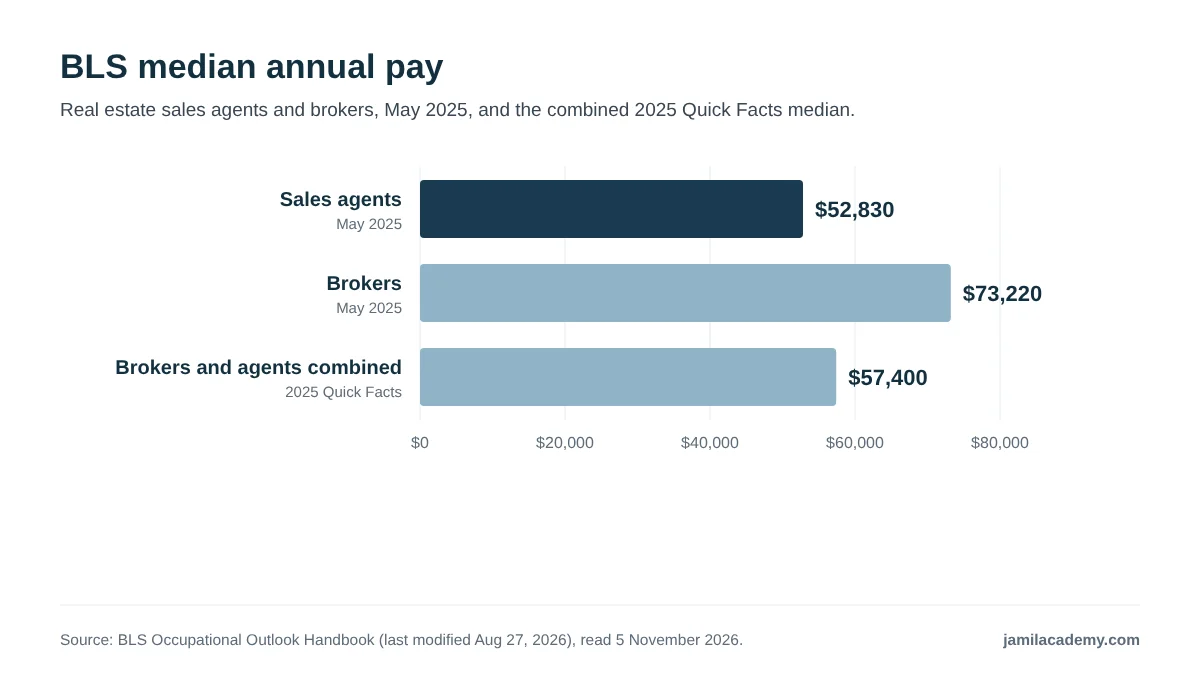
The BLS counts "Number of Jobs, 2025: 530,600" for brokers and sales agents combined. Employment is "projected to grow 2 percent from 2025 to 2035, slower than the average for all occupations." Still, "about 40,400 openings for real estate brokers and sales agents are projected each year".
| BLS measure | Figure | Period |
|---|---|---|
| Median annual wage, real estate sales agents | $52,830 | May 2025 |
| Median annual wage, real estate brokers | $73,220 | May 2025 |
| Median pay, brokers and agents combined (Quick Facts) | $57,400 per year | 2025 |
Source: BLS Occupational Outlook Handbook, "Real Estate Brokers and Sales Agents" (last modified August 27, 2026) at bls.gov, read 5 November 2026.
What do brokers look for in a real estate agent resume?
Short answer: in my view, evidence of the five qualities the BLS lists as important for the job. They are business, interpersonal, organizational and problem-solving skills, plus self-motivation. The best resume lines prove one of them with a number.
| BLS important quality | BLS wording | Resume line that shows it (my suggestion, fill the brackets) |
|---|---|---|
| Business skills | "they must be able to manage every aspect of their business" | Ran a marketing budget of $[amount] across [channels] in [year] |
| Interpersonal skills | "They must be pleasant, respectful, and dependable." | Earned [N] client reviews on [platform]; [N] repeat or referred clients |
| Organizational skills | "must be able to manage their own time for planning and prioritizing their work." | Managed [N] transactions at once from contract to closing |
| Problem-solving skills | "They also mediate negotiations between a seller and a buyer." | Negotiated [repair or price terms] on [N] contracts |
| Self-motivated | "Because they often have little or no supervision, real estate brokers and sales agents must be able to work independently." | Generated [N] of [N] closed sides from sphere and referrals |
Source: BLS Occupational Outlook Handbook, "Real Estate Brokers and Sales Agents" (last modified August 27, 2026), read 5 November 2026.
O*NET skills and work styles
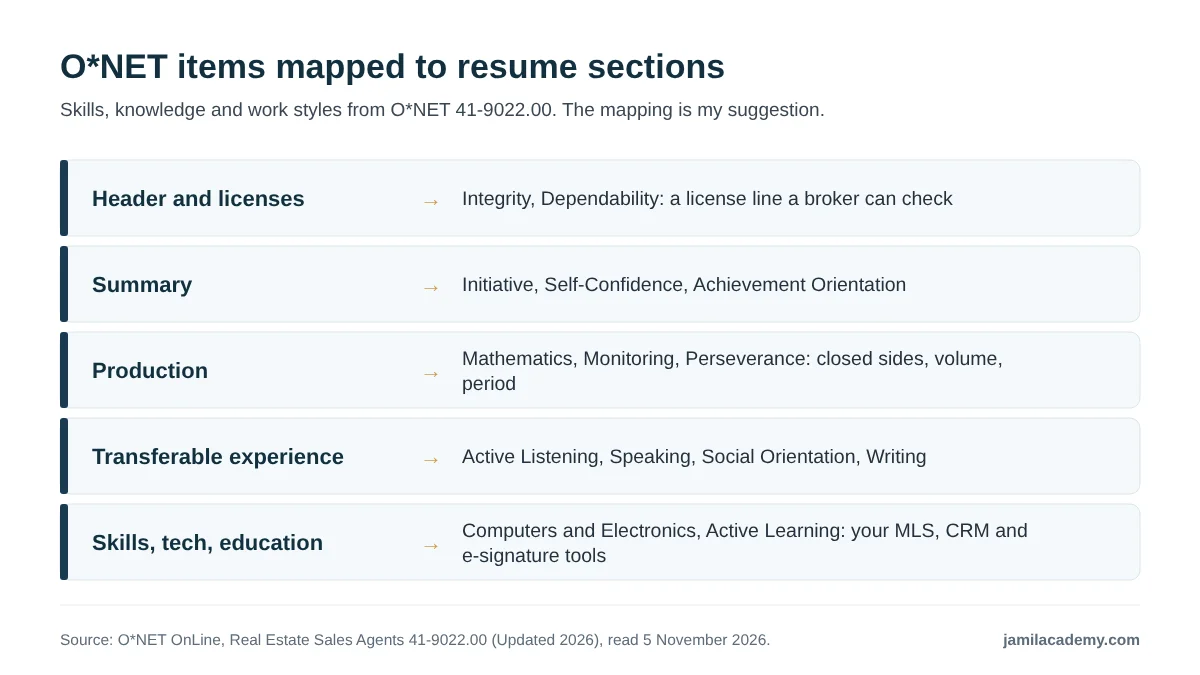
O*NET's profile for real estate sales agents lists these skills: Active Listening, Speaking, Critical Thinking, Reading Comprehension, Active Learning, Writing, Mathematics and Monitoring.
Its work styles are Initiative, Self-Confidence, Perseverance, Social Orientation, Achievement Orientation, Integrity, Attention to Detail and Dependability. Integrity is "A tendency to be honest and ethical at work."
Source: O*NET OnLine, "Real Estate Sales Agents" 41-9022.00 (Updated 2026) at onetonline.org, read 5 November 2026.
Turn O*NET tasks into resume bullets
Each O*NET task can become a bullet once you add your own count and period. The task text is quoted. The bullets are my examples with blanks.
| O*NET task | Example bullet (fill in your own numbers) |
|---|---|
| "Present purchase offers to sellers for consideration." | Presented [N] offers to [N] seller clients in [year] |
| "Compare a property with similar properties that have recently sold to determine its competitive market price." | Prepared [N] comparative market analyses for listing appointments |
| "Coordinate appointments to show homes to prospective buyers." | Scheduled and led [N] showings for [N] buyer clients |
Source: O*NET OnLine, "Real Estate Sales Agents" 41-9022.00 (Updated 2026), read 5 November 2026.
My view: do not paste O*NET's list into a skills section. A broker reads "Active Listening" as a claim. A line with a count, a period and a source reads as evidence.
What goes on a real estate agent resume, in order
Short answer: seven sections, top to bottom. Header, summary, licenses and certifications, real estate experience and production, transferable experience, skills and technology, then education. New licensees can move transferable experience above real estate experience.
Within each section, list entries newest first. Harvard's career office [third party] says to use "reverse chronological order (most recent first)." The section order is my recommendation.
Source: Harvard College Office of Career Services, "Create a Strong Resume" (modified July 13, 2026), third party, read 5 November 2026.
1. Header
Name, phone, email, city and state, and a license line. Harvard [third party] lists "Missing email and phone information" among the top resume mistakes. Write the license line the way the regulator shows it, for example: Virginia real estate salesperson license no. [number].
2. Summary
Two or three lines, written without "I." Harvard [third party] says not to "Use personal pronouns (such as I or We)" and to "Tailor your resume to the type of position you're seeking." So write a new summary for each firm or team.
Source: Harvard College Office of Career Services, "Create a Strong Resume" (modified July 13, 2026), third party, read 5 November 2026.
3. Licenses and certifications
Each state license with its type, number and status. The BLS says "State licenses typically must be renewed every 2 to 4 years," so add the renewal date. List only designations you hold.
Source: BLS Occupational Outlook Handbook, "Real Estate Brokers and Sales Agents" (last modified August 27, 2026), read 5 November 2026.
4. Real estate experience and production
For each brokerage, newest first: firm name, dates affiliated and your role, such as solo agent or team member. Then closed sides and volume for a stated period, with the source.
5. Transferable experience for career changers
If you have few or no closings, this section carries the resume. Match prior work to the duties the BLS lists. One is to "Solicit potential clients to buy, sell, and rent properties", which any prospecting or sales role supports.
| Prior work | What it shows | Related BLS quality or O*NET item |
|---|---|---|
| Sales or business development | Prospecting, follow-up, closing | Self-motivated; Sales and Marketing |
| Customer service or hospitality | Patience, fast replies | Interpersonal skills; Customer and Personal Service |
| Teaching or training | Explaining a process clearly | Speaking; Active Listening |
| Finance, lending or bookkeeping | Numbers, documents, accuracy | Mathematics; Attention to Detail |
Sources: BLS Occupational Outlook Handbook, "Real Estate Brokers and Sales Agents" (last modified August 27, 2026); O*NET OnLine, "Real Estate Sales Agents" 41-9022.00 (Updated 2026), read 5 November 2026.
Write each bullet as action, scope and result. MIT [third party] says to "quantify results whenever possible." If you are still getting licensed, start with the steps to become a Realtor first.
Source: MIT Career Advising & Professional Development, "Crafting an Effective Resume" (modified April 23, 2026), third party, read 5 November 2026.
6. Skills and technology
O*NET's technology examples for the role make a good checklist. List only tools you actually use. Examples O*NET shows, grouped by me:
- MLS and property data: "Internet based MLS database software" and Realtors Property Resource (RPR).
- CRM: examples include TopProducer, Microsoft Dynamics and DataBasix Technologies Lead Commander.
- Office and documents: Microsoft Office, Outlook, Excel, Google Docs, Adobe Acrobat and DocuSign eSignature.
- Marketing and video: Canva, Facebook, LinkedIn, Google Ads and Zoom.
This is a partial list of what O*NET shows. Add languages you can work with clients in.
Source: O*NET OnLine, "Real Estate Sales Agents" 41-9022.00 (Updated 2026), read 5 November 2026.
7. Education
The BLS lists typical entry-level education as "High school diploma or equivalent" and notes that "many real estate brokers and sales agents have a bachelor's degree." List your highest degree or diploma, then your prelicensing course.
O*NET places the role in "Job Zone 1-2: Very Little to Some Preparation Needed". Its education figures come from a survey of current workers, not a licensing rule. States set licensing rules.
Sources: BLS Occupational Outlook Handbook, "Real Estate Brokers and Sales Agents" (last modified August 27, 2026); O*NET OnLine, "Real Estate Sales Agents" 41-9022.00 (Updated 2026), read 5 November 2026.
How to list your license so a broker can verify it
Short answer: write your license type, state and number exactly as the regulator shows them. In Virginia, a broker can check you on DPOR's License Lookup. In Maryland, the Real Estate Commission's Public Query searches active licensees. The BLS notes "All states require real estate brokers and sales agents to be licensed."
Source: BLS Occupational Outlook Handbook, "Real Estate Brokers and Sales Agents" (last modified August 27, 2026), read 5 November 2026.
Virginia: DPOR License Lookup
Virginia's Department of Professional and Occupational Regulation runs the License Lookup. It says: "Enter search terms like name, license number, address, and license type above."
It also warns: "The data located on this website are not the public records of the Department of Professional and Occupational Regulation," and the data "are updated routinely but may not be up to date at all times."
Source: Virginia DPOR, License Lookup (data last updated November 4, 2026), read 5 November 2026.
Maryland: Real Estate Commission Public Query
The Maryland Real Estate Commission page links to a "License Search". It reads "Welcome to the Real Estate Commission Public Query", with searches "By License Registration Number ("License Number")" and "By Name (Last Name, and optionally, City Name)".
Source: Maryland Real Estate Commission, License Search and Public Query (updated May 28, 2026), read 5 November 2026.
How to write the license line
| Situation | License line (fill in your own details) |
|---|---|
| One state, active | Virginia real estate salesperson license no. [number], active with [brokerage name] |
| Several states | Licensed in [state] (salesperson, no. [number]) and [state] (salesperson, no. [number]) |
| Newly licensed | [State] real estate salesperson license no. [number], issued [month year], seeking firm affiliation |
| Mid-transfer | [State] salesperson license no. [number]; transfer to [firm] submitted [date] |
Use the newly licensed line only once the license is issued. Virginia's activation rule says a licensee activating with a firm "must not conduct licensed activity" with it until the board issues the license.
Source: Virginia Administrative Code 18VAC135-20-70, read 5 November 2026.
My view: look yourself up before you send the resume. If you just moved, add the transfer date, since the lookup may lag. I did not check other states' lookups.
Real estate agent resume examples: three fill-in templates
Short answer: pick the real estate resume template that fits your situation. The first is for new licensees and career changers, the second for agents moving brokerages, and the third for agents applying to a team. Every [bracket] is yours to fill from your own records.
Example 1: new licensee or career changer
How to adapt it: drop the real estate activity heading if you have nothing to list yet.
Example 2: experienced agent moving brokerages
How to adapt it: lead with the production block, because in my view it is what a recruiting broker will ask about first. Keep each firm's numbers under that firm, so nothing is counted twice.
In Virginia, the move takes effect when the new principal or supervising broker executes the transfer application. My guide on switching brokerages without losing your clients covers the move itself.
Source: Virginia Administrative Code 18VAC135-20-70, read 5 November 2026.
Example 3: applying to join a team
How to adapt it: name the seat you want. The BLS says schedules "often include evenings and weekends to accommodate clients' schedules," so state your availability.
NAR says "Twenty-one percent of REALTORS® were part of a real estate team in 2025." If you are weighing a team at all, my breakdown of the splits and leads tradeoff of joining a team weighs those two against each other.
Sources: BLS Occupational Outlook Handbook, "Real Estate Brokers and Sales Agents" (last modified August 27, 2026); NAR Realtor Magazine, "Even in a tougher market, Realtors are holding their ground" (June 25, 2026), read 5 November 2026.
My view: cut any line you cannot back up with a record. A blank you leave out costs nothing. A number a broker cannot verify costs your credibility.
How to show your production honestly
Short answer: give the count, the dollar volume, the period and the source, and count only closed deals. Take the numbers from your MLS or brokerage records, so a broker can check them. Use NAR's medians only as context.
MIT's career office [third party] says "Including a quantitative result makes your accomplishments more concrete and compelling." Harvard [third party] lists "Not demonstrating results" as a common mistake.
Sources: MIT Career Advising & Professional Development, "Crafting an Effective Resume" (modified April 23, 2026), third party; Harvard College Office of Career Services, "Create a Strong Resume" (modified July 13, 2026), third party, read 5 November 2026.
Sides and sales volume
NAR reports production in transaction sides and sales volume. I found no NAR definition of a side in the pages I read, so what follows is my explanation, not an NAR definition.
In common industry use, a sale has two sides: the buyer's and the seller's. Sales volume is usually the total of the sale prices on your sides. Ask your broker how their reports count a deal where one agent represents both parties, or a team shares it.
Use numbers a broker can check
- Closed only. Pending contracts can fall through. If you list them, use a separate, labelled line.
- A stated period, such as the last 12 months, and the same period for sides and volume.
- A named source: your MLS records, your brokerage's records or your own closing files.
- Yours, not the team's. Separate your personal sides from the team's total.
- No rounding up, and leases listed apart from sales.
Those rules are my view. A broker who finds one inflated number will doubt the rest.
NAR medians are context, not a target
NAR's 2026 Member Profile covers 2025 and is "Based on a random sampling of members". The pages I read show no sample size, and the full report is a paid download I did not read. NAR says "the typical agent reported nine transaction sides in 2025" and reports "13 median years in the business."
| Measure (2025 data) | NAR figure | Where NAR published it |
|---|---|---|
| Median gross income, all members | $59,200 (up from $58,100 in 2024) | Press release |
| Typical transaction sides | nine | Press release |
| Members with 6+ years: median sides and volume | 10 sides; about $3 million | Realtor Magazine article |
| Median sales volume, individual brokerage specialists | $2.7 million | Press release |
| Median sales volume, team-based brokerage specialists | $17.5 million | Press release |
| Less than one year of experience | 11% of membership | Realtor Magazine article |
Sources: NAR, 2026 Member Profile press release (June 25, 2026); NAR Realtor Magazine, "Even in a tougher market, Realtors are holding their ground" (June 25, 2026); NAR, Member Profile research page (© 2026), read 5 November 2026.
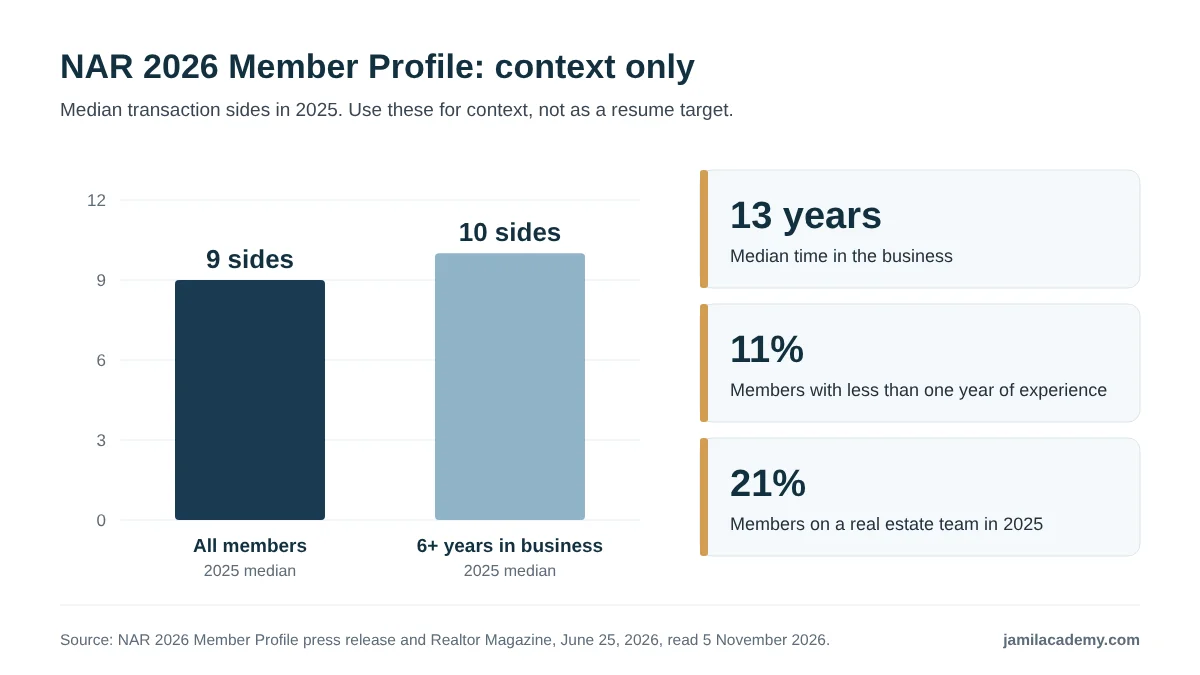
Two cautions. NAR's figures are gross income for its members, while the BLS figures are median wages for the occupation, measured differently, so do not compare them directly. And NAR published two different team median sides figures, so I left team sides out.
My view: put your own numbers on the resume and leave NAR's off it.
Build your production line with the calculator
Short answer: enter your closed sides, volume and buyer and seller split from the last 12 months, and the builder writes a resume line from your numbers only. It also shows your average sale price, your buyer and seller mix, and NAR's medians for context.
An estimate built only from what you enter. Check every number against your MLS or brokerage records before it goes on a resume. NAR medians are from the 2026 Member Profile press release and Realtor Magazine article (June 25, 2026), read 5 November 2026, and are context, not a target.
How the builder counts
- Average sale price: total sales volume divided by closed sides, rounded to the dollar.
- Buyer and seller mix: buyer sides divided by total sides, rounded to a whole percent. Seller share is the rest, so the two always add to 100.
- Check: buyer plus seller sides must equal total sides, or the builder asks you to fix them.
- Context: under 6 years licensed, your sides are compared with NAR's all-member median of nine. At 6 or more, with the median of 10 for members with 6+ years.
My view: paste the line into your production section and add the source after it, such as (source: MLS records, [date range]).
What to leave off a real estate resume
Short answer: leave off your photo, your age or date of birth, your gender, and anything about the traits the EEOC lists as protected. Also cut claims you cannot back up.
What the EEOC says
The EEOC says "it is illegal to discriminate against someone (applicant or employee)" "because of that person's race, color, religion, sex (including transgender status, sexual orientation, and pregnancy)" "national origin, age (40 or older), disability or genetic information."
On photos: "employers should not ask for a photograph of an applicant." "If needed for identification purposes, a photograph may be obtained after an offer of employment is made and accepted."
Source: U.S. Equal Employment Opportunity Commission, "Prohibited Employment Policies/Practices" (no date shown), read 5 November 2026.
One caution. The EEOC page I read does not mention independent contractors, so it is unclear whether these rules cover a brokerage recruiting contractor agents. If that matters to you, ask the broker or an employment lawyer. The advice below costs you nothing either way.
What career offices say
Harvard's career office [third party] lists these under DON'T: "Use personal pronouns (such as I or We)", "Include a picture" and "Include age or gender".
Source: Harvard College Office of Career Services, "Create a Strong Resume" (modified July 13, 2026), third party, read 5 November 2026.
My leave-off list
- Photo, age and gender, per the EEOC line and Harvard [third party]. Dropping graduation years that reveal age is my extension of that.
- Marital or family status, religion and health. None of it helps a broker judge your work.
- Client names and addresses, unless the client agreed. Describe the deal instead.
- Unsourced titles such as "top producer", unless you can name who awarded it and when.
- Commission income. Share it in the interview if asked, with records.
Beyond the first item, the list is my view. The bio section below explains where a photo does belong.
Format, length and applicant tracking systems
Short answer: one page if you are new, two at most if you have substantial history, in a plain single-column layout with the keywords from the posting. The career centers I read disagree on length, so I give all three.
| Source (all third party) | Length advice |
|---|---|
| MIT Career Advising & Professional Development [third party] | "aim for one page or two pages maximum if you have substantial relevant information." |
| UVA Career Center [third party] | "Keep it to 1 page." One page "is the recommended length for undergraduates," which "may vary if you have extensive experience." |
| Harvard Office of Career Services [third party] | No page limit stated in the guide I read |
Sources: MIT Career Advising & Professional Development, "Crafting an Effective Resume" (modified April 23, 2026), third party; UVA Career Center, "Resumes" (no date shown), third party; Harvard College Office of Career Services, "Create a Strong Resume" (modified July 13, 2026), third party, read 5 November 2026.
My reading of that disagreement: one page for new licensees and career changers, up to two for experienced agents. UVA's advice [third party] is written for undergraduates.
Applicant tracking systems
MIT [third party] warns that applicant tracking systems may struggle with "reading tables, columns, graphics, and images." It adds: "Incorporate keywords throughout your document." I found no source on how many brokerages or teams use such software. A simple layout helps either way.
Source: MIT Career Advising & Professional Development, "Crafting an Effective Resume" (modified April 23, 2026), third party, read 5 November 2026.
My view, built on MIT's advice [third party]: use one column and standard headings, put true keywords from the posting in your bullets, such as buyer agent or your CRM's name, and save one tailored version per firm.
Resume vs agent bio vs LinkedIn: what is the difference?
Short answer: the resume is for the broker or team leader, the agent bio is for clients, and LinkedIn is public to both. This comparison is my view.
| Resume | Agent bio | LinkedIn profile | |
|---|---|---|---|
| Main reader | Broker or team leader | Buyers and sellers | Anyone |
| Goal | Get affiliated or hired | Win a client's trust | Be found and checked |
| Photo | Leave it off | Professional headshot | Profile photo |
| Production numbers | Yes, with period and source | Only if your broker approves | Only if your broker approves |
The bio is where your headshot and your story belong. My guide to writing a real estate agent bio clients actually read covers that side. O*NET lists LinkedIn among the role's technology examples, so keep the profile's dates and numbers consistent with the resume.
Source: O*NET OnLine, "Real Estate Sales Agents" 41-9022.00 (Updated 2026), read 5 November 2026.
When does marketing yourself become advertising?
Virginia defines advertising as "all communication disseminated through any medium to consumers for any purpose related to licensed real estate activity." And "All advertising by an affiliated licensee must be done under the policies of a principal or supervising broker."
Sources: Virginia Administrative Code 18VAC135-20-10 and 18VAC135-20-190 (eff. April 1, 2026), read 5 November 2026.
NAR's Code of Ethics, which binds NAR members only, says REALTORS® must "present a true picture in their advertising, marketing, and other representations." Standard of Practice 12-13 covers credentials "to which they are legitimately entitled."
Source: NAR, 2026 Code of Ethics and Standards of Practice (effective January 1, 2026), read 5 November 2026.
The Virginia text does not mention resumes, LinkedIn or social media, and the NAR passages I read do not address them, so I make no claim either way. If you use the resume or LinkedIn profile to market yourself to consumers, ask your broker whether the advertising rules apply.
Is joining a brokerage a job? Independent contractor status
Short answer: usually not in the employee sense. The IRS treats licensed real estate agents as self-employed for federal tax purposes if two conditions are met, and most agents affiliate as independent contractors. Your resume is an application to affiliate.
The IRS says: "There are three categories of statutory nonemployees: direct sellers, licensed real estate agents and certain companion sitters." They "are treated as self-employed for all federal tax purposes," "including income and employment taxes, if:"
- "Substantially all payments for their services as direct sellers or real estate agents are directly related to sales or other output, rather than to the number of hours worked"
- "Their services are performed under a written contract providing that they will not be treated as employees"
Source: IRS, "Statutory Nonemployees" (reviewed June 5, 2026), read 5 November 2026.
The BLS says "Most real estate brokers and sales agents are self-employed." Its table shows 54% of sales agents as self-employed workers, and 55% of brokers. NAR says "86% of REALTORS® are independent contractors at their firms" and "53% of members are affiliated with an independent company".
Sources: BLS Occupational Outlook Handbook, "Real Estate Brokers and Sales Agents" (last modified August 27, 2026); NAR, 2026 Member Profile press release (June 25, 2026), read 5 November 2026.
What it means for the resume
- Use "affiliated with" for brokerages rather than "employed by," unless you were an employee.
- Lead with output. The IRS test ties pay to "sales or other output," so production is the natural headline.
- Read the agreement. The IRS condition refers to a written contract. Read yours before you sign, and ask a tax adviser about your situation.
Those points are my view, not tax advice. Virginia's definition also covers salespeople who are employed, so check your own offer.
What I could not verify
These are the gaps I hit. Be careful with any page that fills them confidently.
- Whether brokers or teams require a resume. No source I read says so, and the BLS page does not mention resumes.
- An NAR definition of a transaction side. None in the pages I read, so my explanation above is labelled as mine.
- Team median sides. Two NAR pages give different figures, so I left the number out.
- NAR membership. Two counts were published the same day, so I give about 1.44 million.
- Whether a resume or LinkedIn profile is advertising under Virginia's rules or NAR's Code. Neither text I read addresses it.
- Whether EEOC rules cover recruiting independent contractor agents. The page I read does not say.
- The exact Virginia sentence that a salesperson must join a firm. I found the requirement only through the definitions and the activation rule quoted above.
- Maryland's affiliation rule. The Commission page does not state it, and I did not read Maryland's statute.
- IRS Publication 15-A. Not read. I used the IRS statutory nonemployees page wording instead.
- NAR's full 2026 Member Profile. It is a paid download. I did not see degree shares, hours worked, the franchise share or how many agents changed firms.

Frequently asked questions
Do real estate agents need a resume?
No rule I found requires one to join a brokerage. A resume still helps a broker or team leader check your license and production before an interview.
What should a real estate agent resume include?
Your license type and number, a short summary, licenses, closed sides and volume with a period and source, transferable experience, skills and technology, and education.
How long should a real estate agent resume be?
One page if you are new. MIT's career office, a third-party source, says up to "two pages maximum if you have substantial relevant information."
Should I put my license number on my resume?
Yes. Virginia's DPOR License Lookup searches by name or license number, and Maryland's Public Query searches active licensees by License Number or name.
How do I write a real estate resume with no experience?
Lead with transferable experience from sales, service or teaching jobs, with numbers from those roles, and list your license and prelicensing course.
Should I include a photo on my real estate resume?
No. The EEOC says "employers should not ask for a photograph of an applicant," and Harvard's career office, a third party, says not to include a picture.
How do I show sales production on a resume?
Give closed transaction sides and sales volume for a stated period, such as the last 12 months, from your MLS or brokerage records.
Are real estate agents employees or independent contractors?
Usually contractors. The IRS treats licensed real estate agents as self-employed for federal tax purposes when substantially all pay ties to sales or other output and a written contract says they are not employees.
Saad Jamil is a top 1 percent Realtor with Samson Properties in Chantilly, Virginia, licensed in Virginia, DC, Maryland and West Virginia since 2013, with more than $500 million in career sales and 900+ homes closed. Reviews and closed sales are on his Zillow profile. He runs Jamil Academy, which sells training to agents. This article is general information, not legal or financial advice, checked on 5 November 2026.
Free: 5 Ways to Get More Listings Without Cold Calling
Five lead strategies that work without cold calls or ad spend, from an agent with $500M sold and 900+ homes closed.
No spam. Unsubscribe any time.
Your Coach