Open House Sign-In Sheet (2026): Free Printable Template, What to Ask and How to Follow Up
Oct 27, 2026
An open house sign-in sheet is a simple form visitors fill in as they arrive. A good one asks for name, phone and email, whether they work with an agent, their timeline and whether you may text them.
You can build a free printable template with the builder below. To keep a file, choose Save as PDF in your print dialog. The rest of this guide covers what to ask, what never to ask and how to follow up within the rules.
Open houses still matter to buyers. In NAR's 2025 Profile of Home Buyers and Sellers, 48% of buyers used open houses as an information source.
Where I stand: I am a Realtor with Samson Properties in Virginia, and I run Jamil Academy, which sells training to agents. This guide is built from NAR data and guidance, federal rules and vendor pages. It is not legal advice. The one product block near the end is my own.
Quick answer
- Ask for: name, phone, email, agent status, timeline and consent to texts. Pre-approval, a home to sell and how they heard are useful extras.
- Never ask about: race, color, religion, sex, disability, familial status or national origin. NAR's Code of Ethics adds sexual orientation and gender identity for Realtors.
- Buyer agreements: NAR says a buyer visiting an open house on their own does not need one.
- Email: CAN-SPAM requires a working opt-out, honored within 10 business days.
- Texts and calls: autodialed or prerecorded marketing calls and texts to cell phones need prior express written consent under the FCC's rule.
- Do Not Call: the FTC says an inquiry lets a company call for three months, unless the person asks not to be called.
- Paper or app: Curb Hero and Google Forms are free. Open Home Pro Premium is $24.99 a month or $239.99 a year on Apple's App Store.
- Build and print your open house sign-in sheet
- What should an open house sign-in sheet include?
- Why does the sign-in sheet matter? What NAR's buyer data shows
- Should you use a paper or digital open house sign-in sheet?
- What should you never ask on an open house sign-in sheet?
- Do open house visitors need to sign a buyer agreement?
- What rules apply when you follow up by email, text or phone?
- How should you store sign-in sheets and visitor details?
- How can a sign-in sheet help you stay safe at an open house?
- What does a 7-day open house follow-up plan look like?
- Copy these open house follow-up scripts
- What I could not verify
- Frequently asked questions
Build and print your open house sign-in sheet
Short answer: enter the property and your details, tick the columns you want, choose how many rows, then press Print sheet. The button prints only the sheet, not this article.
The builder runs in your browser. Nothing you type is sent anywhere or saved. To get a PDF, open the print dialog and choose Save as PDF as the destination.
The consent line is a plain-language starting point I wrote. It is not legal advice. Check your state's rules and your broker before you use it.
How to use the builder
- Columns: six are ticked by default. Add pre-approval, home to sell or how they heard if you will act on the answer.
- Rows: choose 5 to 30. About 15 fit on one landscape page; more continue on a second page.
- Layout: landscape gives each column more writing room. Portrait suits four or five columns.
- Consent line: on by default. Edit it to match how you and your brokerage really contact people.
My view: print the sheet fresh for each open house. A sheet with the right address and your name on it looks more professional than a generic form.
What should an open house sign-in sheet include?
Short answer: ask only for what you will use in your follow-up. Each field should lead to a specific next step, or it slows the line at the door for nothing.
| Field | Why ask it | The follow-up it enables |
|---|---|---|
| Name | So you can greet them and log the visit | A personal thank-you message the same day |
| Phone | The fastest way to reach a warm visitor | A call or text, within the rules on consent |
| Lets you send details, photos and similar homes | A thank-you email with the listing and an opt-out | |
| Working with an agent? (Y/N, agent name) | Shows who is a prospect and who already has representation | Listing details for them, or for their agent |
| Pre-approved? (Y/N) | Shows how ready they are to make an offer | A quicker call for ready buyers |
| Timeline to buy | Sorts visitors into now, soon and later | Calls for near-term buyers, a slower email plan for the rest |
| Home to sell? (Y/N) | Flags a possible listing lead | An offer to talk about their home's value |
| How did you hear about this open house? | Shows which marketing brought people in | Better seller reports and smarter promotion next time |
| Okay to text me? (initial) | Records their permission for texts in writing | Text follow-up, only to those who agreed |
My recommendations, based on the follow-up rules covered later in this guide.
The columns that need a word of explanation
Working with an agent. If a visitor already has an agent, send listing details and leave the relationship alone. The agent's name lets you send disclosures or an offer deadline their way.
Pre-approval, timeline and home to sell. These tell you how soon someone might act. Keep them optional, because some visitors will not share finances on a clipboard.
Okay to text me. This initial box records, in the visitor's own hand, that they agreed to texts at the number they wrote. The consent rules section below covers what the federal rule says.
What to leave off
- Questions about protected traits, such as children, religion or where someone is from.
- "Household size", which can read as a question about familial status.
- Exact budget or income. Ask about pre-approval as yes or no instead.
- Anything that looks like a buyer agreement or contract signature.
My view: six columns is plenty for most open houses. A visitor will fill in a short row honestly, and skip or scribble through a long one.
Why does the sign-in sheet matter? What NAR's buyer data shows
Short answer: open houses are a research step for nearly half of buyers, and the sheet is how you keep in touch with them. Without it, the visit ends at the front door.
NAR's 2025 Profile, released on 4 November 2025, covers purchases from July 2024 to June 2025.
| Measure (2025 Profile) | All buyers | First-time | Repeat |
|---|---|---|---|
| Used open houses as an information source | 48% | 48% | 48% |
| Open house was their first step in the search | 3% | 3% | 3% |
Source: NAR 2025 Profile of Home Buyers and Sellers, Exhibits 3-1 and 3-2, via the copy hosted by Rhode Island Realtors, read 27 October 2026.
NAR's highlights add: "Open houses, while not as popular, were still deemed very useful by 43 percent of buyers."
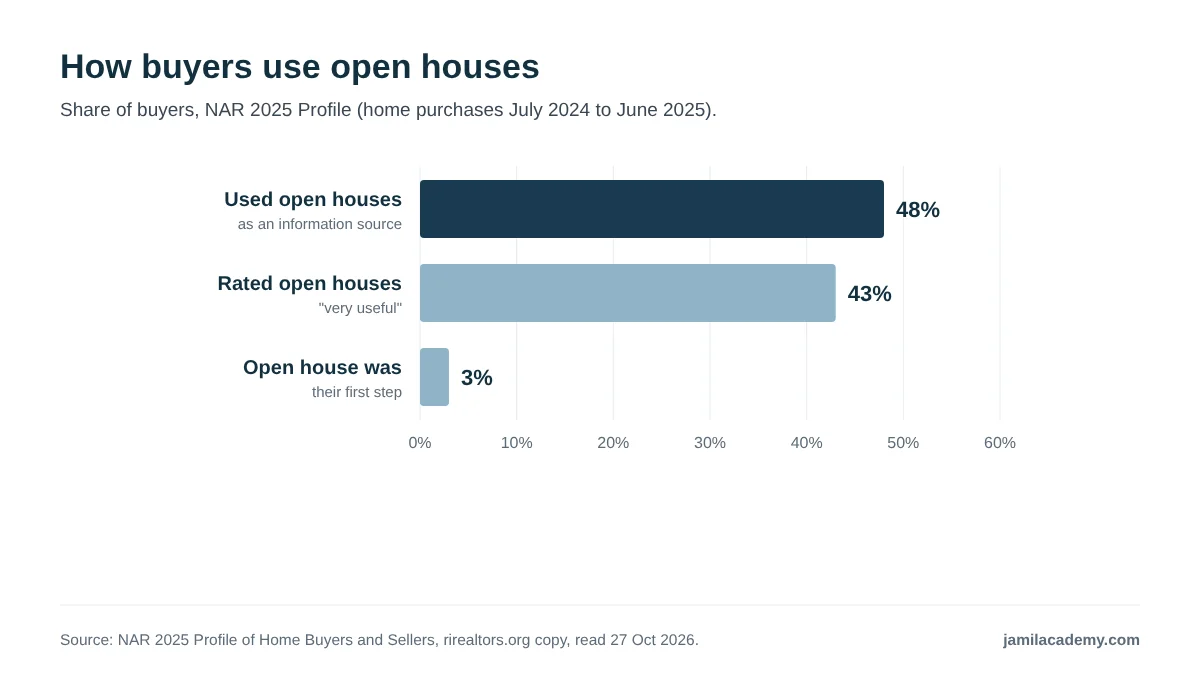
Open houses are rarely where a search begins. Only 3% of buyers started there. In the same report, 52% of buyers found the home they bought on the internet and 27% through an agent.
NAR also reported that 88% of buyers used an agent or broker. Some of your visitors will already have one, which is why the agent column matters.
Source: NAR news release, 4 November 2025, read 27 October 2026.
A sign-in sheet only works if people come through the door. For ways to bring more of them in, see my list of ideas for drawing more visitors to an open house.
My view: treat each visitor as someone partway through a search. Your follow-up should help with the next step, not restart the conversation from zero.
Should you use a paper or digital open house sign-in sheet?
Short answer: either works, and using both is sensible. Paper is quick and needs no setup. Digital sign-in saves typing and can feed contacts straight into your systems.
Paper: the strengths and the gaps
- Strengths: no device, no Wi-Fi, no app to learn. Any visitor can use a pen.
- Gaps: handwriting can be hard to read, and every later visitor can see earlier entries.
- Work after: every entry has to be typed into your CRM.
Digital sign-in options and their published prices
| Option | What the vendor's own listing says | Published price |
|---|---|---|
| Open Home Pro (seller: Placester, Inc.) | Free app with in-app purchases | Premium $24.99 a month or $239.99 a year |
| Curb Hero (seller: Roadless Co.) | Free; visitors "can choose between QR code and on-screen sign-in options" | Free, no in-app purchases listed |
| Spacio (Lone Wolf) | "Custom event and open house sign-in software" with sections for agents, teams and brokers | "USD $150 setup fee"; no subscription price shown |
| Google Forms | A free personal tier; responses can be stored in a Google Sheet | Free |
Sources: Apple App Store listings for Open Home Pro, Curb Hero and Spacio Open House; lwolf.com open house page; Google Forms pages. All read 27 October 2026. Prices before tax.
Curb Hero's listing also claims "Over 100K agents use Curb Hero". I could not check that.
Watch for old prices. HousingWire's February 2025 roundup lists Open Home Pro's premium plan at $20 and Spacio at $25. The App Store shows $24.99 today, and Lone Wolf shows only the setup fee.
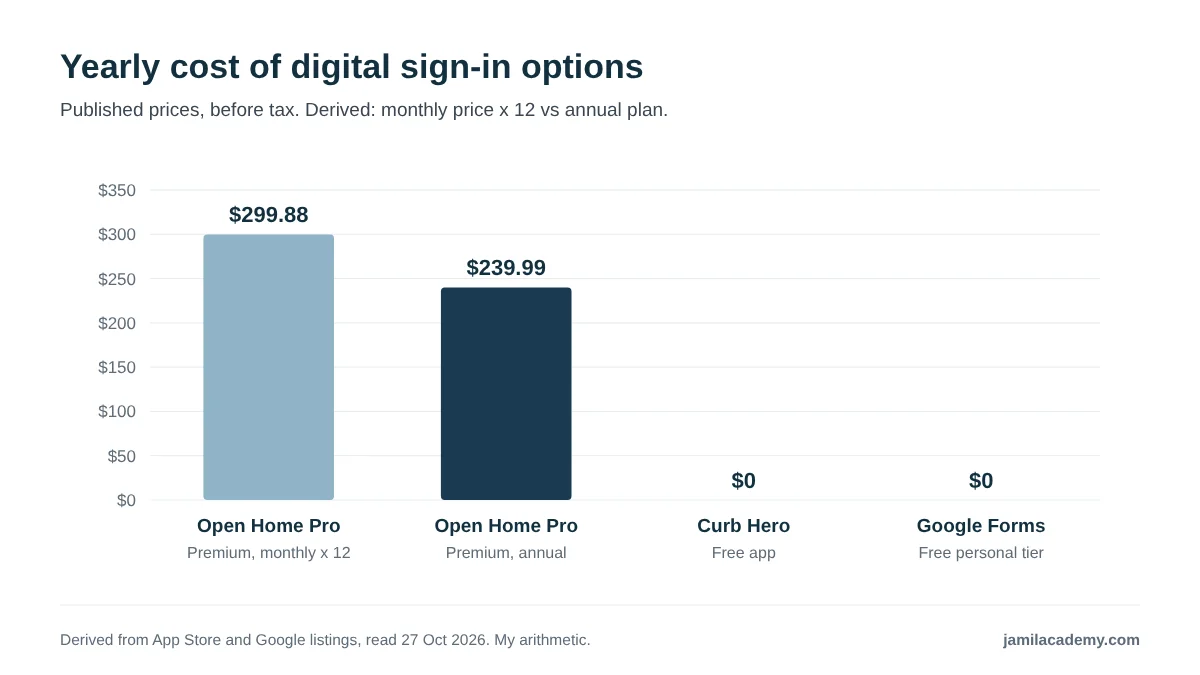
Paid monthly, Open Home Pro Premium comes to $299.88 a year. The annual plan saves $59.89.
QR codes and tablets
A QR code lets visitors sign in on their own phones, which can keep the line moving. I found no credible data on how many visitors complete a QR sign-in, so I will not quote a rate.
If you use a Google Form, add the consent line and a tick box for texts. The rules are the same.
My view: keep paper as a backup even if you go digital. Batteries die and Wi-Fi fails, and a visitor you cannot sign in is a visitor you cannot follow up with.
What should you never ask on an open house sign-in sheet?
Short answer: anything that touches a protected trait under fair housing law. That means no questions about race, color, religion, sex, disability, familial status or national origin, even friendly ones.
What the Fair Housing Act says
Section 3604(c) of the Fair Housing Act makes it unlawful "to make, print, or publish, or cause to be made, printed, or published any notice, statement, or advertisement, with respect to the sale or rental of a dwelling that indicates any preference, limitation, or discrimination" based on those traits.
The traits listed are "race, color, religion, sex, handicap, familial status, or national origin." A sign-in sheet is something you print, so its questions matter.
Source: 42 U.S.C. 3604(c), text via Cornell Law School's Legal Information Institute, read 27 October 2026.
HUD puts it plainly: "The Fair Housing Act prohibits discrimination in housing because of:" race, color, national origin, religion, sex, familial status and disability.
Source: HUD, Fair Housing Act overview, read 27 October 2026.
What NAR's Code of Ethics adds
If you are a Realtor, NAR's 2026 Code of Ethics, effective 1 January 2026, goes further. Article 10 says: "REALTORS® shall not deny equal professional services to any person for reasons of race, color, religion, sex, disability, familial status, national origin, sexual orientation, or gender identity."
Standard of Practice 10-3 says Realtors "shall not print, display or circulate any statement or advertisement with respect to selling or renting of a property that indicates any preference, limitations or discrimination" on those same grounds.
Source: NAR, 2026 Code of Ethics and Standards of Practice, nar.realtor, read 27 October 2026. The Code binds NAR members, not every licensee.
Questions to keep off your sheet
| Do not ask | Why it is a problem |
|---|---|
| Do you have kids? How many children? | Familial status is protected |
| Household size, or how many people will live here | Can read as a familial status question |
| Which church, mosque or temple do you attend? | Religion is protected |
| Where are you from originally? What language do you speak at home? | Points to national origin |
| Any health, disability or accessibility needs | Disability is protected |
| Age, marital status or date of birth | Not on the federal list, but may be protected under state or local law |
| Sexual orientation or gender identity | Protected under NAR's Code for Realtors, and under some state laws |
My examples, drawn from the Fair Housing Act's protected classes and NAR's Article 10. Not a HUD list.
State and local laws often protect more groups than federal law. I did not research each state, so check your state's list and your brokerage's policy.
My view: if a question does not help you show or sell a home, leave it off. Every column on the builder above passes that test, and none asks about a protected trait.
Do open house visitors need to sign a buyer agreement?
Short answer: no. NAR says a buyer visiting an open house on their own does not need a written buyer agreement. Neither does the hosting agent.
NAR's "Consumer Guide to Open Houses and Written Agreements" says: "If you are simply visiting an open house on your own ... you do not need to sign a written buyer agreement."
On the hosting agent, it says that "since the agent is only there at the direction of the listing broker or seller ... the agent is not required to have a written agreement with the buyers touring the home."
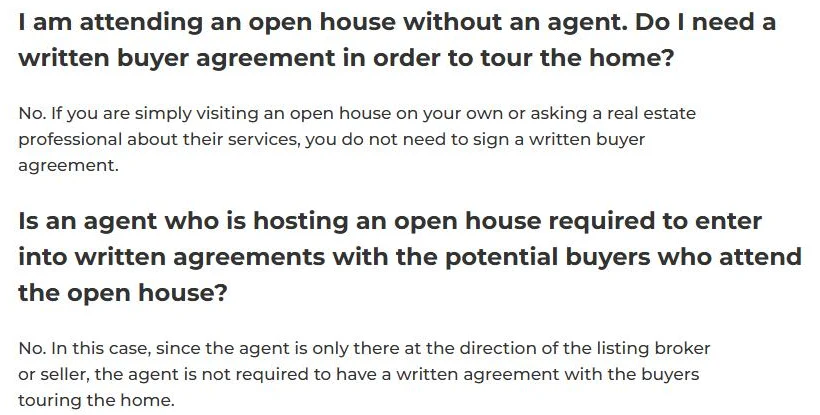
The guide adds that agents "simply marketing their services or speaking to a buyer" at an open house are "not considered to be working with the buyer."
NAR's settlement explainer, updated 24 May 2024, says the same: "You do not need a written agreement if you are just speaking to an agent at an open house."
Sources: NAR, Consumer Guide to Open Houses and Written Agreements, and NAR, What the NAR Settlement Means for Home Buyers and Sellers, nar.realtor, read 27 October 2026.
When a written agreement is needed
The change comes when a visitor wants your help beyond this house. NAR's guide says an agreement is needed "After you begin 'working with' an agent and at any point before you tour your first house together."
NAR's explainer adds: "Written agreements are required for both in-person and live virtual home tours." If a visitor asks to see other homes, sign the agreement before that first tour.
What this means for your sheet
- Keep agreement wording and contract-style signature lines off the sheet.
- Do not tell visitors they must sign anything to look around.
- If a visitor wants help with other homes, explain your buyer agreement then.
My view: a relaxed sign-in gets more honest answers. Visitors who feel they are signing up for something tend to leave the phone column blank.
What rules apply when you follow up by email, text or phone?
Short answer: email needs a working opt-out, automated marketing texts and calls need written consent, and Do Not Call rules still apply. This is a summary of federal rules, not legal advice. Check with your broker or attorney.
Email: the CAN-SPAM basics
CAN-SPAM is an opt-out law. The FTC's guide does not require prior consent for commercial email, but it sets rules for every message you send.
- Header details "must be accurate and identify the person or business who initiated the message."
- "The subject line must accurately reflect the content of the message."
- "you must disclose clearly and conspicuously that your message is an advertisement."
- "Your message must include your valid physical postal address."
- "Your message must include a clear and conspicuous explanation of how the recipient can opt out".
- "You must honor a recipient's opt-out request within 10 business days."
The guide says each separate email in violation "is subject to penalties of up to $53,088".
Source: FTC, CAN-SPAM Act: A Compliance Guide for Business, read 27 October 2026.
Texts and calls: the FCC's consent rule
The FCC's rule, 47 CFR 64.1200, bars telemarketing calls to cell phones made with "an automatic telephone dialing system or an artificial or prerecorded voice" without consent.
For marketing, that consent must be "prior express written consent". The rule defines it as "an agreement, in writing, bearing the signature of the person called" that covers those messages and names the phone number.
The agreement must also disclose that it authorizes such messages and that signing is not a condition of purchase. The builder's default consent line tries to cover both, but it is my wording, not legal advice.
Texts count. The rule says "the term 'call' includes a text message, including a short message service (SMS) call."
- Calling hours: no telephone solicitations "before the hour of 8 a.m. or after 9 p.m.", in the called person's local time.
- National registry: no telephone solicitations to a residential number on the national do-not-call registry, unless an exception applies.
- Inquiries: an inquiry "within the three months immediately preceding the date of the call" creates an established business relationship.
Source: 47 CFR 64.1200, eCFR, up to date as of 23 October 2026, read 27 October 2026.
Do Not Call and the three-month window
The FTC's Q&A on the Telemarketing Sales Rule explains the inquiry window. "If a consumer makes an inquiry or submits an application to a company, the company can call for three months."
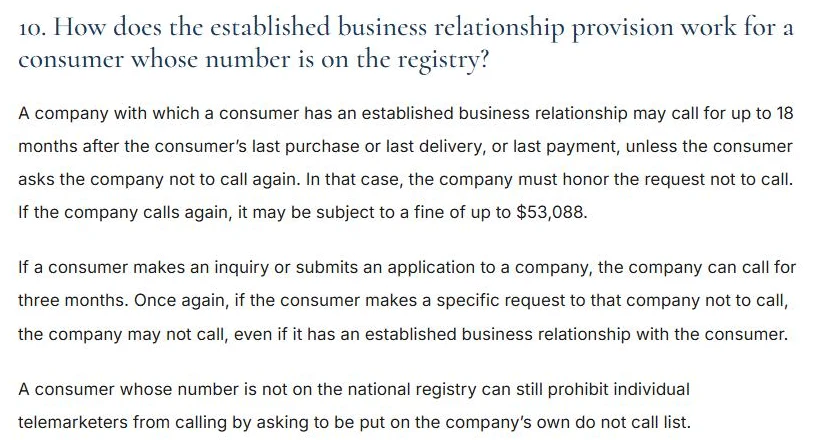
That window "exists for three months starting from the date the consumer makes the inquiry or application." It ends early if the consumer asks to be on your own do not call list.
Beyond that, the FTC says "The consumer must give express agreement in writing to receive calls". The writing "must include the number to which calls may be made and the consumer's signature."
| FTC Do Not Call rule | What the FTC says |
|---|---|
| List scrubbing | Sync your call lists with the registry "at least every 31 days" |
| Penalties | "fines of up to $53,088 per violation"; "Each call may be considered a separate violation" |
| Registry data fees | "Data for up to five area codes is free" |
| Fees from 1 October 2026 | "$85 per area code of data (after five) up to a maximum annual fee of $23,425" |
| Calls within one state | The registry "covers intrastate telemarketing calls under the FCC's rules" |
Source: FTC, Q&A for Telemarketers and Sellers About DNC Provisions in TSR, edited September 2026, read 27 October 2026.
The FTC page does not mention real estate or open houses. My reading is that a visitor who signs in has made an inquiry, which supports calls for three months unless they ask you to stop. That is my inference, not an FTC statement.
What happened to the one-to-one consent rule
You may have heard about the FCC's "one-to-one" consent rule. According to Morrison Foerster, the Eleventh Circuit vacated it just days before it was due to take effect on 27 January 2025.
Goodwin, another law firm, reported in September 2025 that the FCC formally removed it. The older prior express written consent standard still applies.
My view: the safest sign-in sheet records consent in the visitor's own hand, with their number next to it. Then text only those who agreed, and stop the moment anyone asks.
How should you store sign-in sheets and visitor details?
Short answer: treat the sheet as private client information. Keep it with you, enter it into your CRM promptly and follow your brokerage's rules on how long to keep the paper.
During the open house
- Keep the clipboard where you can see it. Do not leave it by the door when you step into another room.
- Consider a fresh sheet, or a cover page, so later visitors are not reading earlier entries.
- Take the sheet with you when you lock up.
After the open house
- Type each entry into your CRM the same day, and note who agreed to texts.
- Record anyone who asks you not to contact them, and keep that list. CAN-SPAM opt-outs and do-not-call requests both need it.
- Ask your brokerage how long to keep paper records before you shred anything.
- If you used a digital sign-in tool, check who at the vendor can see your visitor data and how to export or delete it.
These are my recommendations, not legal requirements. Your brokerage's privacy policy comes first.
State privacy laws: the California example
California's CCPA applies to a "business" that meets one of three thresholds. They are annual gross revenue above $25,000,000, "as adjusted", or buying, selling or sharing the personal information of "100,000 or more consumers or households" a year.
The third is earning "50 percent or more" of revenue from selling or sharing personal information.
The California Privacy Protection Agency set the adjusted revenue threshold at $26,625,000, effective 1 January 2025.
Sources: California Civil Code 1798.140, via california.public.law, and California Privacy Protection Agency, CPI adjustment, posted 17 December 2024, read 27 October 2026.
Most individual agents and small teams will not meet those thresholds, but large brokerages may. I did not research other states' privacy laws, so ask your broker what applies to you.
My view: collect only the columns you will use. A shorter sheet holds less that could go wrong.
How can a sign-in sheet help you stay safe at an open house?
Short answer: it tells you who is in the house. A record of every visitor helps if something goes wrong later.
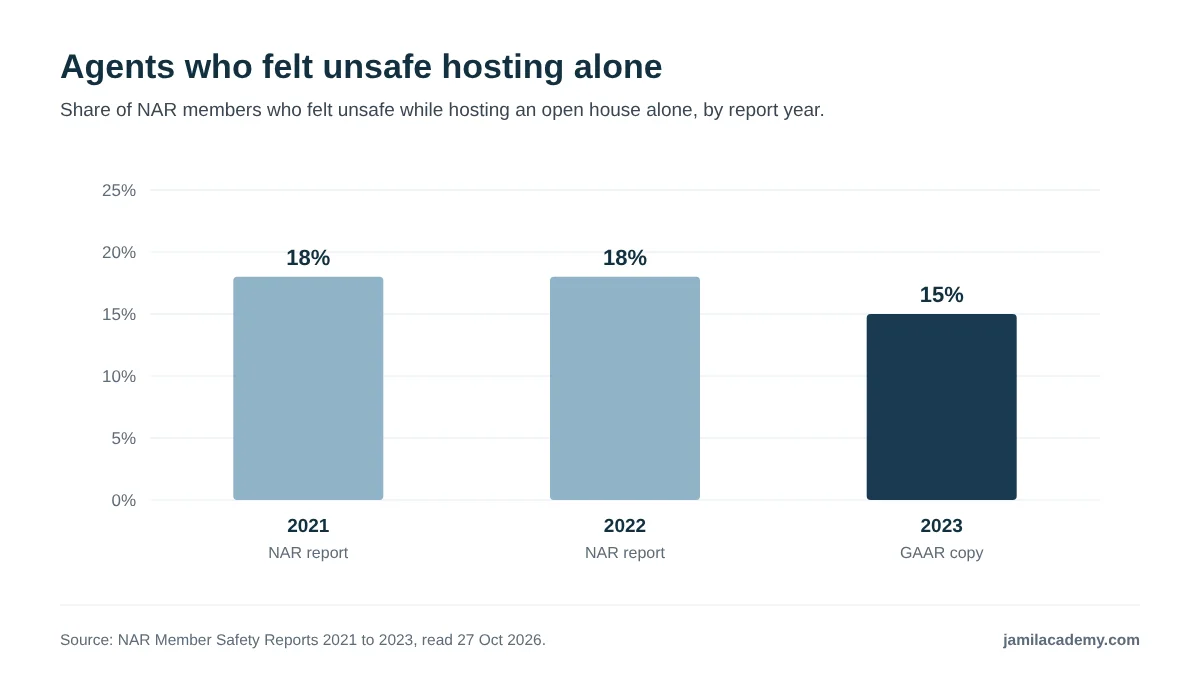
In the NAR member safety reports I could check, 15% to 18% of members felt unsafe hosting an open house alone.
| Report | Finding | Source status |
|---|---|---|
| 2021 Member Safety Report | "Eighteen percent of REALTORS® felt unsafe while hosting an open house alone." | NAR's own PDF |
| 2022 Member Safety Report (residential) | 18% felt unsafe while hosting an open house alone; 42% hosted an open house alone | NAR's own PDF |
| 2023 Member Safety Report (residential) | "Fifteen percent of residential members felt unsafe while hosting an open house alone." | Association copy (GAAR) |
| 2024 Member Safety Report (residential) | "Members felt least safe during an open house (34%)" | Secondary: reported by BAM; NAR's PDF was unreachable |
Sources: NAR Member Safety Reports 2021 and 2022 (nar.realtor); GAAR's copy of the 2023 residential report; BAM, 9 September 2026. All read 27 October 2026.
The 2022 report also charts situations in which members feared for their personal safety. "During an open house" was 24%, fourth after threatening communications, showings and meeting new clients at secluded locations.
The 2023 report adds that "Four percent reported a theft during an open house". I could not open NAR's 2024 PDF to confirm BAM's 2024 figure, and I found no 2025 edition.
NAR's own safety advice
NAR's safety page says: "Don't let open houses become dangerous." It suggests you "keep the blinds raised, always walk behind the client, look for exits and check in with your office."
NAR's "Window to the Law: Safety Best Practices for Real Estate Professionals", from March 2021, recommends a safety plan for situations including "hosting an open house."
Source: NAR, REALTOR Safety page, nar.realtor, read 27 October 2026.
How to use the sheet for safety
- Ask every visitor to sign in, the same way, as they arrive. Applying it to everyone keeps it fair.
- Text your office or a colleague the count of visitors during the event, and when you lock up.
- Keep the sheet in a folder so visitors cannot photograph other people's details.
My view: a sign-in sheet is not a security system. It is one habit in a safety plan that also covers who knows where you are and how you leave.
What does a 7-day open house follow-up plan look like?
Short answer: thank every visitor the same day, call the near-term buyers within a day or two, and send something useful by day 7. This plan is my recommendation, not the result of a study.
I found no credible real estate study on open house follow-up timing. Texts go only to visitors who initialed the text column.
| Day | Channel | What to send | Who gets it |
|---|---|---|---|
| Day 0, same evening | Text or email | A short thank-you with the listing link | Everyone who left contact details, texts only with consent |
| Day 1 | Phone call | A check-in: what they liked, what they need next | Near-term buyers and anyone with a home to sell |
| Day 2 | Two or three similar homes, or the disclosures if they asked | Visitors without an agent | |
| Day 3 | Text or email | An answer to any question they asked at the open house | Anyone who asked one |
| Day 5 | A note on price changes or offers on this home, if your seller agrees | Interested visitors | |
| Day 7 | Call or text | A short check-in and an offer to help with next steps | Visitors who replied or opened your emails |
| After day 7 | A regular, low-key update with an easy opt-out | Everyone who has not opted out |
My recommendation. Opinion, not data.
Why the same day matters
A visitor may see several homes the same weekend. A thank-you that arrives the same evening reaches them while your listing is still fresh in their mind.
For more on reply times for new leads and how to automate them, see my guide to responding to new leads within minutes.
Sort before you send
- Has an agent: one thank-you with the listing details. Offer to send disclosures to their agent.
- No agent, buying soon: the full plan, with a call on day 1.
- No agent, buying later: the thank-you, then the slower email updates.
- Home to sell: a call about their home, as well as the buyer follow-up.
- Neighbors: a thank-you only, unless they ask for more.
Turning visitors into clients takes more than a schedule. My guide on how to turn open house visitors into clients goes deeper on the conversations.
My view: the thank-you matters most. It is the easiest message to send, and it sets the tone for everything after it.
Copy these open house follow-up scripts
Short answer: keep them short, personal and easy to say no to. Change the brackets, and text only visitors who agreed. I wrote these as starting points, not tested scripts.
1. Same-day thank-you text
Send the same evening, only if they initialed the text column.
2. Same-day thank-you email
The postal address and unsubscribe line follow the CAN-SPAM basics above.
3. Visitor who already has an agent
Keeps you helpful without crossing into their agent's relationship.
4. Home to sell
Send by email, or by text only with consent.
5. Day 7 check-in
Short and easy to answer. If there is no reply, move them to occasional email updates.
6. When someone opts out
Then record the opt-out in your CRM straight away.
For what to say at the door, before anyone signs in, see my scripts for greeting visitors and booking the next meeting. For more text wording, see my collection of follow-up text messages for agents.
My view: write the way you talk. A message that sounds like you gets more replies than one that sounds like a template, even a good one.
What I could not verify
Short answer: several figures that other articles repeat. I left these out or labelled them, because I could not confirm them in an original source.
- The 2025 NAR Profile share of buyers who found their home through a yard or open house sign.
- NAR's 2024 Member Safety Report PDF, which I could not open. The 34% figure above comes only from BAM. I found no 2025 edition.
- The FCC order that formally removed the one-to-one consent rule. My sources are two law firms.
- The speed-to-lead figures often quoted from a 2011 Harvard Business Review study about online sales leads, not open houses. They sit behind a paywall.
- Any credible statistics on QR code sign-in rates at open houses.
- Spacio's subscription price, and whether Curb Hero has paid tiers.
- State privacy laws other than California's, and the extra protected classes in each state and city's fair housing laws.
- A sourced cost for printing paper sign-in sheets, so paper is left out of the cost chart.
My view: if a number you see elsewhere sounds precise but has no original source, treat it as marketing until you can trace it.

Frequently asked questions
What should be on an open house sign-in sheet?
Name, phone, email, whether the visitor works with an agent, their timeline to buy and a box to agree to texts. Pre-approval, a home to sell and how they heard are useful extras.
Where can I get a free printable open house sign-in sheet?
Use the builder in this guide. Add your details, pick columns and rows, then press Print sheet. To keep a PDF, choose Save as PDF in the print dialog.
Do open house visitors need to sign a buyer agreement?
No. NAR's consumer guide says a buyer visiting an open house on their own does not need a written buyer agreement, and the hosting agent does not need one either.
Can I text people who signed in at my open house?
Autodialed or prerecorded marketing texts need prior express written consent under the FCC's rule. Text only visitors who agreed in writing, and stop when asked. This is not legal advice.
What questions should a sign-in sheet never ask?
Anything about race, color, religion, sex, disability, familial status or national origin. That includes children, household size, church or where someone is from. State laws may add more.
How long can I call someone who signed in?
The FTC says an inquiry lets a company call for three months, unless the person asks not to be called. After that, a number on the Do Not Call registry needs their written agreement, with the number and their signature.
Is a digital sign-in app better than a paper sheet?
Neither is always better. Apps save typing and some are free, like Curb Hero and Google Forms. Paper needs no device. In my view, keep paper as a backup.
How soon should I follow up after an open house?
In my view, the same day, with a short thank-you to every visitor who left contact details. Then call near-term buyers within a day or two.
Saad Jamil is a top 1 percent Realtor with Samson Properties in Chantilly, Virginia, licensed in Virginia, DC, Maryland and West Virginia since 2013, with more than $500 million in career sales and 900+ homes closed. Reviews and closed sales are on his Zillow profile. He runs Jamil Academy, which sells training to agents. This article is general information, not legal or financial advice, checked on 27 October 2026.
Free: 5 Ways to Get More Listings Without Cold Calling
Five lead strategies that work without cold calls or ad spend, from an agent with $500M sold and 900+ homes closed.
No spam. Unsubscribe any time.
Your Coach