Compass Commission Split and Review (2026): What Agents Really Keep
Oct 14, 2026
Compass does not publish a commission split. Each agent's split is set in their own contract, based on their market and production. In 2022, Compass said new agents would get their market's standard split.
What Compass does publish is the average. Across the company, about 82 percent of its revenue went to commissions and related costs from 2023 to 2025. That is my calculation from its annual reports, and it is not anyone's split.
This review covers how Compass pays, what it charges and its stock program. It also covers Concierge, the listing fights with Zillow and the MLSs, and what changed after Compass bought Anywhere in January 2026. Sources were checked on 14 October 2026.
Where I stand: I am a Realtor with Samson Properties, not Compass, and I run Jamil Academy, which sells training to agents. No brokerage paid to be mentioned. The one product block near the end is my own.
Quick answer
- The split: not published. In 2022, Compass said new recruits would get its standard split for their market. A recruit whose current split was better could keep it for one year.
- The average payout: about 82 percent of revenue went to commissions and related costs in 2023, 2024 and 2025, by my math from Compass's filings.
- Fees: Compass says it collects fees from agents. It does not publish the amounts.
- Size: No. 1 US brokerage by 2025 sales volume, $262.2 billion, before it added Anywhere.
- The big risk: its private listing strategy has led to lawsuits with Zillow and MLSs. Know your MLS's rules before you use it.
- How does the Compass commission split work?
- How much of each commission does Compass pay agents?
- What fees do Compass agents pay?
- Does Compass still give agents stock?
- What would you keep at Compass compared with a capped brokerage?
- What is Compass Concierge?
- What is Compass's private listing strategy?
- What happened with Compass, Zillow and the MLS lawsuits?
- What changed when Compass bought Anywhere?
- How big is Compass, and is it profitable?
- How big is Compass in Virginia, Maryland and DC?
- How does Compass compare with eXp, Keller Williams and RE/MAX?
- Who is Compass a good fit for?
- What should you ask Compass before you join?
- What I could not verify
- Frequently asked questions
How does the Compass commission split work?
Short answer: your split is in your contract, and Compass does not publish a schedule. I found no split, cap or fee table on any Compass page or filing.
Compass's 2025 annual report says its agents "are independent contractors." It earns money "when we collect a share of the gross sales commissions."
It does not say how big that share is. The phrase "commission split" did not appear in the parts of the report I could read.
Source: Compass Form 10-K for 2025, filed with the SEC in February 2026.
The 2022 change: market-standard splits
In August 2022, Compass stopped using stock and cash bonuses to recruit agents. CEO Robert Reffkin said new agents would get the policy split for their market.
RISMedia reported that a recruit whose split beat Compass's policy could keep it for one year, then move to the policy split. Inman reported that top agents could no longer negotiate splits better than their regional peers.
Compass regional president Rory Golod told RISMedia in 2022 that splits depend on "industry market standards and agent production history." By that logic, two agents in the same office can have different splits.
What a market-standard split means for you
If Compass offers you its standard split, ask what that standard is in your market and whether it is written in a policy you can read. Ask who sets it and how often it changes.
If your current split beats Compass's policy, RISMedia reported in 2022 that you could keep it for one year. Ask whether that still applies, and price your second year at the standard split.
How Compass counts its agents
Through the end of 2025, Compass reported a count of "principal agents." It had 21,190 at the end of 2025, up from 17,752 a year earlier.
Since 2026 it reports total agents instead, so the numbers before and after the change do not line up.
Teams set their own terms
Many Compass agents work on teams. On a team, your share is set in your agreement with the team, so get it in writing.
Compass said in 2026 that agent separations were "more often than not made by individual agent team leaders, rather than decisions made by Compass."
My view: at Compass, the split is a negotiation, not a published plan. Bring your closed volume, and get every number in writing.
How much of each commission does Compass pay agents?
Short answer: about 82 percent on average. That is the share of revenue Compass reports as commissions and related expense.
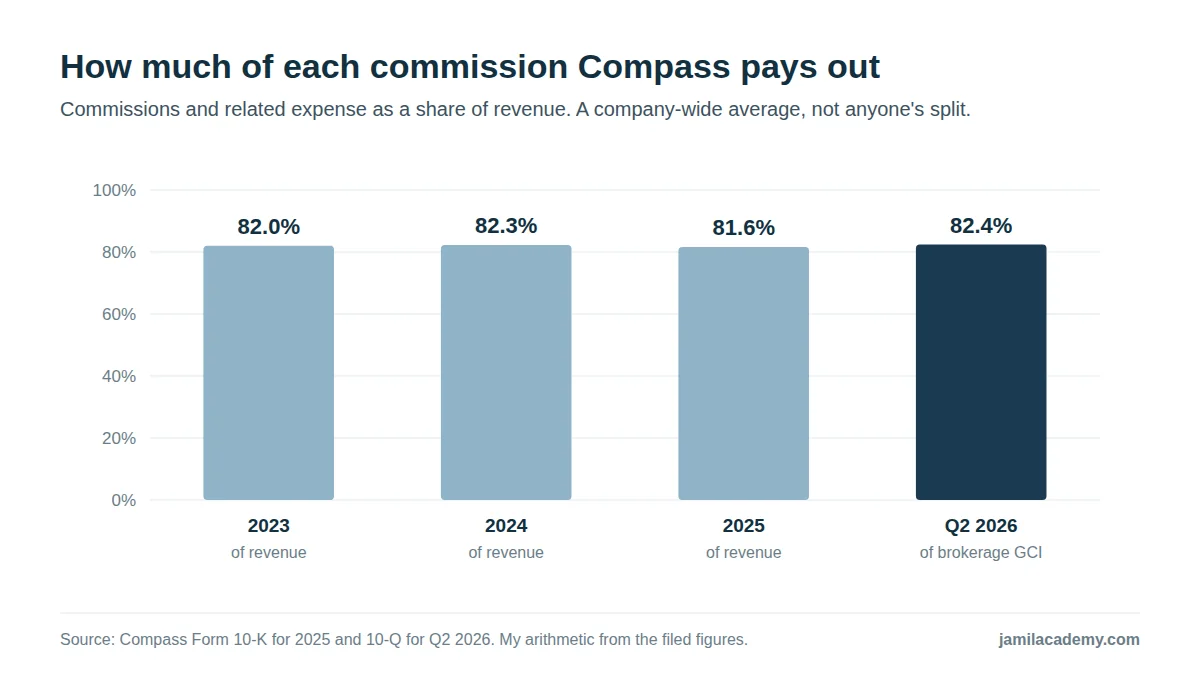
| Period | Revenue | Commissions and related expense | Share |
|---|---|---|---|
| 2023 | $4,885.0M | $4,007.0M | 82.0% |
| 2024 | $5,629.1M | $4,634.6M | 82.3% |
| 2025 | $6,961.6M | $5,679.7M | 81.6% |
| Q2 2026 (base: brokerage GCI, not total revenue) | $3,947M brokerage GCI | $3,254M | 82.4% |
Sources: Compass 2025 Form 10-K and Q2 2026 Form 10-Q, income statements and revenue note. Shares are my calculation.
Why 2026 uses a different base
Since buying Anywhere, a much larger share of Compass's revenue comes from franchise fees and other services. Against total second-quarter revenue of $4,306 million, the ratio is 75.6 percent.
That lower figure is not a pay cut. Against brokerage commission income of $3,947 million, it is 82.4 percent. That is closer to the earlier years, which I measured against total revenue, but it is not an exact match.
On the same commission-income basis, the second quarter of 2025 was about 84 percent.
What the average hides
- It blends everyone. New agents, top producers and teams all sit in one number.
- It includes other costs. The line is "commissions and other related" expense, not splits alone.
- It is not a promise. Your contract sets your share, not the company average.
What 82 percent means in dollars
On $100,000 of gross commission, an 82 percent average means about $18,000 stays with the brokerage. On $250,000, it is about $45,000, unless your split improves or a cap applies.
That is why the cap question matters so much. At a capped brokerage, the company's share stops growing once you hit the cap.
How that compares with Anywhere before the deal
Anywhere's company-owned brokerage reported $4,629 million of commission income and $3,718 million of commission and agent-related costs in 2024. That is about 80 percent, my math.
So Compass's average payout ran a couple of points higher than Anywhere's owned offices before they combined. Both figures are averages across very different agents.
The Real Deal reported a similar trend in 2025, with the share moving "from 81.8 percent to 81.6 percent" between the first quarters of 2024 and 2025.
My view: use 82 percent as a reality check, not a target. If an offer is far below it, ask what you get for the difference.
What fees do Compass agents pay?
Short answer: Compass charges fees, but it does not publish them. Ask for every fee in writing before you sign.
The 2025 annual report says Compass collects "fees from real estate professionals at our owned-brokerage and from our franchisees." It gives no amounts.
The only dollar figure I found is old and from one person. In 2022, a former agent told RISMedia that Compass charged "anywhere between $1,300 to $1,400 annually" in resource fees.
That is one agent's account from four years ago. Do not treat it as current policy.
Fees worth asking about
- Any monthly or yearly brokerage, technology or resource fee.
- Per-transaction fees, including compliance or file review.
- E&O insurance, and whether it is per deal or yearly.
- Marketing costs: what Compass pays for and what you pay for.
- Team fees, if you join a team.
How to compare a Compass offer
Write the offer as a list: split, any cap, every fixed fee and every per-deal fee. Then put your last year's income into the calculator below, next to another brokerage's plan.
Do the same for your goal year. An offer that wins at your current income can lose at a higher one.
My view: with no published schedule, the fee list is part of your negotiation. Ask for it before you discuss the split, so you can price the whole offer.
Does Compass still give agents stock?
Short answer: it did, through its Agent Equity Program. I could not confirm the program is still offered in 2026.
The program let agents take part of their commissions as Compass stock. HousingWire reported in March 2022 that 1,149 of about 7,000 agents took part in 2018.
Compass recorded $84.8 million in program expense in 2021, HousingWire reported. Reffkin said Compass was "winding down the use of equity to recruit agents."
The Real Deal reported in October 2022 that Compass offered a 10 percent stock match on deferred commissions. It said the program "remains active, if less popular among agents."
What the latest filings show
The 2025 annual report still lists a "2022 Agent Equity Program" in its stock compensation notes. The parts of the second quarter 2026 report I could read do not mention the program.
Should stock change your decision?
Stock in place of cash means you carry the risk of the share price. HousingWire's 2022 report noted that relatively few agents chose equity.
My view: if stock matters to you, ask whether any equity program is open to new agents today, and get the terms in writing. Judge the offer on cash first.
What would you keep at Compass compared with a capped brokerage?
Short answer: it depends on your split and your income. A capped brokerage usually wins for high producers. A straight split can cost less in a smaller year.
Because Compass does not publish a plan, the calculator starts Plan A at the 82 percent company average. Replace it with the split and fees in your actual offer.
Plan B starts with eXp's published plan, which I priced in my eXp Realty review. Change it to any other offer you have.
Plan A is a stand-in, not a Compass plan. Enter your own offer. The calculator works deal by deal, so a cap stops the brokerage share once it is reached. Fees are before tax and your own costs.
What the starting numbers show
| Gross commission | 82% straight split: you keep | eXp plan: you keep |
|---|---|---|
| $50,000 | $41,000 | $38,555 |
| $100,000 | $82,000 | $82,130 |
| $200,000 | $164,000 | $181,280 |
At $100,000 the two are nearly even. Below that, the straight split leaves more. Above it, the cap pulls ahead fast, because the capped plan stops taking a share.
My view: if you produce well above $100,000 a year, ask Compass whether your split improves with production. A flat split with no cap gets expensive as you grow.
What is Compass Concierge?
Short answer: a program that fronts a seller's home-prep costs until closing. It is a listing tool for agents, not part of your pay.
Compass's Concierge page says sellers can "get fronted for the cost of home improvement services with zero due until closing."
Repayment is due when the home sells, the listing ends or 12 months pass, whichever comes first.
- Loans come from a lender. Concierge Capital loans are provided by Notable Finance, LLC. Compass says it is not the lender.
- Costs can apply. "Depending on your state of residence, fees or interest may apply."
- Approval is required. Loans are subject to credit approval, and terms vary by market.
- It is optional. Sellers do not have to use Concierge to list with Compass.
Compass's 2025 annual report says Concierge projects since the program began, through 2025, totaled about $1.45 billion. The average project was about $29,000.
How to present Concierge to a seller
- Show the repayment triggers in writing: sale, end of the listing or 12 months.
- Ask the seller to check any fees or interest that apply in their state.
- Price the repairs against the likely gain in sale price, using local comparable sales.
- Remind the seller that using Concierge is optional.
My view: Concierge helps in listing appointments with sellers who need repairs and lack cash. Make sure the seller reads the repayment terms before you promote it.
What is Compass's private listing strategy?
Short answer: market a listing inside Compass first, then publicly, then everywhere. Compass calls it a three-phased marketing strategy.
Inman described the three phases when Compass launched them in November 2024:
- Private Exclusive: visible only to Compass agents and their clients.
- Coming Soon: public on Compass.com, with no days on market or price-drop history.
- Full launch: listed on the MLS and every platform.
Compass's Private Exclusives page says these listings are "accessible to 340,000 agents." It now lists the public second phase on Compass.com and Redfin.com.
What Compass claims about price
Compass says its pre-marketed listings in 2024 were "associated with an average 2.9% increase in the final close price." That is Compass's own analysis.
Its own footnote adds: "Correlation does not necessarily equal causation." I found no independent study that confirms the figure.
What to tell a seller who asks about a private listing
- Explain who can see the listing in each phase, and for how long.
- Explain that fewer buyers may see it at first, and why that can cost or help.
- Check your MLS's rules on office exclusives and delayed marketing.
- Get the seller's choice in writing, signed, before you market the home.
Compass.com's 2026 redesign
On 22 September 2026, Compass redesigned Compass.com to show listings from all of its brands without public days on market or price drops, Real Estate News reported. Private exclusives stay off the public site. Compass says buyers can see them through its agents or offices.
Where the MLS rules come in
NAR's Clear Cooperation Policy requires most listings to go on the MLS within one business day of public marketing. In March 2025, NAR added a delayed marketing option that works alongside it.
MLSs set and enforce their own rules. I explain what listing agents must do in the Clear Cooperation Policy guide.
State law can matter too. Washington signed a law on 16 March 2026 that limits exclusive marketing to select groups unless the listing is also broadly marketed.
My view: private marketing can serve some sellers. But the seller should choose it in writing, knowing it may reach fewer buyers at first.
What happened with Compass, Zillow and the MLS lawsuits?
Short answer: Compass dropped its Zillow suit, settled with one MLS, and now faces a suit from another. A Zillow case against Compass is paused.
Compass v. Zillow
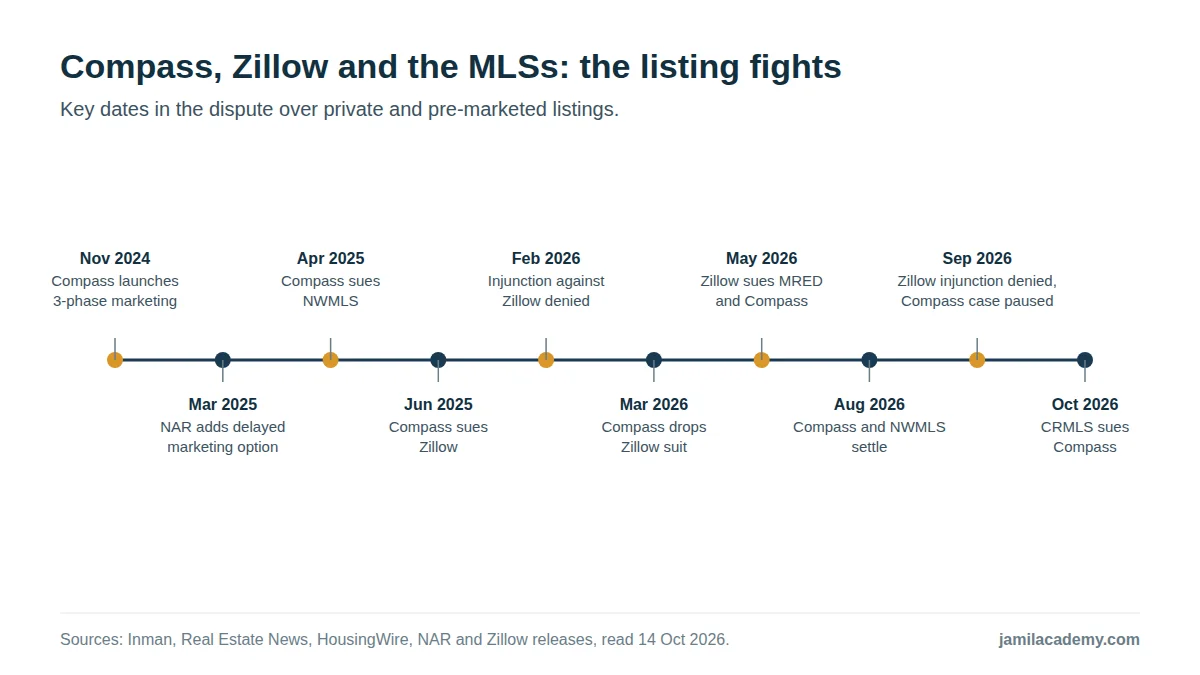
Compass sued Zillow in federal court in New York on 23 June 2025, over Zillow's Listing Access Standards. In February 2026, Judge Jeannette Vargas denied Compass's request for a preliminary injunction.
On 18 March 2026, Compass said it was dropping the suit after Zillow launched a pre-marketing feature. The dismissal was without prejudice, so Compass could refile.
Zillow v. MRED and Compass
Zillow sued Chicago's MRED and Compass on 12 May 2026. On 15 September 2026, Judge John Tharp denied Zillow's preliminary injunction and paused the case against Compass while the MRED claims go to arbitration.
Compass v. NWMLS
Compass sued the Northwest MLS in April 2025. They announced a settlement on 31 August 2026. The deal created a 21-day "First Look" status for public pre-marketing. No payment was disclosed.
Under the settlement, NWMLS listings must show the listing broker's name and contact prominently on portals by 15 October 2026, and photo watermarks end. Reffkin said Compass's "original objective" had been "fully realized."
CRMLS v. Compass
Compass sent California's CRMLS a demand letter in September 2026 over fines for publicly marketed office exclusives. On 5 October 2026, CRMLS sued Compass first, in New York.
Real Estate News reported that CRMLS asks the court to declare its rules lawful. Compass told Real Estate News on 7 October that it plans to sue CRMLS.
As of 13 October 2026, I found no report that Compass had filed that suit.
The commission settlements
Compass also settled the seller commission class action, known as Gibson, for $57.5 million. The court gave final approval on 31 October 2024, and an appeal was heard on 14 January 2026.
Compass's second quarter report says "No further amounts are due under the Compass Settlement." A separate opt-in settlement of about $7 million won preliminary approval on 26 May 2026.
My view: for an agent, the practical risk is MLS fines. Before you market any listing privately, read your own MLS's rules and get your broker's written guidance.
What changed when Compass bought Anywhere?
Short answer: Compass became the owner of Coldwell Banker, Century 21, Corcoran and other brands. Compass completed the deal on 9 January 2026.
Its second quarter 2026 report puts the total purchase consideration at $2,569 million. The former Anywhere brands kept their names.
Source: Compass Form 10-Q for the quarter ended 30 June 2026, Notes 1 and 3.
Fewer agents, mostly low producers
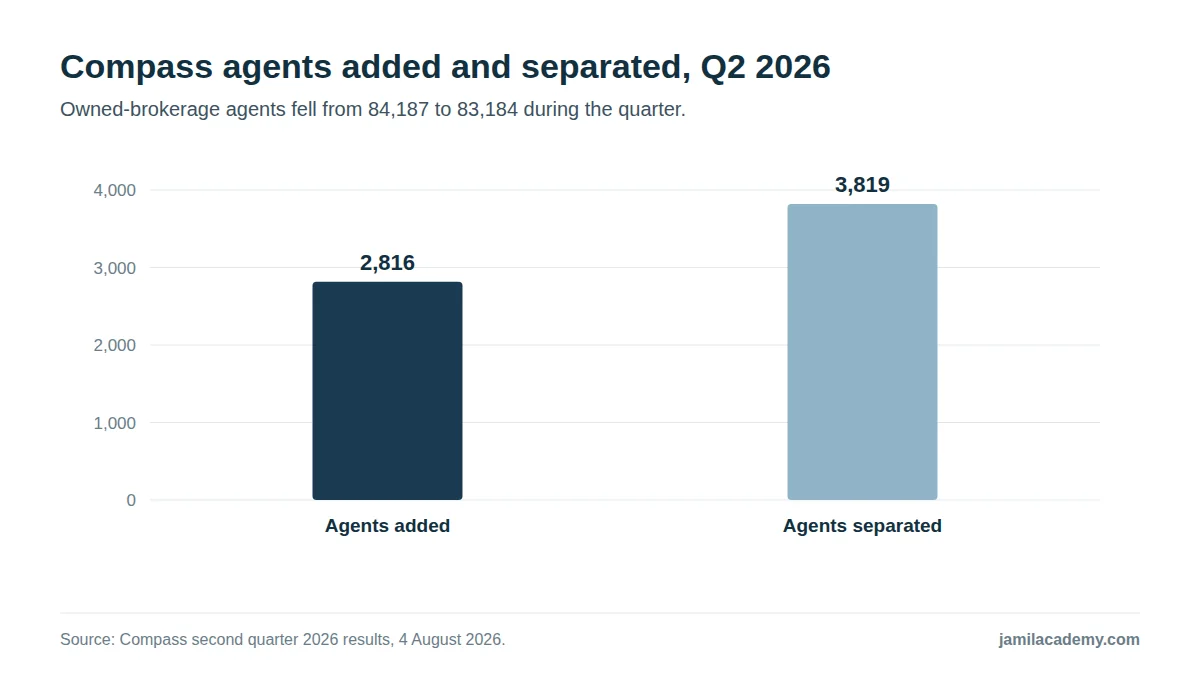
Compass's owned brokerages had 84,187 agents at the end of March 2026 and 83,184 at the end of June. Compass said the drop was "driven primarily by a strategy at a specific brand acquired through the Anywhere transaction."
In the first quarter, Compass reported 5,041 separations. It said 56 percent of those agents had $0 in commission income over the prior 12 months, and 77 percent had $20,000 or less.
Agent retention was 95.5 percent in the second quarter. Excluding agents with $0 in commission income, it was 97.7 percent. Excluding agents with $20,000 or less, it was 98.7 percent.
Those figures suggest most productive agents stayed. The departures were concentrated among agents who closed little or nothing in the prior year.
The technology rollout
In July 2026, Compass released its Home Platform to more than 4,000 agents at Coldwell Banker Realty, Corcoran and Sotheby's International Realty. It said nearly 50,000 should have it by the end of September.
Franchise agents, such as those at Century 21 and franchised Coldwell Banker offices, are due to get it beginning in the first quarter of 2027, HousingWire reported.
What it means for agents at the former Anywhere brands
I found no announced change to splits or fees at Coldwell Banker or Century 21 through mid-October 2026. I cover what did change in the Coldwell Banker commission split.
My view: Compass is clearly removing low producers. If you are newer or part-time, ask about minimum production expectations before you join any Compass brand.
How big is Compass, and is it profitable?
Short answer: it is the largest US brokerage by sales volume, and it reported GAAP net income in the first half of 2026. The first-quarter profit came from a $401 million non-cash tax benefit. The second quarter, at $92 million, was profitable without one.
- No. 1 by volume: $262.2 billion in 2025 sales, in both the RealTrends Verified and T3 Sixty rankings, before adding Anywhere.
- About 37,000 agents at the end of 2025 in its own brokerage. Its annual report says "over 37,000."
- 153,009 brokerage transactions in the second quarter of 2026, worth $155.2 billion. Deals where Compass represents both sides count twice.
- Revenue of $4,306 million in that quarter, with net income of $92 million.
Compass's franchise brands closed another 203,207 transactions worth $120.0 billion in the same quarter. Compass says it now has "more than 300,000 real estate professionals" across owned and franchise offices.
Compass's own counts of its network vary. Its second quarter release says "more than 300,000." Its annual report and Private Exclusives page say 340,000. I quote each with its source.
Adjusted EBITDA, a profit measure that excludes some costs, was $363 million in the second quarter. Compass guided third-quarter revenue of $3.85 billion to $4.05 billion.
By transaction count rather than volume, eXp ranked No. 1 in the RealTrends Verified list. My read: Compass's agents sell higher-priced homes on average, which is why it leads on volume but not on sides.
Compass lost money for years before that. Its net loss was $320.1 million in 2023, $154.5 million in 2024 and $58.7 million in 2025. Its stock trades on the NYSE as COMP.
My view: profitability matters to agents. A profitable brokerage has less reason to cut splits or add fees. Watch the next few quarters to see if it lasts.
How big is Compass in Virginia, Maryland and DC?
Short answer: Compass has been here since about 2014, but it does not publish a regional agent count.
Compass says the Capital Region was its first market outside New York City, about 11 years before February 2025. Compass CEO Robert Reffkin said Compass had "welcomed nearly 2,000 top agents" in the region since then.
In February 2025, Compass added Washington Fine Properties, a luxury firm of about 150 agents covering DC, Maryland and Virginia. That firm kept its own brand.
Compass also bought the Wydler Brothers brokerage in 2018 and opened a McLean office in 2019, Arlington Magazine reported.
Since January 2026, Compass also owns Coldwell Banker Realty, which operates offices in the region. I found no verified current list of Compass offices or agents here.
My view: in Northern Virginia, Compass competes hard for luxury listings. Ask a local manager for the office's agent count and average production, not the national figures.
How does Compass compare with eXp, Keller Williams and RE/MAX?
Short answer: Compass is the only one of the four with no published plan. The others print a split, a cap or office terms you can compare.
| Brokerage | Published split and cap | Main fees |
|---|---|---|
| Compass | None published. Market-standard split for new agents. | Fees charged, amounts not published. |
| eXp | 80/20 to a $16,000 cap | $85 a month, $149 to join, $25 and $60 per deal |
| Keller Williams | Commonly 64/30/6, with caps set by each market center | 6% royalty capped at $3,000 |
| RE/MAX | Set by each office. The brand recommends 95/5. | Office desk fees, $410 annual dues (as shown on office pages) and a broker fee of generally 1% |
Sources: Compass 2025 Form 10-K and 2022 trade press; eXp, Keller Williams and RE/MAX figures from my reviews, checked September and October 2026.
Why a published plan helps you
With a published plan, you can price a full year before you talk to anyone. With Compass, you need a written offer first.
Ask Compass for an offer with every number filled in, then run it through the calculator next to a published plan. The comparison takes five minutes.
My view: an unpublished plan is not a bad plan. It just shifts the work to you. Do not sign until you can see the whole year in dollars.
Who is Compass a good fit for?
Short answer: established agents who want a premium brand and listing tools. It is a harder fit for agents who want a published, capped plan.
Where Compass is strong
- Brand and scale. The largest US brokerage by sales volume.
- Seller tools. Concierge and the three-phased marketing plan help in listing presentations.
- A large internal network. Compass says its private exclusives reach 340,000 agents.
- Technology. Compass is rolling its Home Platform out across its brands.
Where Compass is weaker
- No published plan. You cannot compare offers without a written schedule.
- Less room to negotiate. In 2022, Compass said new agents would get the market-standard split.
- Listing-rule risk. Its private marketing push has led to MLS disputes and fines elsewhere.
- Pressure on low producers. Low producers are leaving Compass brands, through team leaders' decisions and one brand's strategy.
If a published plan matters to you, compare it with a franchise model such as the RE/MAX commission split, where some offices publish their plans.
Questions to ask yourself first
- Do I get most of my business from listings, or from buyers?
- Would a premium brand help me win listings in my price range?
- Do I want a team, or will I work solo?
- Do I need a published plan to feel confident about my income?
My view: Compass suits a listing agent with a strong sphere who values the brand. A newer agent should weigh it against brokerages that publish their plans and train new agents.
What should you ask Compass before you join?
Short answer: ask for your split, every fee and the production expectations in writing. These questions cover the gaps in Compass's public information.
- What is my split, and is it the market's standard split? How long does any better split last?
- Does my split improve with production? At what levels?
- What fees do I pay each month, each year and on each deal?
- Is there a cap on what Compass takes in a year?
- What marketing does Compass pay for, and what do I pay for?
- Is any stock or equity program open to new agents today?
- What are the minimum production expectations?
- How does private marketing work under my MLS's rules? Who pays any fine?
- What happens to my listings and pending deals if I leave?
If you decide to move, plan it first with how to switch brokerages without losing your clients.
My view: Compass managers will answer most of these. Compare their answers with at least one written offer from another brokerage.
What I could not verify
These are the gaps I hit while checking sources. Be careful with any page that fills them with a confident number.
- Any Compass split, cap or fee amount. None is published by Compass or reported by the trade press I checked for 2025 or 2026.
- Whether the Agent Equity Program is open in 2026. Not confirmed.
- Any split or fee change after the Anywhere deal. None reported.
- Which brand Compass trimmed agents at. Compass did not name it.
- Full-year 2025 transaction totals and agent productivity. Those sections of the annual report did not load for me.
- Compass's office and agent counts in Virginia, Maryland and DC. Not published.
- An independent test of the 2.9 percent price claim. None found.
- Whether Compass has sued CRMLS. It said on 7 October that it plans to. No suit reported as of 13 October 2026.

Frequently asked questions
What is the Compass commission split?
Compass does not publish one. Splits are set in each agent's contract. In 2022, Compass said new agents would get their market's standard split.
How much does Compass pay its agents on average?
About 82 percent of revenue went to commissions and related costs in 2023 to 2025, by my math from its filings. That is an average, not a split.
Does Compass have a cap?
I found no published cap. Ask whether your split improves with production, and get the terms in writing.
What fees do Compass agents pay?
Compass says it collects fees from agents but does not publish amounts. Ask for every monthly, yearly and per-deal fee.
Does Compass still offer stock to agents?
It ran an Agent Equity Program. I could not confirm it is open to new agents in 2026, so ask.
Is Compass the biggest brokerage?
By sales volume, yes. It ranked No. 1 with $262.2 billion in 2025 sales, before adding Anywhere.
Does Compass own Coldwell Banker?
Yes. Compass completed its purchase of Anywhere Real Estate, Coldwell Banker's parent, on 9 January 2026.
What is Compass Concierge?
A program that fronts a seller's home-prep costs, repaid when the home sells, the listing ends or 12 months pass, whichever comes first. Loans come from Notable Finance, and fees or interest may apply.
Is Compass good for new agents?
It can be on a strong team. But Compass said in 2022 that new agents get market-standard splits, and many low producers have left Compass brands, so ask about expectations.
Saad Jamil is a Realtor with Samson Properties in Chantilly, Virginia, licensed in Virginia, DC, Maryland and West Virginia. His sales record and client reviews are on his Zillow profile. He runs Jamil Academy, which sells training to agents. He is not affiliated with Compass. This is general information, checked on 14 October 2026.
Free: 5 Ways to Get More Listings Without Cold Calling
Five lead strategies that work without cold calls or ad spend, from an agent with $500M sold and 900+ homes closed.
No spam. Unsubscribe any time.
Your Coach