RE/MAX Commission Split Explained (2026): Real Plans and Fees
Oct 13, 2026
There is no single RE/MAX commission split. Every RE/MAX office is independently owned and sets its own plan. RE/MAX corporate recommends a 95/5 split, with the agent paying fixed fees toward the office's costs.
In practice, the published plans I found run from 60/40 to 100 percent. Monthly fees ran from $0 to $400, and some plans cap what the office takes. On top of that, RE/MAX charges annual dues and a broker fee of generally 1 percent.
This guide shows the real plans, what corporate charges, and the math at three income levels. It also covers what changed when Real Brokerage bought RE/MAX Holdings in August 2026. Sources were checked on 12 October 2026.
Where I stand: I am a Realtor with Samson Properties, not RE/MAX, and I run Jamil Academy, which sells training to agents. No brokerage paid to be mentioned. The one product block near the end is my own.
Quick answer
- The split: set by each office. RE/MAX recommends 95/5 to its franchisees, in exchange for fixed fees from the agent.
- Published office plans: 95/5 with $400 a month in Florida, 60/40 to a $13,900 cap in Michigan, and plans from $225 a month, including a 100 percent plan, in Las Vegas.
- Corporate fees: annual dues paid by agents, $410 on the office pages I read, plus a broker fee of generally 1 percent of commissions.
- The crossover: in my example, the 95/5 plan costs less below about $138,000 in gross commission. The capped plan costs less above it.
- Ownership: Real Brokerage completed its purchase of RE/MAX Holdings on 24 August 2026. Offices remain franchises.
- How does the RE/MAX commission split work?
- What does RE/MAX corporate charge?
- What do real RE/MAX offices charge?
- Is a 95/5 split better than a capped split?
- Which RE/MAX plan keeps more for you?
- What are Aspire, Ascend and Appreciate?
- What does the Real merger mean for RE/MAX agents?
- How big is RE/MAX, and are its agents more productive?
- How does RE/MAX compare with Keller Williams, eXp and Real?
- What do RE/MAX offices in Virginia, Maryland and DC charge?
- Who is the RE/MAX model right for?
- What should you ask a RE/MAX office before you join?
- What I could not verify
- Frequently asked questions
How does the RE/MAX commission split work?
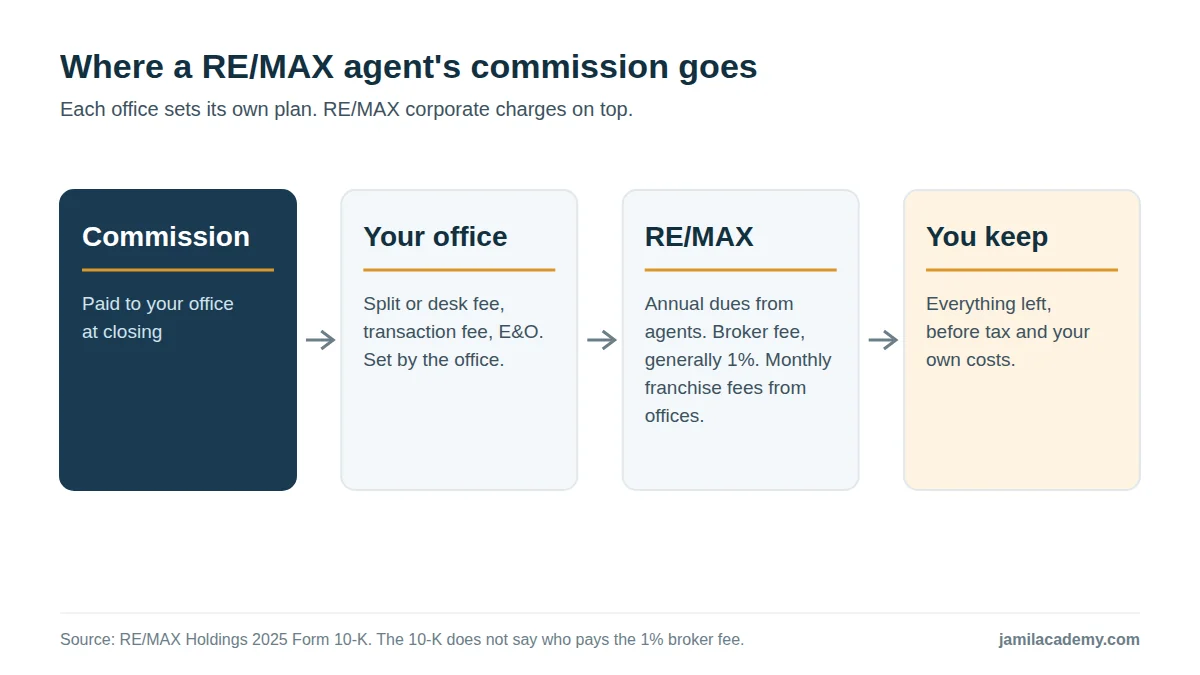
Short answer: each office sets its own split and fees. RE/MAX recommends a 95/5 split, paid for with fixed monthly fees.
RE/MAX Holdings' 2025 annual report says it plainly: "Our franchisees are independently owned and operated businesses." It also says RE/MAX is "100% franchised."
The same report says the company continues "to recommend to our franchisees an agent-favorable commission split of 95%/5%." In return, agents pay fixed fees to share the office's overhead.
A recommendation is not a rule. The office you join decides the split, the desk fee, any cap and every transaction fee.
RE/MAX Holdings Form 10-K for 2025, filed with the SEC in February 2026.
Why corporate prefers fixed fees
RE/MAX's continuing franchise fees are "fixed contractual fees paid monthly," based on the number of agents. So these monthly fees do not change with how many deals an office's agents close. The broker fee, by contrast, rises with commissions.
That is the logic of the 95/5 recommendation. The office and the agent share fixed costs, and the agent keeps most of each commission.
Where the RE/MAX model came from
Dave Liniger founded RE/MAX in Denver in January 1973, with Gail Main, later Gail Liniger. The company says he had "experienced the maximum-commission model" and believed it would appeal to full-time agents.
The idea was that agents would rather share office expenses than give up a large part of each commission. The 95/5 recommendation is that idea today.
RE/MAX, "RE/MAX History," news.remax.com.
Two ways an office can charge
RE/MAX's recruiting site describes the two common approaches. An office charges "a commission split or a monthly desk fee plus a smaller split." It adds that "some brokerages offer flat-fee models."
- High split plus a desk fee. You keep 95 percent or more, but pay a fixed fee every month, whether you close or not.
- Lower split, no desk fee. The office takes a bigger share, often until you reach a cap. You pay little in a slow month.
That page also notes agents "may also pay marketing, tech and training fees" and that "costs vary by brokerage and experience level."
join.remax.com, "About us," read 12 October 2026.
What does RE/MAX corporate charge?
Short answer: annual dues from agents, a broker fee of generally 1 percent, and monthly franchise fees from offices. The 2025 annual report gives no dollar amounts for the dues or the monthly fees.
| Fee | Who pays, per RE/MAX | What I found |
|---|---|---|
| Annual dues | Agents, once a year | $410 a year on the office pages I read |
| Broker fee | Not stated clearly in the 10-K | "Generally 1%" of commissions |
| Continuing franchise fees | Franchise owners, monthly, based on agent count | No dollar figure in the 10-K |
RE/MAX Holdings 2025 Form 10-K; REMAX Direct (Florida) and RE/MAX Platinum (Michigan) plan pages, read 12 October 2026.
How those fees reach you
Dues are an agent charge. The other two are paid by the franchise owner, who can pass them on through the plan you sign.
One Michigan office, for example, lists a "5% REMAX fee, capped at $3000." That is the office's own line item. Other offices may fold such costs into the split or the desk fee.
So ask each office for every fee in writing, including any it passes through from RE/MAX.
What the 1 percent broker fee means in dollars
On $100,000 of gross commission, 1 percent is $1,000. On $200,000 it is $2,000. Whether you or the office pays it depends on your plan.
How the dues have moved
Inman reported in April 2014 that RE/MAX raised annual dues from $390 to $400. At the time, company-owned regions charged about $123 a month per agent in franchise fees.
The office pages I read in 2026 list dues of $410. So dues have risen slowly, while the bigger costs sit in each office's own plan.
Inman, 1 April 2014.
The scale of these fees
In the second quarter of 2026, RE/MAX Holdings reported $25.7 million in continuing franchise fees, $7.4 million in annual dues and $14.1 million in broker fees.
Continuing franchise fees fell from $29.0 million a year earlier. The company said lower revenue mainly reflected changes to its standard fee models, including Aspire and Ascend, along with a lower US agent count.
RE/MAX Holdings second quarter 2026 results, 6 August 2026.
What do real RE/MAX offices charge?
Short answer: anything from 60/40 to 100 percent. The plans I could find published by RE/MAX offices differ a lot.
| Office | Plan as published |
|---|---|
| REMAX Direct, Florida | 95/5 with $400 a month, or 95/5 with $4,000 a year, or no monthly fee with a 90/10 to 80/20 split. All plans: $18,500 cap, $375 per sale, $350 a year E&O, $410 a year RE/MAX dues. |
| RE/MAX Advantage, Las Vegas | Plans "from $225/mo" with no company transaction fee, including a 100 percent plan, and a plan that shares a little with the office until $50,000 in GCI, then converts to 100 percent. |
| RE/MAX Platinum, Fenton, Michigan | 60/40 until a $13,900 cap ($15,900 with an office), then 100 percent. $0 monthly. 5% RE/MAX fee capped at $3,000. E&O $25 per closing. $410 a year to RE/MAX. |
| RE/MAX Lakes Realty, Iowa | New agents: 60/40 on the first $50,000 GCI, then 75/25 on the next $50,000. Experienced agents: 75/25, then 95 percent after $100,000 GCI. |
| RE/MAX Real Estate Center | 95/5 with a monthly desk fee, or 80/20, 70/30 or 60/40 by prior-year GCI until a $23,000 cap, then 95/5. |
| RE/MAX ONE, Connecticut | All agents start at 80/20 plus a bonus to join, the office's baseline. Top producers can negotiate a custom plan. |
Office websites and, for RE/MAX Platinum, its ChooseMyBroker profile. All read 12 October 2026. None showed an effective date, so confirm current terms with the office.
What these plans have in common
- Caps are common. Four of the six plans limit what the office takes in a year, at $13,900 to $50,000 of GCI or company dollars.
- Dues are separate. The $410 RE/MAX annual dues appear as their own line where offices list them.
- Lower producers often start lower. Several plans begin at 60/40 to 80/20 for newer agents or agents with lower prior-year GCI.
- Small fees add up. A $375 transaction fee on 20 sales is $7,500 a year.
Details that hide in the fine print
- Eligibility. RE/MAX Lakes Realty's 75/25 plan is for agents with three or more years and 20 sides.
- Soft caps. RE/MAX Real Estate Center has a "Soft CAP": after the cap you move to 95/5, not 100 percent.
- Unpriced shares. RE/MAX Advantage says agents "share a little" until the $50,000 cap but does not give the percentage.
- Rental fees. REMAX Direct charges $50 per rental transaction as well as $375 per sale.
Terms you will see on a fee sheet
- GCI: gross commission income, your share of commissions before the office split.
- Split: how GCI divides between you and the office, such as 95/5.
- Desk fee: a fixed monthly charge for office costs, due whether you close or not.
- Cap: the most the office takes from your split in a year.
- Transaction fee: a flat charge on each closed sale or rental.
- E&O: errors and omissions insurance, charged yearly or per closing.
- Annual dues: the yearly fee RE/MAX charges each agent.
My view: the headline split tells you little. Add up every fee for a year at your expected production before you compare offices.
Is a 95/5 split better than a capped split?
Short answer: it depends on how much you sell. A high split with a desk fee suits higher producers. A capped split with no desk fee costs less in a slow year.
The only way to know is to price a whole year. A plan that looks cheap at one income can be expensive at another.
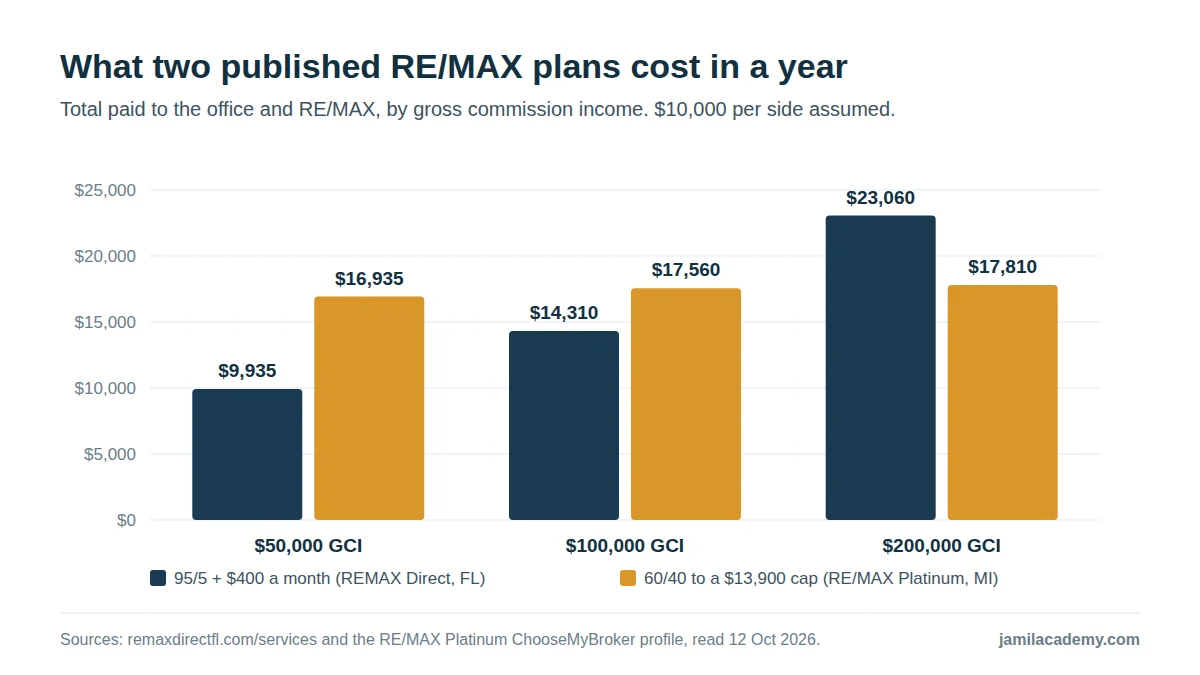
Here are two published RE/MAX plans side by side. I assumed $10,000 of commission per side, so $100,000 of gross commission is 10 sales.
- Plan A, REMAX Direct, Florida: 95/5, $400 a month, $375 per sale, $350 a year E&O and $410 dues.
- Plan B, RE/MAX Platinum, Michigan: 60/40 until the $13,900 cap (the option without a private office), a 5 percent RE/MAX fee capped at $3,000, $25 E&O per closing and $410 dues.
| Gross commission | Plan A fees | Plan A you keep | Plan B fees | Plan B you keep |
|---|---|---|---|---|
| $50,000 | $9,935 | $40,065 | $16,935 | $33,065 |
| $100,000 | $14,310 | $85,690 | $17,560 | $82,440 |
| $200,000 | $23,060 | $176,940 | $17,810 | $182,190 |
Plan A wins at lower production because its 5 percent share stays small. Plan B wins at higher production because its office share stops at $13,900.
With these terms, the two plans cost the same at about $138,000 of gross commission. Above that, the capped plan leaves you more.
Plan A at $100,000, line by line
| Item | Cost for the year |
|---|---|
| 5 percent office share | $5,000 |
| Desk fee, $400 x 12 | $4,800 |
| Transaction fees, $375 x 10 sales | $3,750 |
| E&O | $350 |
| RE/MAX annual dues | $410 |
| Total | $14,310 |
The desk fee and transaction fees together cost more than the 5 percent split. That is normal on a high-split plan, and it is why the split alone misleads.
How the cap works on Plan B
On Plan B the office takes 40 percent until it has collected $13,900. That happens at $34,750 of gross commission.
After that, you keep 100 percent of the split for the rest of the year. Only the small per-closing fee, the capped RE/MAX fee and the $410 dues still apply.
Paying the desk fee yearly
REMAX Direct also offers 95/5 with $4,000 a year instead of $400 a month. That is $800 less over a year, if you can pay up front and plan to stay.
Three things that change the answer
- Your average commission per sale. Smaller sales mean more transaction fees for the same income.
- When your cap year starts. Ask whether it resets in January or on your join date.
- What "cap" covers. REMAX Direct lists an $18,500 cap on every plan. I treated it as a cap on the office share. I did the same for Plan B's $13,900. Confirm both with the office.
Common mistakes when comparing offers
- Comparing splits without adding the desk fee and transaction fees.
- Using your best year's income instead of a realistic one.
- Forgetting the RE/MAX dues and any pass-through fee.
- Assuming a cap covers every fee, when it may only cover the split.
- Ignoring when the cap year resets.
My view: a desk fee is a fixed cost you pay in your worst month. If your income is uneven, weight that risk more than the headline split.
Which RE/MAX plan keeps more for you?
Short answer: run your own numbers. Enter the plans you are offered and your expected income. The calculator shows the fees and what you keep.
Starting values are the two published plans in this guide, with the cap treated as a cap on the office share. Change any number to match the plan you are offered. Fees are before tax and your own business costs.
How to fill it in
- Your share is the agent side of the split, such as 95 for 95/5.
- Cap on the office share is the most the office takes from your split in a year. Enter 0 if there is none.
- Other fee as % covers line items like a 5 percent RE/MAX fee, with its cap.
- Other yearly fees covers dues, E&O and any annual charges.
Run three scenarios, not one
- Expected year: the income you realistically plan for.
- Slow year: half of that. This shows the cost of fixed fees.
- Strong year: one and a half times your plan. This shows the value of a cap.
The plan that wins in all three is the safe choice. If the winner changes, pick the one that fits the year you are most likely to have.
A worked first-year example
Say you are a newer agent and close four sales at $10,000 each, $40,000 in total.
- Plan A: $2,000 split, $4,800 desk fees, $1,500 transaction fees and $760 in E&O and dues. Fees $9,060, so you keep $30,940.
- Plan B: the office share reaches its $13,900 cap, plus a $2,000 RE/MAX fee, $100 E&O and $410 dues. Fees $16,410, so you keep $23,590.
At this level, Plan A leaves you $7,350 more. The fixed desk fee is still the bigger risk if a sale falls through, because you pay it either way.
For how commission flows from closing to your account, see how agents get paid.
What are Aspire, Ascend and Appreciate?
Short answer: three optional fee models RE/MAX launched in 2025. They are for franchise owners in US company-owned regions, not plans you sign with corporate directly.
- Aspire shares the cost of bringing on newer agents.
- Ascend lowers monthly fixed fees, caps broker fees and ties variable fees to agent productivity.
- Appreciate lets agents near retirement stay with RE/MAX at an affordable rate.
RE/MAX Holdings 2025 Form 10-K.
What Aspire costs
Inman reported the Aspire terms in July 2025. In the agent's first year, the franchisee pays 5 percent of the agent's gross commission on each closing, up to $5,000. There is also a $25 per-transaction fee and the standard $410 annual dues.
A RE/MAX broker page adds that Aspire removes the monthly franchise and marketing fund fees for the first 12 months. That page does not name a country, so treat the details as indicative.
Inman, 29 July 2025; agentbrokerhub.remax.ca, "Aspire program," read 12 October 2026.
In dollars: for a new agent with $40,000 of gross commission and four sales, the Aspire cost would be $2,000 plus $100 in transaction fees. With the $410 dues, the total is $2,510 for the year.
What this means for you
If your office uses Aspire or Ascend, its own costs may be lower. Whether that reaches you depends on the plan the office offers.
Ask the office which corporate model it is on. Then ask how that changes your split or fees.
What does the Real merger mean for RE/MAX agents?
Short answer: the owner changed, the franchise model did not. Real Brokerage completed its purchase of RE/MAX Holdings on 24 August 2026.
| Date | What happened |
|---|---|
| 26 April 2026 | Merger agreement signed |
| 14 August 2026 | Shareholders of both companies approved the deal |
| 24 August 2026 | Deal completed. The company is now Real REMAX Group Inc., listed on Nasdaq as REAX |
Tamir Poleg is Chairman and CEO of Real REMAX Group. The completion release describes "180,000+ agents, more than 100,000 of whom are based in the U.S. and Canada."
Inman reported in May 2026 that the franchise model was expected to continue. It also reported that Real's technology would be offered to franchisees, but adoption "will not be required."
The completion release says nothing about changes to RE/MAX agent fees. As of 12 October 2026, I found no announced change to the RE/MAX fee models.
Real and RE/MAX Holdings releases of 14 and 24 August 2026; Inman, 6 May 2026.
Real's own agent fees did change on 1 September 2026. I cover that in my Real Broker review.
If you are already at RE/MAX
- Your agreement is with your office, so read its terms on fee changes and notice periods.
- Ask your broker whether the office's franchise fees or fee model have changed.
- Keep copies of your current fee schedule, with its date.
- Watch for any announcement from Real REMAX Group about RE/MAX agent fees.
The commission lawsuit settlement
RE/MAX, LLC agreed in September 2023 to pay $55.0 million to settle the Burnett and Moehrl commission lawsuits. A later release also names Nosalek. RE/MAX said in May 2024 that the settlement had final approval.
RE/MAX said the settlement includes releases for all US RE/MAX independent regions, franchisees and agents.
RE/MAX Holdings Form 8-K, 18 September 2023; RE/MAX news release, 9 May 2024.
My view: if you are at RE/MAX or thinking of joining, ask your broker in writing whether your plan will change in the next 12 months.
How big is RE/MAX, and are its agents more productive?
Short answer: 149,267 agents worldwide at 30 June 2026, with 47,170 in the US. The US count was down 5.0 percent from a year earlier.
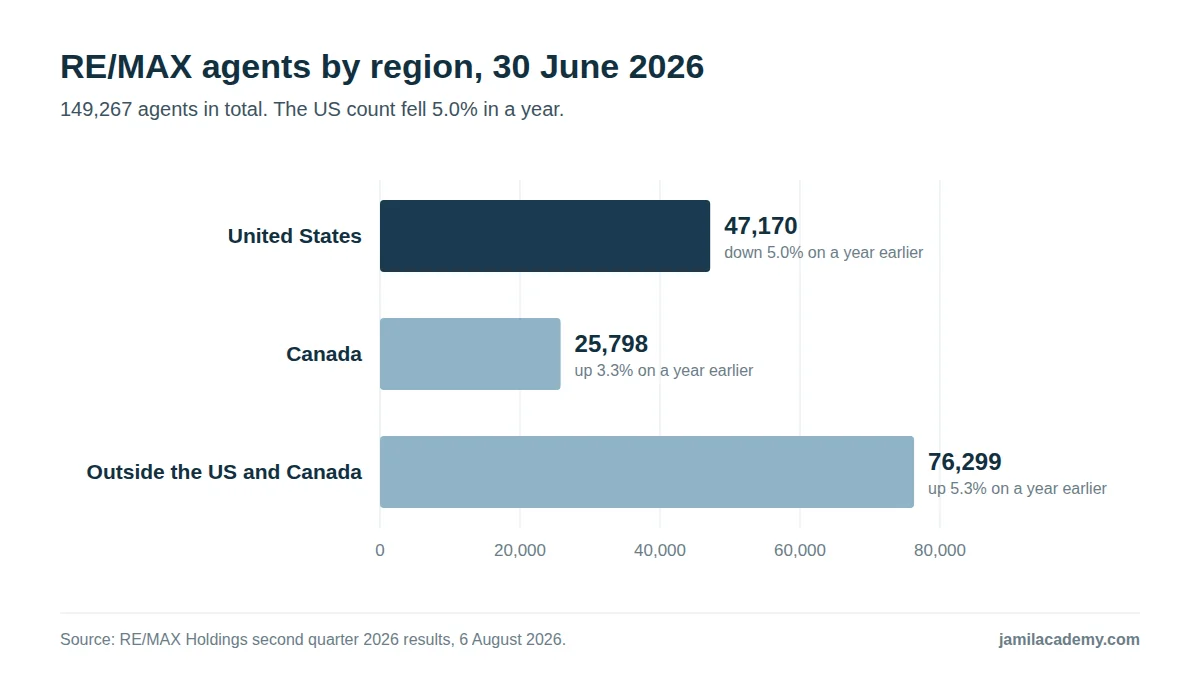
Growth came from outside the US. Canada rose 3.3 percent and the rest of the world rose 5.3 percent. The US and Canada together fell 2.2 percent to 72,968.
How many large brokerages fly the RE/MAX flag
RE/MAX says it accounted for 289 of the 1,267 brokerages, 23 percent, in the 2026 RealTrends list of firms with 500 or more sides. It also says it has more than 145,000 agents in over 8,500 offices.
The productivity claim
RE/MAX says its agents at large US brokerages averaged 11.7 transaction sides in 2025. It says competitors' agents averaged 5.4.
RE/MAX calculated those figures itself, from RealTrends data on brokerages that closed 500 or more sides. It says it has held this lead for 18 years.
Treat it as the company's own claim. It compares large brokerages only, and it does not tell you what any one office's agents earn.
RE/MAX news release, 15 April 2026.
My view: ask the office for its own numbers. The average sides per agent in that office tells you more than a national average.
How does RE/MAX compare with Keller Williams, eXp and Real?
Short answer: RE/MAX is a franchise system where each office sets its own plan. Keller Williams also varies by market center. eXp and Real publish one national plan.
| Brokerage | Who sets your split | How to compare |
|---|---|---|
| RE/MAX | Each independently owned office | Ask each office for its full fee sheet |
| Keller Williams | Each market center, within KW's model | See the Keller Williams commission split |
| eXp and Real | The company, one published national plan | See eXp vs Keller Williams vs Real |
This is why a national RE/MAX split does not exist. Two RE/MAX offices in the same county can offer very different deals.
What to compare besides the split
- Training. Is it included, and who runs it?
- Leads. Does the office give leads, and what referral fee does it take on them?
- Mentoring. Is there a mentor split for your first deals, and for how long?
- Support. Is transaction coordination included or charged per file?
- Exit terms. What happens to pending deals and listings if you leave?
If you are newer and still deciding what matters, start with how to choose a brokerage as a new agent.
My view: compare the total yearly cost at your real production, plus training and support. Do not compare brands.
What do RE/MAX offices in Virginia, Maryland and DC charge?
Short answer: I found no published dollar terms for any RE/MAX office in Virginia, Maryland or DC. You will need to ask each office.
RE/MAX Gateway in Chantilly, Virginia, advertises "competitive compensation plans," "No hidden fees" and "Your first transaction is FREE!" It does not publish the split.
Local RE/MAX offices in the 2026 T3 Sixty Mega 1000
RE/MAX's own resource page lists its offices in the 2026 T3 Sixty Mega 1000 ranking. These are the Virginia and Maryland offices, ranked by sales volume.
| State | Office | Rank by sales volume |
|---|---|---|
| Virginia | RE/MAX Allegiance | #380 |
| Virginia | RE/MAX Gateway | #449 |
| Virginia | RE/MAX Distinctive | #592 |
| Virginia | RE/MAX Alliance | #763 |
| Virginia | RE/MAX Commonwealth | #831 |
| Virginia | RE/MAX Executives | #926 |
| Maryland | RE/MAX Advantage Realty | #398 |
| Maryland | RE/MAX Realty Group | #419 |
| Maryland | RE/MAX One | #529 |
resources.remax.com, "2026 T360 Mega 1000," 20 April 2026.
Getting a plan in writing quickly
Call or email the office's managing broker. Ask for the current compensation plan and fee schedule, and the date it took effect.
Ask for the same document from two or three offices. Then run each one through the calculator above.
A ranking shows size, not the deal you will get. Use it to make a shortlist, then ask each office for its plan in writing.
Who is the RE/MAX model right for?
Short answer: steady producers who want a high split and an office to work from. A fixed desk fee rewards consistent production and punishes slow months.
What works in the model's favor
- A high split is possible. RE/MAX recommends 95/5, and several offices offer it.
- Caps limit the office's take. Four of the six plans I found cap it.
- Each office is local. The owner is nearby, and you can negotiate with them.
What to weigh against it
- Fixed costs. A desk fee is due whether or not you close.
- Two layers of fees. Office fees and RE/MAX fees stack.
- No national standard. You must check every office separately.
- Ownership change. RE/MAX now belongs to Real REMAX Group, and future fee policy has not been announced.
My view: check two numbers for every plan. One is the total cost for a full year at your expected production. The other is what you pay in a month with no closing. On Plan A that is the $400 desk fee. On Plan B it is nothing.
What should you ask a RE/MAX office before you join?
Short answer: ask for every fee, in writing, for a full year. These questions cover the items that differ most between offices.
- What is the split, and does it change with my production?
- Is there a cap? What does it cover, and when does my cap year reset?
- What is the monthly desk fee, and is it charged in months I do not close?
- What is the fee per transaction, and per rental or referral?
- What do I pay to RE/MAX: annual dues, a broker fee, or any other pass-through?
- What are the E&O, technology, marketing and training fees?
- Which RE/MAX fee model is the office on, such as Aspire or Ascend?
- Has anything changed, or is anything expected to change, since the Real merger?
- Can I see a sample year of statements for an agent at my production?
Get answers from at least two RE/MAX offices and one non-RE/MAX brokerage. Put them side by side in the calculator before you decide.
Can you negotiate a RE/MAX split?
It can be. RE/MAX ONE in Connecticut, for example, says top producers can negotiate a custom plan. Each office owner decides.
Bring a year of closed volume and your expected production. A clear track record is the strongest case for a better plan.
My view: a good office will answer every question on one page. If the answers are vague, that tells you something too.
What I could not verify
These are the gaps I hit while checking sources.
- A national RE/MAX split. None exists. RE/MAX only recommends 95/5.
- The dollar amount of continuing franchise fees. The 2025 10-K gives none. Two secondary sources quoting the 2026 franchise disclosure document disagree.
- Who pays the 1 percent broker fee. The 10-K does not say clearly.
- The annual dues figure from RE/MAX itself. $410 comes from office pages and Inman, not the 10-K.
- Typical desk fees. Ranges like $300 to $2,500 a month appear online without sources. The highest I found on an office page was $400 a month.
- Current terms of each office plan. None of the pages showed an effective date.
- Any RE/MAX fee changes after the Real merger. None announced as of 12 October 2026.
- Any RE/MAX office fee sheet in Virginia, Maryland or DC.
- Which country the Aspire details on the RE/MAX broker page apply to. It is hosted on a Canadian domain and names no currency.

Frequently asked questions
What is the standard RE/MAX commission split?
There is no standard split. RE/MAX recommends 95/5 to its franchisees, but each independently owned office sets its own split and fees.
Do RE/MAX agents pay desk fees?
Some published plans do. The ones I found ranged from $0 to $400 a month, often paired with a 95/5 split. Some offices offer no-desk-fee plans with a lower split.
How much are RE/MAX annual dues?
Office pages and Inman put RE/MAX annual dues at $410 a year. RE/MAX's 2025 annual report says agents pay them but gives no amount.
Does RE/MAX take a percentage of every deal?
RE/MAX says it collects a broker fee of generally 1 percent of commissions. Whether you or the office pays it depends on your plan.
Is RE/MAX owned by Real Brokerage now?
Yes. Real completed its purchase of RE/MAX Holdings on 24 August 2026. The combined company is Real REMAX Group Inc.
Can you negotiate a RE/MAX commission split?
It can be. Each office owner sets the plan, and RE/MAX ONE in Connecticut says top producers can negotiate a custom one. Bring your closed volume to the conversation.
Does RE/MAX cap its commission split?
Four of the six published plans I found do, at $13,900 to $50,000 of GCI or office share. Ask what the cap covers and when it resets.
How much does it cost to join RE/MAX?
It depends on the office. Expect RE/MAX annual dues, $410 on the pages I read, plus the office's desk fee, transaction fees and E&O. Ask for the full fee list.
Is RE/MAX good for new agents?
It depends on the office. Several published plans start newer agents at 60/40 to 80/20, so compare training and support along with the cost.
Saad Jamil is a Realtor with Samson Properties in Chantilly, Virginia, licensed in Virginia, DC, Maryland and West Virginia. His sales record and client reviews are on his Zillow profile. He runs Jamil Academy, which sells training to agents. He is not affiliated with RE/MAX or Real. This is general information, checked on 12 October 2026.
Free: 5 Ways to Get More Listings Without Cold Calling
Five lead strategies that work without cold calls or ad spend, from an agent with $500M sold and 900+ homes closed.
No spam. Unsubscribe any time.
Your Coach