What College Has the Best Real Estate Program? (2026)
Aug 10, 2026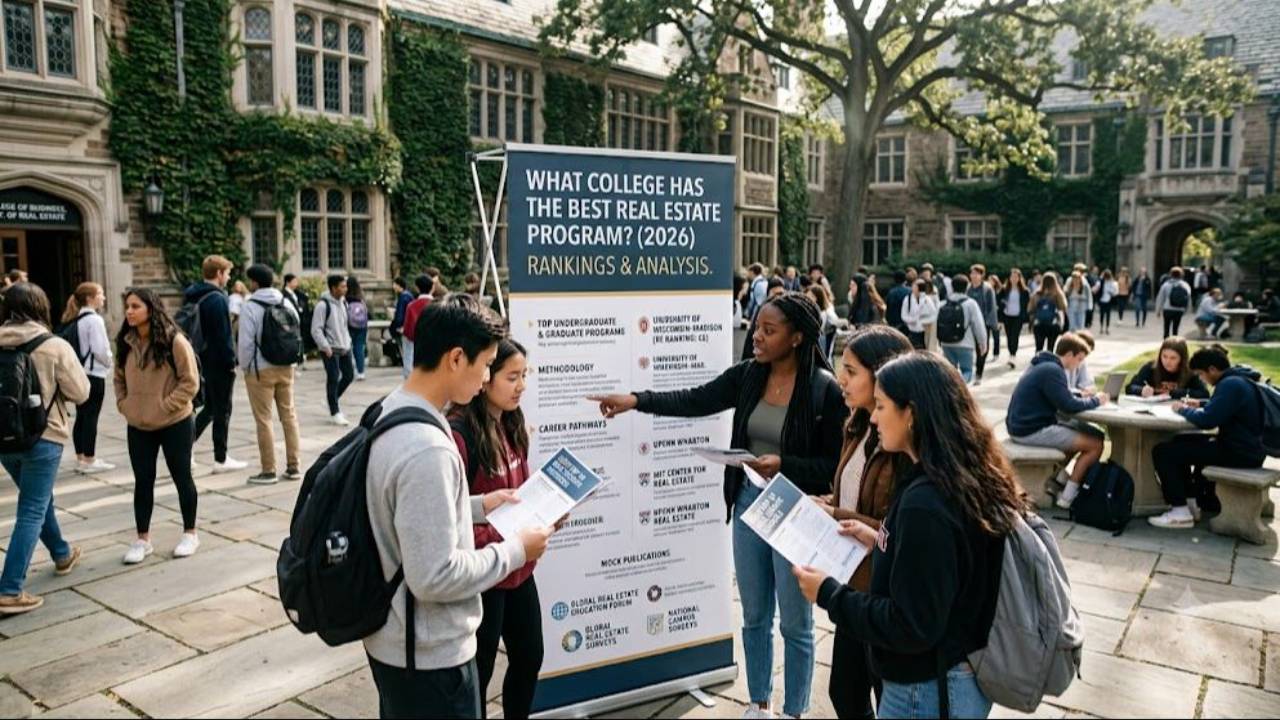
If you are asking which college has the best real estate program, you deserve two honest answers, not one. First, the academic answer: a handful of universities genuinely stand above the rest for real estate. Second, the answer almost no ranking site will tell you: for most people who want to work in real estate, a four-year degree is not the fastest or cheapest path to actually doing it. This guide covers both, so you spend your time and money on the right thing.
I am Saad Jamil. I have closed more than $500M and over 800 homes in Northern Virginia, and I never needed a real estate degree to do it, because selling homes is a licensed skill, not a diploma. I still list and sell today and I run the real estate coaching at Jamil Academy, so I will give you the college rankings straight and then help you decide whether a degree is even the right move for your goal.
Quick Answer
For a real estate degree, the University of Wisconsin-Madison and its Graaskamp Center are consistently ranked at or near number one, with the University of Pennsylvania (Wharton), the University of Georgia, New York University, the University of Southern California, and UC Berkeley right behind. The best program for you depends on whether you want a career in real estate finance and development or you simply want to sell homes. If it is the latter, you do not need a degree at all. You need a license and real coaching, which get you earning years sooner.
In This Guide
First: do you even need a degree to sell real estate?
How to read these rankings
Best college real estate programs at a glance
University of Wisconsin-Madison
University of Pennsylvania (Wharton)
University of Georgia (Terry)
New York University (Schack)
University of Southern California (Lusk)
UC Berkeley (Haas)
Other strong real estate programs
Undergraduate degree vs graduate (MBA and MSRED)
What a real estate degree actually teaches
Which path fits you? Try the finder
The faster path if you just want to sell homes
Mistakes when choosing a real estate education
Frequently asked questions

The short answer: which college is best
If you want the one-line version, the University of Wisconsin-Madison is the school most often ranked number one for real estate, thanks to its James A. Graaskamp Center for Real Estate and a legendary alumni network across the investment and development world. When people in the industry talk about the top academic program, Wisconsin is almost always in the conversation.
But best is not a single answer, because these programs are built for different careers. The University of Pennsylvania through Wharton is the powerhouse for real estate finance and investment. New York University puts you inside the largest real estate market in the country. The University of Southern California leads on the West Coast. The University of Georgia is a perennial top-ranked pick at a public-school price. The right one depends on the career you are actually chasing.
And there is a bigger question hiding underneath this one. A lot of people searching for the best college real estate program actually just want to become an agent and earn a living selling homes. If that is you, the honest answer is that you may not need any of these programs. Let us settle that first, because it changes everything about what you should do next.
First: do you even need a degree to sell real estate?
Here is the truth that no university brochure will lead with: you do not need a college degree to become a real estate agent. In every state, you get licensed by completing a state-approved pre-license course, passing the licensing exam, and hanging your license with a brokerage. There is no diploma requirement anywhere in that process. Some of the highest earning agents in the country never studied real estate in college.
So who is a real estate degree actually for? It genuinely matters for careers in real estate finance, investment, commercial development, appraisal, and corporate or institutional real estate. If you want to underwrite deals at an investment firm, run development projects, or work on the capital side, a strong degree opens doors that experience alone often will not. For those paths, the schools below are worth every dollar.
But if your goal is to help people buy and sell homes and earn commission income, a four-year degree is optional at best and an expensive detour at worst. Clients choose an agent for skill, trust, and results, not for a diploma on the wall. The faster route is to get licensed, then invest in the practical skills that actually produce closings. For the full breakdown of every education path, see real estate programs explained, and for the step-by-step licensing route, read how to become a real estate agent.
To be fair, there is a real exception. If you plan to work in luxury, commercial, or investment sales, or you think you may move into development later, a finance or business background can add genuine credibility and understanding. Just treat it as a bonus, not a gate. You can still get licensed and start earning now, and add the academic side when a specific goal actually calls for it, rather than paying for it on the assumption that you must.
How to read these rankings
Before the list, a caution about rankings. Different sources measure completely different things. US News weighs academic reputation among peers, while other sites rank by graduate salaries, program size, or student reviews. That is why the same school can be number one on one list and outside the top ten on another. None of them is wrong, they are just answering different questions.
The programs below are the ones that show up near the top across reputation-based rankings year after year, which is a more stable signal than any single year's order. Even so, exact positions shift annually, so treat this as a shortlist of genuinely excellent programs rather than a rigid one-to-ten. Before you apply, pull the current US News real estate ranking for the latest order.
Most important, weigh each program against your goal and your budget. A famous name is worth less than the right fit, the right location for the market you want to work in, and a cost you can carry without burying yourself in debt for a career that may not even require the degree. Read the list with your actual plan in mind.
Best college real estate programs at a glance
Here are the programs that consistently rank near the top, with what each is known for and who it suits. Read the full sections below for the ones that fit your goal.
University of Wisconsin-Madison
Wisconsin is the name that comes up first in almost any serious conversation about real estate education, and it has held that position for decades. The James A. Graaskamp Center for Real Estate is famous for a rigorous, finance-driven approach and for an alumni network that reaches into the top ranks of real estate investment, development, and pension-fund advisory across the country.
What sets it apart is the depth of that network and the reputation of the program among employers. A Wisconsin real estate graduate carries instant credibility on the investment and development side of the business, and the school offers both undergraduate and graduate paths. If you want the single most respected all-around real estate degree, this is the benchmark everyone else is measured against.
Who it is for: students aiming at institutional real estate, investment, and development careers who want the strongest possible academic pedigree. Who it is not for: someone who simply wants to get licensed and start selling homes next year, since none of that requires this level of academic investment.
University of Pennsylvania (Wharton)
If your ambition points toward the money side of real estate, Wharton is the mountaintop. As one of the most prestigious business schools in the world, Penn brings elite real estate finance, private equity, and investment training, plus the recruiting pipeline into the biggest firms that an Ivy League name commands.
The strength here is finance depth and network. Wharton graduates move into real estate private equity, investment banking, REITs, and institutional investment at a level few programs can match. The trade-off is cost and selectivity, since this is among the most competitive and expensive routes in the country, and it is aimed squarely at high finance rather than everyday brokerage.
Who it is for: students targeting real estate finance, private equity, and institutional investment at the highest level. Who it is not for: aspiring residential agents, who would pay a fortune for prestige that clients buying a home will never ask about.
University of Georgia (Terry)
The Terry College of Business at Georgia runs one of the most consistently top-ranked undergraduate real estate programs in the country, and it does so at a public-university cost. For students who want an elite program without an elite price tag, this is one of the best value plays on the entire list.
The program is known for a strong curriculum, active student real estate organizations, and solid placement into brokerage, development, and finance roles across the Southeast and beyond. It punches well above its price, which is exactly why it shows up near the top of undergraduate rankings year after year.
Who it is for: undergraduates who want a genuinely top-tier real estate degree with strong return on investment. Who it is not for: someone who has already decided on residential sales and just needs a license and a plan to start earning.

New York University (Schack)
The NYU Schack Institute of Real Estate puts you inside the largest and most competitive real estate market in the country. Its greatest asset is proximity and connection, with faculty and adjuncts drawn from working professionals and a location that turns internships and networking into a genuine pipeline into New York real estate.
Schack is especially strong at the professional and graduate level, and it runs one of the largest real estate programs by enrollment, which speaks to its industry pull. For someone who wants to work in commercial real estate, development, or investment in a major metro, the connections alone can justify the choice.
Who it is for: students who want to build a career in New York or another major market and value industry access above all. Who it is not for: budget-conscious students far from a major metro, or anyone whose plan is simply to get licensed and sell homes locally.

University of Southern California (Lusk)
On the West Coast, USC is the standard-bearer. Through the Ross Minor in Real Estate Development and the Lusk Center for Real Estate, USC combines a strong curriculum with one of the most powerful alumni networks in California real estate, which matters enormously in a relationship-driven market.
USC is particularly respected for real estate development and for placement into West Coast firms, where the Trojan network is famously active. If you intend to build your career in California or the broader West, the combination of program quality and local connections is hard to beat.
Who it is for: students targeting development, investment, and commercial real estate careers on the West Coast. Who it is not for: someone outside that region on a tight budget, or an aspiring agent who needs a license and a book of business, not a four-year program.
UC Berkeley (Haas)
UC Berkeley, through the Haas School of Business and its Fisher Center for Real Estate and Urban Economics, brings a rigorous, analytical, and increasingly technology-forward approach to real estate. As one of the top public universities in the world, it pairs academic firepower with proximity to the innovation economy.
Berkeley suits students drawn to the finance, economics, and PropTech side of real estate, where data and analysis drive decisions. The program and its research center carry serious credibility for investment and urban-economics careers, and the Bay Area location connects students to both capital and technology.
Who it is for: analytical students aiming at real estate finance, investment, or technology-driven roles. Who it is not for: someone who wants a fast, practical route into residential sales rather than a rigorous academic and quantitative program.
Other strong real estate programs
Plenty of excellent programs sit just outside that headline group, and several may fit your goals or budget better. The right school is often the strong regional program in the market where you actually want to work, not the most famous name on a national list.
- University of Florida (Bergstrom Center). A strong, well-connected program for the fast-growing Sun Belt, with good placement across Florida and the Southeast.
- San Diego State University (Corky McMillin Center). A well-regarded undergraduate real estate center with a loyal regional network on the West Coast.
- Cornell University. Elite graduate real estate through its Baker Program in Real Estate, a top choice for master's-level development and investment study.
- MIT (Center for Real Estate). A rigorous, research-driven graduate program for the analytical and development-focused, with a strong finance and innovation bent.
- Ohio State, Villanova, Florida State, Texas, and SMU. All run respected programs that place well regionally and can offer excellent value depending on your residency and goals.
If you already know the metro you want to work in, look hard at the leading program in that region. Local alumni networks and internship pipelines often matter more for your first job than a national ranking does.
Undergraduate degree vs graduate (MBA and MSRED)
Real estate education splits into two levels, and knowing which you need saves you years and a lot of money. An undergraduate degree in real estate, finance, or business is the common foundation, and for many careers it is enough on its own, especially when paired with internships and a strong first job.
The graduate route, an MBA with a real estate concentration or a specialized Master of Science in Real Estate Development, is the step up for people aiming at development leadership, investment management, and senior institutional roles. Programs like Cornell's Baker, MIT's Center for Real Estate, USC, and Wisconsin are known for this level. A graduate degree is a serious investment that pays off in specific, capital-intensive career tracks.
And to be clear one more time, neither level is required to become a licensed agent. If you are weighing a costly graduate degree purely to sell homes, pause. That money and time would almost certainly produce more income invested into licensing, a strong start, and coaching that builds your actual sales skills.
What a real estate degree actually teaches
It helps to know what you are actually buying with a real estate degree, because the coursework is heavily weighted toward the finance and analysis side of the business, not the sales side. A typical program is built around real estate finance and investment, valuation and appraisal, real estate law, market and feasibility analysis, and development. It is closer to a specialized finance degree than to a sales curriculum.
That focus is exactly why a degree pays off for corporate, investment, and development careers. You come out able to underwrite a deal, model cash flows, read a market study, and speak the language of capital, which is what those employers hire for. Those are real, valuable skills that are genuinely hard to pick up on your own without structure and mentorship.
Notice what is mostly missing from that list, though: prospecting, lead generation, listing presentations, negotiation with real clients, and closing. Those are the skills that actually pay a residential agent, and they are learned in the field and through coaching, not in a lecture hall. That is the core reason a degree and a sales career are not the same purchase, and why buying one to do the other so often disappoints.
Which path fits you? Try the finder
Answer two quick questions and this tool will point you to the education path that fits your actual goal, whether that is a top degree program, a license and coaching, or a hybrid. It collects nothing, and it will tell you honestly when a degree is not the right spend.
The faster path if you just want to sell homes
If the finder pointed you to licensing, here is what that path actually looks like, and why it beats a degree for a would-be agent on every measure that matters. You complete a state-approved pre-license course, pass your exam, and join a brokerage. That is weeks to a few months and a few hundred to about a thousand dollars, not four years and a tuition bill.
The catch is that a license only makes it legal to sell. It does not teach you how to actually generate leads, win listings, convert buyers, and close, which is where most new agents struggle and quit. That gap is exactly what practical coaching fills, and it is the single highest-return investment a new agent can make. It is also why a semester of real estate theory rarely turns into commissions the way real coaching does.
This is the honest reason I built my real estate coaching for new agents: to hand people the exact systems I use to sell at a high level, so they earn while their peers are still paying tuition. Get grounded with how to succeed as a new agent, get realistic about pay in how much agents actually make, and if you want a coach, learn how to pick the right coaching program.
Mistakes when choosing a real estate education
Whatever path you pick, avoid these common and expensive missteps.
- Getting a degree to become an agent. Spending four years and a fortune on a degree you do not need to get licensed is the single most common and costly mistake in this whole decision. Match the education to the job.
- Chasing the ranking instead of the fit. The number one school on a national list may be the wrong choice if it does not connect to the market you want to work in or the budget you can afford.
- Ignoring location. Real estate is intensely local and relationship-driven. A strong regional program in your target market can beat a more famous school two thousand miles away.
- Overlooking cost and debt. A private-school real estate degree can cost more than a starter home. Weigh that debt honestly against the income the degree will actually add over a license-and-coaching path.
- Believing a degree replaces sales skill. No classroom makes you good at winning clients. Whether or not you get a degree, the practical skills of prospecting and closing are what pay you, and those are learned by doing and by coaching.
Frequently asked questions
What college has the best real estate program?
By reputation and by most rankings, the University of Wisconsin-Madison and its Graaskamp Center sit at or near the top for real estate, followed closely by the University of Pennsylvania (Wharton), the University of Georgia, New York University, the University of Southern California, and UC Berkeley. The best one for you depends on your goal, since a program built for real estate finance careers is different from one built for brokerage or development. Exact rankings shift each year, so check the current US News real estate list before you decide.
Do you need a college degree to become a real estate agent?
No. In every US state you become a licensed real estate agent by completing a state-approved pre-license course, passing the licensing exam, and joining a brokerage. A four-year degree is not required to sell homes. A college real estate degree matters most for careers in real estate finance, development, and corporate or institutional real estate, not for working as a residential agent. If your goal is to sell homes, a license plus real coaching gets you earning far faster than a degree.
Is a real estate degree worth it?
It depends entirely on the career you want. For real estate finance, investment, development, and corporate roles, a degree from a strong program is genuinely valuable and can open doors that experience alone will not. For becoming a residential sales agent, a degree is optional and often an expensive detour, because clients hire agents for skill and trust, not for a diploma. Match the education to the job, not the other way around.
What degree is best for a career in real estate?
For most real estate careers, a bachelor's in real estate, finance, or business is the common path, and a graduate degree such as an MBA with a real estate concentration or a Master of Science in Real Estate is the step up for development, investment, and leadership roles. For becoming an agent, no specific degree is required at all, only a state license. Choose based on whether you want to sell real estate or to finance, build, and manage it.
How much does a real estate degree cost versus getting licensed?
A four-year real estate degree can range from tens of thousands of dollars at a public university to well over $200,000 at a private one, plus four years of time. A real estate license typically costs a few hundred to about a thousand dollars in coursework and exam fees and can be completed in a matter of weeks to a few months. If your goal is to start earning as an agent, the license is dramatically faster and cheaper, and coaching is what actually shortens the ramp to real income.
Which is better for real estate, a degree or coaching?
They serve different goals. A degree builds academic and financial foundations for corporate, investment, and development careers. Coaching builds the practical skills that produce closings, lead generation, conversion, follow-up, and negotiation, which is what actually grows an agent's income. If you want to sell homes, coaching from someone who still sells will move your business faster than any classroom. If you want an institutional real estate career, the degree comes first.
About the Author
Written by Saad Jamil, founder of Jamil Academy and a currently producing Top 1% Realtor in Northern Virginia, with $500M+ in career sales and 800+ homes closed. Licensed since 2007 in VA, DC, MD, and WV, Saad built a $500M career without a real estate degree and now coaches agents on the practical systems that actually produce closings. View Saad’s Zillow profile.
Educational content only, not financial, legal, or career advice. College rankings and program details change over time and vary by source, so confirm current rankings, offerings, and costs directly with each school and the latest US News list before deciding.
Free: 5 Ways to Get More Listings Without Cold Calling
Five lead strategies that work without cold calls or ad spend, from an agent with $500M sold and 900+ homes closed.
No spam. Unsubscribe any time.
Your Coach