Real Estate Leads That Pay at Closing (2026): Fees, Programs and the Math
Oct 22, 2026
Real estate leads that pay at closing usually cost you nothing upfront. Instead, the lead company takes a referral fee from your commission when the client closes. If the deal never closes, you owe nothing.
The fees these programs publish run from 15% to 40% of the commission, and most sit between 25% and 40%. HomeLight's standard fee is 33%. Redfin charges 33% to 40% on sales of $100,000 and up.
Below: how the fee works, which programs publish it, the contract terms, and the math against buying leads upfront. I read each program's pages and the legal texts on 22 October 2026.
Where I stand: I am a Realtor with Samson Properties in Virginia, and I run Jamil Academy, which sells training to agents. This is not a hands-on test of each program. It is built from the programs' own pages, legal texts, reported court filings and public data. The one product block near the end is my own.
Quick answer
- Published fees: HomeLight 33%. Agent Pronto typically 25% to 35%. Redfin 33% to 40% on sales of $100,000 and up. Zillow Preferred 15% to 40% by market, and 40% on seller leads.
- Not published: Realtor.com ReadyConnect Concierge, Clever, ReferralExchange and Veterans United Realty.
- On a typical buyer side: $417,500 at 2.70% is $11,272.50. A 35% fee takes about $3,945.
- Break-even: at $102.51 a lead, upfront leads cost less per closing than that fee only if you close more than about 2.6% of them.
- Watch for: fee tails of two to three years, and pending lawsuits.
- What are real estate leads that pay at closing?
- How is the pay-at-closing referral fee calculated?
- Which pay-at-closing programs publish their fees?
- How does Zillow Preferred charge at closing?
- What does the Redfin Partner Program charge?
- What does HomeLight charge for referrals?
- What does Agent Pronto charge?
- What about Realtor.com, Clever and other programs?
- How much do you keep on a typical sale?
- Pay at closing or pay upfront: where is the break-even?
- Pay-at-closing calculator: what will you keep?
- What closing rate should you expect from these leads?
- Which contract terms matter most?
- Who qualifies for pay-at-closing programs?
- Are pay-at-closing referral fees legal?
- Which lawsuits involve pay-at-closing programs?
- How do referral fees work at tax time?
- Who should use pay-at-closing leads, and who should not?
- How to evaluate and negotiate a pay-at-closing program
- What I could not verify
- Frequently asked questions
What are real estate leads that pay at closing?
Short answer: leads from a company that charges no upfront fee and takes a share of your commission when the deal closes. You will also see them called pay-after-closing, pay-at-close or pay-per-close leads.
The company finds a buyer or seller who asked for help, then connects them with a partner agent. You sign a referral agreement first, and in most programs your broker is part of it. Most programs also screen agents on experience and results.
With upfront leads, such as search ads or portal advertising, you pay whether or not anyone closes. With pay-at-closing leads, the company carries that risk and prices it into the fee. I break down the upfront side in real estate lead generation costs by channel.
No upfront cost is not the same as free
Zillow Preferred has no upfront fee, but its FAQ says "The only required expense is a Follow Up Boss (FUB) subscription". ReferralExchange says "There is a one-time fee for membership."
These programs also differ from a referral between two agents, which works on the same commission-split idea. I cover that in real estate referral fees explained.
My view: the model moves the risk of a dead lead from you to the company. You pay for that safety with a large share of every deal that does close.
How is the pay-at-closing referral fee calculated?
Short answer: as a percentage of the commission on your side of the deal, before your brokerage split. It is usually paid through your brokerage at or soon after closing.
- Side commission = sale price x your side's commission rate.
- Referral fee = side commission x the program's fee percentage.
- Your take-home = (side commission minus the fee) x your share under your brokerage split.
Take a $417,500 sale with a 2.70% buyer side. The side commission is $11,272.50. A 35% fee is about $3,945, which leaves about $7,327 for you and your brokerage to split.
What the fee is calculated on
The programs that publish terms all start from the gross commission, not your net:
- Zillow Preferred: "a percentage of the full commission you expect to receive for your side of the transaction."
- HomeLight: "the agent's side of the gross commission." In dual agency with one referred party, 33% of half the total gross commission.
- Redfin: "based on all commissions, fees, bonuses, and/or compensation".
- Agent Pronto: a share of the gross referred-side commission, disclosed before you accept a referral.
Sources: Zillow Preferred pricing page, HomeLight help center, Redfin partner fee schedule and agentpronto.com/learn, read 22 October 2026.
Because the fee comes off the top, it cuts your take-home on that deal by the same percentage, whatever your split. A flat brokerage fee per deal makes the cut deeper.
My view: think of a 35% fee as giving up about a third of your income on that deal. Weigh that against what the same client would cost you any other way.
Which pay-at-closing programs publish their fees?
Short answer: four of the programs I checked publish a fee: Zillow Preferred, Redfin, HomeLight and Agent Pronto. The rest leave the rate to the agreement, so any figure you see for them is third-party or alleged.
| Program | Referral fee | Where the figure comes from | Upfront cost | Tail or payment terms |
|---|---|---|---|---|
| Zillow Preferred | 15% to 40% by market; 40% on seller leads | Published by Zillow | None, but a Follow Up Boss subscription is required | Fee on the first 2 transactions within 2 years of the lead |
| Redfin Partner Program | $100 or $200 flat under $100,000; 33%, 35% or 40% by price from $100,000 | Published by Redfin (fee schedule) | None | Due within 15 calendar days of closing |
| HomeLight Referrals | 33% of your side | Published by HomeLight | None; no monthly or per-lead fees | Closings within 3 years of the referral |
| Agent Pronto | Typically 25% to 35% | Published by Agent Pronto | None | Due at closing; client may get up to 3 agents |
| Realtor.com ReadyConnect Concierge | Not published. Roughly 28% to 40%, according to Clever | Third party | None | Not found |
| Clever | Not published ("a standard rate") | Not published | None | Not found |
| ReferralExchange | Not published. Up to 35%, according to Inman in 2018 | Third party, old | One-time membership fee, amount not stated | Not found |
| Veterans United Realty | Not published. About 35% is alleged in a pending lawsuit | Allegation | Not stated | Pay within 48 hours of closing |
| UpNest | 30% seller, 15% buyer, according to Inman in 2022 | Third party, old | Not verified | Not verified |
Sources: each program's own pages, read 22 October 2026, except where the table names a third party. Third-party and alleged figures are not confirmed by the programs.
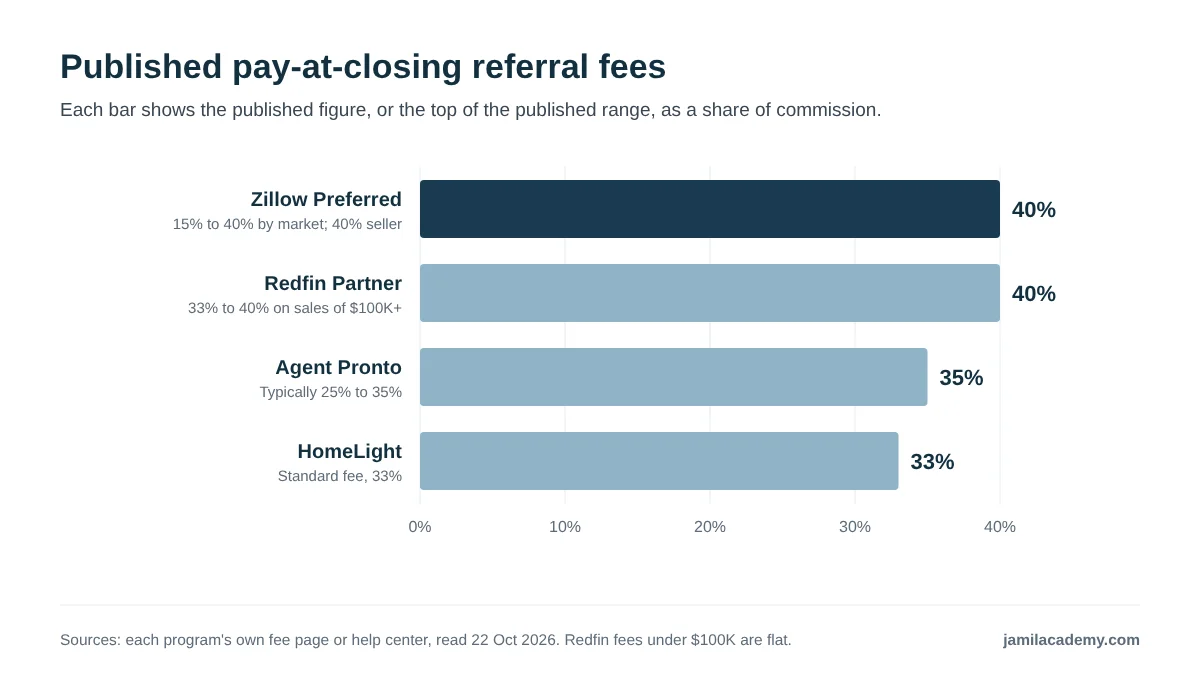
A published fee can change, and it can differ by lead type. Zillow and Redfin both charge 40% on some leads and less on others.
My view: get the fee schedule in writing before you accept a single lead. I would not sign with a program that will not show it to me first.
How does Zillow Preferred charge at closing?
Short answer: Zillow Preferred, which replaced Flex, has no upfront fee and charges a success fee of 15% to 40% of your side, with 40% on seller leads. It is invite-only.
Zillow's FAQ calls it "the next evolution of the Flex program". Its 2025 annual report calls it "the invite-only, pay-when-you-close program for top real estate agent teams."
Sources: Zillow Preferred FAQ (modified 14 October 2026), pricing page and compliance page (modified 7 October 2026), and Zillow Group Form 10-K for 2025 (SEC), read 22 October 2026.
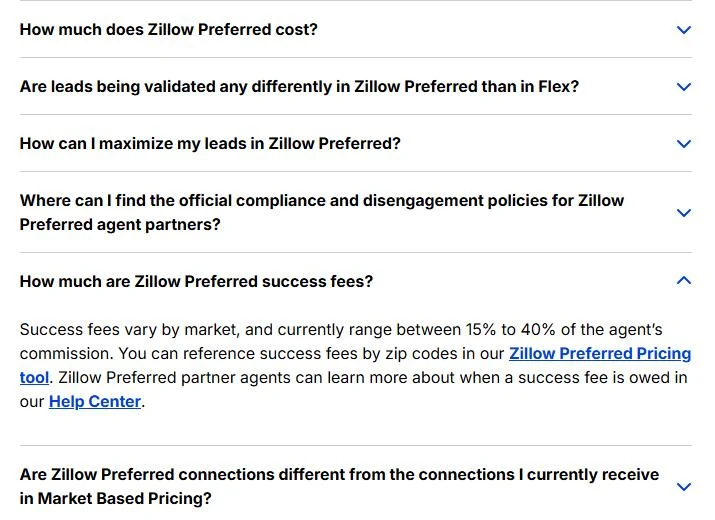
- Overall range: "Success fees vary by market, and currently range between 15% to 40% of the agent's commission."
- Seller leads: "The success fee for all seller originated connection transactions is 40% for all markets."
- Buyer leads: rates "may vary by market, transaction price, and connection delivery date." A ZIP code lookup shows yours.
- Changes: on 15 days' notice, for connections you receive after the notice period.
The tail and who pays
Zillow is owed a fee on "the first two transactions (buyer or seller representation)" you complete with a Zillow Preferred lead "during the two years after you received the lead."
Payment is due within 15 days if it is not paid at escrow. Zillow "may pursue any contracted partner (Broker, Team Lead, Individual Agent)" for an unpaid fee, whatever your roster status.
Invitations go "to teams with a strong track record of performance", and Zillow says the main path in will be through Zillow Pro. More in my guide to Zillow Flex costs and how to get invited.
My view: the two-year, two-deal tail matters as much as the rate. A happy buyer who later sells with you can mean a second 40% fee.
What does the Redfin Partner Program charge?
Short answer: no upfront cost, and a referral fee set by sale price. It is a flat $100 or $200 below $100,000, then 33%, 35% or 40% as the price rises.
You "only pay a referral fee once you close a transaction," and the program now serves "Redfin and Rocket customers".
| Sale price | Standard customer connections | Specialty leads |
|---|---|---|
| Under $50,000 | $100 flat | $100 flat |
| $50,000 to under $100,000 | $200 flat | $200 flat |
| $100,000 to under $500,000 | 33% | 40% |
| $500,000 to under $900,000 | 35% | 40% |
| $900,000 and up | 40% | 40% |
Source: Redfin partner agent referral fee schedule (current form, undated), read 22 October 2026.
An earlier 2024 form also lists "$0 (no fee)" for sales under $100,000. Ask which form applies to you.
At the national median price of $417,500, a standard connection falls in the 33% tier. On a 2.70% buyer side, that is a fee of about $3,720.
Payment and performance standards
The fee is due "within fifteen (15) calendar days" of the purchase or sale. To stay in the program, Redfin's standards page lists:
- A request acceptance rate of 55% or more.
- A customer list compliance rate of 80% or greater.
- An average connection time of 5 minutes or less.
- Closed transactions with customers that meet or exceed local market averages.
Sources: redfin.com/partner, and Redfin partner agent help center pages updated 2 June 2025 and 3 February 2026, read 22 October 2026.
I did not find Redfin's tail period. Redfin also comes up in a pending lawsuit against Rocket, covered below.
My view: the performance standards are part of the price. A 5-minute connection time means someone must answer every lead, every time.
What does HomeLight charge for referrals?
Short answer: nothing upfront, and 33% of your side when a referral closes within three years. HomeLight raised the fee from 25% to 33%, effective 25 October 2022.
- Upfront cost: "Being a HomeLight partner agent is completely free." Agents do not owe "any monthly or per-lead fees."
- Fee: "the standard fee (33%)", calculated from "the agent's side of the gross commission."
- Tail: a fee is due when "a transaction closes within three years of the date of the referral."
- How it is paid: "through their employing broker."
- Investor purchases: agents "are subject to pay 4% of the purchase price to HomeLight."
Sources: HomeLight help center, "What does HomeLight cost?" and "Referral agreement changes FAQ" (dated 25 October 2022), read 22 October 2026.
One caution: HomeLight's changes FAQ gives a 2-year active period for referrals claimed before 25 October 2022, and its deactivation answer refers to your contract "active period" of two years. Confirm the period in your own agreement.
To get referrals, HomeLight wants a signed agreement and three years of verified transaction history. It then matches on volume, reviews, response speed and other results.
My view: three years is a long tail. Tag every HomeLight client in your CRM on day one, so a repeat deal in year three is not a surprise invoice.
What does Agent Pronto charge?
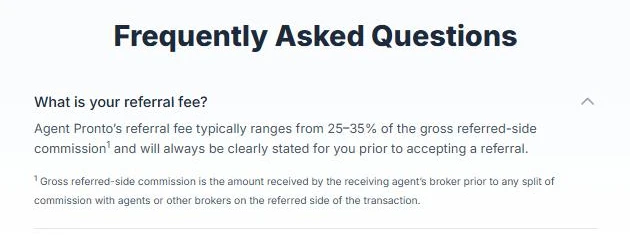
Short answer: typically 25% to 35% of the gross referred-side commission, due at closing. You may be one of up to three agents the client hears from.
Agent Pronto discloses the fee before you accept a referral. It says "Referral fee payments to Agent Pronto are due at the time of closing." There is no upfront cost.
The referral is not exclusive: "we may connect them with up to three agents". It is also selective: "many agents who join our service may not receive a referral."
Source: agentpronto.com/learn, read 22 October 2026.
I did not find a published tail period, or whether your broker must sign. Ask for both.
My view: if two other agents get the same client, your speed and first conversation decide who closes.
What about Realtor.com, Clever and other programs?
Short answer: they work on the same idea, but none publishes its fee. Treat any rate you read for them as third-party, old or alleged.
Realtor.com ReadyConnect Concierge
Opcity is now Realtor.com's ReadyConnect Concierge. The Concierge page says "there are no upfront costs or fees associated with this service". Agents "only pay a referral fee on closed transactions."
Clever, a competitor, says broker-published schedules put the unpublished rate at roughly 28% to 40%. I compare the portals' paid products in buying leads from Zillow, Realtor.com and OpCity.
Clever, ReferralExchange and Veterans United Realty
- Clever says it is "totally free for agents" and is paid "a referral fee at closing", with no rate given. Clever also runs the commission survey I use below.
- ReferralExchange charges "a one-time fee for membership", amount not stated. Inman reported a referral fee of up to 35% in 2018.
- Veterans United Realty requires an agreement "signed by both you and your broker" and payment by card within 48 hours of closing. A pending lawsuit alleges a fee of about 35%.
Secondary only: UpNest and OJO
Inman reported in 2022 that Move, which operates Realtor.com, bought UpNest, with fees of 30% for seller leads and 15% for buyer leads. I could not load UpNest's site to confirm 2026 terms.
A brokerage help page from 2023 listed OJO fees of 20% to 35% by price, over 24 months. I found nothing current, so do not rely on it.
My view: when the fee is unpublished, get the rate, base and tail on paper first.
How much do you keep on a typical sale?
Short answer: on a median-priced home with a 2.70% buyer side, about $6,764 to $8,454 after a 25% to 40% fee. That is before your brokerage split.
NAR's median existing-home price for September 2026 was $417,500. Clever's August 2026 survey of 434 agents put the average buyer side at 2.70%. That is a survey of standard rates, not closed sales.
Redfin's closed-sale data put the average buyer's agent commission at 2.42% for the third quarter of 2025, so I show both.
| Referral fee | Fee at 2.70% | Left at 2.70% | Fee at 2.42% | Left at 2.42% |
|---|---|---|---|---|
| None | $0 | $11,273 | $0 | $10,104 |
| 25% | $2,818 | $8,454 | $2,526 | $7,578 |
| 33% | $3,720 | $7,553 | $3,334 | $6,769 |
| 35% | $3,945 | $7,327 | $3,536 | $6,567 |
| 40% | $4,509 | $6,764 | $4,041 | $6,062 |
Sources: NAR existing-home sales release, 13 October 2026; Clever average commission survey, updated 1 October 2026; Redfin press release, 8 December 2025. My arithmetic, rounded to whole dollars.
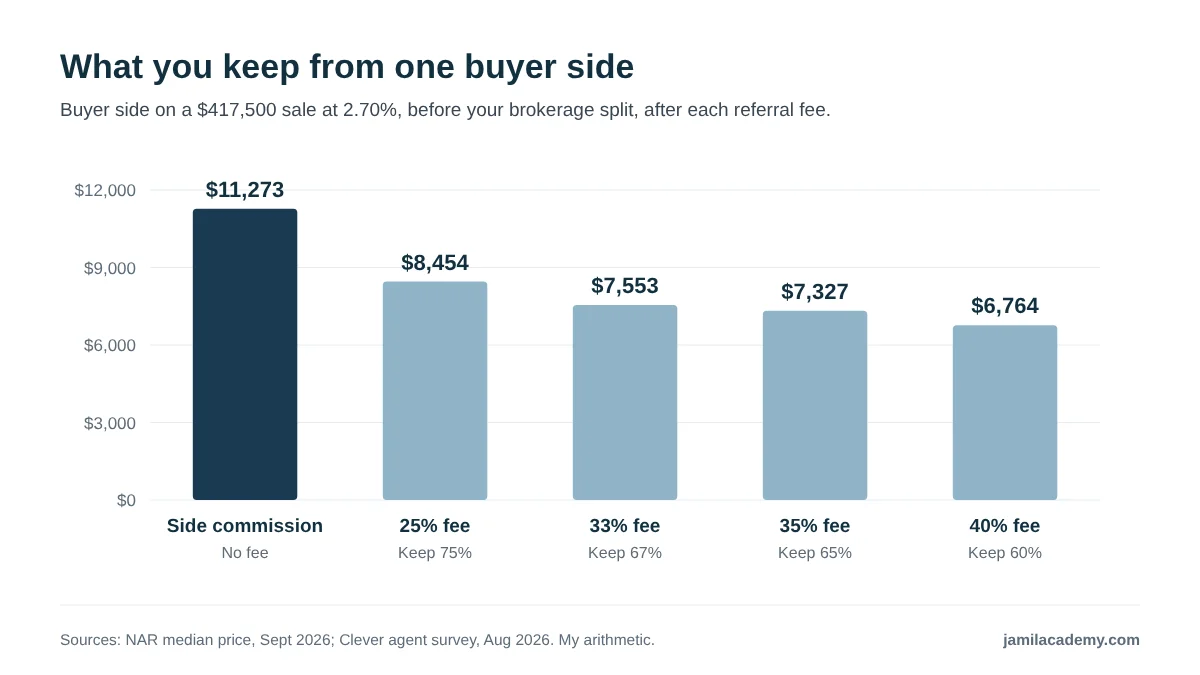
NAR's 2026 Member Profile says the typical Realtor had nine transaction sides in 2025. Two referred buyer sides at the median, with a 35% fee, would send about $7,891 to the lead company.
My view: run the numbers at your own price point and commission rate. National medians are a starting point, not your market.
Pay at closing or pay upfront: where is the break-even?
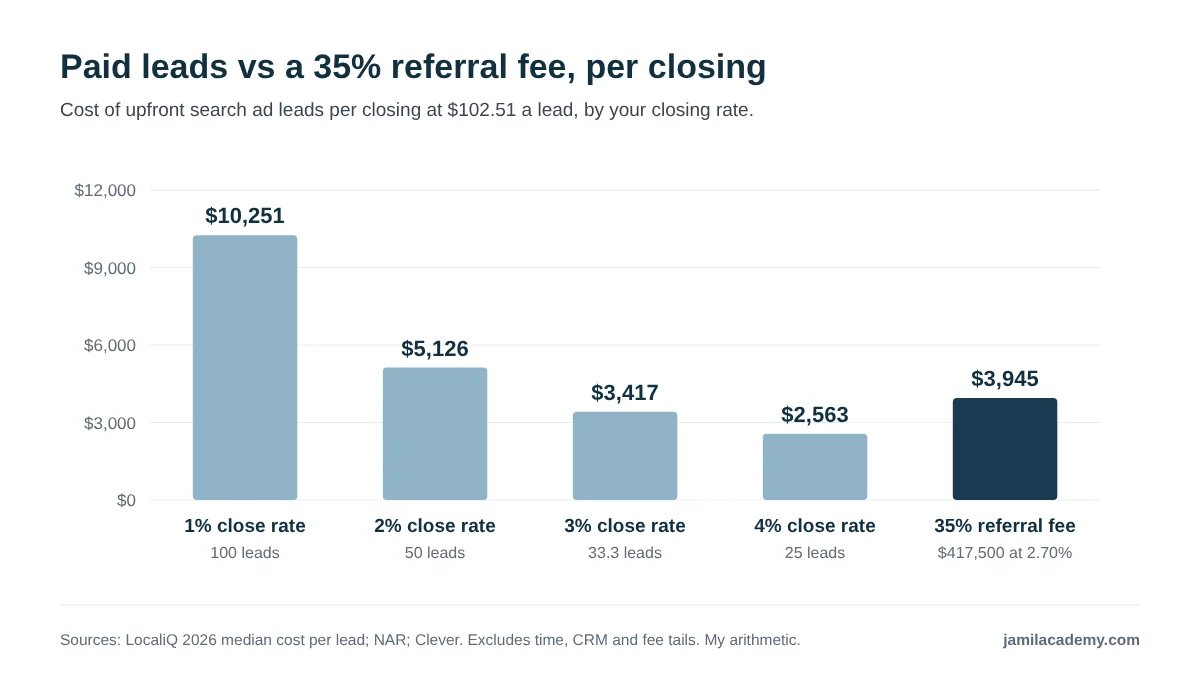
Short answer: with search ad leads at $102.51 each, paying upfront beats a 35% fee only if you close more than about 2.6% of those leads. Below that, pay-at-closing costs less per closing.
LocaliQ published benchmarks from 894 US real estate search ad campaigns running from April 2025 to March 2026. The median cost per lead was $102.51.
The report covers search ads only and does not say whose campaigns were sampled. Its 3.70% conversion rate is click to lead, not lead to closing.
Source: LocaliQ, Real Estate Search Advertising Benchmarks, last updated 14 September 2026, read 22 October 2026.
- Paid-lead cost per closing = cost per lead / your closing rate. At 2%, that is $102.51 / 0.02 = $5,125.50.
- Break-even closing rate = cost per lead / referral fee. At a $3,945 fee, that is about 2.60%.
| Referral fee | Fee on $417,500 at 2.70% | Leads that fee would buy at $102.51 | Break-even closing rate |
|---|---|---|---|
| 25% | $2,818 | 27.5 | 3.64% |
| 33% | $3,720 | 36.3 | 2.76% |
| 35% | $3,945 | 38.5 | 2.60% |
| 40% | $4,509 | 44.0 | 2.27% |
My arithmetic from LocaliQ, NAR and Clever figures above.
What the math leaves out
- Your time. At a 2% closing rate, you work 50 paid leads for each closing.
- The tail. A pay-at-closing client's next deal may carry a second fee. Your own ad lead's next deal does not.
- Tools. Ads need a CRM, a landing page and often management fees.
For a wider view of paid vendors, I compared the main options in top real estate lead generation companies for 2026.
My view: if you do not know your closing rate on paid leads, start tracking it before you spend on either model.
Pay-at-closing calculator: what will you keep?
Short answer: enter your price, commission and fee to see what you keep, and your closing rate to see which model costs less per deal.
The defaults use the NAR median price, Clever's 2.70%, a 35% fee and LocaliQ's $102.51 cost per lead. The 2% closing rate is only a placeholder.
The fee is taken from the gross side commission, then your split applies to what is left. The break-even rate is the closing rate at which paid leads cost the same per closing as the referral fee. Your time, tools, ad management and fee tails on later deals are not included. An illustration, not financial advice.
My view: try your best and worst month's closing rates. If the answer flips, you are close to the break-even line.
What closing rate should you expect from these leads?
Short answer: nobody publishes a reliable one. The figures repeated online have no primary source I could find, so use your own CRM data.
- "0.5% to 1.2%": Real Geeks attributes this to NAR, with no sample or year. I found no NAR document with it.
- "About .5% to 1%" and "1% to 3%": a 2020 HousingWire article presents these as one executive's estimate and one company's rule of thumb.
- Referrals at 15% to 25%, Zillow at 3% to 5%: labelled industry averages on one website, with no source.
Zillow's 4Q25 shareholders letter says it "improved transaction conversion among Zillow Preferred agents" in 2025, with no rate.
What the data does show
NAR's 2025 Profile of Home Buyers and Sellers asked how consumers found their agent. It covers transactions from July 2024 to June 2025, with 6,103 responses.
| How they found the agent | Buyers | Sellers |
|---|---|---|
| Referred by a friend, neighbor or relative | 43% | 37% |
| Used the agent before | 15% | 29% |
| Referred by another real estate agent or broker | 7% | 4% |
| Found the agent on a website | 6% | 4% |
Source: NAR 2025 Profile of Home Buyers and Sellers tables, as hosted by Rhode Island Realtors. The full report is for NAR members.
NAR's 2026 Member Profile adds that the typical Realtor got 28% of business from repeat clients and 22% from referrals by past clients. These are not conversion rates. They show most business comes through relationships, which carry no fee.
My view: track six months of your own leads by source, from first contact to closing. That number beats any national average for this decision.
Which contract terms matter most?
Short answer: the tail period, what the fee is calculated on, who the company can collect from, whether it can change the fee, and the performance standards. The rate is only one line.
| Term | What to look for | Example from a published program |
|---|---|---|
| Tail period | How long the fee applies, and to how many deals | Zillow: first 2 transactions within 2 years. HomeLight: closings within 3 years |
| Fee base | Full side, gross commission, bonuses | Zillow: the full commission for your side. Redfin: all commissions, fees and bonuses |
| Who owes it | Whether your broker, team lead or you can be pursued | Zillow may pursue the broker, team lead or individual agent |
| Fee changes | Notice period, and which leads it affects | Zillow: 15 days' notice, for later connections |
| Payment deadline | Days after closing, and how you pay | Redfin: 15 calendar days. Veterans United Realty: 48 hours, by card |
| Performance standards | Acceptance, response time, results | Redfin: 55% acceptance, 5-minute average connection time |
| Exclusivity | Whether other agents get the same client | Agent Pronto: up to three agents |
| Other fees | Membership, software, special leads | ReferralExchange membership; HomeLight's 4% on investor purchases |
Sources: the program pages cited in each section above, read 22 October 2026.
The tail is the clause most likely to surprise you. With HomeLight, any closing within three years of the referral triggers the fee. Zillow says it can collect "regardless of a partner's current Zillow Preferred roster status".
If you change brokerages, ask both brokers in writing who pays a fee that comes due later.
My view: before you sign, list the clients you already know, in case one is later sent to you as a program lead.
Who qualifies for pay-at-closing programs?
Short answer: mostly experienced agents with a track record. Very few of these programs are built for new agents.
| Program | Published entry rules |
|---|---|
| Zillow Preferred | Invite-only, for "teams with a strong track record of performance"; all team agents at one brokerage |
| Redfin Partner Program | "experienced, successful, and customer-service-focused agents", plus performance standards |
| HomeLight | Signed referral agreement and 3 years of transaction history, uploaded and verified |
| Clever | "Professional full time agents with over 5 years of experience" and strong seller reviews |
| ReferralExchange | Apply for membership; "Most of our agents have more than 8 years of experience" |
| Agent Pronto | Selective, with no published minimums |
Sources: each program's own pages, read 22 October 2026. A 2022 Movoto post set OJO's bar at three years full time and 25 or more closings a year; not confirmed for 2026.
My view: if you are new, build your sphere, closed sales and reviews first. Those are what these programs check.
Are pay-at-closing referral fees legal?
Short answer: generally yes, between agents and brokers acting as brokers. Federal law has an exemption for these fee splits. State license rules decide who can pay whom, and lawsuits are testing referrals tied to lenders.
RESPA Section 8 and Regulation X
Section 8(a) of RESPA bars giving or accepting "any fee, kickback, or thing of value" for referring settlement service business on a federally related mortgage loan.
Section 8(c)(3) then permits "payments pursuant to cooperative brokerage and referral arrangements or agreements between real estate agents and brokers". That is the safe harbor these programs rely on.
A violation can bring a fine of up to $10,000, up to a year in prison, or both. Civil liability is "three times the amount of any charge paid for such settlement service."
Source: 12 U.S.C. 2607 (RESPA Section 8), govinfo.gov.
The CFPB's Regulation X narrows the exemption. It says the exemption:
12 CFR 1024.14(g)(1)(v)
Source: CFPB, Regulation X, 12 CFR 1024.14, read 22 October 2026.
So a fee split between brokers is one thing. A referral tied to a lender is where the exemption may not reach.
Virginia and Maryland
Virginia's rule 18VAC135-20-280 bars a salesperson or associate broker from accepting a fee "from any person or entity except the licensee's principal broker or supervising broker".
The exception is "the prior written consent of the licensee's principal broker". So in Virginia, payment from anyone else needs that consent first.
Section A.1 also bars paying "any person not licensed in this or any jurisdiction for services that require a real estate license".
Source: 18VAC135-20-280, Virginia Administrative Code, read 22 October 2026.
Maryland's licensing law, as amended in 2022, lists a similar ground for discipline. It covers a salesperson or associate broker who accepts a commission from anyone other than their affiliated broker, except as section 17-604 provides.
I read that in the 2022 chapter law, not the current compiled code, so check the current sections 17-322 and 17-604 before relying on it.
Source: Maryland 2022 Chapter 649 (House Bill 568). DC and West Virginia rules were not researched for this guide.
The NAR Code of Ethics
Article 6 of NAR's 2026 Code requires Realtors to disclose financial benefits from recommending products or services, "other than real estate referral fees". Standard of Practice 6-1 covers businesses you have a direct interest in. State disclosure rules may still apply.
My view: none of this is legal advice. Ask your principal broker to review any pay-at-closing agreement before you sign, since they are usually a party to it.
Which lawsuits involve pay-at-closing programs?
Short answer: three pending class actions, against Zillow, Veterans United and Rocket. Redfin, which Rocket owns, comes up in the Rocket case. Everything below is an allegation. None has been decided on the merits.
Taylor and Armstrong v. Zillow
Taylor was filed on 19 September 2025 in federal court in western Washington (2:25-cv-01818-JLR), over the Flex program. Armstrong followed in November 2025, and the court consolidated the two in December 2025.
Press coverage of the first complaint reported that Flex charged agents up to 40%.
On 27 July 2026, Judge James L. Robart dismissed the claims with leave to amend, according to HousingWire and Inman. He wrote that the claims of lack of notice "are implausible given Zillow's express, repeated disclosures."
A third amended complaint followed on 17 August 2026. Zillow moved on 21 September to dismiss it with prejudice, citing the cooperative brokerage safe harbor. I found no ruling yet.
Peyton v. Veterans United Home Loans
Filed on 18 February 2026 in federal court in western Missouri (2:26-cv-04039-WJE). It alleges a referral fee of about 35% of agent commissions.
On 20 August 2026, the court granted the motion to dismiss in part, according to the plaintiffs' firm and HousingWire. Some RESPA kickback and fee-split claims survived. HousingWire reported that the judge "declined to apply the safe harbor at the pleading stage".
Waller v. Rocket Companies
Filed on 26 January 2026 in federal court in eastern Michigan (2:26-cv-10270) against Rocket Companies, Rocket Mortgage, Amrock and Rocket Homes. The complaint does not name Redfin.
HousingWire reported that Rocket's motion to dismiss nonetheless asks the court to dismiss Redfin too, so Redfin's status in the case is unclear. The complaint alleges a 35% buyer-side referral fee in the Rocket Homes network, plus steering to Rocket Mortgage.
Rocket moved to dismiss on 30 March 2026, arguing that Section 8(c) "categorically exempts cooperative brokerage and referral arrangements." I found no ruling.
Sources: court filings and case pages as reported by HousingWire, Inman and Real Estate News, and plaintiffs' firm case pages, read 22 October 2026.
My view: the common thread is the line between a broker fee split and a referral tied to a lender. Recheck your terms when these courts rule.
How do referral fees work at tax time?
Short answer: commissions and fees paid in your business go on Schedule C, line 10. But your brokerage usually pays the fee, so ask a tax professional.
The IRS instructions for line 10, "Commissions and Fees", say: "Enter the total commissions and fees for the tax year." They exclude fees "capitalized or deducted elsewhere on your return."
The 2025 instructions require Form 1099-NEC for certain commissions and fees of $600 or more. The draft 2026 instructions, marked not for filing, raise that to $2,000.
Sources: IRS Instructions for Schedule C (2025) and draft 2026 instructions, read 22 October 2026.
The IRS text does not use the words "referral fee". And when your brokerage pays the lead company before paying you, you may never pay the fee yourself. Veterans United Realty, which asks agents to pay by card, may be an exception.
My view: keep every referral fee statement, whoever pays it.
Who should use pay-at-closing leads, and who should not?
Short answer, in my view: experienced agents with spare time and fast response, whose closing rate on paid leads is low or unknown.
Pay-at-closing leads can fit if you
- Can answer new leads within minutes, every day.
- Have more time than leads, and no budget to risk on ads.
- Close paid leads below the break-even rate, or do not buy leads at all yet.
Think twice if you
- Already close paid leads above the break-even rate, about 2.3% to 3.6% in my examples.
- Get most of your business from your sphere, which carries no fee.
- Cannot track clients for two to three years to manage fee tails.
- Are uneasy about the pending lawsuits over referrals tied to lenders.
My view: pay-at-closing leads work best as a top-up, not a foundation. A business that runs only on them gives away a third of its income on every deal.
How to evaluate and negotiate a pay-at-closing program
Short answer: get the fee schedule, tail and liability terms in writing, run your own numbers, then decide. Use this checklist before you sign.
- Rate and base: the exact percentage for your market, price range and lead type, and what it is calculated on.
- Tail: how many years, how many deals, and whether it survives if you leave.
- Who pays: you, your broker or your team lead, and what happens if you move brokerages.
- Fee changes and deadlines: notice period, payment deadline and late penalties.
- Standards and exclusivity: acceptance rate, response time, and how many agents get the same client.
- Other costs: membership fees, required software and special lead fees.
- Lenders: anything about recommending a lender or other services.
- Your broker: written approval from your principal broker.
What you can negotiate
None of the programs I checked publishes a way to negotiate its rate. You can still ask whether a lower tier applies to your price range, whether the tail can be shorter, and whether past clients you list in advance are excluded.
My view: a program that will not answer these questions in writing has answered the most important one.
What I could not verify
These are the gaps I hit while checking sources.
- Unpublished fees for Realtor.com ReadyConnect Concierge, Clever, ReferralExchange and Veterans United Realty.
- Tail periods for Redfin, Agent Pronto, Realtor.com, Clever, ReferralExchange and Veterans United Realty. HomeLight says three years for referrals claimed after 25 October 2022, but mentions two years for older referrals and in its deactivation answer.
- Redfin's fee under $100,000: the current form says $100 or $200; an older form also lists no fee.
- The price of the Follow Up Boss subscription that Zillow Preferred requires.
- Current UpNest and OJO terms. UpNest's site and Zillow's old Flex FAQ did not load.
- Any lead-to-closing conversion rate with a primary source and a stated method.
- Maryland's current code text. I read the 2022 chapter law only. DC and West Virginia were not researched.
- Rulings on Zillow's and Rocket's pending motions to dismiss, as of 22 October 2026.
- Whether your brokerage applies its split before or after the referral fee.
- The $2,000 Form 1099-NEC threshold for 2026, which appears only in draft IRS instructions.

Frequently asked questions
What are pay at closing real estate leads?
Leads from a company that charges no upfront fee. When a referred client closes, you pay a referral fee from your side's commission, usually through your broker.
How much is the referral fee for pay-at-closing leads?
Published fees: HomeLight 33%, Agent Pronto typically 25% to 35%, and Redfin 33% to 40% from $100,000. Zillow Preferred charges 15% to 40%, with 40% on seller leads.
Are there free real estate leads that pay at closing?
There is no upfront fee, but they are not free. You pay a share of the commission at closing, and some programs add costs, like Zillow Preferred's required Follow Up Boss subscription.
Are pay at closing leads worth it?
It depends on your closing rate. At $102.51 a lead, upfront leads beat a 35% fee on a median buyer side only if you close more than about 2.6% of them.
How long does the referral fee obligation last?
It varies. Zillow Preferred collects on the first two transactions within two years of a lead. HomeLight charges on closings within three years of the referral. Others do not publish theirs.
Are pay-at-closing referral fees legal?
RESPA permits referral payments between real estate agents and brokers acting as brokers. State license rules also apply, and pending lawsuits allege some programs crossed into steering clients to lenders.
Who pays the referral fee, the agent or the broker?
Usually it runs through your brokerage. HomeLight says agents pay through their employing broker. Veterans United Realty asks agents to pay by card in AgentDash within 48 hours of closing.
Is a pay-at-closing referral fee tax deductible?
IRS instructions say commissions and fees paid in your business go on Schedule C, line 10. Ask a tax professional how fees your brokerage pays for you are handled.
Saad Jamil is a top 1 percent Realtor with Samson Properties in Chantilly, Virginia, licensed in Virginia, DC, Maryland and West Virginia since 2013, with more than $500 million in career sales and 900+ homes closed. Reviews and closed sales are on his Zillow profile. He runs Jamil Academy, which sells training to agents. This article is general information, not legal, tax or financial advice, checked on 22 October 2026.
Free: 5 Ways to Get More Listings Without Cold Calling
Five lead strategies that work without cold calls or ad spend, from an agent with $500M sold and 900+ homes closed.
No spam. Unsubscribe any time.
Your Coach