Dual Agency in Real Estate (2026): How It Works, State Rules and the Disclosures You Need
Nov 05, 2026
Dual agency in real estate means one licensee, or one brokerage, represents both sides of the same deal: the buyer and the seller, or the landlord and the tenant. Virginia, Maryland, DC and West Virginia allow it only with written consent. Florida, Kansas, Oklahoma, Vermont and Wyoming do not allow it, in the official text I read.
The rules change by jurisdiction, and so do the names. Virginia says "dual agent" or "dual representative," Maryland makes the broker the dual agent, and DC says "dual representative." The deadline for the signed consent changes too.
I read the statutes, regulations, commission forms and the NAR Code of Ethics on 5 November 2026 for everything below. Quotes are exact. The gaps I hit are listed near the end.
Where I stand: I am a Realtor with Samson Properties in Virginia, licensed in all four DMV jurisdictions, and I run Jamil Academy, which sells training to agents. This is general information, not legal advice. Your principal broker's policy comes first. The one product block near the end is my own.
Quick answer
- What it is: one licensee or brokerage representing both sides of one transaction.
- Is it legal? In the DMV, yes, with written consent. Bans I verified: Florida, Kansas, Oklahoma, Vermont and Wyoming. Texas uses an "intermediary" instead.
- Virginia: consent "at the earliest practical time," with outside deadlines tied to the offer.
- Maryland: the broker or designee is the dual agent. The buyer consents before the offer is presented to the seller, the seller before accepting it.
- DC: a "dual representative" needs the written consent of all clients.
- West Virginia: written consent on the Notice of Agency Relationship form, before negotiations begin.
- What is dual agency in real estate?
- Is dual agency legal? Which states ban it
- Dual agency in Virginia: consent, timing and the model disclosure
- Dual agency in Maryland: the broker is the dual agent
- Dual representation in DC: what the code requires
- Dual agency in West Virginia: the Notice of Agency Relationship
- How do the DMV dual agency rules compare?
- What can a dual agent do, and what can't they do?
- Dual agency disclosure checker
- What does the NAR Code of Ethics say about dual agency?
- How to explain dual agency to a client
- Pros and cons of dual agency: my view
- What I could not verify
- Frequently asked questions
What is dual agency in real estate?
Short answer: dual agency is when one licensee or brokerage represents both clients in a deal. Virginia's code defines a dual agent as "a licensee who has a brokerage relationship with both seller and buyer, or both landlord and tenant."
It can happen in two ways. One agent can represent both sides. Or two agents at the same brokerage can each represent one side. Maryland's consent form puts the second case plainly: "The possibility of Dual Agency arises when:" "The seller's agent and the buyer's agent are affiliated with the same real estate broker."
Sources: Code of Virginia § 54.1-2130; Maryland Real Estate Commission, "Consent for Dual Agency" (eff. 10/1/19), read 5 November 2026.
Dual agency vs designated agency
Designated agency is the version with two agents. In Virginia, a designated agent is "a licensee who has been assigned by a principal or supervising broker to represent a client." The broker in the middle "shall be considered a dual agent or representative."
Sources: Code of Virginia §§ 54.1-2130 and 54.1-2139.1, read 5 November 2026.
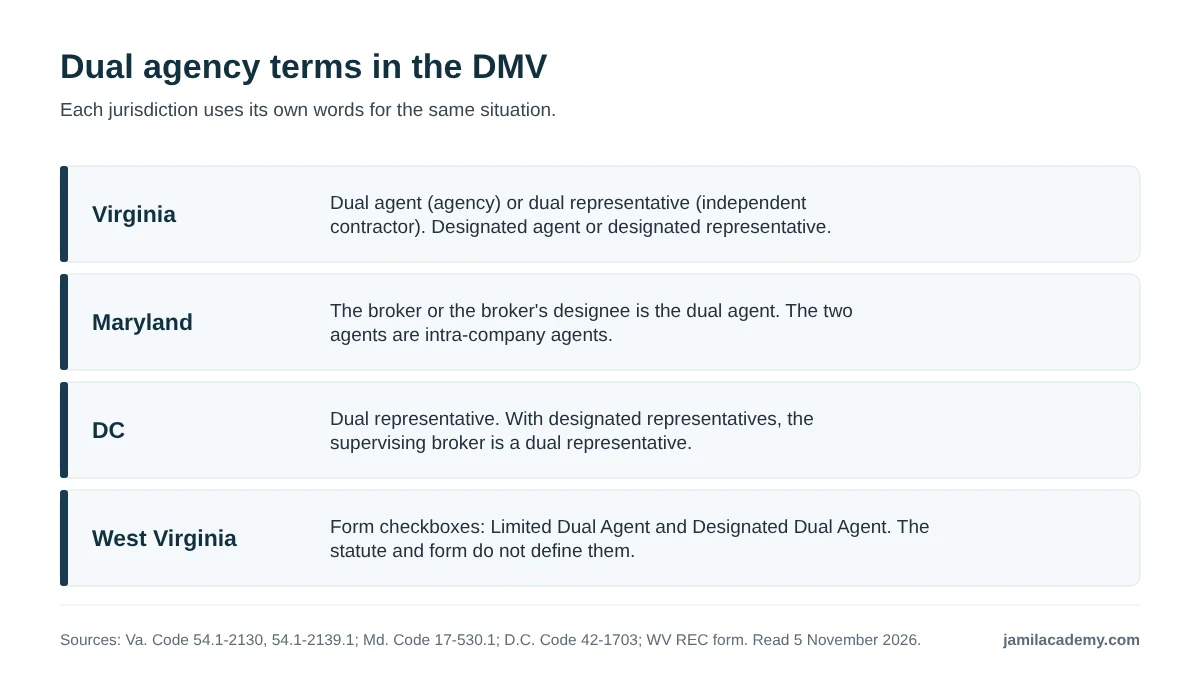
The words each DMV jurisdiction uses
| Jurisdiction | Terms in the law or form | Who holds the dual role |
|---|---|---|
| Virginia | "Dual agent" (agency relationship) or "dual representative" (independent contractor relationship); "designated agent" or "designated representative" | The licensee with both clients; with designated agents, the supervising broker |
| Maryland | "Dual agent" and "intra-company agent" | "The real estate broker or the broker's designee" |
| DC | "Dual representative" and "designated representative" | The licensee with both clients; with designated representatives, the supervising broker |
| West Virginia | Form checkboxes: "Limited Dual Agent" and "Designated Dual Agent" | Not defined in the statute, rule or form I read |
Sources: Code of Virginia §§ 54.1-2130, 54.1-2139, 54.1-2139.1; Md. Code § 17-530.1 and MREC "Understanding Whom Real Estate Agents Represent" (Rev. 10/14/2025); D.C. Code § 42-1703; WV Real Estate Commission Notice of Agency Relationship (revised Oct 24, 2024), read 5 November 2026.
Transaction broker and intermediary: other states' terms
Other states use other roles. Florida, which bans dual agency, presumes licensees "are operating as transaction brokers" unless another relationship is set up. Texas and Wyoming use the word "intermediary." Each state defines these roles its own way.
Sources: Florida Statutes § 475.278; TREC form IABS 1-2 (11-03-2025); Wyoming 2009 enrolled act SF0110, read 5 November 2026.
My view: use your jurisdiction's exact words. In Maryland, the statute gives the dual agent role to the broker.
Is dual agency legal? Which states ban it
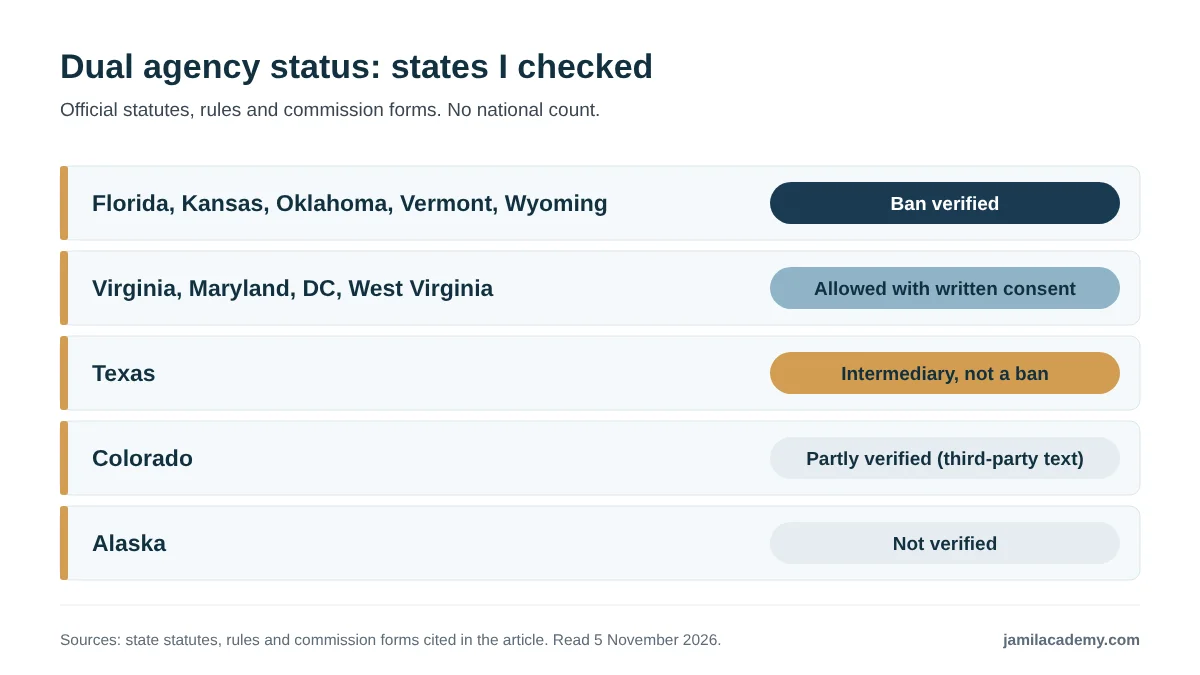
Short answer: it depends on the state. Virginia, Maryland, DC and West Virginia allow it with written consent. I verified a ban in the official text of five states: Florida, Kansas, Oklahoma, Vermont and Wyoming. I did not research every state, so I give no national count.
| State | Status in my research | What the text says | Citation |
|---|---|---|---|
| Florida | Ban verified | "A real estate licensee may not operate as a disclosed or nondisclosed dual agent." | Fla. Stat. § 475.278(1)(a), 2026 Florida Statutes |
| Kansas | Ban verified | "A licensee shall not act as a dual agent or in a dual capacity of agent and undisclosed principal in any transaction." | K.S.A. 58-30,103(a) |
| Oklahoma | Ban verified | "a broker shall not be an agent, subagent, or dual agent and an offer of subagency shall not be made to other brokers." | 59 O.S. § 858-360(B), in an Oklahoma Real Estate Commission archive document "Amended as of November 1, 2013" |
| Vermont | Ban verified | Firms and their licensees shall not "practice dual or limited agency, acting as agent for both a buyer and seller in the same transaction." | Vermont real estate rules 4.3(d)(1) and 4.4(e)(1) |
| Wyoming | Ban verified | "A licensee shall not establish dual agency with any seller or buyer." | W.S. 33-28-302(o), as amended by the 2009 act (SF0110), effective July 1, 2009 |
Sources: the statute, rule and commission pages named in the table, read 5 November 2026.
Colorado, Texas and Alaska: handle with care
- Colorado (partly verified): the official 2026 table of contents lists "12-10-406. Dual agent." The text I could read was a third-party copy saying "A broker shall not establish dual agency with any seller, landlord, buyer, or tenant."
- Texas (not a ban): Texas uses an intermediary. The Texas Real Estate Commission form IABS 1-2 says a broker acting "AS AGENT FOR BOTH - INTERMEDIARY" must "first obtain the written agreement of each party to the transaction."
- Alaska (not verified): it often appears on ban lists. The official statute page did not load for me, and the third-party text I read sets a one-party rule with a "neutral licensee" exception. I do not list it as a ban.
Sources: Colorado official C.R.S. 2026 Title 12 table of contents and [third party] colorado.public.law; TREC form IABS 1-2 (11-03-2025); [third party] Justia, Alaska Statutes § 08.88.600 (2017 edition), read 5 November 2026.
A ban does not mean nobody can help both sides
Every ban state on my list allows some other way of working with both parties. In Oklahoma, "A broker may provide brokerage services to one or both parties in a transaction." Kansas allows transaction brokers and designated agents. A ban means no dual agency, not no help.
Sources: Oklahoma 59 O.S. § 858-355.1(B); K.S.A. 58-30,103, read 5 November 2026.
My view: be wary of neat counts of ban states. Texas and Alaska often appear on those lists. Texas did not hold up, and I could not verify Alaska.
Dual agency in Virginia: consent, timing and the model disclosure
Short answer: in a residential deal, Virginia allows dual agency or dual representation only with the written consent of all parties, given after written disclosure. Consent is due at the earliest practical time, with outside deadlines tied to the offer.
Code of Virginia § 54.1-2139(A)
A dual agent has an agency relationship with the clients. A dual representative "has an independent contractor relationship under the brokerage agreements with the clients."
Source: Code of Virginia § 54.1-2139, read 5 November 2026.
When consent is due: 18VAC135-20-220
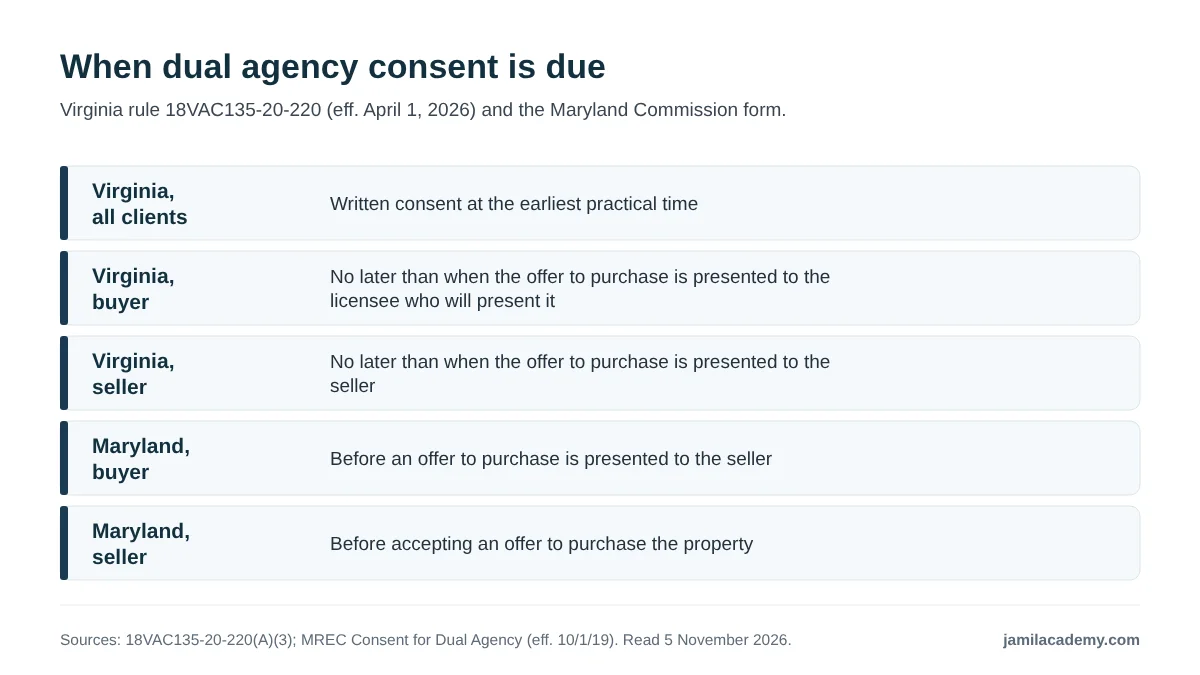
The Real Estate Board's regulation, as amended effective April 1, 2026, sets the timing. A dual or designated agent or representative "must obtain the written consent of all clients to the transaction at the earliest practical time."
It then sets two outside deadlines. Disclosure and consent must come from "(i) the buyer" "not later than the time an offer to purchase is presented to the licensee who will present the offer" "to the listing agent or seller."
And from "(ii) the seller not later than the time the offer to purchase is presented to the seller." In plain terms, the buyer signs no later than handing the offer to the agent who will present it, and the seller no later than receiving it.
Source: Virginia Administrative Code 18VAC135-20-220 (A)(3), eff. April 1, 2026, read 5 November 2026.
Separately, every brokerage relationship must be disclosed in writing no later than "the time specific real estate assistance is first provided" (18VAC135-20-220(A)(2) and § 54.1-2138).
A disclosure inside the contract does not count
Virginia presumes consent "as against any client who signs a disclosure as required in this section." But the disclosure is not valid if it is only "given in a purchase agreement, lease, or any other document related to a transaction." As I read it, the client needs a separate disclosure to sign.
The model disclosure language
I found no Real Estate Board form on an official page. Instead, Virginia law sets out model disclosure language under the heading "DISCLOSURE OF DUAL AGENCY OR DUAL REPRESENTATION IN A RESIDENTIAL REAL ESTATE TRANSACTION." Three lines in it define the job:
- The licensee "may not disclose to either client any information that has been given to the dual agent or representative" "within the confidence and trust of the brokerage relationship."
- "the licensee cannot advise either party as to the terms to offer or accept in any offer or counteroffer."
- "the licensee may have advised one party as to such terms prior to the commencement of dual agency or representation."
Source: Code of Virginia § 54.1-2139(D) and (H), read 5 November 2026. I did not check Virginia REALTORS forms.
Designated agents and representatives
Under § 54.1-2139.1, a "principal or supervising broker may assign different licensees affiliated with the broker" to the buyer and the seller. The broker "shall be considered a dual agent or representative."
Designated agents may not disclose, "except to the affiliated licensee's broker, personal or financial information" about their client, unless "the client consents in writing to the release of such information."
Commercial deals and changes mid-deal
Commercial dual agency is a different section, § 54.1-2139.01, which also requires the written consent of all clients and has its own model form. A mid-deal change must be disclosed "in writing to all clients and customers already involved" (§ 54.1-2138(C)).
If a client refuses, "a licensee may withdraw, without liability, from representing a client who refuses to consent."
Sources: Code of Virginia §§ 54.1-2138, 54.1-2139(G), 54.1-2139.01 and 54.1-2139.1, read 5 November 2026.
My view: the buyer deadline is the easier one to miss, because it comes first. Have the dual agency disclosure signed before you write the offer, not at the kitchen table after.
Dual agency in Maryland: the broker is the dual agent
Short answer: in Maryland, only the broker, or the broker's designee, can be the dual agent, and only with the written informed consent of all parties. The broker assigns a separate intra-company agent to each side.
A licensed broker "may not act as a dual agent in this State" except with "the written informed consent of all parties to a real estate transaction." The dual agent then assigns an agent to each side. Those are the intra-company agents, and "an intra-company agent may not disclose confidential information."
Source: Md. Code, Bus. Occ. and Prof. § 17-530.1 (a) and (b), read 5 November 2026.
One person cannot hold both roles
The statute is direct: "A dual agent may not also act as an intra-company agent in the same real estate transaction." As I read it, the agent working with the seller cannot also be the dual agent. That role sits with the broker or designee.
What the consent must say
Section 17-530.1(c) lists statements the written consent must include. Among them:
- "a dual agent may not disclose confidential information to the buyer or seller in the same real estate transaction;"
- Without the seller's authorization, the agents may not "tell a buyer that the seller will accept a price lower than the listing price." The reverse applies to a buyer willing to pay more.
- "a dual agent may not disclose the motivation of a buyer or seller" and "may not disclose any facts that lead the seller to sell;"
- "the buyer or seller does not have to consent to the dual agency;" and "the buyer or seller has voluntarily consented to the dual agency;"
The consent must also "include an affirmation that identifies the property and the buyer." Any financial bonuses the broker offers its agents for the sale or lease must be disclosed to each party.
When the Maryland form is signed
The Commission's "Consent for Dual Agency" form says the buyer consents "before an offer to purchase is presented to the seller." The seller consents "before accepting an offer to purchase the property." The statute ties the affirmation to signing the contract, so the form's timing is the practical deadline.
Earlier still, the agency disclosure, "Understanding Whom Real Estate Agents Represent," must come "not later than the first scheduled face-to-face contact with the seller or lessor." It must explain "the possibility that a dual agency may arise in a real estate transaction."
Sources: MREC Consent for Dual Agency (eff. 10/1/19); MREC "Understanding Whom Real Estate Agents Represent" (Rev. 10/14/2025); Md. Code §§ 17-530 and 17-530.1, read 5 November 2026.
If a party refuses: the statute and the form differ
The statute says a broker "may withdraw from representing a client who refuses to consent to a disclosed dual agency." The Commission form is firmer: "If either party refuses to consent in writing to dual agency, the real estate broker must terminate" the brokerage relationship for that property.
I cannot settle that difference here. Follow your broker's policy, and get legal advice before a refusal plays out.
Inside the brokerage, an intra-company agent may share confidential information with the broker, but "the broker or dual agent may not disclose that confidential information to the other party."
Sources: Md. Code §§ 17-530.1(e)(1) and 17-532; MREC Consent for Dual Agency, read 5 November 2026.
For the licensing side, see my guide to getting a Maryland real estate license.
My view: Maryland's structure is clear. Each client keeps an agent, and the dual role sits with the broker.
Dual representation in DC: what the code requires
Short answer: DC uses the term "dual representative," and it requires the written consent of all clients. I found no dual-specific deadline in the code.
D.C. Code § 42-1703(i)(1)
Consent "shall be presumed to have been given as against any client who signs a disclosure." The code's model form is headed "DISCLOSURE OF DUAL REPRESENTATION." It says the licensee "represents more than one party in this real estate transaction as indicated below."
The licensee "may not disclose to either client or such client's designated representative any information" given by the other client in confidence.
Source: D.C. Code § 42-1703 (latest amendment D.C. Law 12-81, Mar. 24, 1998), read 5 November 2026.
Designated representatives in DC
"A principal or supervising broker may assign different licensees affiliated with the broker as designated representatives." The supervising broker "shall be considered a dual representative." Designated representatives may share personal or financial information only with their broker, unless the law requires it or the client consents in writing.
Timing and compensation
The only timing rule I found is the general one. Disclosure comes "in no event later than the time when specific real estate assistance is first provided." DC also has an agency disclosure rule, 17 DCMR 2613, but I did not read its text.
Before a brokerage relationship starts, the licensee must also advise "whether the broker will share such salary or compensation with another broker." A licensee "may withdraw, without liability, from representing a client who refuses to consent."
Sources: D.C. Code § 42-1703(f), (h)(1), (i)(4) and (i)(5); DC Register notice listing 17 DCMR 2613 (June 11, 2010), read 5 November 2026.
Licensing details are in my guide to getting a DC real estate license.
My view: with no dual-specific deadline, get the signed disclosure before you give specific help on the home.
Dual agency in West Virginia: the Notice of Agency Relationship
Short answer: West Virginia allows dual agency with the written consent of all parties, on the Commission's Notice of Agency Relationship form. The form is signed before negotiations begin.
The Commission's rule, 174CSR1 § 16.2, says: "A licensee may not be the agent for both the buyer and the seller without first obtaining the written consent..." The statute lists acting "for more than one party in a transaction without the knowledge and written consent of all parties" as a ground for discipline.
Sources: 174CSR1 § 16.2, in the WV Real Estate Commission Law Book (in effect as of June 4, 2024); W. Va. Code § 30-40-19(a)(7), read 5 November 2026.
The form and its timing
"Every licensee shall disclose in writing, on the notice of agency relationship form promulgated by the commission," whom they represent. "The disclosure shall be made prior to any person signing any contract for representation by a licensee."
The rule adds two timing lines. "Prior to the initiation of negotiations, each licensee's agency form shall be signed by all parties." And it "shall be signed by the licensee and the client at the time the agency relationship is created."
Sources: W. Va. Code § 30-40-26(d); 174CSR1 §§ 16.1 to 16.3, read 5 November 2026.
What the form says
- "The licensee may represent the seller/lessor, the buyer/lessee, or both."
- Checkbox options include "The Seller/Lessor as a Designated Dual Agent," "The Buyer/Lessee as Designated Dual Agent" and "Both the Seller/Lessor and Buyer/Lessee, as a Limited Dual Agent."
- "The licensee is not obligated to reveal to either party any confidential information obtained from the other party."
- The parties "have been provided with signed copies prior to signing any contract."
If a change in agency status makes an earlier disclosure inaccurate, a new one "must be dated and must be acknowledged in writing by all parties" (174CSR1 § 16.3).
Source: WV Real Estate Commission, Notice of Agency Relationship (revised Oct 24, 2024), read 5 November 2026.
Neither the statute, the rule nor the form defines "Limited Dual Agent" or "Designated Dual Agent." Ask your broker how your firm uses each box.
More on the license itself is in my guide to getting a West Virginia real estate license.
My view: a short form is easy to rush. Read every checkbox with the client before anyone signs.
How do the DMV dual agency rules compare?
Short answer: all four DMV jurisdictions allow it with written consent, but the term, the deadline and the form differ. Maryland and Virginia tie consent to the offer, and West Virginia to negotiations.
| Virginia | Maryland | DC | West Virginia | |
|---|---|---|---|---|
| Term | Dual agent or dual representative; designated agent or representative | Dual agent (broker or designee); intra-company agents | Dual representative; designated representative | Form boxes: Limited Dual Agent, Designated Dual Agent |
| Consent | Written consent of all parties after written disclosure | Written informed consent of all parties, plus an affirmation naming the property and buyer | Written consent of all clients | Written consent, on the Commission form |
| Timing | Earliest practical time; buyer by the time the offer reaches the presenting licensee; seller by the time the offer is presented | Form: buyer before the offer is presented to the seller; seller before accepting | No dual-specific deadline found; general disclosure by the time specific assistance is first provided | Before negotiations begin; disclosure before any contract for representation is signed |
| Form | Model language in § 54.1-2139(H); no Board form found | MREC Consent for Dual Agency (eff. 10/1/19) | Model language "DISCLOSURE OF DUAL REPRESENTATION"; no Commission form found | Notice of Agency Relationship (revised Oct 24, 2024) |
| What the agent cannot disclose | Information given in confidence; also cannot advise either party on terms | Confidential information, price flexibility, motivation, negotiating strategy | Information the other client gave in confidence | Not obligated to reveal confidential information from the other party |
Sources: Code of Virginia § 54.1-2139 and 18VAC135-20-220; Md. Code § 17-530.1 and MREC Consent for Dual Agency; D.C. Code § 42-1703; W. Va. Code § 30-40-26, 174CSR1 § 16 and the WV Notice of Agency Relationship, read 5 November 2026.
If you hold licenses in more than one of these jurisdictions, the differences are the trap. When the offer reaches the seller, a Maryland seller can still sign the consent, but Virginia's seller deadline has already arrived.
My view: build your routine around the earliest deadline you work under.
What can a dual agent do, and what can't they do?
Short answer: a dual agent keeps each client's confidences and still discloses material facts where the law says so. In Virginia, the dual agent also cannot advise either party on the terms of an offer or counteroffer.
What a dual agent cannot do
- Share confidences: Virginia, Maryland and DC bar disclosing what one client shared in confidence. West Virginia's form says the licensee "is not obligated to reveal" it.
- Advise on terms (Virginia): "the licensee cannot advise either party as to the terms to offer or accept in any offer or counteroffer."
- Reveal price flexibility (Maryland): the form lists "That the seller would accept a lower price or other terms;" and "That the buyer would accept a higher price or other terms;"
- Reveal strategy or motivation (Maryland): "Anything that relates to the negotiating strategy of a party" or a party's motivation.
What a dual agent can or must do
- Disclose material facts (Maryland): "Dual agents and intra-company agents must disclose material facts about a property to all parties."
- Keep serving the client (Maryland): "Intra-company agents are required to provide the same services to their clients" as in other deals.
- Talk to the broker (Virginia, DC, Maryland): designated agents and intra-company agents may share their client's information with their own broker. In Maryland, the broker "may not disclose that confidential information to the other party."
- Withdraw if a client refuses (Virginia, DC, Maryland): see each section above for the exact wording.
Sources: Code of Virginia §§ 54.1-2139 and 54.1-2139.1; Md. Code §§ 17-530.1 and 17-532, MREC Consent for Dual Agency and "Understanding Whom Real Estate Agents Represent"; D.C. Code § 42-1703; WV Notice of Agency Relationship, read 5 November 2026.
My view: the hardest line is advice. Tell clients what you cannot say before they ask "what should I offer?"
Dual agency disclosure checker
Short answer: pick a jurisdiction, a transaction type and a stage to see the rule I found. Every line comes from the sources quoted in this article.
A summary of the sources in this article, read 5 November 2026. It is not legal advice and does not replace your brokerage's forms or your principal broker's policy.
How the checker works
- Transaction type: changes the Virginia result, because commercial deals fall under § 54.1-2139.01 and the offer deadlines are written for purchases.
My view: use it as a reminder, then open the actual form. It cannot see your brokerage's policy.
What does the NAR Code of Ethics say about dual agency?
Short answer: the NAR Code allows REALTORS® to represent both sides only after full disclosure and informed consent. It also requires agents to raise the possibility of dual agency when they sign a listing or buyer agreement.
| Provision | What it says (2026 Code) |
|---|---|
| Standard of Practice 1-5 | "REALTORS® may represent the seller/landlord and buyer/tenant in the same transaction only after full disclosure" ... "with informed consent of both parties" |
| Standard of Practice 1-12 | "When entering into listing contracts, REALTORS® must advise sellers/landlords of:" ... "any potential for listing brokers to act as disclosed dual agents, e.g., buyer/tenant agents." |
| Standard of Practice 1-13 | "When entering into buyer/tenant agreements, REALTORS® must advise potential clients of:" ... "any potential for the buyer/tenant representative to act as a disclosed dual agent" |
| Article 7 | "REALTORS® shall not accept compensation from more than one party, even if permitted by law, without disclosure to" ... "the informed consent of the REALTOR®'s client or clients" |
Source: National Association of REALTORS®, 2026 Code of Ethics and Standards of Practice (effective January 1, 2026), nar.realtor/code, read 5 November 2026.
Written buyer agreements since August 2024
NAR's practice change adds a written agreement before touring. "As of August 17, 2024, an MLS Participant 'working with' a buyer is required to enter into a written agreement" "prior to touring a home, including both in-person and live virtual tours."
NAR's explainer ties that agreement to this topic. It suggests: "Consider addressing how MLS Participants resolve potential conflicts of interest" such as "dual agency, designated agency, or transaction brokerage." It also says the terms must be "permissible under state law."
Compensation in that agreement "must be objectively ascertainable and may not be open-ended." For the background, see my explainer on the NAR settlement and what changed for agents.
Source: NAR, "Written Buyer Agreements 101" (published May 31, 2024), nar.realtor, read 5 November 2026.
My view: the written buyer agreement is the natural place to raise dual agency, and SOP 1-13 asks you to mention it then.
How to explain dual agency to a client
Short answer: say who you represent, what changes, what you cannot do, and that the client decides. Then hand over the right form. The wording below is my suggested wording, not a required script, and your broker's policy comes first.
Virginia buyer (my suggested wording)
My suggested wording, based on Code of Virginia § 54.1-2139
If the buyer hesitates: "If you prefer not to consent, tell me, and I will talk with my principal broker about our options." Say "dual representative" if you work as an independent contractor.
Maryland seller (my suggested wording)
My suggested wording, based on Md. Code § 17-530.1 and the MREC Consent for Dual Agency form
Then cover the limits in the statute's terms. Without your authorization, the dual agent may not tell the buyer you would accept a lower price. The dual agent also may not disclose your motivation.
DC and West Virginia (my suggested wording)
- DC: "I would be a dual representative for you and the other party. I can only do that with the written consent of both of you, and I may not share what either of you tells me in confidence."
- West Virginia: "This Notice of Agency Relationship shows whom I represent. If I represent both of you, we check that box and everyone signs before negotiations begin."
Questions clients ask
- "Will you get paid twice?" Answer from your agreements. NAR's Article 7 requires disclosure and informed consent before taking compensation from more than one party.
- "Can I say no?" Yes. In Maryland the form says so directly. In Virginia and DC, the law lets the licensee withdraw from representing a client who refuses.
For the agreement conversation itself, my buyer broker agreement script covers the wording around signing.
My view: say the limit on advice out loud, so the client hears the trade-off from you, not the form.
Pros and cons of dual agency: my view
Short answer, and this is my opinion: dual agency can work when both clients understand the limits, but it costs each client some advocacy.
Possible upsides (my view)
- A buyer who wants a home your brokerage lists can still work with the brokerage they chose.
- Designated agency in Virginia and DC, and intra-company agents in Maryland, let each client keep an agent of their own.
- The required disclosures put the limits in writing.
Real downsides (my view)
- In Virginia, the dual agent cannot advise either party on the terms to offer or accept. That is a large part of what clients hire an agent for.
- Clients may suspect the agent prefers the deal that pays the brokerage on both sides, even when that is not true.
- Different deadlines in each jurisdiction make a missed signature easy.
My view: offer it only when the client clearly understands the trade-off, and step back when a client needs hard negotiating advice. Your principal broker should know before any dual deal moves forward.
What I could not verify
These are the gaps I hit.
- How often dual agency happens. I found no NAR or official figure for the share of deals with one agent or brokerage on both sides, so I give none.
- A national count of ban states. I did not research every state.
- Alaska. The official statute page did not load; the ban is not verified.
- Colorado and Texas statute text on official sites. I relied on a section title and the TREC form.
- Wyoming's current code. I verified the ban in the 2009 enrolled act, not the current codified section.
- Virginia's 2025 amendments. I did not determine what they changed, and I did not check Virginia REALTORS forms.
- Maryland § 17-533 and COMAR 09.11.08. The statute page returned "File Not Found" twice; I did not read the regulation.
- DC's 17 DCMR 2613 text and any DC Real Estate Commission dual representation form.
- West Virginia's definitions of "Limited Dual Agent" and "Designated Dual Agent."

Frequently asked questions
What is dual agency in real estate?
One licensee or brokerage represents both buyer and seller, or landlord and tenant, in the same deal. Where it is allowed, the clients must give written consent.
Is dual agency legal?
It depends on the state. Virginia, Maryland, DC and West Virginia allow it with written consent. Florida, Kansas, Oklahoma, Vermont and Wyoming ban it in the official text I read.
Is dual agency banned in Texas?
No. Texas does not use dual agency. A broker who represents both sides acts as an intermediary, with the written agreement of each party, per the Texas Real Estate Commission form IABS 1-2.
When must a Virginia agent get dual agency consent?
At the earliest practical time. The buyer's outside deadline is when the offer reaches the licensee who will present it. The seller's is when the offer is presented to the seller.
Who is the dual agent in Maryland?
The broker, or the broker's designee. The two affiliated agents are intra-company agents, and one person cannot be both in the same transaction.
Can a dual agent negotiate for either side?
In Virginia, a dual agent cannot advise either party on the terms to offer or accept. In Maryland, a dual agent may not reveal price flexibility, motivation or negotiating strategy.
Can a client refuse dual agency?
Yes. Maryland's form says "I understand that I do not have to consent to a dual agency." Virginia and DC let the licensee withdraw, without liability, from representing a client who refuses.
What is the difference between dual agency and designated agency?
In Virginia and DC, the broker assigns a different licensee to each client as a designated agent or representative. The supervising broker is then considered a dual agent or representative.
Saad Jamil is a top 1 percent Realtor with Samson Properties in Chantilly, Virginia, licensed in Virginia, DC, Maryland and West Virginia since 2013, with more than $500 million in career sales and 900+ homes closed. Reviews and closed sales are on his Zillow profile. He runs Jamil Academy, which sells training to agents. This article is general information, not legal or financial advice, checked on 5 November 2026.
Free: 5 Ways to Get More Listings Without Cold Calling
Five lead strategies that work without cold calls or ad spend, from an agent with $500M sold and 900+ homes closed.
No spam. Unsubscribe any time.
Your Coach