Century 21 Commission Split (2026): Real Plans and the 6% Fee
Oct 13, 2026
There is no single Century 21 commission split. Every Century 21 office in the US is independently owned, and each one sets its own split, cap and fees.
The published plans I found start at 70 to 90 percent for the agent, and some reach 100 percent. Several also charge a 6 percent Century 21 fee on each commission. At least one office says it pays that fee for you.
This guide shows the real plans, how the 6 percent fee changes your check, and what you keep at three income levels. It also covers Compass, which bought Century 21's parent in January 2026. Sources were checked on 13 October 2026.
Where I stand: I am a Realtor with Samson Properties, not Century 21, and I run Jamil Academy, which sells training to agents. No brokerage paid to be mentioned. The one product block near the end is my own.
Quick answer
- The split: set by each independently owned office. Published plans run from 70 percent for new agents to 90 percent, with 100 percent after a cap at some offices.
- The 6 percent fee: three offices I found charge agents a 6 percent Century 21 fee. One says it absorbs the fee instead.
- Who pays it, and when: on $100,000 and a 90 percent split, you keep $90,000 if the office absorbs the fee, $84,600 if it comes off the top and $84,000 if it comes from your share.
- Four real plans: on $100,000 of commission, yearly costs ran from $11,068 to $36,350 in my math.
- Ownership: Compass completed its purchase of Anywhere Real Estate on 9 January 2026. I found no announced change to Century 21 fees or splits since.
- How does the Century 21 commission split work?
- What does Century 21 charge its offices?
- Do Century 21 agents pay the 6% franchise fee?
- What do real Century 21 offices offer agents?
- How much do you keep on each plan?
- Which Century 21 plan keeps more for you?
- Is there a standard 70/30 Century 21 split?
- What changed when Compass bought Century 21?
- How big is Century 21 in 2026?
- What do Centurion awards mean for your income?
- How does Century 21 compare with Coldwell Banker, RE/MAX and Keller Williams?
- What do Century 21 offices in Virginia, Maryland and DC offer?
- What should you ask a Century 21 office before you join?
- What I could not verify
- Frequently asked questions
How does the Century 21 commission split work?
Short answer: the office you join sets the split. Century 21 does not publish one split for every agent.
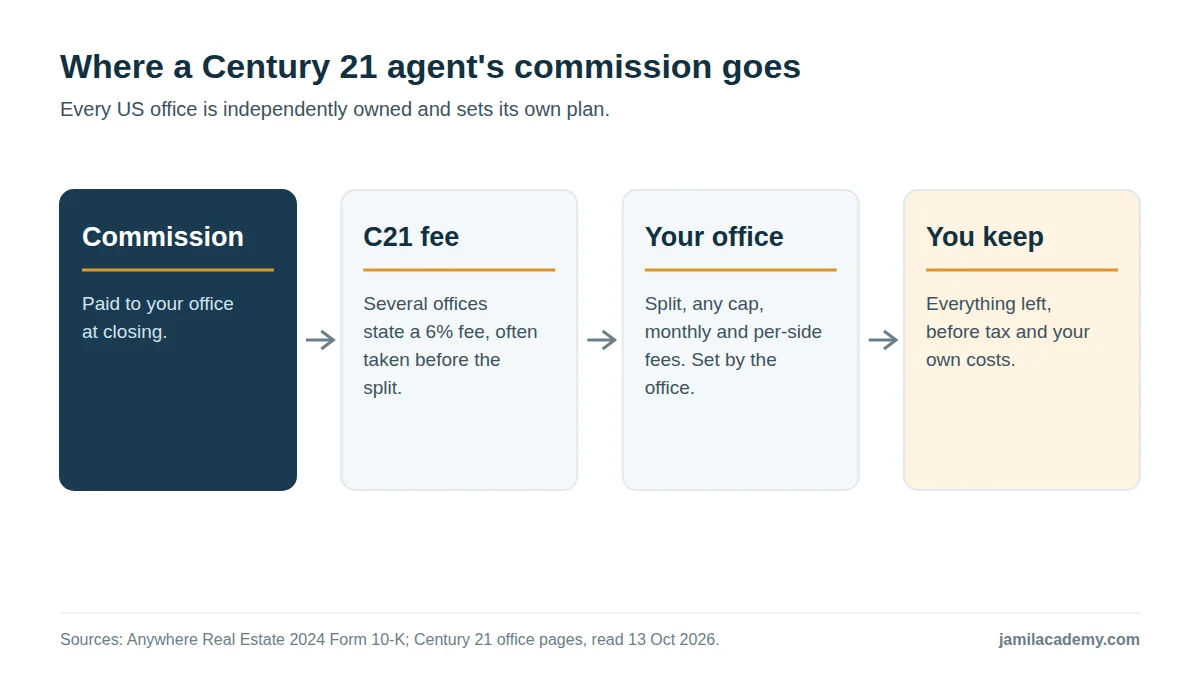
Century 21 offices are franchises. The parent company's last annual report said its franchisees "are independent business operators." The report named its company-owned brokerages, and Century 21 was not among them.
Century 21's CEO, Mike Miedler, put it simply to HousingWire in June 2025: "Our offices are independently owned and operated."
So the owner of your office decides the split, any cap, the monthly fee and every transaction fee. The owner also decides who pays the brand's fee.
Anywhere Real Estate Form 10-K for 2024, filed with the SEC in February 2025.
Find out who owns your office
Because every office is a franchise, the owner's company is the one you sign with. Ask for the company name, the managing broker and how long the owner has held the franchise.
Those answers tell you who sets your plan, who can change it and how stable the office is.
Three numbers decide what you keep
- The split. Your share of each commission. Some plans rise once your gross commission income, or GCI, passes a set level.
- The 6 percent fee. Whether you pay it, and whether it comes out before or after the split.
- Fixed fees. Monthly fees, per-side fees, E&O and risk management fees. They cost the same in a slow year.
If commission splits are new to you, start with how agents get paid. It explains how a commission moves from closing to your account.
Why the headline split can mislead
A 90 percent split sounds generous. But if a 6 percent fee comes off the top first, you keep 90 percent of 94 percent. That is 84.6 percent of the commission, before any other fee.
My view: treat the split as one line of a fee schedule, not the offer itself. Ask for the whole schedule in writing.
What does Century 21 charge its offices?
Short answer: a royalty on the office's gross commission income. The parent's annual report describes a rate that starts at 6 percent, then falls with volume incentives.
Anywhere's 2024 report says: "Certain of our brands utilize a volume-based incentive model with a royalty fee rate that is initially equal to 6% of the franchisee's gross commission income."
The report does not name those brands. Century 21 offices, though, describe a 6 percent Century 21 fee in their own plans. That fits the 6 percent model.
How the volume incentive works
- It starts at 6 percent of the office's gross commission income.
- Larger offices earn an incentive that cuts the rate. The report calls it a "progressive percentage" of annual gross revenue.
- The incentive varies by brand. No maximum or schedule is published.
So a large Century 21 office may pay the brand less than 6 percent on average. A small one may pay close to the full rate.
Marketing fund contributions
Franchisees also make "monthly contributions to marketing funds."
The sections of the 2024 report I read give no percentage for these.
Who pays the royalty
The royalty is owed by the office under its franchise agreement. The parts of the annual report I read do not say agents pay it. Whether you do depends on your office's plan.
Source: Anywhere Real Estate 2024 Form 10-K, Franchise Group section.
Why the royalty matters even if you never pay it
Your office pays its royalty, rent, staff and marketing out of its share of each commission. The more it owes the brand, the less room it has for a generous split.
That is one reason large offices can offer better terms. They earn bigger volume incentives, so their effective royalty is lower.
My view: if an office charges you a flat 6 percent while its own rate falls with volume, the difference is part of its income. That is legal and common. Just know it when you negotiate.
Do Century 21 agents pay the 6% franchise fee?
Short answer: at three of the offices I found that publish a plan, yes. Three of the offices I found charge agents 6 percent. One says it absorbs the fee.
| Office | What the office says |
|---|---|
| CENTURY 21 Signature Real Estate, Ankeny, Iowa | Lists a "6% C21® franchise fee" on both of its plans. |
| Century 21 Carioti, Florida | "90/10% COMMISSION SPLIT & 6% FRANCHISE FEE." |
| CENTURY 21 Redwood Realty, Ashburn, Virginia | "All splits are calculated after 6% CENTURY 21® fee and referral fees, if applicable." |
| Century 21 BE3, Florida | "Franchise Fees- None." Its home page says it absorbs the cost. |
| CENTURY 21 North Homes Realty, Washington and Oregon | Says there is a royalty fee, paid only when you close. No percentage given. |
Sources: each office's plan or policy page, read 13 October 2026. Dates are in the plans table below.
Before or after the split?
Of these offices, only Redwood says in writing that the fee comes off first. Here is what that means on $100,000 of commission and a 90 percent split.
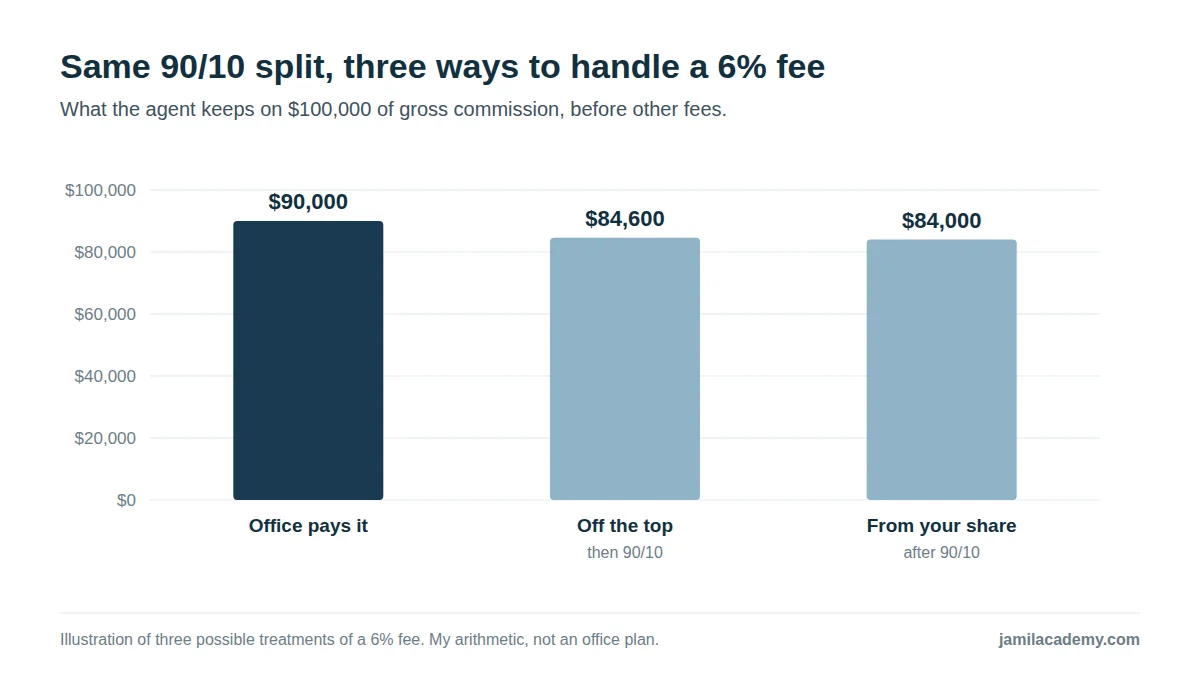
- The office pays it: you keep $90,000.
- Off the top, then the split: you keep $84,600.
- From your share, after the split: you keep $84,000.
What it looks like on one commission
Take a $10,000 side with a 90 percent split and the fee taken off the top:
| Line | Amount |
|---|---|
| Gross commission | $10,000 |
| Century 21 fee, 6% | $600 |
| Amount split | $9,400 |
| Office share, 10% | $940 |
| Your share, 90% | $8,460 |
Then subtract any per-side fee your plan charges. Check your first statement against your plan, line by line.
My view: an office that absorbs the fee is offering you roughly 6 points of commission. Compare its other fees carefully, because the money has to come from somewhere.
What do real Century 21 offices offer agents?
Short answer: 70 to 90 percent to start, with fees from $0 to $350 a month. Some plans reach 100 percent after a cap.
Most Century 21 office sites I checked do not publish their plans. These printed real terms on a page I could open.
| Office | Split | Fees | Page date |
|---|---|---|---|
| Signature Real Estate, Ankeny, Iowa: Relentless plan | 90% until $200,000 of GCI, then 100% | $350 a month, $295 per side, 6% C21 fee | July 2022 |
| Signature Real Estate: Kickstart plan | 70% | $100 a month, $95 per side, 6% C21 fee | July 2022 |
| Carioti virtual division, Florida | 90/10 | $149 a month, $149 per closing side, $395 transaction fee, a $598 yearly risk management fee paid in two $299 installments, 6% franchise fee | No date shown |
| BE3, Florida | 90/10 | $89 a month ($124 in Pensacola, with MLS dues). Transaction fee of $149 to $399, "Typically paid for by client." No franchise fee. | No date shown |
| HomeStar, location not shown | 80%, then 90% after $60,000 of GCI in a calendar year | No monthly fee. $395 a year for insurance. | December 2019 |
| Redwood Realty, Ashburn, Virginia: cap plan | 100% after a cap on company dollar, for the rest of the cycle | 6% C21 fee taken before the split. Cap amount not published. | August 2025 |
Sources: iowac21career.com, century21carioticareers.com/virtual, joinc21be3.com, joinhomestar.com/faqs and policymanual.c21redwood.com, read 13 October 2026.
Read the fine print on each plan
- Carioti's page is inconsistent. Its body says 90/10, but its page summary mentions 80 and 90 percent. Ask which applies.
- Carioti lists two transaction charges. The page does not say whether both apply to every closing, or who pays the $395.
- BE3's transaction fee includes E&O, and the office says the client typically pays it. If you end up paying, add it back in.
- BE3's home page mentions a cap but gives no amount. If one applies, BE3 keeps you more at higher incomes than the tables show.
- Redwood's cap plan is for experienced agents only. Deals from Redwood's own leads are split 50/50 and do not count toward the cap.
- HomeStar's page is from 2019. It is the oldest here. Treat it as an example, not a current offer.
Signature's Relentless plan also notes lower per-side fees on cheaper homes: $255 for a $100,000 to $150,000 sale and $195 under $100,000.
What a new-agent plan trades away
Signature's two plans show the trade. Kickstart cuts the monthly fee from $350 to $100 and the per-side fee from $295 to $95. In return, your split drops from 90 to 70 percent.
In my math (fee off the top, $10,000 per side), Kickstart costs less only below about $17,900 of gross commission a year. Above that, Relentless leaves you more. At $60,000, the difference is $7,080.
My view: the plan with the lowest monthly fee is not always the cheapest. Price a whole year, including the 6 percent fee, before you decide.
How much do you keep on each plan?
Short answer: on $100,000 of commission, between $63,650 and $88,932. The fee treatment and the starting split drive most of the gap.
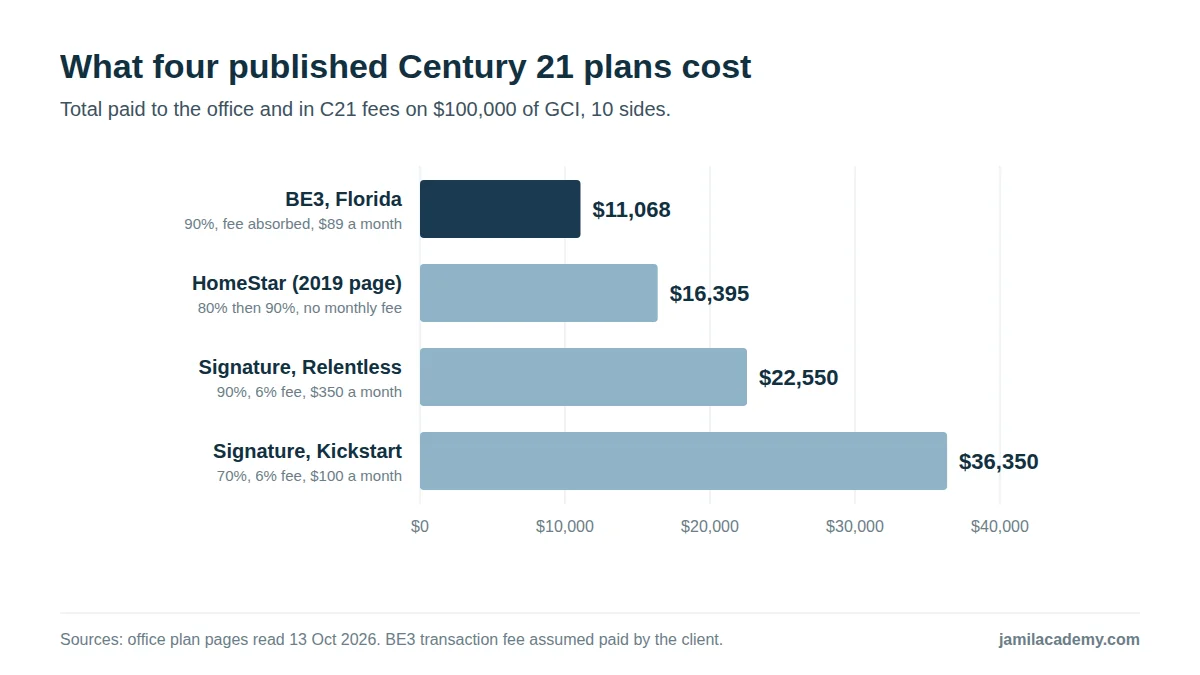
| Gross commission | BE3 | HomeStar (2019) | Relentless | Kickstart |
|---|---|---|---|---|
| $60,000 | $52,932 | $47,605 | $44,790 | $37,710 |
| $100,000 | $88,932 | $83,605 | $77,450 | $63,650 |
| $150,000 | $133,932 | $128,605 | $118,275 | $96,075 |
What you keep after the split and the listed fees, before tax and your own costs. $10,000 of commission per side.
How I did the math
- The 6 percent fee comes off the top on the Signature plans, as Redwood describes. Signature does not say when it is taken.
- BE3's transaction fee is paid by the client, as the office says is typical.
- HomeStar's page lists no franchise fee, so none is included. If one applies, its cost rises by roughly $5,000 to $6,000 on $100,000.
- Carioti and Redwood are left out. Carioti's fees are unclear, and Redwood does not publish its cap.
What the gap is made of
BE3 and Relentless have the same 90 percent split. On $100,000, the difference of $11,482 comes from the $6,000 franchise fee, $3,132 more in monthly fees and $2,950 in per-side fees, less a $600 smaller office share.
Kickstart costs the most because it starts at 70 percent. That is a plan for new agents, and the office presumably offers more support in return.
What a cap would change
Here is a made-up example, not any office's plan. Take a 90/10 split with the 6 percent fee off the top, on $150,000 of commission.
Without a cap, the office share is $14,100. With a $10,000 cap on that share, you keep $4,100 more. The fee still comes out in full.
That is why Redwood's unpublished cap matters. You cannot compare a capped plan until you know the cap in dollars.
My view: if you are new, judge Kickstart-style plans on the help you get, not the cost alone. If you are experienced, the fee and the cap matter more.
Which Century 21 plan keeps more for you?
Short answer: the one that leaves more after a full year of fees. Enter your own income and each office's terms.
The calculator starts with two published plans: Signature's Relentless plan and BE3's plan. Change any number to match the offers in front of you.
Starting values are two published plans in this guide. Use the step-up fields for a split that rises with GCI, and leave them at 0 for a flat split. The cap applies to the office share only. Fees are before tax and your own business costs.
How to use it
- Ask how the 6 percent fee is charged, then pick the matching option.
- Use last year's GCI. A plan should work in an ordinary year, not only a great one.
- Add every yearly fee, such as risk management or E&O, to the yearly box.
- Change the side size if your average commission per side is far from $10,000.
Board, association and MLS dues are usually the same wherever you hang your license, so they are left out. I cover them in what it costs to be a Realtor.
Is there a standard 70/30 Century 21 split?
Short answer: not one that I could verify. Century 21 does not publish a required starting split.
One office's blog, CENTURY 21 Advantage Realty, says: "All C21 Franchisees start at a 70/30 split." I found no franchisor source that says this.
The plans above contradict it. HomeStar started transferring agents at 80 percent. BE3 and Carioti advertise 90/10. Signature's 70 percent plan is one of two options.
Many recruiting sites also quote ranges like 50/50 to 70/30 for Century 21. The ones I read gave no source, so I left them out.
Where a 70/30 start does make sense
A lower split can be fair when the office gives you real support: training, leads, a mentor on your first deals or a team. Those cost the office money.
I weigh that trade in should you join a real estate team. The same logic applies to a new-agent plan.
My view: a 70/30 plan should come with a written path to a better split. Ask when and how you move up.
What changed when Compass bought Century 21?
Short answer: the owner changed. I found no announced change to Century 21 royalties, fees or splits through 13 October 2026.
Compass's second quarter 2026 report says: "On January 9, 2026, the Company completed its acquisition of Anywhere Real Estate Inc."
Anywhere owned Century 21, Coldwell Banker and other brands. A Century 21 release dated 16 April 2026 says the company "operates within Compass International Holdings."
Source: Compass Form 10-Q for the quarter ended 30 June 2026, Note 1.
What Compass and Century 21 have said
- On closing day, Compass CEO Robert Reffkin said: "Our affiliates will continue to have the same independence they've always had." Real Estate News reported this on 9 January 2026.
- On the brand, Inman reported on 1 May 2026 that Century 21 "isn't about to disappear" under its new owner.
- On technology, HousingWire reported on 20 May 2026 that all Compass International Holdings brands, Century 21 included, are slated to move onto Compass technology. Miedler said it is "extremely important that we earn the agents' trust in the platform."
- On timing, Compass says it plans to roll out its platform to franchise agents beginning in the first quarter of 2027.
Century 21 also brought back its "legacy gold" yard signs, HousingWire reported. None of these announcements included a new fee or split.
What franchise offices pay per side
Compass reports a net royalty per franchise side. It was $505 in the second quarter of 2026, against $591 a year earlier. In the first quarter it was $440, against $660.
Those year-earlier figures cover only Compass's pre-merger franchise network, Christie's International Real Estate. So the comparison is not like for like.
Compass says the drop came mainly from adding Anywhere's franchise sales, which have lower average prices. On its pro forma basis, the second-quarter figure rose 5.4 percent from $479.
The franchise network closed 203,207 transactions worth $120.0 billion in the second quarter, HousingWire reported.
These figures cover Compass's whole franchise network, not Century 21 alone. They show what offices pay on average, not what any office charges you.
Is Century 21 covered by the commission settlement?
Yes. Anywhere agreed to pay $83.5 million to settle the Burnett, Moehrl and Nosalek commission cases. The court gave final approval on 9 May 2024.
Anywhere said the deal releases "all subsidiaries, brands, affiliated agents, and franchisees." Franchisees, including Century 21 offices, were encouraged but not required to adopt the practice changes.
What to ask about the transition
- Will the office's fee schedule change when the new platform arrives?
- Will any technology or brand fee be passed to agents?
- Does the office's franchise agreement renew soon, and on what terms?
My view: watch for fees tied to the 2027 technology rollout. None has been announced, but ask any office whether it plans one.
How big is Century 21 in 2026?
Short answer: more than 124,000 agents in about 11,000 offices. That is Century 21's own count, across 79 countries and territories, from April 2026.
Founded in 1971
Century 21's corporate profile says the brand has been in business "Since 1971." Franchising.com reported that Art Bartlett and Marsh Fisher opened it that year in Santa Ana, California.
Still recruiting at scale
In June 2025, Miedler told HousingWire: "We're bringing in about 1,000 new agents a month." He also said the brand was converting 30 to 50 new offices a year.
Those are the CEO's figures from before the Compass deal. I found no update from 2026.
Why size does not set your split
A large network helps with name recognition and referrals between offices. But each office sets its own plan.
My view: ask the office for its own numbers, such as agent count, average sides per agent and agent turnover. The brand's totals tell you little about your office.
What do Centurion awards mean for your income?
Short answer: they recognize production, and they do not change your split by themselves. Ask your office whether any plan is tied to them.
Century 21's production awards include CENTURION, Double CENTURION and Grand CENTURION. There are also Masters awards: Ruby, Emerald and Diamond.
A Century 21 Redwood help page says awards are "Based on AGC/Units total for the calendar year." It does not publish the thresholds.
A 2024 WilmingtonBiz item was based on a local office's news release. It described Grand Centurion as going to "the top 1% of producers in the Century 21 system." I found no franchisor source for the cutoffs.
My view: awards help your marketing. If an office links a better split to an award level, get that link in writing.
How does Century 21 compare with Coldwell Banker, RE/MAX and Keller Williams?
Short answer: the big franchise brands all leave the split to the office. They differ in how the brand gets paid.
| Brand | Who sets your split | What the brand charges |
|---|---|---|
| Century 21 | Each office | A royalty from the office, starting at 6% under the parent's volume model. Several offices pass a 6% fee to agents. |
| Coldwell Banker | Each office | A tiered royalty model offered since 2021, from 5.5% down to a 3% minimum. |
| RE/MAX | Each office. The brand recommends 95/5. | Fixed monthly franchise fees from the office, based on agent count. Annual dues from agents ($410 on the office pages I read), and a broker fee of generally 1%. |
Sources: Anywhere Real Estate 2024 Form 10-K; RE/MAX Holdings 2025 Form 10-K; office pages read 12 and 13 October 2026.
Percentage fees versus fixed fees
A percentage fee grows with every sale. A fixed fee costs the same at five deals or fifty. Percentage fees are gentler in a slow year and costlier in a big one.
Where Keller Williams, eXp and Real fit
All three use annual caps. eXp and Real publish national caps. At Keller Williams, each market center sets its own. I run the numbers at 12, 24 and 36 deals in eXp vs Keller Williams vs Real.
Which model suits which agent
- Newer or part-time agents often pay less under percentage fees and low monthly fees.
- Steady mid-level producers should look hard at the fee treatment and per-side fees.
- High producers usually gain most from a cap, if the cap is published and reasonable.
My view: compare what you keep at your real income. A brand's fee model matters less than your own office's plan.
What do Century 21 offices in Virginia, Maryland and DC offer?
Short answer: one large local office publishes how its plan works, but not the dollar cap. Ask each office for its schedule.
CENTURY 21 Redwood Realty
Redwood started in 2002 "in an Ashburn, VA basement," its site says. It lists more than 600 agents and 12 offices, serving DC, Maryland, Virginia, West Virginia and Pennsylvania.
Its policy manual, updated August 2025, describes a cap plan for experienced agents. After the cap, your split moves to 100 percent for the rest of the cycle.
The cap is "a pre-determined amount of Company dollar," with no amount published. Splits are figured after the 6 percent Century 21 fee.
Two other rules matter. Redwood leads pay 50/50 and do not count toward the cap. Relocation leads pay 50/50 after a relocation fee of 41 percent or more.
CENTURY 21 New Millennium
New Millennium lists offices in Virginia, Maryland, DC and West Virginia. Its pages give different counts: 21 to 23 offices, and "900+ agents" or "more than 1,000 agents and staff."
It publishes no split or fee figures. It cites RealTrends rankings of #101 by sales volume and #102 by sides, labeled current as of June 2023.
Adjust the math for local prices
The calculator assumes $10,000 per side. Many Northern Virginia sales pay more. Change the side field so per-side fees reflect your real number of deals.
My view: in this market, ask Redwood or any capped office for the cap in dollars. Without that number, you cannot price the plan.
What should you ask a Century 21 office before you join?
Short answer: ask for the written schedule, then ask about the 6 percent fee. These questions cover what a recruiting call often skips.
- What is my split, and when does it rise? Does it reset each year?
- Is there a cap on the office's share? What is it in dollars, and what counts toward it?
- Do I pay the Century 21 fee? What percent, and is it before or after the split?
- What do I pay each month, and what does that cover?
- What do I pay per side or per transaction? Who pays it, me or the client?
- Are there risk management or E&O fees? How often are they billed?
- How are office leads and relocation deals split? Do they count toward the cap?
- What happens to my pending deals if I leave?
Get every answer in writing
Ask for the fee schedule as a document, not a summary in an email. Read it against your independent contractor agreement before you sign either one.
If the two documents disagree, ask which one controls. Do this before your first closing, not after it.
If this is your first brokerage, weigh training and mentorship too. I cover that in how to choose a brokerage as a new agent.
My view: a good office answers these quickly and in writing. Vague answers on fees are a warning sign.
What I could not verify
These are the gaps I hit while checking sources. Be careful with any page that fills them with a confident number.
- Century 21's exact royalty rate. The annual report says 6 percent for "certain" brands without naming them. Office pages state 6 percent.
- The marketing fund rate. No figure was published.
- The volume incentive schedule. Not published.
- Any company-owned Century 21 office in the US. No source names one.
- Any 2026 change to fees or splits under Compass. None was announced in what I read.
- Cap amounts at Redwood, North Homes and BE3. Not published.
- Centurion award thresholds. Not published by the franchisor.
- A standard 70/30 starting split. Claimed by one office, not confirmed.
- Whether the older plan pages are current. Signature's is from 2022 and HomeStar's from 2019.
- A Century 21 filing for 2025. Anywhere's last annual report covers 2024.

Frequently asked questions
What is the standard Century 21 commission split?
There is no standard split. Each independently owned office sets its own plan. Published plans I found start at 70 to 90 percent, and some reach 100 percent.
Do Century 21 agents pay a 6% franchise fee?
At three offices I found, yes. Signature, Carioti and Redwood state a 6 percent fee. BE3 says it pays the fee itself. Ask your office.
Is the Century 21 fee taken before or after the split?
It depends on the office. Redwood takes it before the split. On a 90 percent split, that leaves you 84.6 percent of the commission.
Does Century 21 have a cap?
Some offices do. Signature's Relentless plan moves to 100 percent after $200,000 of GCI. Redwood has a cap plan but does not publish the amount.
Does Century 21 charge desk fees?
Many offices charge a monthly fee. The published ones I found ranged from $0 to $350 a month.
Is Century 21 owned by Compass?
Yes. Compass completed its purchase of Anywhere Real Estate, Century 21's parent, on 9 January 2026. Offices remain independently owned franchises.
Are Century 21 offices company-owned?
US offices are independently owned franchises. I found no source naming a company-owned Century 21 office in the US.
Can you negotiate your split at Century 21?
Often, because each owner sets the plan. Bring your closed volume and any written competing offer to the conversation.
Is Century 21 good for new agents?
It depends on the office. Some have a new-agent plan, such as a 70 percent split with lower fees. Weigh it against the training you get.
Saad Jamil is a Realtor with Samson Properties in Chantilly, Virginia, licensed in Virginia, DC, Maryland and West Virginia. His sales record and client reviews are on his Zillow profile. He runs Jamil Academy, which sells training to agents. He is not affiliated with Century 21 or Compass. This is general information, checked on 13 October 2026.
Free: 5 Ways to Get More Listings Without Cold Calling
Five lead strategies that work without cold calls or ad spend, from an agent with $500M sold and 900+ homes closed.
No spam. Unsubscribe any time.
Your Coach