Best Real Estate Signs (2026): Yard Signs, Riders and Rules
Oct 05, 2026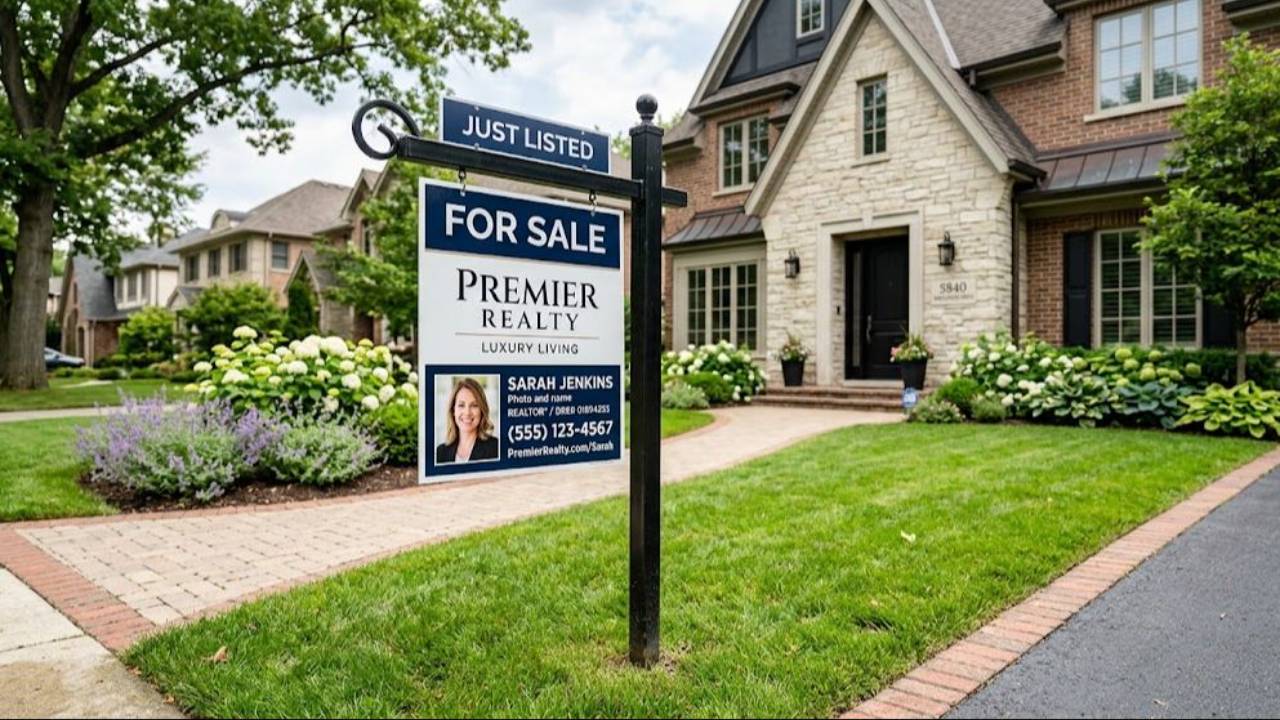
The best real estate sign is the one a driver can read in three seconds, that follows your state's advertising rule, and that the county will not make you take down.
Many sign guides are written by companies that print signs, so they talk about materials and colors. They skip the parts that cost agents money: lettering nobody can read at 25 miles an hour, riders that push a sign over the local size limit, a "Coming Soon" rider that counts as public marketing, and a post hole dug without calling 811.
Below are the four sign setups with real prices, the legibility rules traffic engineers use, a checker for your own sign, what Virginia, Maryland, DC and West Virginia require on it, a rider plan for each stage of a listing, and the permission rules.
Where I stand: I sell in Northern Virginia and run Jamil Academy, which sells coaching. The blocks below sell my own products. I have no deal with any sign company, installer or app named here, and nothing is an affiliate link. This is information, not legal advice.
Quick answer
Best all-round setup: a double-sided 24 by 30 inch panel on a post, set at a right angle to the street, with one rider. Installers around DC charge $55 to $90 per post.
Readability: the federal highway sign manual uses 1 inch of letter height for every 30 feet of reading distance. Three-inch letters are readable from about 90 feet, which is about 2.5 seconds at 25 mph.
What must be on it: the firm's licensed name and office contact in Virginia. Your licensed name and the full brokerage name in Maryland. The company, the responsible broker with the word "Broker," and a phone number in West Virginia.
Size: Fairfax County allows one sign of up to 6 square feet on a single-family lot. A 24 by 30 panel is 5 square feet and each rider adds 1.
Riders: NAR counts a yard sign, Coming Soon rider included, as public marketing, which gives one business day to get the listing into the MLS. Only the listing or selling broker may claim "Sold."
- What a yard sign actually does
- The best real estate signs: four setups and what they cost
- Can a driver read it? The legibility rules
- Check your sign: readability and size
- What to put on the panel
- What your state requires on a yard sign
- Rider strategy: which rider, when
- Permission: the owner, the HOA and the county
- Before the post goes in: call 811
- QR codes and text riders
- When the sign makes the phone ring
- What I could not verify
- Common questions about real estate signs
What a yard sign actually does
Start with what the numbers say, because they are more modest than you might expect. These are from NAR's 2025 Profile of Home Buyers and Sellers.
| Question | Share |
|---|---|
| Buyers who found the home they bought through a yard sign or open house sign | 4% |
| Buyers who used a yard sign as an information source during their search | 32% |
| Sellers whose agent used a yard sign to market the home | 67% |
| Buyers who found their agent from contact details on a sign | 2% |
| Sellers who found their agent from contact details on a sign | 2% |
NAR, 2025 Profile of Home Buyers and Sellers, Exhibits 3-2, 3-6, 4-6 and 7-2 and Chapter 7. I read these in a copy hosted by a state Realtor association, not on NAR's own site, where the full report is sold.
Read together, those five numbers say three things:
- The sign rarely finds the buyer. The internet did that for 52 percent of buyers. The sign did it for 4 percent.
- A third of buyers still look at signs as one source of information.
- The neighbors see it every day. My view is that they are the sign's real audience, because some of them will be the next to sell.
So a yard sign has two jobs. It tells buyers already looking that this is the house and how to reach you. And it tells the street who lists homes here. Both jobs fail if the sign cannot be read from a moving car.
The best real estate signs: four setups and what they cost
There are four common setups. Prices below are from the vendors' own pages on 5 October 2026, for double-sided panels where a panel is included.
| Setup | What it is | Price found | Best for |
|---|---|---|---|
| Panel in a metal frame | A 24 by 30 or 18 by 24 inch panel in an angle-iron frame you push into the ground yourself | Frame $34 to $57; aluminum panel about $73 each when you buy 10 | Agents who place their own signs; townhouses and small yards |
| Post and hanging panel | A 4 by 4 post with an arm, the panel hanging below and riders above or below | Installed and removed for $55 to $90 around DC; a PVC post to own is $127 | Most single-family listings. It sits higher and reads from both directions |
| Corrugated plastic on a wire stake | A light plastic panel, usually 18 by 24 | About $36 each at 10 for a 30 by 24 panel | Short-term signs and riders. It is the least rigid |
| A-frame | A folding frame that stands on pavement | $82 for a plastic A-frame that holds two 24 by 24 panels | Open houses and condos with no lawn |
Oakley Signs & Graphics and BuildASign category pages; Realty SignPost, SignPost Install and My Agent Sign Post price pages. Vendors run promo codes, so your price may differ.
Panel materials
- Aluminum, .040 inch. The standard. One panel from Oakley is $233, but $73 each at ten, so order in batches.
- Aluminum composite, 3 mm. Two thin aluminum faces over a plastic core. Stiffer and a little cheaper: about $63 each at ten.
- Corrugated plastic. The cheapest, about $36 each at ten, and the lightest and least rigid. It suits riders and short-term signs.
- Reflective aluminum. About $137 each at ten. My view: worth considering on an unlit road. Fairfax County does not allow these signs to be illuminated, and reflective is not the same as lit.
Do it yourself or use an installer?
Three installers that publish prices and serve this area charge $55 to $90 per post. At the two with three tiers, the lowest is the post only, and higher tiers store your panels and riders and swap riders during the listing. Those two say the price includes removal. Ask the third.
At eight listings a year, the middle tier at those two costs $480 to $520. For that someone else deals with the post and the hole. The hole matters more than it sounds, as the 811 section below explains.

Can a driver read it? The legibility rules
I found no legibility standard written for real estate signs. Traffic engineers have written one for road signs, and the physics is the same.
Federal Highway Administration, Manual on Uniform Traffic Control Devices, 11th Edition, Section 2A.08
The United States Sign Council uses the same figure for business signs, and adds a reading speed: about half a second per word. Put the two together and you can work out what a driver can take in.
| Capital letter height | Readable from | Time in view at 25 mph | Time in view at 35 mph |
|---|---|---|---|
| 1 inch | 30 feet | 0.8 seconds | 0.6 seconds |
| 2 inches | 60 feet | 1.6 seconds | 1.2 seconds |
| 3 inches | 90 feet | 2.5 seconds | 1.8 seconds |
| 4 inches | 120 feet | 3.3 seconds | 2.3 seconds |
| 6 inches | 180 feet | 4.9 seconds | 3.5 seconds |
Arithmetic from the 30 feet per inch ratio. Speed in feet per second is miles per hour times 1.467. These are ideal conditions: good light and good eyesight.
What that means for a sign
- One-inch type is decoration. A website address, a license line or a slogan in one-inch letters is readable for less than a second from a car.
- Count your words. At half a second a word, 2.5 seconds is five words. The Sign Council counts five letters as a word, so a ten-digit phone number is two.
- Face the traffic. The Sign Council's rule of thumb drops from 30 feet per inch to 10 for a sign that sits parallel to the road. A panel flat against the house loses two thirds of its reading distance.
- Leave space. The Sign Council says empty space "ideally should not be less than 60 percent of the sign or background area."
A Federal Highway Administration handbook puts the limit plainly: in one glance a driver reads at most "three to four familiar words or abbreviations." Design for that.
Check your sign: readability and size
Enter the speed on the street, the height of your main lettering and how many words the sign carries. The checker shows how far away it can be read, how long a driver has, and whether your panel and riders fit the local size limit.
Uses the 30 feet per inch ratio from the federal road sign manual and half a second per word from the United States Sign Council. Local limits as read on 5 October 2026. Nothing you enter leaves this page.
The distances assume good light and good eyesight, so treat them as the best case. If the checker says a driver can read five words, plan for four.
What to put on the panel
A 24 by 30 panel has room for about five things a driver can read. Choose them in this order.
| Priority | What | Size to aim for |
|---|---|---|
| 1 | A phone number that gets answered | The largest thing on the panel: 3 inches or more |
| 2 | Your firm's licensed name | Required in Virginia, Maryland and West Virginia. Large enough to read from the street |
| 3 | Your name | 2 inches or more. Required in Maryland, optional under Virginia's rule |
| 4 | "For Sale" | Can be small, or left to a rider. People know what a sign in a yard means |
| 5 | A QR code or web address | For people on foot. Drivers will not read it |
Design rules that follow from the numbers
- Two typefaces at most, both plain.
- Strong contrast. In one published study of printed text, black on white was "the most legible contrast combination for all age groups." Dark letters on a light panel, or the reverse, and nothing in between.
- Both sides printed. A sign at a right angle to the street is read from two directions.
- A headshot is your call. It takes the space of a line of type and gives a driver nothing to read. It may help neighbors recognize you.
- One brand. Use the same colors and name as your website and cards, so the sign someone saw on Tuesday matches what they find on Thursday.
You will see a ranked list of color pairs with black on yellow at the top. I could not trace it to an original study, so I am not repeating it. Test your own panel instead: stand 90 feet away and see what you can read.
What your state requires on a yard sign
A yard sign is advertising, so your state's advertising rule decides the minimum content. Two of the four rules changed in April 2026.
| Where | What the sign must show | Source |
|---|---|---|
| Virginia | The firm's licensed name, "clearly and legibly displayed," and the office contact information your broker's written policy specifies. Your own name and license number are not in the rule | 18VAC135-20-190, effective 1 April 2026 |
| Maryland | Your name as it appears on your license and the full name of your brokerage, "not a logo," both "meaningfully and conspicuously included." If your own phone or email is shown, the broker's or branch manager's phone must be too | Business Occupations and Professions 17-527.2; COMAR 09.11.02.01 G(3) |
| West Virginia | The company name, the responsible broker's name with the word "Broker," and a phone number. A yard sign does not need the office address | 174 CSR 1, section 17.1, effective 7 April 2026 |
| DC | The statute bars a sign that is "misleading" or is "false advertising." I could not read DC's detailed advertising regulation | D.C. Code 47-2853.197(9) |
Virginia: the old sign sentence is gone
Until 31 March 2026 the regulation said for sale signs "shall include but not be limited to the firm's name and the firm's primary or branch office telephone number." That sentence was deleted. The rule now requires the firm's name and "the office contact information," and leaves the details to the broker's written policy. Contact information is defined as a "telephone number, email address, or web address of the firm or branch office," or a digital link to one.
In practice your old panels probably still comply, because they carry the firm name and office phone. A new panel with only your cell number may not. Ask your broker for the written policy before you order.
Maryland: the rider is advertising too
Maryland's statute lists what counts as an advertisement, and the list includes a "for sale or for lease sign and sign rider." I read that as one advertisement: the sign with its riders must carry your licensed name and the full brokerage name. A team sign also needs the brokerage name shown "in a meaningful and conspicuous way," the name of at least one licensed team member, and the broker's or branch manager's phone number.
West Virginia: mind the proportions
The company name, the broker's name and the word "Broker" must be "no less than half the size of the names of the associate broker(s), salesperson(s), or team name" in the advertisement. A panel where your name is four inches tall and the brokerage is one inch fails. Agents named on the sign must also be identified as an associate broker or salesperson.
The Equal Housing logo
I found no federal regulation that requires the Equal Housing Opportunity logo on a yard sign. The federal rule, 24 CFR Part 110, is about a poster. For an ordinary single-family resale the poster goes at the broker's place of business. Your brokerage may require the logo anyway, so check its policy.
Rider strategy: which rider, when
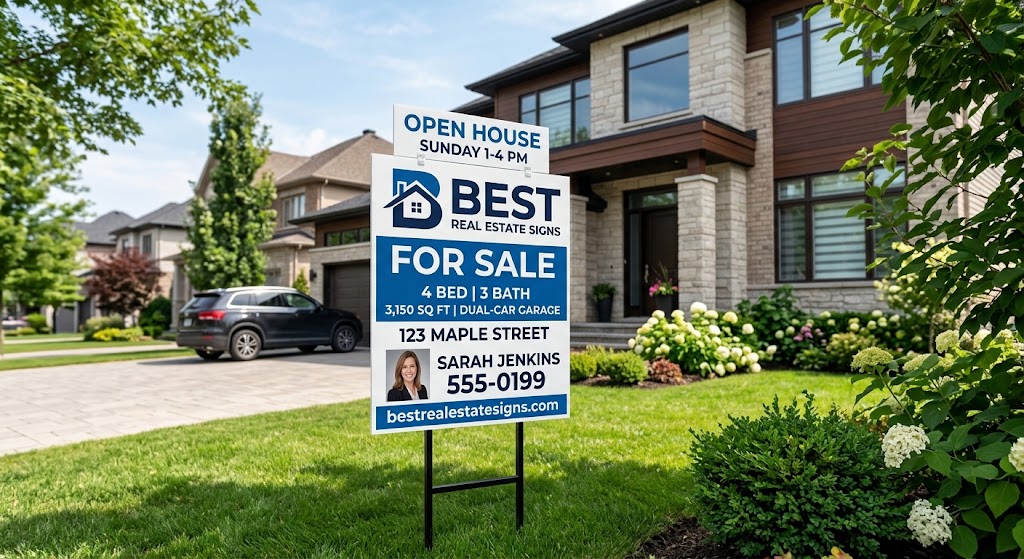
A rider is a small panel, usually 6 by 24 inches, that hangs above or below the main sign. Its job is to give the street something new to read. My view: a sign that never changes stops being noticed.
Riders are cheap. A pre-printed plastic rider is about $8 at one vendor. A custom aluminum rider is about $15 each when you buy ten. So plan a sequence, not a single rider.
| Stage | Rider | The rule to know |
|---|---|---|
| Before it is live | Coming Soon | A yard sign is public marketing under NAR's Clear Cooperation Policy, which gives one business day to submit the listing to the MLS |
| Week one | Your name and phone, or one feature: "Finished Basement," "Main-Level Bedroom" | Describe the house, never the buyer you imagine in it |
| Open house week | Open Sunday 1 to 4 | Take it down Sunday night. A stale date looks careless |
| Offer accepted | Under Contract | Virginia requires advertising to match "the property's current contract status" and to be updated "in a timely manner" |
| Closed | Sold | Only the listing broker or the selling broker may claim to have sold it |
Coming Soon
NAR's policy lists "yard signs" by name as public marketing and gives the listing broker one business day to submit the listing. Bright's own entry rule, in the 2024 version I could read, is stricter: a listing is due within two calendar days of the signed listing agreement, sign or no sign. I cover the triggers in what starts the Clear Cooperation clock.
In Bright MLS, Coming Soon is also a listing status with its own condition. Under the rules I could read, dated August 2024, the showing ban "is deemed to apply to all Subscribers, including those affiliated with the listing broker." If anyone can see the house, it is Active, not Coming Soon. Bright changed its statuses in summer 2026 and I could not open the new rules, so confirm this with Bright.
Under Contract and Sold
The Under Contract rider is easy to skip, and in Virginia I read the advertising rule as covering it. A bare For Sale sign on a house that went under contract three weeks ago is advertising that no longer matches the contract status.
For Sold, the Realtor Code of Ethics is specific: "Prior to closing, a cooperating broker may post a 'sold' sign only with the consent of the listing broker." If you brought the buyer, ask before you hang your rider. More on the rules on sold claims.
Riders and the size limit
Each 6 by 24 rider is one square foot. A 24 by 30 panel with two riders is 7 square feet, which is over Fairfax County's 6 if riders are counted. The Fairfax text I read does not say whether they are. Montgomery County's does: the area "includes the space between the sections, plus the measurement of the sections" of the sign. Prince William's limit is on the "total" signage. One rider at a time is the safe habit.

Permission: the owner, the HOA and the county
Three parties can say no to a sign: the owner, the association and the local government. Clear all three before the post goes in.
The owner
| Where | The rule | Source |
|---|---|---|
| Maryland | Signs "may not be placed on any property without the owner's prior consent" | COMAR 09.11.02.03 C |
| DC | No sign "without the written consent of the owner or his or her authorized agent." Fines up to $2,500 per violation | D.C. Code 47-2853.197(18) |
| West Virginia | No sign "without an agency relationship being established or without the owner's knowledge and written consent" | W. Va. Code 30-40-19(a)(10) |
| Virginia | The sign-specific rule was repealed on 1 April 2026. What remains is a rule against offering property without the owner's knowledge and consent "without taking reasonable steps to verify identity." It does not mention signs | 18VAC135-20-280 B |
The Realtor Code of Ethics says the same everywhere: signs "shall not be placed on property without consent of the seller/landlord." Put a line in your listing agreement that authorizes the sign, the post and any riders, and you are covered in all four.
The association
Virginia has a statute on this. A property owners' association may make rules on the number of real estate signs, their location, how they are fixed and how soon they come down after settlement, but only "so long as at least one real estate sign is permitted." The Condominium Act says the same for unit owners. An association can still ban signs in the common area, and the section begins with an exception for what the declaration expressly authorizes, so read the declaration too.
I found no matching statute in Maryland, DC or West Virginia. There, the declaration and the rules decide, so read them before you order a post.
The county or city
Local zoning sets the size, the number of signs and the removal date for a sign on the lot. These are the rules I could read on official pages.
| Where | Size and number | Take it down |
|---|---|---|
| Fairfax County | One sign on a single-family lot, "six square feet in area or a height of six feet." Two on a corner lot, one facing each street. No permit. May not be lit | Within 7 days of settlement |
| Prince William County | One freestanding sign, up to 8 feet tall. 8 square feet of signage in total on a lot with 80 feet of frontage or less; more on wider lots, up to 32. No permit | Within 14 days of settlement |
| City of Alexandria | 7 square feet each sign, up to 6 feet tall. Never on public right of way | After 120 days, with a 30-day break before it goes back up |
| Montgomery County | 10 square feet in total for all temporary signs on the lot. No permit. The date it went up must be written on the lower right corner | A temporary sign is one displayed for less than 90 days |
| Loudoun County | The 2023 ordinance has no real estate sign category. A temporary sign needs a permit. I could not confirm what is allowed on a house lot without one | Ask the county |
Fairfax County Zoning Ordinance 7100.4; Prince William County Code 32-250.23; Alexandria Zoning Ordinance 9-101, 9-102 and 9-201; Montgomery County Zoning Ordinance 1.4.2, 6.7.6 and 6.7.8; Loudoun County Zoning Ordinance Chapter 8. Arlington, Prince George's County and DC would not open for me.
Two of those catch agents. Montgomery County's date rule is easy to miss: the sign is supposed to carry the date it went up, in ink. And Alexandria's 120-day clock runs on a listing that sits.
Keep it out of the right of way
The strip between the sidewalk and the curb is usually public right of way, not the seller's lawn. In Virginia a sign "within the limits of any highway" carries a civil penalty of $100, and if nobody saw who placed it, "the person, firm, or corporation being advertised shall be presumed to have placed the sign" unless it proves otherwise. Maryland treats your name on a sign in a state highway right of way as evidence that you put it there. So set the post on the lot. I cover open house signs separately in where open house directional signs are illegal.
Before the post goes in: call 811
A post set in a dug hole is an excavation. Virginia, Maryland, DC and West Virginia all require notice to the one-call center before you excavate.
| Where | Notice before digging | Penalty in the statute |
|---|---|---|
| Virginia | A locate request first. Utilities must mark by 7 a.m. on the third working day after it. VA811 says to allow 3 working days | Up to $10,000 for excavating without a request, where reasonable care was not used |
| Maryland | A start date "not sooner than 3 business days after the ticket is initiated" | Up to $2,000 for a first offense |
| DC | "At least 96 hours, but no more than 10 days," not counting weekends and holidays | $2,500 for a first violation |
| West Virginia | "Not less than forty-eight hours," not counting weekends and holidays | A misdemeanor, fined up to $5,000 |
Va. Code 56-265.17, 56-265.19 and 56-265.32; Md. Public Utilities 12-124 and 12-135; D.C. Code 34-2704 and 34-2707; W. Va. Code 24C-1-5.
What counts as digging
Virginia's statute answers this directly. Excavation "does not include installation of a sign that consists of metal, plastic, or wooden poles placed in the ground by hand or by foot without the use of tools or equipment." So a metal frame you step into the lawn is outside the law. A post hole made with a digger or an auger is inside it.
Virginia also exempts "any hand digging performed by an owner or occupant of a property." You are neither. That is my reading of the statute, not a ruling.
Maryland's exemption is narrower still: a hole of 6 inches or less, dug by the owner or tenant of the home, without machinery. A sign post goes much deeper than that.
If you use an installer, ask whether they call in a ticket for every post and get it in writing. If you set your own posts, call 811 or use a frame sign you can step in. The fine is the small risk. A gas or fiber line a foot down is the large one.
QR codes and text riders
A sign cannot tell a driver the price or show the kitchen. A QR code or a text code can, for the person who stops or walks past.
| Option | Price found | What it does |
|---|---|---|
| QR code rider | $7.49 each at ten, corrugated plastic | A printed code. You choose where it points |
| Text-code service, basic | $1 a month for one listing | A buyer texts a code from the sign and gets the details. You are notified |
| Text-code service, second vendor | $9 a month for one code; printed riders cost extra | The same idea, with an optional QR code |
| Solar post cap light | $29.66 | Lights the top of a PVC post at night. Check local rules first: Fairfax does not allow these signs to be lit |
SpeedySigns, TXT Place, Agent Text and Oakley Signs & Graphics, read 5 October 2026.
Make the code worth scanning
- Point it at one page for that house: photos, price, and a way to book a showing. Not your homepage.
- Say what the scan gets them: "Scan for price and photos."
- Tag the link so your analytics show the scan came from the sign. Add
?utm_source=yard-signto the end of the address. - Test it from the sidewalk, with two phones, before the post goes in.
A text to your code is not consent to market
Someone who texts your sign code has asked about one house. Answering that question is fine. Adding the number to a drip campaign is a different thing and, as I read the FCC's rule, needs its own consent. I go through it in who you can legally text, and the wording to use.
When the sign makes the phone ring
A sign call comes from someone who has seen the house and wants to know more. Whatever they ask first, be ready for two questions: the price, and whether they can see it.
Three rules for sign calls
- Answer. A caller who reaches voicemail may not call back. If you cannot answer, the number on the sign should ring someone who can.
- Give the price. They can look it up online anyway.
- Ask one question back. "Are you looking in this neighborhood, or did this one catch your eye?" Then offer a time to see it.
A sign call, answered
If the caller is already working with an agent, say so plainly and send them back to that agent. If they are a neighbor asking out of curiosity, treat them better than a buyer. They are the audience the sign was really for.
Then log it. Note the address, the date and what they asked, the same day. After a year you will know how many calls a sign brings, which is a number no vendor can give you. The follow-up system is in answering a lead in the first five minutes.

What I could not verify
- DC's advertising regulation, 17 DCMR 2615, and DC's sign size rule. Neither would open, so I cannot say what DC requires on a sign or how big it may be.
- Arlington and Prince George's County sign rules. Their code pages would not open.
- What Loudoun County allows on a house lot without a permit.
- Whether riders count toward the size limit in Fairfax or Alexandria, and whether the Prince William text I read is the current codified version.
- Bright MLS's rules after its summer 2026 changes. The Coming Soon rule I quote is from August 2024.
- Whether Virginia moved its sign-consent rule or dropped it. The old section is repealed and I found no replacement in the sections I read.
- NAR's figures on NAR's own site. I read them in an association-hosted copy of the report.
- Whether one installer's price list, dated 2022, is still current.
Common questions about real estate signs
What is the best size for a real estate yard sign?
A 24 by 30 inch panel is a common choice for a single-family home. It is 5 square feet, which is within Fairfax County's 6 square foot limit with one 6 by 24 inch rider. Use 18 by 24 for townhouses and small yards.
How big should the letters be on a real estate sign?
The federal road sign manual uses 1 inch of capital letter height for every 30 feet of reading distance. For a street with a 25 mph limit, make your phone number and name at least 3 inches tall, which is readable from about 90 feet for about 2.5 seconds.
What has to be on a real estate sign?
In Virginia, the firm's licensed name and office contact information. In Maryland, your name as licensed and the full brokerage name. In West Virginia, the company name, the responsible broker's name with the word Broker, and a phone number. Your broker's policy can require more.
Can an HOA ban for sale signs?
In Virginia, an association's rules on the number of real estate signs must allow at least one on the owner's lot, as I read the statute. It can ban signs in the common area, and the declaration can say more, so read it. I found no similar statute in Maryland, DC or West Virginia, so the association's own documents decide there.
Do I need to call 811 before installing a sign post?
If the post goes in a dug or augered hole, yes. Virginia, Maryland, DC and West Virginia all require notice before excavating. Virginia's law does not cover a sign pushed in by hand or by foot without tools, so a step-in metal frame is outside it.
When does a real estate sign have to come down?
Fairfax County requires removal within 7 days of settlement and Prince William County within 14. Virginia's advertising rule also requires advertising to match the current contract status, so add an Under Contract rider once an offer is accepted.
Saad Jamil is a top 1 percent Realtor with Samson Properties in Chantilly, Virginia, licensed in Virginia, DC, Maryland and West Virginia since 2013, with more than $500 million in career sales and 900+ homes closed. His reviews are on his Zillow profile. He runs Jamil Academy, which sells coaching. This is information, not legal advice. The rules, ordinances and prices quoted here were checked on 5 October 2026.
Free: 5 Ways to Get More Listings Without Cold Calling
Five lead strategies that work without cold calls or ad spend, from an agent with $500M sold and 900+ homes closed.
No spam. Unsubscribe any time.
Your Coach