Average Real Estate Commission (2026): What the Data Shows
Oct 09, 2026
The average real estate commission in 2026 is about 5 to 6 percent of the sale price in total. Each side, listing and buyer, is roughly 2.4 to 2.7 percent.
That range comes from the US Department of Justice, Redfin, Anywhere Real Estate, the Federal Reserve and an agent survey. No single source measures every sale, so no one number is the true national average.
This guide puts every published figure side by side. It shows who measured each one, how, and what it means in dollars. Every source was checked on 9 October 2026, except where I say otherwise near the end.
Where I stand: I sell homes in Northern Virginia and run Jamil Academy, which sells training to agents. Nobody paid to be mentioned here. The one product block near the end is my own.
Quick answer
- Total commission: 5 to 6 percent, according to the DOJ in December 2025. An August 2026 survey of 434 agents by Clever Real Estate says 5.46 percent.
- Buyer agent side: 2.42 percent in Redfin's sample for the third quarter of 2025. Clever's survey says 2.70 percent.
- Listing agent side: 2.76 percent in Clever's survey. I found no closed-deal data for the listing side alone.
- The rule: commission is negotiable and not set by law. Since 17 August 2024, NAR rules require a written buyer agreement with a defined fee before touring.
- In dollars: on Virginia's August 2026 median price of $449,000, each 0.1 percent is $449. A 5.46 percent total is $24,515.
- What is the average real estate commission in 2026?
- Why do commission averages disagree?
- What is the average buyer agent commission now?
- What is the average listing agent commission?
- Has the average commission changed over time?
- Does the commission rate change with the home price?
- How much is the commission on your sale?
- Is real estate commission set by law?
- What is the average commission in Virginia, Maryland and DC?
- How do discount listing fees compare?
- How should agents use the average?
- What I could not verify
- Frequently asked questions
What is the average real estate commission in 2026?
Short answer: about 5 to 6 percent in total, or about 2.4 to 2.7 percent a side. The exact figure depends on which source you use.
Here is every figure I could trace to the organization that produced it. Read the third column first, because each source measures something different.
| Source | Figure | What it measures | Period |
|---|---|---|---|
| Clever Real Estate | 5.46% total (2.76% listing, 2.70% buyer) | Survey of 434 agents on typical rates in their market | August 2026 |
| US Department of Justice | 5% to 6% total | Statement in a court filing, not a new study | December 2025 |
| Redfin | 2.42% buyer side | Average on a sample of Redfin's own and partner deals | Q3 2025 |
| Anywhere Real Estate | 2.41% (franchised), 2.37% (owned) | Average rate earned on one side of a sale, from company results | Q3 2025 |
| Consumer Policy Center | 95% quoted 2.5% to 3% | Mystery shopper interviews with 281 buyer agents in 26 metro areas | July to September 2025 |
| Federal Reserve staff note | About 2.7% buyer side | Offers advertised to buyer agents on MLS listings | 2023 (series 1995 to 2023) |
| RealTrends | 5.32% total | Brokerage earnings plus RealTrends' own data | 2022 |
Sources: listwithclever.com, updated 1 September 2026; DOJ press release, 19 December 2025; Redfin, 8 December 2025; Anywhere Real Estate third quarter 2025 results; Consumer Policy Center study, November 2025; Federal Reserve FEDS Note, 12 May 2025; RealTrends, 26 April 2023.
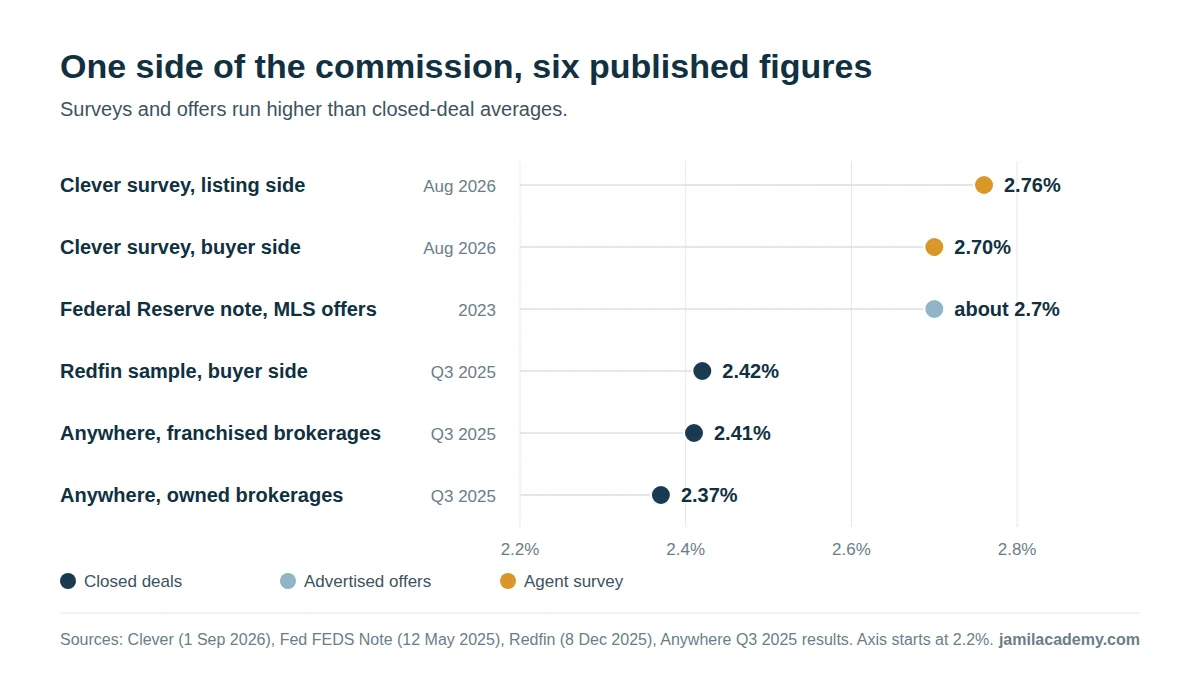
What the table tells you
- The total is about 5 to 6 percent. The DOJ, Clever and RealTrends all land there, each measured a different way.
- One side is about 2.4 to 2.7 percent. Closed-deal sources sit at the low end. Surveys and quotes sit higher.
- Nothing here counts every sale. The newest closed-deal figures I found stop at the third quarter of 2025.
- The two newest numbers are surveys. A survey asks what is typical. It does not record what was paid.
My view: if a client asks for the average, say "about 5 to 6 percent in total, and around 2.4 to 2.7 percent a side in the published data." One number to two decimal places is not an honest answer.
Why do commission averages disagree?
Short answer: they measure different moments in a deal. A quote, an advertised offer, a signed agreement and a closed payment are four different numbers.
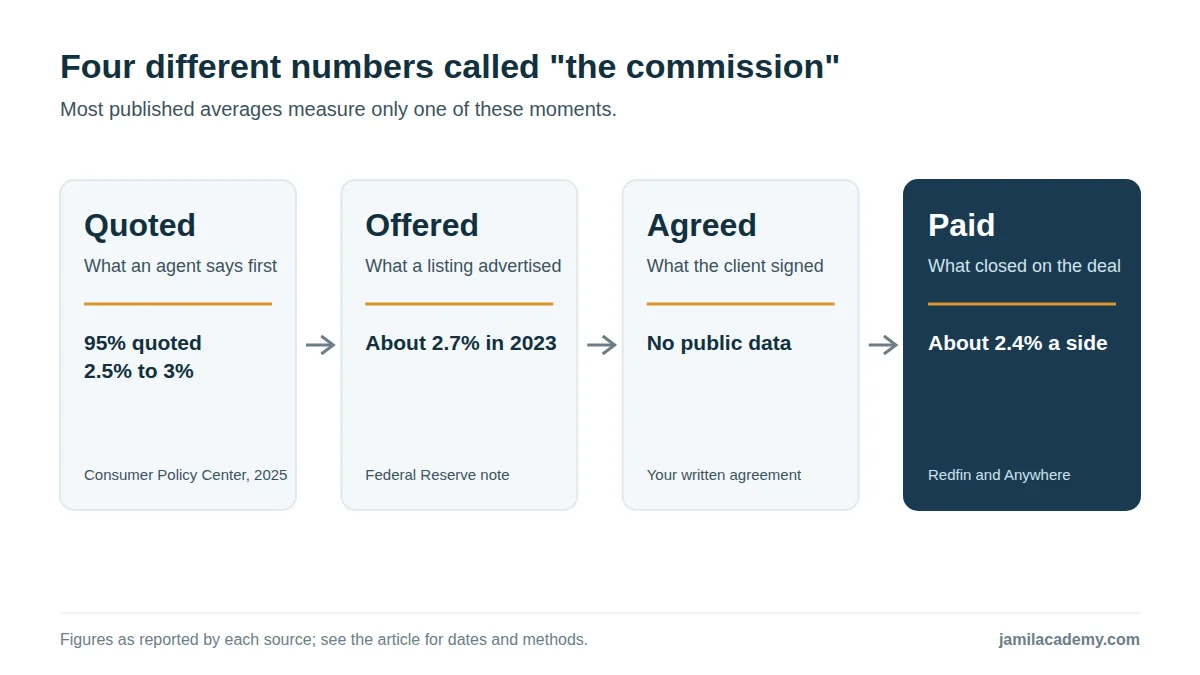
- Quoted is what an agent says when a buyer first asks.
- Offered is what a listing advertised to buyer agents. Offers left the MLS in August 2024.
- Agreed is what the client signed. No public dataset collects these.
- Paid is what a brokerage earned at closing, on its own deals.
The gap between quoted and paid
The Consumer Policy Center sent mystery shoppers to 281 buyer agents in 26 metro areas. Of the 269 agents who gave a rate, 95 percent quoted 2.5 to 3 percent.
Then came the follow-up. Of 254 agents who answered, 171, about two thirds, said they would accept a lower rate. And 39.4 percent said they charged, or would accept, 2 percent or less.
Quotes were also bunched tightly. In 12 of the 26 cities, at least 90 percent of quoted rates were the same. In the 20 cities also studied in 2022, the share quoting 3 percent rose from 40 to 64 percent.
Among agents willing to go lower, 32.2 percent would accept at least one full point less. On a $449,000 home, that is $4,490 or more.
Brobeck and Gilch, "The Homebuyer Experience: Commissions and Contracts", Consumer Policy Center, November 2025. It measures quotes and stated willingness, not closed deals.
Who is behind each number
- Clever surveys agents, partly from its own referral network. It also sells a 1.5 percent listing service. Its headline moved from 5.70 percent in February 2026 (533 agents) to 5.46 percent in August.
- Redfin reports its own book: its agents' listings, deals its partner agents closed, and Bay Equity Home Loans buyers. It says the sample leaves out most deals where Redfin agents represented the buyer.
- Anywhere Real Estate reported the rate its brokerages earned on either side of a sale. Compass bought Anywhere on 9 January 2026. Compass's second quarter 2026 release does not report the rate.
- The Federal Reserve note used MLS data covering about half of US listings. It measured advertised offers from 1995 to 2023.
Five questions to ask of any commission statistic
- Who measured it? A brokerage, a regulator, a researcher or a company selling a service.
- How? Closed deals, advertised offers, quotes or a survey.
- Which side? Total, listing side or buyer side.
- When? Before or after the August 2024 practice changes.
- How many deals or people? A stated sample is a good sign. A missing one is a warning.
If a page cannot answer these five questions, treat its average as a rough guide at best.
Which number should you use?
It depends on the question. For what is usually paid, use the closed-deal figures from Redfin and Anywhere. For what agents ask for, use the quotes. For what agents believe is typical, use the survey.
Whichever you use, name the source and the period. A number without a source invites the next agent to quote a different one.
I cover the same problem from the buyer agent's side in how to justify your commission as a buyer agent. A national average is useful context, as long as you say where it came from.
What is the average buyer agent commission now?
Short answer: about 2.4 percent in closed-deal data, and 2.7 percent in the latest agent survey. It barely moved after the NAR settlement practice changes took effect on 17 August 2024.
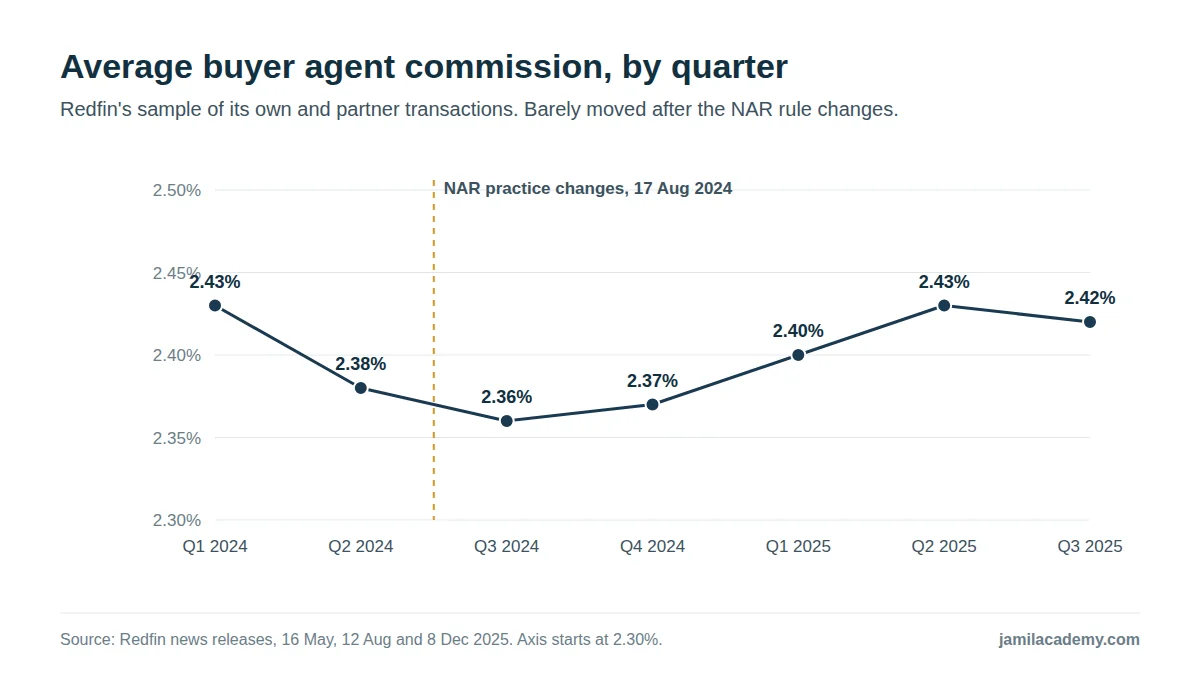
Redfin publishes the longest run of post-settlement figures. The low point was 2.36 percent in the third quarter of 2024. A year later it was 2.42 percent.
I found no Redfin commission report covering any quarter of 2026.
Anywhere Real Estate shows the same flat line
Anywhere owned Coldwell Banker, Century 21 and other brands before Compass bought it. It reported the average rate earned on either side of a sale.
| Quarter | Franchised brokerages | Owned brokerages |
|---|---|---|
| Q2 2023 | 2.46% | 2.43% |
| Q2 2024 | 2.42% | 2.36% |
| Q3 2024 | 2.41% | 2.36% |
| Q3 2025 | 2.41% | 2.37% |
Anywhere Real Estate results for Q2 2024 (filed with the SEC) and Q3 2025. The rate covers either side of a sale, not the buyer side only.
From Q2 2024 to Q3 2025, the franchised rate moved from 2.42 to 2.41 percent. The owned-brokerage rate moved from 2.36 to 2.37 percent. Neither moved by more than a hundredth of a point.
What agents say about their own buy side
A HousingWire agent survey published on 30 April 2025 found about 90 percent typically earn 2 to 3 percent on the buy side.
Asked if that had changed since the settlement, 58.8 percent said no. Nearly 30 percent said it fell and about 12 percent said it rose. HousingWire did not publish the sample size.
What the buyer side looks like in dollars
NAR's national median existing-home price for August 2026 was $429,100. At Redfin's 2.42 percent, the buyer side is $10,384. At Clever's 2.70 percent, it is $11,586.
That gap of about $1,200 is the size of a real negotiation. The two figures also cover different periods: late 2025 for Redfin and August 2026 for Clever.
My view: the flat line is the headline. The settlement changed who negotiates the buyer side and how it is written down. So far, the published data shows little change in the size of the fee.
What is the average listing agent commission?
Short answer: 2.76 percent in Clever's August 2026 agent survey. No closed-deal source I found reports the listing side alone.
The Federal Reserve note says it plainly: "there is no comprehensive information on the seller-side commission or fee." So most listing-side numbers are survey answers.
| Clever survey | Listing side | Buyer side | Total |
|---|---|---|---|
| 2023 | Not split | Not split | 5.49% |
| 2024 | Not split | Not split | 5.32% |
| 2025 (806 agents) | 2.77% | 2.67% | 5.44% |
| February 2026 (533 agents) | 2.88% | 2.82% | 5.70% |
| August 2026 (434 agents) | 2.76% | 2.70% | 5.46% |
Clever Real Estate press release of 17 June 2025 and listwithclever.com, updated 1 September 2026. These are agents' answers about typical rates, not closed deals.
Anywhere's per-side rate, 2.41 and 2.37 percent, is the only closed-deal figure that includes listings. It mixes both sides, so it cannot isolate the listing side.
How the seller's cost is now built
Before the settlement, a seller usually signed one total fee. The listing broker then offered part of it to buyer agents through the MLS.
Offers of compensation are no longer allowed on the MLS. A seller now agrees on a fee with the listing agent. Then the seller decides separately whether to pay anything toward the buyer's agent.
NAR says sellers can still offer buyer agent compensation off the MLS. Buyer concessions can still be listed on it. The details are in the NAR settlement, explained for agents.
What this means for a listing appointment
Expect sellers to ask two questions now. What is your fee? And do I have to pay the buyer's agent?
The honest answer to the second is that it is the seller's choice. The seller can offer something off the MLS, agree to a concession in the contract, or offer nothing. If the seller offers nothing, the buyer pays their own agent under their written agreement.
In dollars
On Virginia's August 2026 median of $449,000, a 2.76 percent listing side is $12,392. If the seller also pays 2.70 percent toward the buyer's agent, that adds $12,123. The total is $24,515.
Has the average commission changed over time?
Short answer: yes, slowly. The total fell from 6.10 percent in 1991 to 4.94 percent in 2020, then rose to 5.32 percent in 2022.
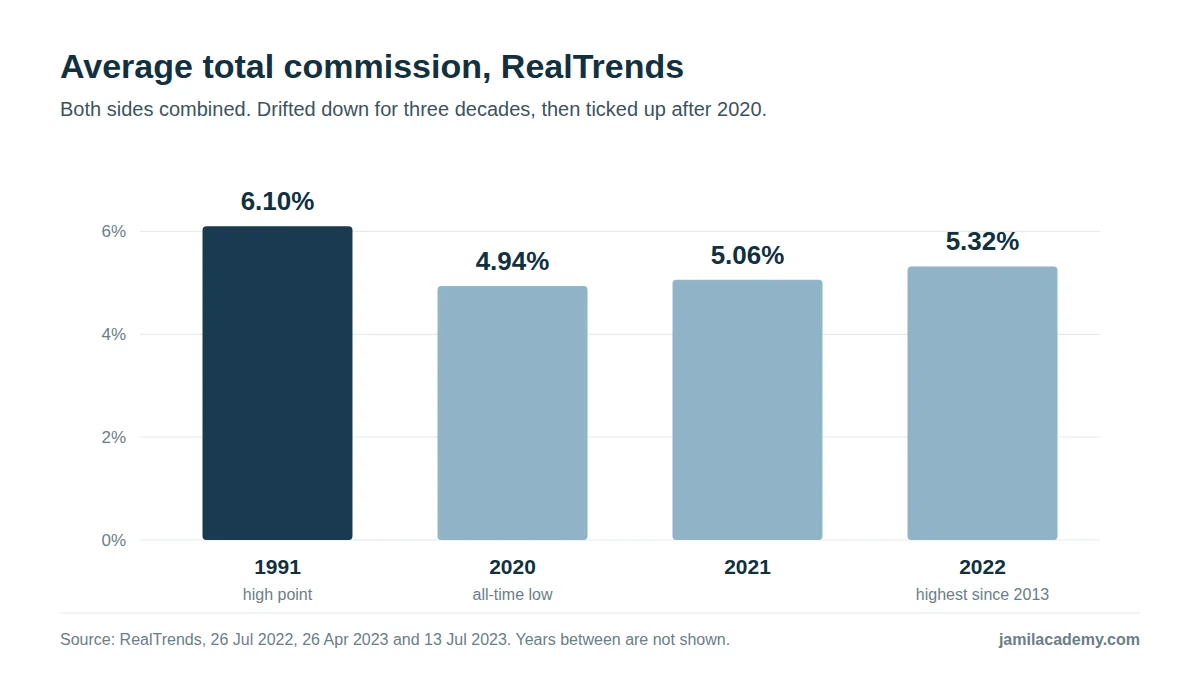
RealTrends combines public brokerage earnings with its own data. Its 2021 figure was the first to include Compass and eXp, which ran higher.
What the Federal Reserve found
The Fed note looked at offers to buyer agents on MLS listings. They fell "from about 3 percent in the late 1990s to about 2.7 percent today," with today meaning 2023.
- Offers were bunched. In 2002, most offers sat at exactly 3 percent.
- Some regions ran lower. Rates were lower in the Northeast, California and the Pacific Northwest. In the New York metro in 2022, the median and the most common offer were both 2 percent.
- Higher prices explain more than half of the drop. The authors estimate rising prices cut rates by about 0.2 percentage points.
- State law made no clear difference. They found no significant effect from state rules on buyer agreements or rebate bans.
Banerjee and Paciorek, "Commissions and Omissions," FEDS Notes, Federal Reserve Board, 12 May 2025.
How the DOJ reads this history
In December 2025 the DOJ said commissions "have remained at 5% to 6% for decades." It also said they are two to three times the level in other developed economies.
That is the DOJ's position in a lawsuit. Treat it as an argument as well as a data point.
The statement was filed in Davis v. Hanna Holdings, a case in federal court in Pennsylvania. The DOJ said competition among brokerages "is critical for protecting American homebuyers." My view: commission levels will stay a live legal issue.
US Department of Justice press release, 19 December 2025.
Does the commission rate change with the home price?
Short answer: yes. The rate falls as the price rises. In Redfin's third quarter 2025 data, homes under $500,000 averaged 2.52 percent. Homes over $1 million averaged 2.22 percent.
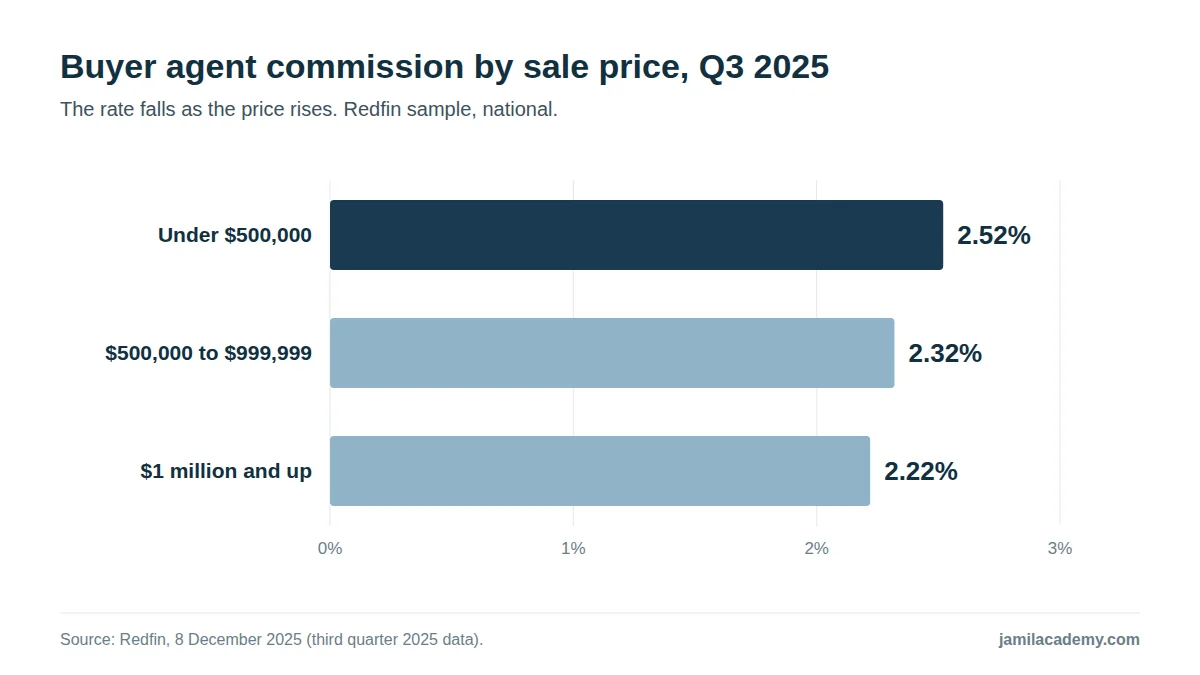
The gap has widened. A year earlier the same bands were 2.45, 2.31 and 2.24 percent. Redfin said 2.52 percent was the highest for the lowest band since the third quarter of 2023.
A lower rate can still mean a bigger check
| Example price | Rate | Buyer side in dollars |
|---|---|---|
| $400,000 | 2.52% | $10,080 |
| $750,000 | 2.32% | $17,400 |
| $1,500,000 | 2.22% | $33,300 |
This matters in Northern Virginia. NVAR's August 2026 median sale prices fall in the middle band. A rate that sounds normal on a $350,000 house can sound high on a $750,000 one.
My view: answer price-based pushback with a dollar figure and a list of what you will do. That works better than defending a percentage. See objection handlers for "your commission is too high".
How much is the commission on your sale?
Short answer: multiply the sale price by the rate. On a $449,000 sale, 5 percent is $22,450 and each 0.1 percent is $449.
Enter a price and the rates you are discussing. The calculator shows each side in dollars and what you keep after your brokerage split. It also compares your rates with the published figures above.
- Calculating
The starting price is Virginia's August 2026 median. The starting rates and split are examples, not a recommendation. Every fee is negotiable and is whatever your client signs.
How to read the result
- Each 0.1% is worth is the number to know before any fee talk. On a $449,000 sale, a request to drop half a point is a request for $2,245.
- Your share is before self-employment tax, fees and marketing. Enter your own split. Plans range from percentage splits to caps and flat fees.
- The comparison lines use the DOJ range, Redfin's 2.42 percent and Clever's survey figures. None of them is your market's number.
What the agent actually keeps
The commission is not the agent's take-home pay. It goes to the brokerage first.
Take the calculator's starting example. A 2.5 percent buyer side on $449,000 is $11,225. At a 70 percent share, the agent receives $7,858 before tax and costs.
The share varies widely by brokerage plan. That is why the same rate can mean very different income for two agents.
Commission at common price points
These are total commissions, both sides combined. Divide by two for a rough single side.
| Sale price | At 5% | At 5.46% | At 6% |
|---|---|---|---|
| $300,000 | $15,000 | $16,380 | $18,000 |
| $400,000 | $20,000 | $21,840 | $24,000 |
| $500,000 | $25,000 | $27,300 | $30,000 |
| $750,000 | $37,500 | $40,950 | $45,000 |
| $1,000,000 | $50,000 | $54,600 | $60,000 |
So a $500,000 home at the 5.46 percent survey figure carries $27,300 in total commission. That is before any split with a brokerage.
For what happens to the money after closing, including splits, caps and taxes, see how agents actually get paid.
Is real estate commission set by law?
Short answer: no. No law sets a commission rate. The rules control how the fee is agreed and written down, not how much it is.
NAR's consumer guide says compensation "is negotiable and not set by law." Written buyer agreements must also say fees are "fully negotiable and not set by law."
What the NAR settlement changed
These practice changes took effect on 17 August 2024, according to NAR. The court gave final approval on 26 November 2024.
- No offers on the MLS. Offers of compensation to buyer agents are no longer allowed on MLSs. Sellers can still offer them off the MLS.
- A written agreement before touring. This covers in-person and live virtual tours. Visiting an open house alone does not trigger it.
- A defined fee. The amount must be clear, such as a flat fee or a percent. It cannot be open-ended or a range.
- No more than agreed. An agent may not receive more than the amount in the buyer agreement, from any source.
nar.realtor: "What the NAR Settlement Means for Home Buyers and Sellers" and "Consumer Guide: Written Buyer Agreements."
Virginia
Va. Code 54.1-2137 requires a written brokerage agreement before brokerage services begin. It must "state the amount of the brokerage fees and how and when such fees are to be paid."
It also needs a definite end date. Without one, the agreement ends after 90 days.
A 2025 change, HB 1684 and SB 1309, requires a signed agreement with a buyer before showing a property. It took effect on 1 July 2025, according to the Northern Virginia Association of REALTORS. I could not load the bill page itself.
Maryland
Maryland has required written buyer agency agreements since 1 October 2016, according to Maryland REALTORS.
Md. Business Occupations and Professions 17-534 says a buyer agreement must state the fee "as a percentage of the purchase price, a specific dollar amount, or a combination of both." It must also have an end date.
Washington, DC
DC Code 42-1703(f) requires a licensee to tell the client "the broker's compensation" before the relationship starts. I found no written buyer agreement requirement in that section. The NAR rule still applies to members.
This is a summary, not legal advice. Your broker and your association's forms are the final word.
What is the average commission in Virginia, Maryland and DC?
Short answer: no closed-deal source publishes it. The only state figure is a survey. Clever's August 2026 survey puts Virginia at 6.00 percent in total.
That survey splits Virginia into 3.08 percent listing and 2.92 percent buyer side. It is the highest of any state in Clever's table. It reflects what agents said is typical, not a count of closings.
Redfin's commission reports are national only. Bright MLS, which serves the region, removed its compensation fields in August 2024. Current listings no longer carry offer data.
Bright MLS release, reposted by the Southern Maryland Association of REALTORS on 3 July 2024. It gave the planned date as 14 August 2024.
What local prices do to the dollars
| Area and month | Median sale price | At 5% | At 6% |
|---|---|---|---|
| United States, August 2026 (NAR) | $429,100 | $21,455 | $25,746 |
| Virginia, August 2026 (Virginia REALTORS) | $449,000 | $22,450 | $26,940 |
NAR Existing-Home Sales release of 10 September 2026; Virginia REALTORS August 2026 home sales report, published late September 2026.
Northern Virginia prices run well above the state median. So the same rate means a much larger fee there. NVAR's August 2026 release gave two different medians, so I have left that number out.
Quoting the Virginia figure to a client
If a Virginia client has seen the 6.00 percent figure online, explain where it comes from. It is a survey of agents in August 2026, not a record of closed sales.
Then bring it back to the agreement. The fee in front of them is the one that counts, and it is negotiable. Show the dollar amount and the services it covers.
My view: in a high-priced market, the dollar amount drives the conversation. Be ready to show the dollar figure and what it pays for.
How do discount listing fees compare?
Short answer: published discount listing fees run 1 to 1.5 percent, with conditions. That compares with Clever's 2.76 percent survey figure for a full-service listing side.
These are the terms on each company's own site, read on 9 October 2026. Read the conditions before you compare one with a full-service fee.
| Company | Published listing fee | Conditions on the page |
|---|---|---|
| Redfin | 1% | Only if the seller also buys with Redfin within 365 days. Redfin charges 2% at listing and refunds 1% after the purchase. Minimums apply and it is not in all markets. The fee rises 1% if the buyer is unrepresented. |
| Houwzer | 1% of the sale price | Its locations page lists 18 states plus DC, including Virginia and Maryland. |
| Clever | 1.5%, $3,000 minimum | Through partner agents. Any buyer agent commission is separate and negotiable. |
Company websites, opened 9 October 2026. Redfin's page footer says it was updated in September 2025.
The gap in dollars
On Virginia's $449,000 median, a 1 percent fee is $4,490. Clever's 1.5 percent is $6,735, before any minimum.
A 2.76 percent listing side is $12,392. The gap, roughly $5,700 to $7,900, is what a full-service agent has to justify.
What a discount fee leaves out
- The buyer side. All three figures are listing fees. If the seller also pays toward the buyer's agent, the total is higher.
- Minimums. A minimum fee can turn a low rate into a normal one. Clever's $3,000 minimum equals 1.5 percent of $200,000.
- Service. A fee only means something next to a list of what it pays for.
Questions to ask when a seller mentions a discount fee
- Which conditions apply to the low rate, and does the seller meet them?
- Is there a minimum fee, and what is it on this price?
- Does the quoted fee include anything for the buyer's agent?
- Which services are included, and which cost extra?
These questions keep the conversation on facts. They also show the seller you have read the other offer carefully.
My view: do not attack the discount company. Show the seller your plan, your marketing and your negotiation results in writing. Let them compare the whole offer.
How should agents use the average?
Short answer: as context, not as a price list. Your fee is whatever your client agrees to in writing.
Quote a range and a source
If a client asks what is normal, give the range and its source. For example: "Published figures put the total around 5 to 6 percent. Redfin's sample averaged about 2.4 percent on the buyer side in late 2025."
Know your own realized rate
Add up the commission you received on your last 20 closings. Divide it by the total of the sale prices. That is your real average.
A made-up example: 20 closings worth $9,000,000 in total, with $207,000 received. The realized rate is 2.3 percent, whatever rate was first quoted.
Track it by side too. If your listing and buyer rates drift apart, you will see it before any national report does.
Talk in dollars and services
Use the calculator to turn a rate into dollars. Then list what those dollars pay for: pricing, preparation, marketing, showings, negotiation and the work to closing. A bare rate invites a cut.
What that sounds like with a seller
Here is one way to put it, using the figures in this guide:
"Published figures put total commission at about 5 to 6 percent. That number covers both sides. My fee for the listing side is in this agreement, and here is what it pays for."
"On your price, every tenth of a percent is about this many dollars. If you want a lower fee, we can talk about which services change."
The point is to move from a rate to a list of work. Sellers can compare a list. They cannot easily compare a percentage.
Write the fee down early
A defined fee in a signed agreement prevents most arguments later. Virginia and Maryland both require the fee to be stated in the agreement.
Revisit your fee once a year
Check your realized rate and your costs every year. If your costs rose and your rate fell, you will see the squeeze on your income in the numbers.
My view: decide your fee on purpose. Do not let it drift down one negotiation at a time without noticing.
Plan on what you keep
Your rate is only the start. After your split, fees, tax and costs, you keep a much smaller share. I break that down in how much agents really make.
My view: agents who know their numbers stay calm in fee conversations. They know exactly what a cut costs and what they would give up to accept it.
What I could not verify
These are the gaps I hit while checking sources. Be careful with any page that fills them with a confident number.
- A true national average. No public source covers every US closing.
- Closed-deal commission data for 2026. I found no Redfin report after Q3 2025, and Compass no longer reports Anywhere's rate.
- RealTrends totals after 2022. I found none published.
- The share of sellers who now pay the buyer agent. Redfin says only that most sellers still choose to pay.
- Builder commissions on new construction. I found no verifiable data.
- Closed-deal averages for Virginia, Maryland or DC. Only surveys publish these.
- Virginia's 2025 buyer agreement bill text. The bill page did not load, so the bill numbers and date come from NVAR.
- The exact date Bright MLS removed compensation fields. Bright's release gave 14 August 2024 as the plan.
- The Northern Virginia median for August 2026. NVAR's release gave both $765,000 and $750,000.
- Figures like 5.49 or 5.57 percent. 5.49 percent traces to Clever's 2023 survey. I could not trace 5.57 percent to a source I could open.

Frequently asked questions
Is a 6 percent commission still normal?
It is the top of the usual range. The DOJ describes 5 to 6 percent as the long-run level, and every fee is whatever the client agrees to in writing.
Who pays the real estate commission now?
The seller usually pays the listing agent. The buyer agent's fee is set in a written buyer agreement, and the buyer pays it unless the seller agrees to contribute.
Are real estate commissions negotiable?
Yes. NAR says compensation is negotiable and not set by law. Virginia and Maryland require the agreed fee to be stated in the written agreement.
How much is 1 percent commission on a typical home?
On NAR's August 2026 national median price of $429,100, 1 percent is $4,291. On Virginia's median of $449,000, it is $4,490.
Did the NAR settlement lower commissions?
Not by much so far. Redfin's buyer agent average was 2.36 percent in Q3 2024 and 2.42 percent a year later.
Do buyers have to pay their agent?
The buyer agrees to a fee in writing before touring. The buyer pays it unless the seller contributes, for example through a negotiated concession toward the buyer's costs.
Saad Jamil is a Realtor with Samson Properties in Chantilly, Virginia, licensed in Virginia, DC, Maryland and West Virginia. His sales record and client reviews are on his Zillow profile. He runs Jamil Academy, which sells training to agents. This is general information, not legal advice. Everything here was checked on 9 October 2026.
Free: 5 Ways to Get More Listings Without Cold Calling
Five lead strategies that work without cold calls or ad spend, from an agent with $500M sold and 900+ homes closed.
No spam. Unsubscribe any time.
Your Coach